The Car Keys He Had to Put Down: Peter Lawson’s Parkinson’s Disease Deep Brain Stimulation Story from Australia to Thailand

Publish date: Modified date: Author: Subham Sarkar

Peter Lawson’s Parkinson’s Disease Deep Brain Stimulation Story 

Patient Profile

Name: Peter Lawson

Age: 62

Condition: Parkinson's disease with progressive movement and balance limitations

Treatment: Advanced neurology assessment with possible Deep Brain Stimulation and multidisciplinary rehabilitation

Destination: Bangkok, Thailand

Journey at a Glance

Main problems: Progressive tremor, rigidity, and bradykinesia (slow movement); Postural instability and gait disturbance; Cognitive changes and mood disorders (depression, anxiety); Sleep disturbances and autonomic dysfunction

Previous care: Multiple consultations with local private neurologists (delays of 3–6 months between appointments); Trials of multiple dopamine agonists and levodopa combinations with suboptimal response; Physical therapy, occupational therapy, and speech pathology…

Travel driver: AUDIENCE HOME

Treatment explored: Advanced neurology assessment with possible Deep Brain Stimulation and multidisciplinary rehabilitation

Personal goal: Preserve independence, improve daily movement and reduce the caregiving burden on his spouse.

You stop carrying full cups of coffee across the living room.

You map out the flat paths from the car park to the supermarket entrance.

You switch from lace-up shoes to slip-ons.

You quietly resign from the local community board.

You ask your partner to open jars you used to manage effortlessly.

You start avoiding crowded restaurants.

You memorize the exact time your medication begins to wear off.

You hand the car keys over permanently.

"Let me carry that for you."

"We can go tomorrow instead."

"Why don't you just sit and rest?"

Your world has quietly become smaller.

You have learned the quietest lesson of all:

The hardest part is not the tremor or the loss of balance, but the waiting.

Who is the person actually sitting on this waiting list?

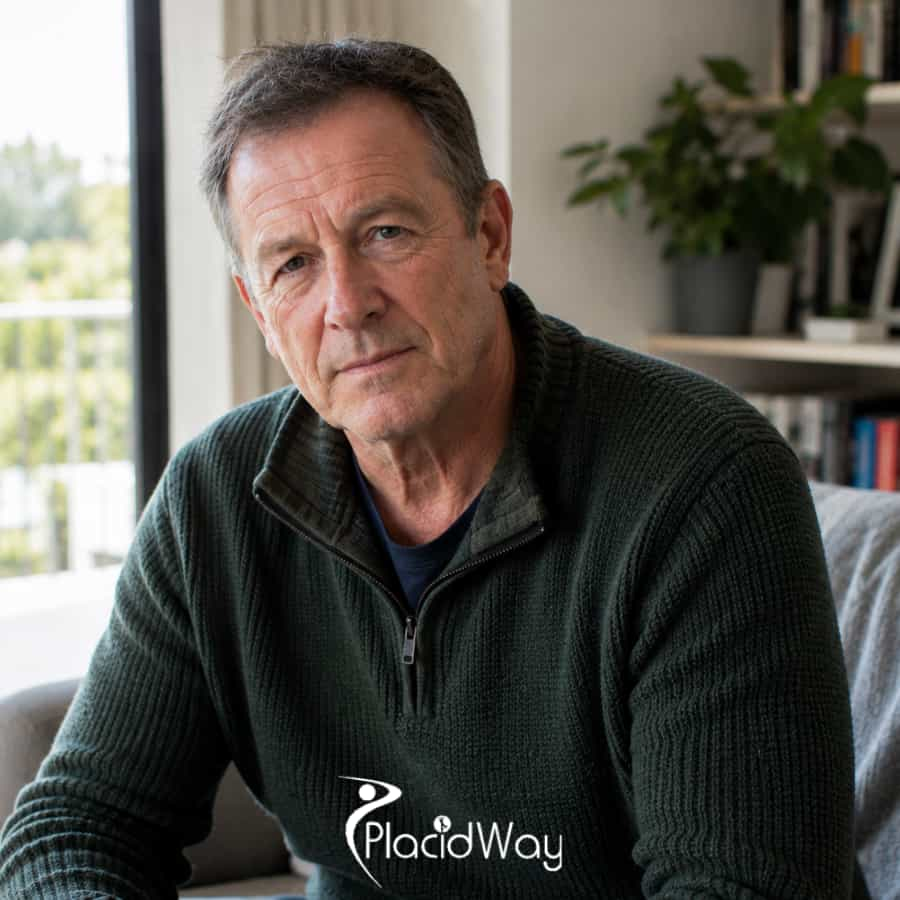
Peter Lawson is not a real PlacidWay patient, but a fictional composite built from the exact situations and questions Australian patients face every day.

He is sixty-two years old and lives in Ballarat.

In his memory, he still manages a busy high school timetable.

He prunes the high branches of the fruit trees in his backyard.

He maintains the physical rhythm of an ordinary, competent life.

Now, he plots every physical movement carefully.

He measures out his remaining energy in hourly increments.

The long, quiet escalation of a progressive disease.

He explains the early tremors away as fatigue.

He blames the stiffness in his right arm on getting older.

Then comes the formal diagnosis and the subsequent scramble for solutions.

A new pill.

A higher dose.

A different combination.

Another referral.

More waiting.

Deep Brain Stimulation is an established neurosurgical procedure typically considered when Parkinson's patients develop severe motor fluctuations and dyskinesia that can no longer be managed with medication alone.

He hears the verdict clearly:

"You are a candidate for surgery, but the public list is quite long."

When?

The statistics do not capture the reality of the waiting room.

Waiting times for non-urgent elective neurosurgery in the Australian public system can stretch from 12 to 24 months, depending heavily on regional categorisation and hospital triage urgency.

But Peter Lawson does not experience the healthcare system as a national statistic.

He experiences it watching his wife Helen struggle to lift the lawnmower into the shed.

"Leave it there, I'll ask the neighbor."

He experiences it freezing at the threshold of a doorway while strangers wait behind him.

"Take your time, mate, no rush."

He experiences it waking at three in the morning unable to turn over in bed.

"Do you need me to pull you up?"

He has already tried to be patient.

He is not an impulsive consumer demanding a quick fix.

He pays thousands of dollars out-of-pocket just to secure the initial private neurologist consultations.

He logs his symptom fluctuations meticulously for months in a small notebook.

He undergoes rigorous physical therapy and speech pathology sessions with diminishing returns.

"I just have to hold out a bit longer."

"There are people much worse off than me."

But as the condition progresses faster than the public system moves, his internal calculus shifts:

From "Can I tolerate this?" to "How much of my life am I prepared to organise around it?"

The nearer alternative requires a different kind of sacrifice.

The domestic private healthcare system offers a faster route to surgery.

An uninsured or underinsured patient can bypass the public queue by paying entirely out of pocket, commonly facing costs of AUD 80,000–120,000.

This path requires accessing a substantial portion of their superannuation or selling an asset.

State plainly that price should not answer a surgical question, and the goal of this exploration is not to persuade you to travel.

The choice is not simply whether they possess the funds, but whether spending them will compromise their financial security for the next twenty years.

"We have the money in the superannuation account, Peter Lawson."

"Having the money isn't the same as being able to afford it, Helen."

He isn't searching for medical travel options yet.

His initial desktop research focuses entirely on local solutions:

levodopa wearing off faster
dbs surgery wait times victoria
how to fund private neurosurgery australia
dbs overseas cost comparison
parkinson's treatment bangkok

He stares at the search results for overseas neurosurgery with deep skepticism.

"I'm not going abroad just because something is cheaper."

He is entirely correct to resist treating complex neurological care as a consumer bargain.

Why does Bangkok keep appearing in the search results?

Thailand has strategically developed advanced tertiary infrastructure to serve a regional medical market.

Several private hospitals in the capital hold the exact same rigorous clinical accreditations as major Western medical centers.

The crucial reframe is understanding that geography does not dictate medical competence.

Countries do not perform highly specialized brain surgery.

Internationally trained neurosurgeons do.

Dedicated multidisciplinary neurology teams do.

There is a concrete, verifiable clinical reality beneath the glossy marketing materials.

Australian authorities explicitly advise citizens considering medical procedures overseas to research providers independently and consult their local general practitioner first.

His first question was: "How much?"

An indicative self-funded cost for Deep Brain Stimulation in Bangkok varies between AUD 35,000–50,000, depending heavily on the specific neurostimulator hardware required and the duration of inpatient rehabilitation.

"If it sounds too good to be true, you haven't read the fine print."

"What exactly am I getting?"

Does this include the mandatory pre-operative neuropsychological assessment?

Is the surgical MRI brain mapping billed separately?
Are the microelectrode recording specialists included in the theatre fee?
Does this cover the specific Medtronic or Abbott pulse generator my doctor mentioned?
How many nights in the intensive care unit are factored into this package?
What happens to the final bill if I need an extra week of inpatient physical therapy?
Are the initial device programming sessions included before I fly home?
Does this account for specialized Parkinson's nursing care on the recovery ward?
Are specialized medical translation services available around the clock?
Does the quoted price cover Helen's accommodation near the hospital campus?
What are the costs for follow-up telehealth consultations once I am back in Victoria?
Is the generator battery replacement going to cost this much again in five years?

The advertised number is only the beginning of a much longer conversation.

What does deep brain stimulation actually involve?

Deep Brain Stimulation involves implanting thin electrodes into specific targets deep within the brain to block the abnormal electrical signals causing tremors and rigidity.

These electrodes are connected via a wire tunneled under the skin to a pacemaker-like generator placed in the upper chest.

It is a highly specialized intervention requiring precise neuroimaging, wakeful surgical mapping, and complex post-operative programming.

"But how do I fly home with a new pacemaker in my brain?"

The part the brochures rarely put on the front page.

Recovering from cranial surgery in a foreign city is a gruelling operational challenge.

Aviation medicine guidelines regarding fitness to fly after intracranial procedures dictate mandatory ground times that vary significantly between airlines and treating clinicians.

The variation itself is the most important lesson.

This logistical constraint must be fully integrated into the travel plan before committing, not addressed as an afterthought.

"Wait. Does that mean I might be stuck in a Bangkok hotel room for a month?"

Possibly, depending on your post-operative swelling, healing rate, and initial programming needs.

Who changes my surgical dressings at the hotel?

How do we navigate the dense humidity and heat while actively avoiding infection?

What if I experience sudden dyskinesia from the new neurostimulator settings?

Can Helen physically assist me into a standard Thai hotel shower enclosure?

Where do we go if I have a complication in the middle of the night?

How do we transport our heavy luggage to the airport when I cannot lift anything?

Will the airport security scanners interfere with my newly implanted generator?

Do I need a specialized medical clearance form to board the long-haul flight back to Melbourne?

What if my local neurologist refuses to adjust a device that was implanted overseas?

Who do I call if the chest wound becomes red two days after landing back in Australia?

This is not tourism in any usual sense.

Helen isn't just coming along for the trip.

She is the invisible second participant in the entire undertaking.

She will carry the clinical files, administer the transition medications, and navigate a sprawling foreign hospital environment.

She will be the one communicating with doctors if Peter Lawson is temporarily unable to speak clearly after surgery.

Standard travel insurance policies routinely exclude pre-existing neurodegenerative conditions and elective overseas procedures, making specialized medical travel coverage an absolute necessity.

She is an integral part of the clinical care system too.

Then comes the uncomfortable conversation about risk.

The procedure carries inherent surgical risks including intracranial hemorrhage, stroke, severe infection, and hardware malfunction, alongside potential cognitive side effects.

Peter Lawson actively learns to distrust certain phrases:

Completely safe. No risk. Guaranteed success.

True informed consent means thoroughly understanding the mechanisms of failure, not just the hoped-for outcome.

Peter Lawson's questions become better as he learns more.

His initial queries about price and location are replaced by rigorous clinical vetting:

How many times has this specific neurosurgeon performed the STN-DBS procedure this year?
Can I speak to an Australian patient who was operated on by this exact team?
What is the hospital's published infection rate for neurosurgical implants?
Which brand of pulse generator is used, and is it actively supported by Australian clinicians?
Who is responsible for the ongoing programming of the device once I am back in Victoria?
Is the pre-operative psychiatric evaluation conducted by a native English speaker?
What happens if the intraoperative mapping shows I am no longer a viable candidate?
If a surgical complication occurs, who bears the cost of the extended intensive care stay?
Will my Australian neurologist receive a comprehensive handover report in English?
What would you see that would make you tell me not to proceed?

They don't only want a team willing to do the surgery.

They want a team willing not to.

Have I actually exhausted my options at home?

Australian patients retain the right to request their clinical records and seek secondary opinions across different public health networks or specialized clinics.

Is there a cancellation list I can be placed on for an earlier local consultation?
Can a different medication combination bridge the gap until public surgery becomes available?
Are there any clinical trials for advanced Parkinson's interventions currently recruiting in Australia?
Would a referral to a different regional health district significantly shorten my wait time?
Can my general practitioner take over some of the routine management to expedite the surgical referral?
Is there a telehealth programming service available locally if I have the surgery done elsewhere?

Bangkok should be compared with Peter Lawson's real alternatives, not with a worst-case assumption about the Australian system.

The night before the decision arrives quietly.

The kitchen table is entirely covered in paperwork.

Printed MRI reports.

Emails from the overseas care coordinator.

Spreadsheets calculating the exchange rate against hospital and hotel costs.

A notebook filled with Helen's careful handwriting.

"I feel like we know more about this than my GP does."

"That's because we have to."

The extensive research did not make them more afraid; it made them more capable of deciding.

What Peter Lawson actually wants isn't a surgical device.

"Why do you want this surgery so badly?"

"To stop the shaking."

To be able to hold a full cup of tea without spilling it on the saucer.

To tie his own shoelaces without needing a twenty-minute head start.

To walk through a crowded room without freezing to the floor.

To stop watching his wife age ten years for every one of his.

Not the fine electrodes in his brain. Not the titanium casing of the pulse generator. Not the all-inclusive medical travel package. Not a trip to Thailand.

His realization was simple:

Agency.

And underneath that:

Dignity.

This option might be the answer, but it might not be.

Peter Lawson might fly to Bangkok and undergo a highly successful procedure.

He might discover his psychological assessment disqualifies him from surgery entirely.

He might find an Australian private surgeon willing to operate with an extended payment plan.

He might decide the travel risks outweigh the benefits and choose to remain on the public waitlist.

He might explore continuous medication infusion therapies locally instead.

Any of those paths can represent an informed decision.

The goal is not to persuade a patient to travel, it is to make sure frustration doesn't make the decision for them.

Where does this leave you?

Maybe you've watched your own physical independence slowly recede.

Maybe you've tallied the cost of private surgery and felt a quiet despair.

Maybe you've searched for overseas options in the middle of a sleepless night.

Maybe you've felt guilty for being a daily burden to the person you love most.

Maybe you've wondered if there is a safe way to bypass the waiting list entirely.

You do not need to decide today.

Am I medically stable enough to endure a long-haul flight?

Do I have a local physician willing to provide long-term device aftercare?

Is the financial saving worth the logistical stress of recovery far from home?

Who will act as my advocate if I am temporarily incapacitated abroad?

Have I pushed my local health network as hard as I can for an earlier appointment?

Am I prepared to hear a foreign surgeon tell me 'no'?

What happens to my ongoing care plan when I return to Australia?

You are searching for something more than just lower prices:

Paths forward.

Hope isn't the promise that the disease will disappear.

Hope is not the promise that everything will be fixed.

It is not a guarantee of a perfect surgical outcome.

It is not an escape route from a progressive neurological diagnosis.

Hope is having enough accurate information to make a decision that feels entirely yours.

It is understanding the complex options in front of you.

It is knowing the exact right questions to ask a specialist.

It is calculating the risks logically rather than emotionally.

It is taking back a deliberate measure of control over a narrowing life.

It is deciding how the next chapter will be managed.

From "I suppose I'll just have to keep waiting."

To

"What other informed options do I have?"

PlacidWay — Your Way to Hope.

PlacidWay helps individuals explore international medical options, compare facility credentials, and prepare the rigorous questions required for cross-border care.

The platform does not provide clinical advice or recommend specific surgical interventions.

For someone in Peter Lawson's position, exploring advanced neurological care in Bangkok isn't a promise of a cure, it is one potential route worth understanding.

Medical disclaimer

This article is provided for educational and informational purposes only and does not recommend that any individual undertake medical travel or specific surgical procedures. Individual clinical suitability and risk require independent professional assessment. Readers should always consult their own treating clinician or local medical adviser, verify the current regulatory and accreditation status of any foreign provider, and obtain appropriate specialized travel and medical protection.


The Car Keys He Had to Put Down: Peter Lawson’s Parkinson’s Disease Deep Brain Stimulation Story from Australia to Thailand

About Article

  • Treatment: Neurology
  • Country: Thailand
  • Overview This educational overview follows Peter Lawson, a composite Australian patient exploring Parkinson's Treatment in Bangkok, Thailand. It summarizes daily-life effects, previous care and why treatment abroad is being considered. Candidacy, safety, recovery and follow-up remain central to informed decision-making.

Trusted Medical Tourism Platform Since 2007

60+
Countries
2k+
Clinics
19.5k+
Reviews
2.5k+
Qualified Doctors
1.1M+
Patients Served Since 2007