The Relapse Cycle Detox Never Broke: Simon Mercer’s PTSD and Substance Use Disorder Dual-Diagnosis Treatment Story from the United Kingdom to Spain

Publish date: Modified date: Medically reviewed by: Dr. Hector Mendoza on Sep 01, 2026 Author: Iqra Naseer

Simon Mercer’s PTSD and Substance Use Disorder Dual-Diagnosis Treatment Story 

Patient Profile

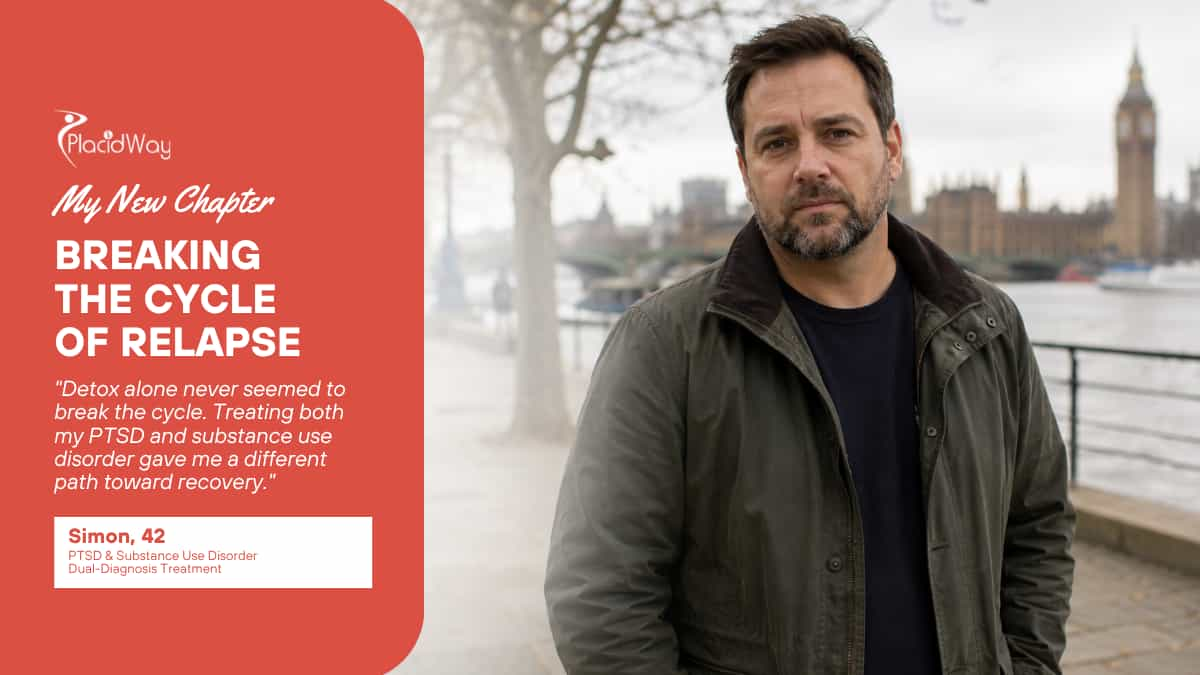
Name: Simon Mercer

Age: 42

Condition: Concurrent PTSD and Substance Use Disorder

Treatment: Integrated dual-diagnosis treatment with detoxification and trauma-specific psychotherapy

Destination: Tenerife, Spain

Journey at a Glance

Main problems: Recurrent substance use (alcohol, opioids, stimulants) despite treatment attempts; Intrusive trauma memories, hypervigilance, nightmares; Depression, anxiety, suicidal ideation; Fractured relationships and social isolation

Previous care: NHS-funded detox (1–2 previous episodes); Outpatient counseling through GP referral; Narcotics Anonymous or Alcoholics Anonymous meetings

Travel driver: AUDIENCE HOME CONTEXT

Treatment explored: Integrated dual-diagnosis treatment with detoxification and trauma-specific psychotherapy

Personal goal: Treat the trauma driving repeated relapse instead of returning to another short detox-only cycle.

You stop answering phone calls from numbers you do not recognise.

You stop keeping alcohol in the house, hoping the inconvenience will be enough.

You accept the morning tremors as a routine tax on getting out of bed.

You quietly drop out of weekend plans.

You calculate exactly how much you can consume without smelling of it at the office.

You endure the sweating and the insomnia.

You watch the clock until it is a socially acceptable hour to start.

You memorise the local pharmacy schedules to rotate your visits.

You nod when people tell you that it takes time.

"We just want you back."

"Have you tried calling the clinic again?"

"Take all the time you need."

Your world has quietly become smaller.

You have learned the quietest lesson of all:

The hardest part is not the withdrawal itself, but the endless, hollow waiting.

Simon Mercer is not a real client, but his situation is entirely ordinary.

This persona is a fictional composite built from the actual situations, questions and dead ends faced by adults in the UK seeking dual-diagnosis recovery.

Simon Mercer is forty-two and lives in a terraced house in Manchester.

For most of his adult life, he managed a regional logistics team, paid a mortgage, played five-a-side on Thursdays, and kept his front garden tidy.

He solved problems for a living.

He carried his own weight.

The decline was not sudden.

He called it stress.

He called it taking the edge off.

He blamed the restless nights on the job.

White-knuckling.

GP visits.

Outpatient counselling.

Church-hall meetings.

Tapering.

Cold turkey.

NHS detox.

For individuals with concurrent trauma and substance use disorders, clinical guidelines recommend an integrated approach where both the addiction and the underlying psychological distress are treated simultaneously, rather than sequentially. When standard community detox fails to prevent relapse, residential dual-diagnosis treatment is commonly indicated to provide medical stabilisation alongside intensive psychotherapy.

The assessment was clear:

"Approved."

Then the reality of the system provided the timeline:

When?

The gap between needing help and receiving it is widening.

Current data indicates that adults in England seeking specialist inpatient detoxification or residential rehabilitation can face waiting lists extending from six to twelve months, heavily dependent on local authority funding constraints. During this waiting period, clinical deterioration is common, and the risk of fatal overdose or severe social fracture increases significantly.

But Simon Mercer doesn't experience the system as a national statistic.

He experiences it staring at the ceiling at three in the morning while his wife sleeps in the spare room.

"I can't keep doing this."

He experiences it sitting in his car in the supermarket car park, gripping the steering wheel.

"Just get through today."

He experiences it opening a letter from his employer's human resources department.

"We need to discuss your attendance."

He has already tried to be patient.

People with trauma-linked addiction are often incorrectly stereotyped as impulsive.

Simon Mercer is not careless, and he is not looking for a shortcut.

He has already completed a seven-day community detox twice.

He has already sat in circle meetings.

He has already tried a daily prescription to block the cravings.

He has already downloaded the mindfulness applications.

"I did what they asked."

"Why isn't it sticking?"

The detox cleared his system, but it left him wide open to the night terrors and the hypervigilance that drove him to drink in the first place.

The logic of his survival had to change:

From "Can I tolerate this?" to:

"How much of my life am I prepared to organise around it?"

Going private in the UK is the obvious next thought.

There are excellent dual-diagnosis facilities in London and the Home Counties.

They offer immediate admission, psychiatric oversight, and daily EMDR therapy for trauma.

A month in these facilities typically costs between GBP 25,000 and 40,000.

Simon Mercer has savings, and his parents offered to help, but draining a pension fund or taking a second mortgage to pay for rehab introduces a different kind of trauma.

A lower price tag should not answer a clinical question, but an impossible price tag ends the conversation entirely.

Simon Mercer sat at the kitchen table with his wife, Sarah, looking at a glossy brochure.

"We could remortgage the house."

"Having the money isn't the same as being able to afford it."

He isn't searching for Spain yet.

His browser history tells a story of escalating geography.

Inpatient detox near me

Trauma therapy and addiction NHS

Why do I keep relapsing after detox

Affordable private rehab UK

Dual diagnosis clinics Europe cost

Specialized residential addiction treatment in Tenerife

When the Canary Islands first appear in the search results, his reaction is instinctively cynical.

"I'm not going abroad just because something is cheaper."

It is a healthy, protective instinct.

He is looking for medical care, not a holiday.

Why does Tenerife keep appearing in dual-diagnosis research?

Spain operates under European Union medical directives, meaning clinical qualifications, psychiatric prescribing protocols, and healthcare facility standards are strictly regulated and comparable to UK practices. Over the last decade, Tenerife has quietly developed a specialized mental health infrastructure, attracting English-speaking psychiatrists and trauma therapists who prefer the climate to Northern Europe.

But the vital reframe comes when Simon Mercer reads a patient forum.

The question is never whether Spain is good at treating addiction.

Countries do not treat patients.

Clinics do.

Psychiatrists do.

Therapeutic communities do.

There is something concrete to verify, independent of the destination's weather.

Official advice from health advocacy groups strongly recommends that patients exploring cross-border treatment independently verify the registration of the overseas facility and consult their domestic GP regarding their fitness to travel.

His first question was about the money.

Indicative costs for a 28-day residential program in Tenerife vary between GBP 8,000 and 15,000, depending on the need for acute medical detoxification, the intensity of one-on-one psychiatric care, and the level of privacy required.

It is a sixty to seventy percent saving compared to London.

"If it sounds too good to be true, it usually is."

"What exactly am I getting?"

Fifteen critical questions to clarify the package.

Does that price include the initial psychiatric evaluation?
Is a medically supervised detox included, or is that billed separately?
Does the facility employ full-time medical staff, or are they on call?
How many hours of individual trauma therapy are scheduled per week?
Are the therapists trained in EMDR or somatic processing?
Is the medication required for detox included in the flat rate?
What happens if the detox takes longer than seven days?
Are meals and nutritional planning part of the package?
Is the accommodation private or shared?
Do they provide translation services, or are the clinical staff fluent in English?
Does the price cover airport transfers upon arrival in a vulnerable state?
Is there an aftercare plan included for when I return to the UK?
What happens if I require emergency hospital admission during withdrawal?
Are there hidden fees for weekend psychiatric support?
How much of the fee is refundable if I leave against medical advice?

The advertised number is only the beginning of the conversation.

Simon Mercer began to see the shape of the work ahead.

The questions were no longer about whether it was possible.

They were about how it would actually function.

What does trauma-informed treatment actually involve?

Standard addiction treatment often focuses solely on behavior cessation and physical stabilization, whereas a trauma-informed dual-diagnosis approach actively treats the nervous system dysregulation that makes sobriety intolerable. It integrates pharmacological support to ease withdrawal with targeted therapies that process intrusive memories, reducing the patient's reliance on substances to numb psychological pain.

Understanding the clinical mechanism was reassuring, but it immediately raised a logistical barrier:

"How do I manage the transition back home?"


The part the sales decks rarely put on the front page.

The operational reality of cross-border rehab is entirely unglamorous.

Guidelines regarding the transfer of psychiatric care across borders vary significantly, and patients often find that their local UK services require a formal handover period to continue prescribing medications initiated abroad. The variation itself is the lesson.

This constraint must be part of the plan before committing, not a surprise encountered at passport control.

"Wait. Does that mean I'm on my own the day I land at Gatwick?"

Possibly, depending on the clinic's discharge protocols.

Who writes the discharge summary for my NHS GP?

Will the summary be provided in English and formatted to UK clinical standards?

Will I carry enough medication to bridge the gap until my GP appointment?

Does the Tenerife clinic offer remote Zoom therapy sessions for the first three months?

Who do I call if I experience a severe trigger on the flight home?

Are there local UK support groups the clinic partners with?

How do we manage the transition from an isolated island back to my local pub on the corner?

Can my partner be involved in the discharge planning sessions?

Is there a clear relapse prevention plan documented in my file?

What is the protocol if my UK doctor disputes the medication regime?

Sarah isn't just waving him off at the airport.

The invisible second participant in this journey is the family member.

She will carry the anxiety of the distance.

She will be the one holding the emergency contact numbers.

She will notice if the communication from the clinic goes dark for three days.

Standard travel insurance explicitly excludes coverage for travel undertaken for the purpose of receiving medical or psychiatric treatment, requiring specialized medical travel policies to protect against emergency repatriation costs.

She is part of the care system too.

Then comes the uncomfortable conversation about risk.

The risk of early departure from residential rehab is significant; patients undergoing intensive trauma therapy may experience an initial spike in psychological distress, prompting them to discharge themselves against medical advice before stabilization occurs.

Simon Mercer learns to distrust certain phrases instantly:

Completely safe. No risk. Guaranteed success.

Informed consent means understanding the machinery of failure just as clearly as the hoped-for outcome.

Simon Mercer's questions become better.

He is no longer asking "Will it work?" or "How much?"

Can I speak directly with the lead psychiatrist before transferring any deposit?
What is the ratio of patients to clinical staff on a Sunday evening?
How do you handle a patient who refuses to participate in group therapy?
Do you test for co-occurring medical issues like liver function upon admission?
What physical security measures exist to ensure a safe environment?
How often will my wife receive clinical updates, and from whom?
What is your protocol for managing severe panic attacks during trauma processing?
Are all your nursing staff registered to administer controlled substances?
Can you provide an anonymized example of an aftercare plan?
What would you see in my medical history that would make you tell me not to proceed?

He doesn't only want a clinic willing to admit him.

He wants someone willing not to.

Have I exhausted my options at home?

Patients registered with an NHS GP have the right to request a referral to a specialist service outside their local area if local provision is inadequate, though securing funding through an Individual Funding Request (IFR) requires demonstrating exceptional clinical need.

Is there a specialized dual-diagnosis charity in the UK I haven't contacted?

Could my GP escalate my case due to the occupational risk?

Are there intensive day programs locally that I missed?

Can I afford private trauma therapy if I manage the detox through the NHS?

What exactly does the local waiting list look like right now?

Tenerife should be compared with Simon Mercer's real alternatives, not with a worst-case assumption about the NHS.

The night before the decision.

The kitchen table looks different now.

Printed emails from the clinic coordinator. A drafted list of medical history bullet points for the psychiatrist. A specialized medical travel insurance quote. A copy of his last NHS discharge summary.

"It feels real now."

"It feels like we have a plan."

The research didn't make them more afraid; it made them more capable of deciding.

What Simon Mercer actually wants isn't residential rehab.

"What are you hoping to get out of this?"

The expected answer is a lifetime of sobriety.

The real answer is simpler: TO SLEEP THROUGH THE NIGHT WITHOUT WAKING UP IN A COLD SWEAT.

To look his boss in the eye.

To sit in the living room without calculating where the nearest bottle is.

To stop carrying the shame of the previous failures.

Not a bed in a Spanish clinic. Not a tailored detox protocol. Not a schedule of intensive psychotherapy sessions. Not a cheaper alternative to London.

Relief.

And underneath that:

Control.

Tenerife might be the answer. It might not be.

He might realize the logistics of returning to the UK are too fragile.

He might push his GP for an urgent local referral instead.

He might decide the distance is too much for his wife to bear.

He might seek a loan to fund care closer to home.

He might simply decide he isn't ready for trauma processing yet.

He might book the flight, confident that he understands exactly what he is walking into.

Any of those can be an informed decision.

The goal is not to persuade anyone to cross an ocean for rehab, but to ensure that frustration with the home system doesn't make the decision for them blindly.

The choice returns to you.

Maybe you have stared at the local waiting lists until the numbers blurred.

Maybe you have watched someone you love shrink under the weight of an invisible cycle.

Maybe you have searched for private alternatives, only to close the laptop when you saw the cost.

Maybe you are tired of being told to just hold on a little longer.

You do not need to decide today.

What exactly does the clinical team abroad look like?

How does the standard of care match what I am denied at home?

What are the specific inclusions and exclusions of the program?

Who is managing the medical risk of detox?

How will my return home be supported?

What are the reasons they would turn me away?

Am I comparing apples to apples?

It isn't just about comparing prices.

It is about comparing paths forward.

Hope isn't the promise that the past can be erased.

It is not a guarantee of a seamless recovery.

It is not a brochure showing a sunny courtyard.

It is not the absence of hard work.

Hope is having enough transparent, verifiable information to make a choice that finally feels like yours.

You can write down the questions. You can consult your own doctor. You can demand to speak to the specialists. You can refuse to settle for ambiguity. You can take the next step quietly.

The quiet shift happens when the internal dialogue changes.

From "I suppose I'll just have to keep waiting."

To:

"What other informed options do I have?"

PlacidWay — Your Way to Hope.

PlacidWay helps individuals and families explore international medical options, compare facility credentials, and prepare the rigorous questions needed for informed consultations. We do not provide clinical advice, psychiatric diagnoses, or recommend specific treatments. For someone trapped between a delayed local system and unaffordable private care, specialized treatment in Tenerife isn't a promised cure—it is one route worth understanding thoroughly. Your Way to Hope.

Medical disclaimer

This article is for educational and informational purposes only and does not recommend that any individual undertake travel for medical or psychiatric treatment. Individual suitability for dual-diagnosis recovery and the risks associated with international travel require independent professional assessment. Readers should always consult their own licensed clinician or medical adviser, independently verify the current regulatory status of any overseas facility, and obtain appropriate specialized travel and medical insurance before making healthcare decisions.


The Relapse Cycle Detox Never Broke: Simon Mercer’s PTSD and Substance Use Disorder Dual-Diagnosis Treatment Story from the United Kingdom to Spain

About Article

  • Treatment: Addiction Treatment
  • Country: Spain
  • Overview This educational overview follows Simon Mercer, a composite British patient exploring Trauma-Informed Addiction in Tenerife, Spain. It summarizes daily-life effects, previous care and why treatment abroad is being considered. Candidacy, safety, recovery and follow-up remain central to informed decision-making.

Trusted Medical Tourism Platform Since 2007

60+
Countries
2k+
Clinics
19.5k+
Reviews
2.5k+
Qualified Doctors
1.1M+
Patients Served Since 2007