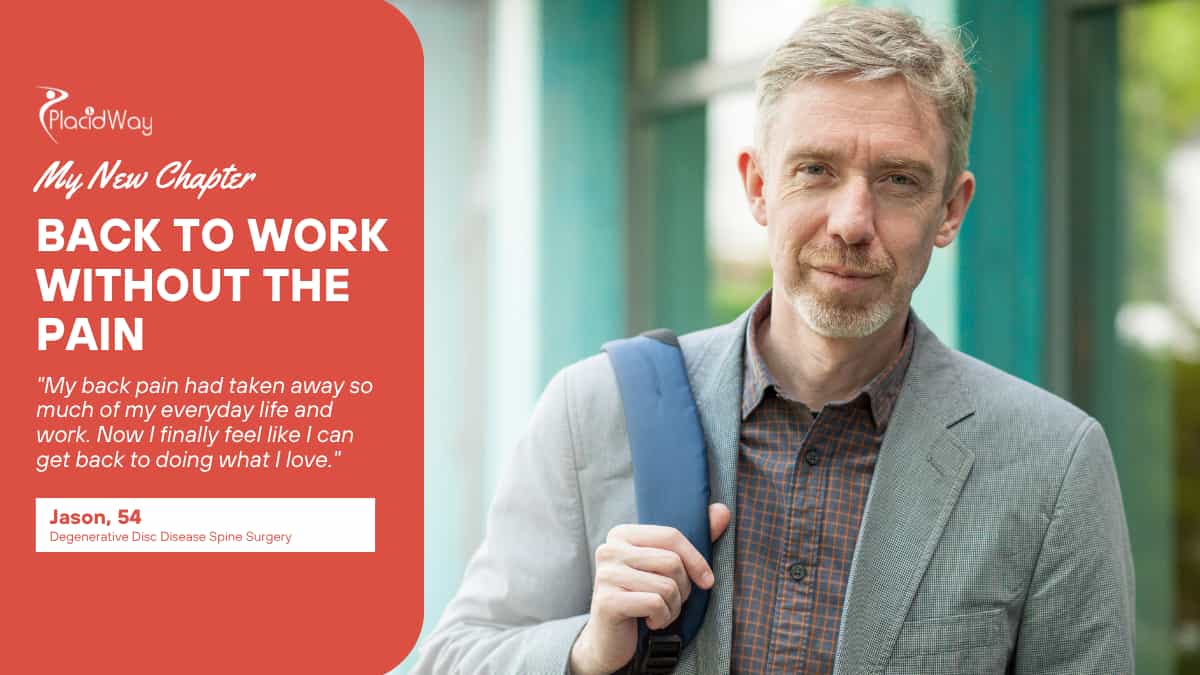
Patient Profile
Name: Jason Miller
Age: 54
Condition: Degenerative disc disease, herniated disc or spinal stenosis
Treatment: Minimally invasive spine surgery, microdiscectomy or laminectomy as clinically indicated
Destination: Puerto Vallarta, Mexico
Journey at a Glance
Main problems: Radiating leg or arm pain (radiculopathy); Chronic lower back or neck pain unresponsive to physical therapy; Numbness, tingling, or weakness in limbs; Mobility restrictions; difficulty sitting, standing, or walking for extended periods
Previous care: 3–6 months of physical therapy or chiropractic care; Epidural steroid injections (1–3 rounds); Oral pain management (NSAIDs, muscle relaxants, opioids)
Travel driver: Insurance denial or unaffordable out-of-pocket costs; urgent need + long US wait times; desire to avoid opioid dependency or chronic pain disability. --- PERSONA BREAKDOWN PERSONA NAME + AGE + LOCATION
Treatment explored: Minimally invasive spine surgery, microdiscectomy or laminectomy as clinically indicated
Personal goal: Reduce disabling back and nerve pain and return to a full working day.
You began by giving up the stairs.
Then you adjusted your car seat to a rigid, unnatural angle.
You stopped carrying the heavy groceries into the house.
You started pausing halfway across the warehouse floor to pretend to check your phone.
You gave up the weekend golf games.
You stopped sitting on the soft sofa in the living room.
You learned exactly which physical movements would send a shockwave down your leg.
You accepted that a full night of uninterrupted sleep was a thing of the past.
"You should just take it easy today."
"Let me grab that box for you."
"We can push the meeting back again."
Your world has quietly become smaller.
And you have realized that the hardest part is not the daily physical toll, but the sheer exhaustion of:
Waiting.
Meet the man who has done everything right.
Jason Miller is not a real patient, nor is he a client of any specific medical agency.
He is a fictional composite built entirely from the physical realities and financial frustrations that thousands of working Americans face every year.
Jason Miller is fifty-four years old and lives in Columbus, Ohio.
He works as a regional logistics manager for a mid-sized commercial distributor.
Ten years ago, he unloaded freight trucks himself.
Today, he walks the concrete dispatch floor with a rigid, guarded gait, keeping his weight shifted entirely to his left side.
The radiating pain in his right leg dictates exactly how long he can stand, how far he can walk, and how long he can sit at his desk.
He followed the rules of the system.
For the first year, he told himself it was just a pulled hamstring.
Then the numbness started reaching his toes.
He went to his primary care doctor, who prescribed conservative management.
He tried it all.
Rest.
Ice.
Stretching.
Ibuprofen.
Chiropractic visits.
Physical therapy.
Epidural steroid injections.
Waiting.
Degenerative disc disease that progresses to severe radiculopathy is typically managed with non-invasive therapies for several months before surgical interventions, such as a microdiscectomy or spinal decompression, are evaluated as necessary medical options.
Jason Miller finally secured an MRI, saw a specialist, and received the verdict he had been quietly hoping for.
"You are a candidate for surgery."
When?
The gap between authorization and action.
Access to specialized spine surgery in the United States is increasingly defined by administrative delays, with many elective orthopedic procedures facing insurance denial appeals and regional wait times extending well past six months.
But Jason Miller doesn't experience the American healthcare system as a national statistic.
He experiences it when he drops his car keys in the driveway and stares at the asphalt, unwilling to bend over.
"I'll just pick them up later."
He experiences it when the human resources coordinator looks at him apologetically over her monitor.
"Your surgical authorization is still under review."
He experiences it when the clinic scheduler hands him a printed appointment card.
"My first available date is in November."
He has already tried to be patient.
There is a quiet assumption that people who look outside their local medical system are simply impatient or acting like careless shoppers.
Jason Miller is neither of those things.
He has spent twelve months playing by the rules of a highly regulated bureaucracy.
He has paid thousands of dollars out of pocket for deductibles, imaging copays, and specialist fees.
He has consumed a slow, steady diet of over-the-counter pain medication just to get through his shifts.
"I just need to push through this week."
"Maybe the next injection will actually work."
He is tired of managing his own decline.
The question in his mind has fundamentally shifted from a passive hope to an active, logistical boundary.
He has gone from asking, "Can I tolerate this?" to:
"How much of my life am I prepared to organize around it?"
The domestic alternative always comes with a catch.
Jason Miller briefly considers paying for the surgery in the domestic private market.
He learns that a private microdiscectomy in his region runs between USD 35,000 and USD 60,000, assuming no complications.
He has savings, but liquidating them would mean dismantling the financial security he has spent thirty years building.
There is a vast difference between theoretically having the money and actually being in a position to spend it on a single medical event.
He sits at the kitchen table with his wife, Sarah, looking at a spreadsheet of their assets.
"We cannot drain the kids' college fund."
"But I cannot keep working like this."
They find themselves backed into a corner defined by a single concept:
Compromise.
He isn't searching for an international flight yet.
Jason Miller opens his laptop late on a Tuesday night.
He starts typing queries into the search bar, looking for a loophole in the system.
how to appeal spine surgery insurance denial
self pay cost for lumbar microdiscectomy ohio
minimally invasive spine surgery near me out of pocket
is spine surgery cheaper in other states
spine surgery cost in mexico
spine surgeons puerto vallarta
The algorithm begins presenting him with medical travel destinations.
His immediate reaction is highly skeptical.
"I'm not going abroad just because it's cheaper."
His instinct is correct.
Price alone should never be the deciding factor in a complex clinical intervention.
Why does a Mexican coastal city keep appearing in his research?
Puerto Vallarta frequently emerges in cross-border healthcare research because its private hospital sector has deliberately aligned with international accreditation frameworks designed to mirror North American standards.
But Jason Miller realizes he has to change how he evaluates the information.
The question is never whether a specific country is good at medicine.
Countries do not perform spinal decompressions.
Individual fellowship-trained spine surgeons perform spinal decompressions in specific, highly regulated operating theaters.
There are tangible, verifyable credentials to seek out, such as membership in specialized global organizations.
Patients considering treatment abroad are strongly advised to consult with a domestic clinician and review the specific facility's clinical outcomes and infection control protocols prior to making any commitments.
It requires a fundamental shift in perspective:
Verification.
His first question was always going to be about the cost.
Current market data indicates that an all-inclusive surgical package for minimally invasive spine surgery in Puerto Vallarta generally ranges from USD 12,000 to USD 18,000, depending on the complexity of the procedure, the number of spinal levels involved, and the specific implant technology required.
He stares at the figure, hearing his father's voice in his head.
"You always end up paying for cheap work."
"What exactly am I getting?"
Twelve things the advertised price may or may not cover.
Does this include the pre-operative MRI?
Are the anesthesiologist's fees billed separately?
How many nights in the intensive care unit are covered if there is a complication?
Who pays for the surgical hardware if titanium screws are needed?
Is the post-operative physical therapy session included in the hospital stay?
Does the quoted price cover the companion's stay in the hospital room?
Are prescription pain medications provided upon discharge?
Who handles the airport transfers in a specialized medical vehicle?
What happens to the deposit if I fail the pre-operative cardiology clearance?
Is there a surcharge for specific brands of disc replacement devices?
Does the surgical center provide itemized billing in English for my records?
Will I be charged extra for translated medical reports?
The advertised number is only the beginning of the conversation.
He closes his laptop and rubs his eyes.
He realizes that navigating this process requires a totally different skill set.
He is no longer just a patient; he has become an auditor.
What does the procedure actually involve?
Minimally invasive spine surgery utilizes tubular retractors to create a small tunnel to the problem area, allowing the surgeon to remove bone spurs or herniated disc material without severing the surrounding muscle tissue, which generally results in a shorter hospital stay compared to traditional open spine surgery.
The biological mechanics of the operation are identical whether performed in Ohio or Jalisco.
The variables that change are entirely logistical.
"How do I get home?"
The brochures rarely put the operational reality on the front page.
International aviation bodies and individual airlines maintain highly variable rules regarding patient travel after major surgery, with some carriers requiring medical clearance forms and others imposing strict waiting periods of seven to fourteen days before allowing post-operative passengers to board a commercial flight.
The variation itself is the lesson.
This logistical constraint must be integrated into the planning phase before any financial commitments are made, not treated as an afterthought once the stitches are in place.
"Wait. Does that mean I have to recover in a hotel room for a week?"
Possibly, depending on your surgeon's specific discharge protocols.
How firm is the hotel mattress?
Is there a walk-in shower, or will I have to step over a high bathtub rim?
Does the building have an elevator, or will I be navigating stairs?
Who changes my surgical dressings on day four?
Where is the nearest pharmacy that carries the prescribed anti-inflammatories?
What is the emergency contact protocol if I develop a fever at two in the morning?
Can I sit upright in an economy airplane seat for five hours?
Will I trigger the airport security scanners?
Who manages my luggage at the departure terminal?
How do I secure an aisle seat with extra legroom on short notice?
What happens if my flight is delayed and I am trapped in the terminal?
This isn't tourism in the traditional sense.
It boils down to:
Management.
Sarah isn't just coming along for a holiday.
The invisible second participant in every medical journey is the supporting spouse or companion.
Sarah will be the one holding the discharge papers.
She will be the one remembering the medication schedule when Jason Miller is groggy from anesthesia.
She will be the one communicating with the hotel concierge and the transport driver.
She will need to know exactly what steps to take if an unexpected clinical issue arises.
Patients engaging in cross-border healthcare are strongly encouraged to procure specialized medical complication insurance, as standard domestic health policies rarely cover emergency interventions or extended hospital stays required on foreign soil.
Sarah is a crucial component of the entire care system.
Then comes the uncomfortable conversation about risk.
Any structural intervention on the human spine carries inherent risks, including post-operative infection, nerve damage, cerebrospinal fluid leaks, and the development of deep vein thrombosis during the subsequent recovery and travel phases.
Jason Miller learns to immediately close any browser tab that uses specific phrases.
Completely safe. No risk. Guaranteed success.
Informed consent requires a clear-eyed understanding of the potential complications, not just a glossy brochure illustrating the hoped-for outcome.
Jason Miller's questions eventually become much sharper.
He is no longer asking if Puerto Vallarta is nice, or if the hospital looks modern.
He begins setting up virtual consultations and bringing specific demands to the video calls.
How many times have you performed this specific decompression this year?
What is your facility's current post-operative infection rate?
Do you have an English-speaking neurologist on staff for consultations?
Will my domestic PCP be able to reach you directly if an issue arises?
What brand of spinal hardware do you use, and is it FDA-approved?
Are you the surgeon who will be holding the instruments, or will a resident be assisting?
Where is the nearest tertiary care center if a major cardiac event occurs?
How do you handle medical records transfer upon discharge?
Can I speak with a previous patient from the United States?
What would you see on my imaging that would make you tell me not to proceed?
Jason Miller realizes what he is actually looking for.
He doesn't only want a surgeon who is willing to operate.
He wants a surgeon who is willing not to.
Have I really exhausted my options at home?
Patients facing continuous insurance denials for elective procedures have the right to request a formal peer-to-peer review or escalate their case to a state-level external review board before abandoning the domestic care pathway.
He prepares a final list of questions for his local provider.
Can my case be re-coded to reflect an urgent structural decline?
Is there a different facility in the network with a shorter waitlist?
Will you serve as my point of contact for follow-up care if I go abroad?
Would you be willing to review an international surgeon's operative plan?
Can we schedule my three-month follow-up imaging now?
He knows that any international option must be judged against a fair baseline.
Puerto Vallarta should be compared with Jason Miller's real alternatives, not with a worst-case assumption about the American system.
The night before the decision looks exactly like work.
The kitchen table is covered in paper.
Printed MRI reports. Insurance denial letters. Spreadsheets tracking flight costs. Printed CVs of Mexican spine surgeons. Emails from medical travel coordinators.
"Are you actually going to do this?"
"I think I finally have enough information."
The exhaustive research did not make them more afraid.
It made them capable of making a choice.
What Jason Miller actually wants isn't spine surgery.
"You just want the pain to stop."
"I want to get my mobility back."
To stand in the yard and throw a baseball without wincing.
To walk through the warehouse without looking for a place to lean.
To sleep through the night.
To stop managing a slow decline.
Not a hospital. Not a titanium rod. Not a medical travel package. Not a coastal city in Mexico.
Function.
And underneath that:
Autonomy.
Puerto Vallarta might be the answer, but it might not be.
He might realize the post-operative flight is too daunting.
He might decide to drain his savings and stay in Ohio.
He might win his insurance appeal on the third try.
He might choose to endure the six-month waitlist locally.
He might decide his spine is too compromised to risk traveling abroad.
He might book the flight, schedule the surgery, and take control of the timeline.
Any of those can be an informed decision.
The goal of this research is not to persuade you to travel across a border.
The goal is to ensure that frustration does not make the decision for you.
The choice sitting in front of you today.
Maybe you've been living with the numbness for a year.
Maybe you've just received your second denial letter.
Maybe you've exhausted your physical therapy benefits.
Maybe you've been staring at a domestic out-of-pocket quote that makes your stomach turn.
Maybe you've started adjusting how you walk just to get through the workday.
You do not need to decide today.
What exactly is keeping me grounded?
What is the financial cost of waiting another six months?
What is the physical cost of doing nothing?
Who is the surgeon I would trust with my spine?
Where do they operate?
How do I verify their credentials?
What logistical boundaries am I unwilling to cross?
You are no longer just comparing prices.
You are comparing paths forward.
Hope isn't the promise that everything will go perfectly.
It isn't a guarantee of zero pain.
It isn't a glossy brochure of a resort recovery.
It isn't the assumption that medical travel is easy.
Hope is having enough accurate information to make a decision that feels entirely like your own.
You are capable of asking difficult questions. You are capable of auditing credentials. You are capable of managing complex logistics. You are capable of navigating risk. You are capable of redefining the boundaries of your own care.
You have replaced the old phrase:
"I suppose I'll just have to keep waiting."
With a much more powerful one:
"What other informed options do I have?"
PlacidWay — Your Way to Hope.
We help individuals explore international medical options, compare accredited facilities, and prepare the difficult questions required for an informed decision.
We do not provide clinical advice, nor do we promise specific surgical outcomes.
For someone facing a paralyzed domestic pathway, an accredited option abroad isn't a promised cure; it is simply one route worth thoroughly understanding.
Your way to hope.
Medical disclaimer
This article is entirely educational and does not recommend that any individual undertake cross-border medical travel or specific surgical interventions. Individual clinical suitability, inherent physical risks, and recovery protocols require direct professional assessment. Readers should continually consult their own domestic clinicians, verify the current regulatory status of any international provider independently, and obtain appropriate specialized medical travel protection or insurance prior to making financial or health commitments.



.png)










.png)
.png)




.png)
.png)
.png)









Share this listing