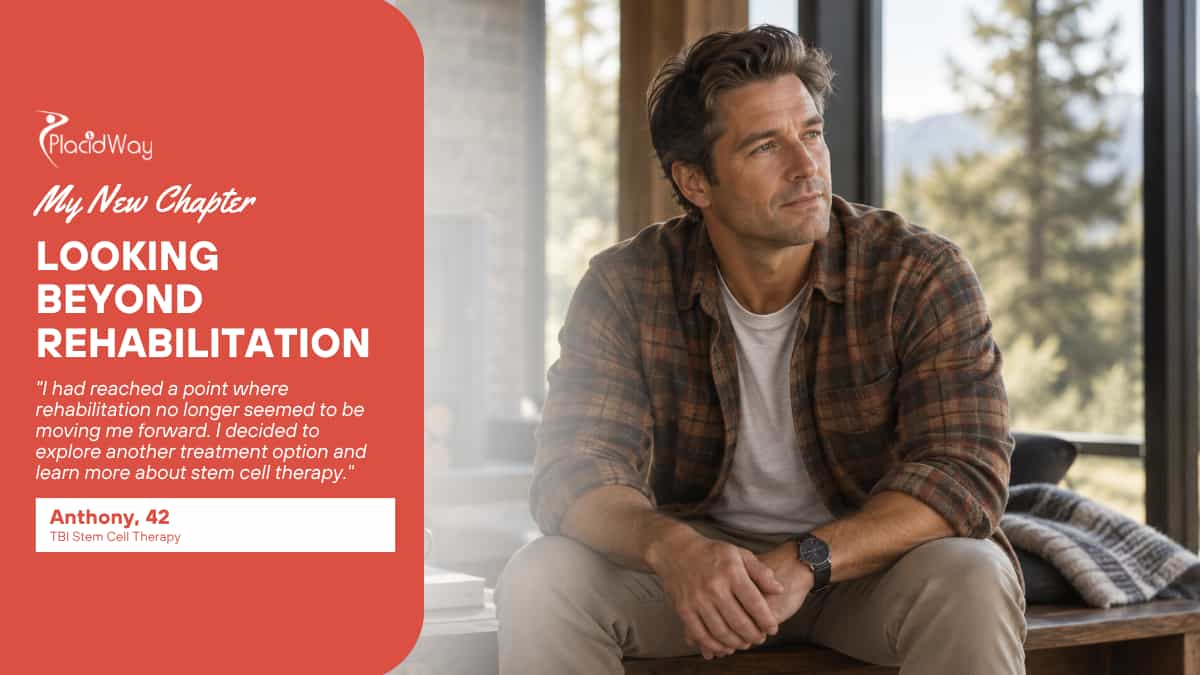
When Rehabilitation Stopped Moving the Needle for Anthony Martinez: An American Patient’s TBI Stem Cell Therapy in Guadalajara

Publish date: Modified date: Medically reviewed by: Dr. Alejandro Fernando on Sep 11, 2026 Author: Pinki Sharma

American Patient’s TBI Stem Cell Therapy in Guadalajara 

Patient Profile

Name: Anthony Martinez

Age: 42

Condition: Traumatic Brain Injury (TBI) with chronic sequelae

Treatment: Autologous or allogeneic stem cell therapy

Destination: Guadalajara, Mexico

Provider: CellsTime Clinique

Journey at a Glance

Main problems: Persistent cognitive dysfunction, chronic fatigue, slow or plateaued recovery despite 12+ months of conventional rehabilitation.

Previous care: 18 months of intensive physical, occupational, and speech therapy; multiple U.S. neurology consultations ending in a "wait and see" approach; insurance denials for extended experimental therapies.

Travel driver: Seeking accessible, timely regenerative medicine options and dedicated neuro-focused protocols without the $150,000+ domestic price tag or inaccessible trial criteria.

Treatment explored: Mesenchymal stem cell therapy administered via intravenous or intrathecal methods to target chronic neuroinflammation.

Personal goal: Regain cognitive independence, reduce daily caregiving burdens on family, and secure enough recovery to reconstruct a meaningful daily life.

You stopped reading the complex novels first.

Then you stopped driving on the highway at night.

You handed over the household budget because the numbers wouldn't stay still.

You let the lawn overgrow.

You stopped calling friends because you kept losing the thread of the conversation.

You gave up your office keys.

You started taking afternoon naps that feel more like comas.

You stopped looking at the career plan you drafted three years ago.

You learned to smile vaguely when you don't understand what was just said.

"You're looking so much better."

"Just give it time, honey."

"Brain injuries are unpredictable."

Your world has quietly become smaller.

The hardest part is not the daily headache or the lost income, but the waiting.

Who is this actually happening to?

Anthony Martinez is not a real PlacidWay client.

He is a fictional composite built from the exact situations, frustrations, and questions American traumatic brain injury patients face every day.

At forty-two, he lives in rural Ohio.

Before the accident, he managed regional logistics for a freight company.

He drafted complex routing schedules on dual monitors.

He coached his daughter's travel soccer team.

He rebuilt an old transmission in his garage just to see if he still could.

How does an ordinary life grind to a halt?

Then came the accident.

Then the hospital.

Then the acute rehabilitation.

Then the speech therapy.

Then the occupational therapy.

Then the neuropsychological evaluations.

Then the waiting for neuroplasticity to work its magic.

Standard medical protocol for moderate-to-severe traumatic brain injury dictates intensive multidisciplinary rehabilitation during the first six to twelve months post-injury, when spontaneous recovery is most rapid . After a year, the statistical curve of natural recovery flattens significantly. Neurologists typically transition the patient from active rehabilitation to symptom management and adaptive coping strategies.

The verdict is delivered gently but firmly:

"You have likely reached maximum medical improvement."

When?

What does the plateau look like from the inside?

Approximately 5.3 million Americans currently live with a long-term disability resulting from a traumatic brain injury . Clinical data suggests that many of these individuals will require ongoing assistance with daily activities and face permanent alterations to their cognitive processing speeds.

But Anthony doesn't experience the healthcare system as a national statistic.

He experiences it standing in his kitchen, staring at a coffee maker he suddenly doesn't remember how to operate.

"I think it needs water first, Dad," his daughter says gently.

He experiences it sitting in a neurologist's waiting room for ninety minutes just to have a ten-minute consultation.

"Let's maintain your current medication dose and check back in six months."

He experiences it looking at a denied insurance claim for extended cognitive therapy.

"Coverage limits have been exhausted for this diagnosis code."

Has he given the system a fair chance?

He isn't a hasty consumer looking for a quick fix.

He gave the domestic system eighteen months to work.

He did the memory puzzles.

He took the prescribed stimulants to stay awake and the prescribed depressants to sleep.

He drove two hours each way to a specialized clinic until he couldn't afford the gas.

I did everything they asked me to.

Why am I still stuck right here?

The central question has quietly shifted:

From "Can I tolerate this?" to "How much of my life am I prepared to organise around it?"

Why not just seek advanced treatment at home?

There are experimental regenerative protocols in the United States.

Anthony found a private clinic in Florida offering specialized cell therapies for brain injury.

The quoted price tag was USD 120,000.

His insurance explicitly denies coverage for these protocols, classifying them as experimental for neurological trauma.

Clinical trials exist, but they are geographically distant and require strict inclusion criteria he no longer meets because his injury is older than twelve months.

He sits at the kitchen table with his wife, Sarah.

"We could take out a second mortgage if we really had to."

"Affording something and being able to afford it are two very different things."

Where does the search actually begin?

He isn't searching for medical tourism yet.

His late-night internet searches begin as quiet attempts to understand his symptoms and local alternatives.

TBI recovery plateau after one year

Neuroplasticity supplements that actually work

Experimental TBI treatments near me

Why won't insurance cover brain injury rehab

Stem cell therapy TBI cost

Stem cell clinics in Mexico reviews

The algorithm eventually leads him to Guadalajara.

He reads about a dedicated facility called CellsTime Clinique.

His reaction is immediate:

"I'm not going abroad just because something is cheaper."

He is entirely right to trust that instinct.

Price should never be the deciding factor when answering a complex medical question.

Why does Guadalajara keep appearing in patient forums?

Mexico has established a flexible regulatory framework allowing licensed clinics to administer mesenchymal stem cells cultured for neurological use, treatments that remain bound in phase-two trial bottlenecks in the US . Clinics in cities like Guadalajara leverage proximity to the US alongside access to international laboratory protocols.

But the central question requires a critical reframe.

The question is never whether Mexico is good at regenerative medicine.

Countries do not administer complex biological infusions.

Specialist neurologists do, clinical teams do, and dedicated laboratories do.

There is something concrete and operational to verify.

Patients exploring unapproved cellular therapies abroad are strongly advised to independently verify clinic licensure and consult their primary care physician before committing to travel .

What is the actual financial commitment?

His first question was:

How much?

Indicative pricing for a comprehensive stem cell protocol in Guadalajara varies between USD 15,000–35,000, depending on the cell count required, the administration method chosen, and the necessary length of clinical observation .

He remembers his grandfather's rule:

"If it sounds too good to be true, it probably is."

"What exactly am I getting?"

Twelve things the advertised price may or may not cover.

Are the stem cells autologous or allogeneic?
Are they derived from bone marrow or umbilical cord tissue?
Does the laboratory cultivate the cells on-site or transport them from a third-party facility?
What is the guaranteed viability rate of the cells upon injection?
Is the administration intravenous, or does it require an intrathecal lumbar puncture?
Who exactly performs the puncture if intrathecal administration is used?
Is updated neuro-imaging included in the pre-treatment medical assessment?
How many days of observation are required inside the clinic itself?
Are ground transfers from the airport handled by medically trained staff?
What post-treatment rehabilitation support is provided once I return home?
Who officially translates the resulting medical records?
What happens financially if there is an adverse reaction during the infusion?

The advertised number is only the beginning of the conversation.

How does the procedure actually work?

Mesenchymal stem cell therapy for chronic TBI aims to introduce anti-inflammatory and neurotrophic factors into the central nervous system, theoretically promoting axonal regeneration and modulating the chronic neuroinflammation that prevents natural recovery . It is an investigational approach focused on altering the brain's internal environment rather than executing a mechanical repair.

It is not a localized surgery to simply remove a problem.

It is a biological infusion requiring a highly controlled sterile environment and precise physiological timing.

"How do I manage the travel logistics with a broken brain?"

What do the brochures rarely show you?

The part the glossy sales decks rarely put on the front page is the harsh friction of travel.

International health bodies note that flying after recent neurological procedures can carry variable risks regarding intracranial pressure, though specific guidelines differ heavily based on the exact intervention performed .

The variation itself is the lesson.

This constraint must be part of the plan before committing, not discovered afterward.

"Wait. Does that mean I might be stuck in a hotel room in pain?"

Possibly, depending on your body's specific response to the intervention.

Who goes to the local pharmacy for pain relief if you cannot walk?

How do you communicate with the hotel staff if the room's Wi-Fi drops?

What if the sensory overload of a foreign airport triggers a massive migraine?

Who manages the passports when your executive function temporarily falters?

Are the clinic's discharge instructions available in native English?

Is there a direct emergency line to the attending neurologist after hours?

Will the hotel provide room service food that doesn't upset a stressed stomach?

How close is the nearest conventional emergency room if a non-neurological medical issue arises?

Can the clinic arrange a dedicated wheelchair for the airport transfer home?

This isn't tourism in the usual sense.

Who else is carrying the weight of this trip?

Sarah isn't just coming along for a vacation.

She will carry the heavy medical binders and the backup medications.

She will be the one to notice if Anthony's speech begins to slur from exhaustion.

She is the one who will be responsible for interpreting complex medical decisions if he becomes cognitively overwhelmed in the clinic.

She needs to know exactly what the contingency plan is if something goes wrong.

Medical travel insurance must specifically cover complications arising from elective, non-FDA-approved treatments abroad, as standard policies almost universally exclude them .

She is part of the care system too.

Are we avoiding the hardest conversation?

Then comes the uncomfortable conversation about risk.

Documented risks of stem cell infusions include localized site infections, immune system rejection, unintended cellular proliferation, and severe inflammatory responses within the central nervous system .

Anthony learns to immediately distrust a specific vocabulary:

Completely safe. No risk. Guaranteed success.

Informed consent means understanding far more than just the hoped-for outcome.

How do you interview a clinic?

Anthony's questions become better.

He contacts CellsTime Clinique directly.

What is your clinical protocol for a suspected central nervous system infection?
Can you provide peer-reviewed data on your specific cell culture methods?
How many TBI patients have you treated this calendar year?
Who is the attending physician and what are their neurological credentials?
How do you systematically screen out patients who are not suitable candidates?
What percentage of your patients report no improvement at all?
Where do you safely source your umbilical cord tissue?
Do you use independent third-party auditing for your laboratory standards?
Can my neurologist in Ohio speak directly with your medical director?
What would you see in my medical records that would make you tell me not to proceed?

He doesn't only want someone willing to do it.

He wants someone willing not to.

What if the answer is still at home?

Have I truly exhausted my options at home?

Patients have the right to request a formal peer-to-peer review of insurance denials for emerging treatments, though success rates remain historically low for experimental codes .

Is there a compassionate use exemption available at my current local hospital?

Would a different diagnostic code unlock further physical therapy sessions?

Are there any new domestic clinical trials opening in the next six months?

Can my local doctor supervise my aftercare if I ultimately go abroad?

Will traveling to Mexico permanently void my current local care plan?

Stem cell therapy in Guadalajara should be compared with Anthony's real alternatives, not with a worst-case assumption about the domestic system.

How does it feel when the choice is finally real?

He sits at the kitchen table again.

A printed PDF from CellsTime Clinique. An Excel spreadsheet of anticipated travel costs. A list of final questions for his scheduled tele-consultation. A notebook tracking his daily cognitive fatigue levels.

"We don't have to do this if it feels wrong."

"It doesn't feel wrong, it just feels heavy."

The research didn't make them more afraid; it made them more capable of deciding.

What is he actually trying to buy?

What Anthony actually wants isn't a medical procedure.

"Why do you want to go through all this?"

To read a book without losing the plot after three pages.

To remember a conversation I had yesterday.

To stand in a crowded room without feeling like the walls are vibrating.

To not feel like a ghost haunting my own house.

Not a stem cell infusion. Not a biological culture. Not a medical tourism package. Not a flight to Mexico.

Agency.

And underneath that:

Dignity.

Can walking away be a victory?

Guadalajara might be the answer.

It might not be.

He might decide the logistical stress outweighs the potential biological benefit.

He might find that his specific injury type is simply not a candidate for the protocol.

He might realize he cannot secure the necessary local aftercare support.

He might choose to protect his remaining savings for long-term supportive care.

He might accept that his current baseline is his permanent reality.

He might book the tickets, organize the care, and board the plane with his eyes wide open.

Any of those can be an informed decision.

The goal is not to persuade you to pursue stem cell therapy in Mexico. The goal is to make sure frustration doesn't make the decision for you.

Where does this leave you?

Maybe you've stopped reading the complex novels too.

Maybe you've accepted a smaller life because the effort of fighting for a bigger one is simply exhausting.

Maybe you've been told to wait and see by a medical system that has clearly moved on.

Maybe you are staring at a clinic brochure right now.

Maybe you feel guilty for wanting more recovery than you've been given.

You do not need to decide today.

What exactly am I trying to recover?

What am I truly willing to risk to get it?

Who will carry the burden if this intervention fails?

Who is independently verifying the laboratory standards?

Is price forcing me into a corner I shouldn't be in?

He has to ask himself a very difficult question:

Am I running toward a solution, or running away from grief?

What happens the day after I get home?

You are no longer just comparing prices.

You are comparing paths forward.

What does hope actually look like?

Hope isn't the promise that damaged neurons will miraculously fire again perfectly.

Hope isn't a blanket guarantee of safety from an offshore clinic.

Hope isn't pretending the injury never happened.

Hope is having enough accurate, unvarnished information to make a decision that feels like yours.

It is knowing exactly what questions to ask the laboratory director. It is understanding the logistics of navigating a foreign airport with profound cognitive fatigue. It is carefully separating the marketing brochures from the biological reality. It is protecting yourself with proper medical travel insurance. It is looking at your family and knowing you made a deliberate, careful choice together.

The sentence changes:

From "I suppose I'll just have to keep waiting" to:

"What other informed options do I have?"

PlacidWay — Your Way to Hope.

We help individuals navigate the complex landscape of international medical options by providing structured information, provider comparisons, and a framework for critical evaluation.

We do not provide clinical advice, and our platform is never a substitute for a thorough consultation with your own neurologist.

For someone like Anthony, exploring CellsTime Clinique isn't a promise of a cure, it is one route worth understanding comprehensively.

Your Way to Hope.
Medical disclaimer

This article is for educational purposes only and does not recommend that any individual undertake medical travel or experimental therapies. Individual suitability, risks, and potential benefits require thorough professional assessment. The reader should consult their own primary care clinician or neurologist, verify the current regulatory status of any international facility independently, and obtain appropriate medical travel protection or insurance.


When Rehabilitation Stopped Moving the Needle for Anthony Martinez: An American Patient’s TBI Stem Cell Therapy in Guadalajara

About Article

  • Treatment: Stem Cell Therapy
  • Country: Mexico
  • Overview Anthony Martinez has invested 18 months in physical, occupational and speech therapy after a traumatic brain injury, yet cognitive fatigue and function have plateaued. Guadalajara offers access to a stem cell protocol unavailable through his US coverage. Because the approach is experimental, he should prioritize neurological eligibility, evidence quality, cell handling, adverse-event protocols, measurable goals and continued rehabilitation rather than promises of recovery.

Trusted Medical Tourism Platform Since 2007

60+
Countries
2k+
Clinics
19.5k+
Reviews
2.5k+
Qualified Doctors
1.1M+
Patients Served Since 2007