
PlacidWay Patient Diaries · Regenerative Aesthetics · Japan
Fig. 1. On a kitchen table in Walnut Creek, California: two boarding pass stubs from SFO to Haneda, a consent form printed in Japanese and English side by side, and a yellow sticky note that says ASK FOR THE PLAN NUMBER in capital letters.
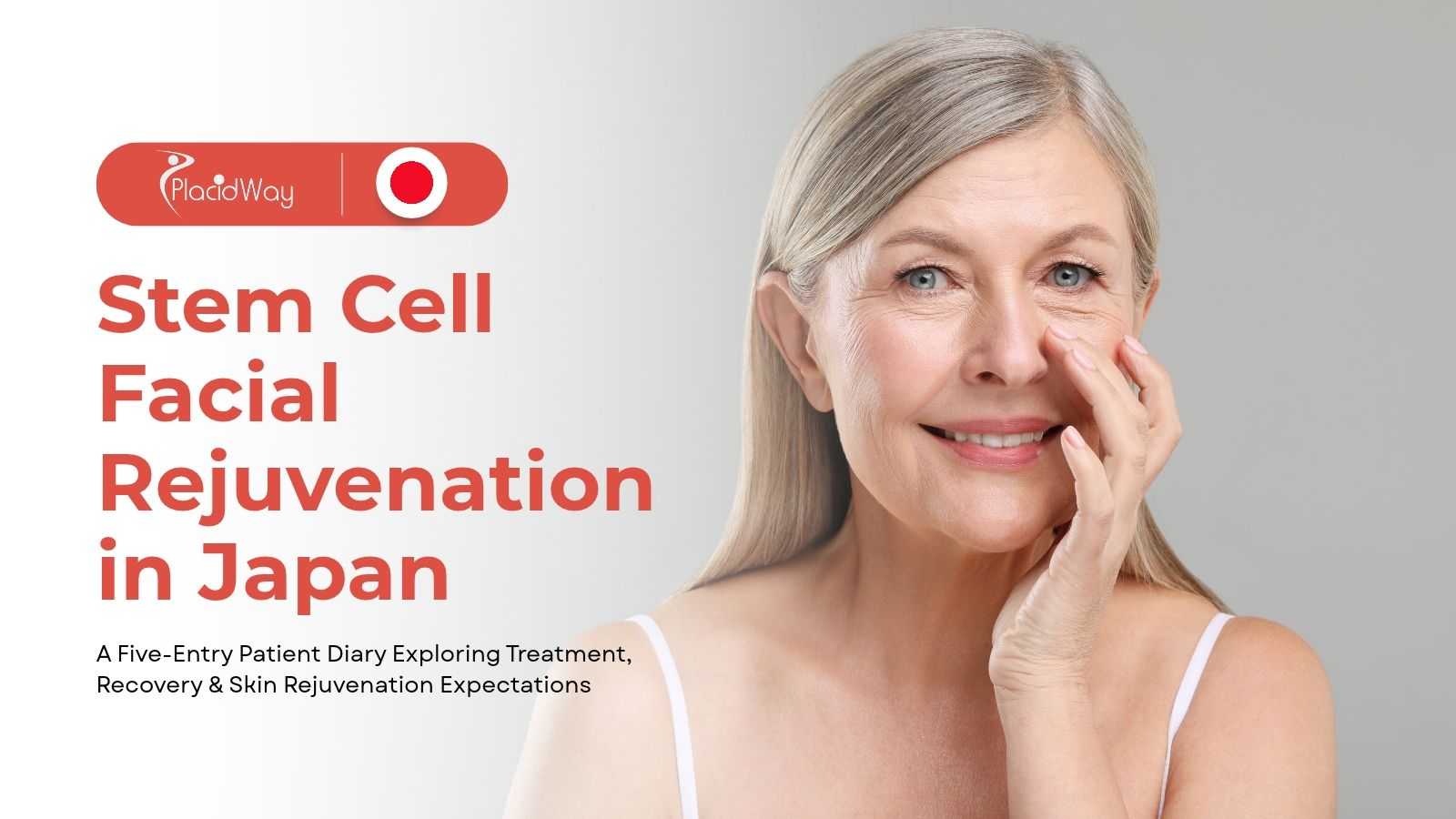
Stem Cell Facial Rejuvenation in Japan: one patient's five entries, read again months later
Each entry below comes in two halves. The left half is what she wrote at the time, tired and a little jet-lagged. The right half is what she thinks now, looking back with the results in the mirror and the receipts in a folder. We kept the pairing because the gap between the two is where most of the useful advice lives.
One honest note before you start. Carol, the patient, and Joanne, her sister, are composites. We built them from the questions, worries and turns of phrase PlacidWay coordinators hear again and again from American women in their late forties to sixties who are looking at regenerative facial treatment abroad. No single real person said these lines, and you should read them that way. The regulations, the price ranges and the logistics, on the other hand, are real and worth checking against your own quotes.
Patient
Composite, 57, consultant
Protocol
Cultured adipose-derived cells
Trips
Two, about five weeks apart
City
Tokyo
Entry 01 of 05
The Decision
Written at home · late evening · about three months before the first flight
Then · in the moment
Okay so. I have now read more about the FDA's tissue rules than any non-lawyer should. Here is what I understand, in plain words. In the U.S., a clinic can take your own fat and put it back in the same day if it's only minimally handled. The moment the cells are grown in a lab, multiplied, they count as a drug, and the FDA hasn't approved one for faces. So the American places either do the same-day version or they do something I don't fully trust.
The quotes I got here ran anywhere from five thousand to fifteen thousand dollars and up, and none of them were covered (of course). One office couldn't tell me who processed anything. Honestly, that was the moment.
Then a colleague who used to work in Osaka told me Japan has an actual law for this. Clinics register a plan, a committee reviews it, the government gets a copy, and the lab growing the cells has to be licensed. I wrote PLAN NUMBER on a sticky note and stuck it on the fridge.
Now · looking back
What I got right was asking how the rules worked before I asked how much it cost. That order saved me from at least two clinics, here and there, that were mostly marketing.
What I got wrong was assuming Japan meant one trip. With cultured cells, the fat comes out first, the lab grows the cells for several weeks, and then you come back for the injections. That's two sets of flights, two hotel stays and two chunks of PTO. Some clinics can store cells frozen so the second visit is flexible, but plan on going twice.
I'd also tell my earlier self that Japan's law makes a clinic accountable. It doesn't make the result certain. Those are different promises.
"I didn't want the cheapest version. I wanted the version somebody had to answer to."
Carol · composite patient voice
Ledger § 1
The five Japanese cities she weighed, ranked
Before she picked a clinic, Carol picked a city. The scores below are PlacidWay's editorial judgment of each city's general landscape for American patients, weighted by the criteria shown. They are not survey results, patient ratings or a verdict on any individual clinic. Prices are approximate per-session estimates in U.S. dollars, exclude flights and hotels, and change by clinic, cell-processing method and number of sessions. Always get a written quote.
Weights · provider qualifications and regulatory compliance 25% · safety and clinical protocols 20% · aftercare and follow-up 20% · cost 15% · travel access from the U.S. 10% · patient reputation and track record 10%
| # | City | Approx. per session | Getting there from the U.S. | Score / 10 |
|---|---|---|---|---|
| 1 | Tokyo | $4,000–$10,000 | Nonstops to Haneda and Narita from many West Coast and East Coast hubs | 8.65 |
| 2 | Osaka | $3,800–$9,500 | Kansai Airport, limited U.S. nonstops, easy connection via Tokyo | 8.30 |
| 3 | Yokohama | $4,000–$9,800 | Close to Haneda by train or car, uses Tokyo's flight network | 7.90 |
| 4 | Fukuoka | $3,500–$8,500 | Usually one connection via Tokyo, Seoul or Honolulu, airport close to downtown | 7.25 |
| 5 | Nagoya | $3,500–$8,800 | Chubu Centrair, typically a connection, or the bullet train from Tokyo | 7.15 |
| ref | United States | $5,000–$15,000+ | Home, but culture-expanded facial cell therapy is not FDA-approved | n/a |
Tokyo came first because of depth. It has the largest pool of clinics running registered regenerative medicine plans, more clinics with English-speaking coordinators on staff, and the most nonstop flights, which matters when you're doing the trip twice and a late-night cancellation would cost you a PTO day.
Osaka is a close second with comparable clinical standards and slightly lower typical pricing. If you're flying from Los Angeles or San Francisco and can catch one of the Kansai nonstops, it's a strong choice.
Yokohama often means a satellite of a Tokyo provider. That can be a plus for aftercare, since records and doctors are shared, and the hotels are often calmer and cheaper than central Tokyo.
Fukuoka and Nagoya have lower overhead and established, if fewer, specialized clinics. You may find shorter waits and kinder prices. Ask early whether English coordination is in-house or arranged by an outside interpreter.
Entry 02 of 05
Arrival
Written in a Tokyo hotel · early morning, wide awake for no good reason · trip one of two
Then · in the moment
Eleven-ish hours from SFO. Haneda was calm, which surprised me. The clinic's coordinator had emailed me a map with the train transfers drawn in red, and a photo of the building entrance, which honestly was the most useful thing anyone sent me all month.
Consultation day. A medical interpreter sat next to me the whole time. The doctor drew on a paper diagram of a face and the interpreter wrote the English underneath. Blood draw first (infection screening, which the cell lab needs before it will process anything). Then the consent form, Japanese on the left page, English on the right. I asked for the plan number. Nobody blinked. It was printed on page two.
Then the small one. That's what I'm calling the fat harvest, because the injection later is the main event. Local anesthetic, a tiny cannula, a little fat from below my belly button, maybe an hour all in. Sore like I did too many crunches. Two nights later I flew home with a bandage and a pamphlet.
Now · looking back
I spent weeks worrying about the language barrier in the exam room. That part was fine. The interpreter was trained for medical conversations and she slowed the doctor down when I looked lost.
The real barrier was reading. Pharmacy labels, the aftercare sheet, the little card about when to remove the bandage. If I did it again I'd ask the clinic, before I even booked, to email every handout in English so I could read them on the plane. I'd also download the offline Japanese pack in a translation app before leaving home, because the camera mode on labels is a lifesaver.
And I'd book the hotel by the clinic, not by the nice neighborhood. You don't want two train transfers with a sore abdomen.
Ledger § 2
What Japan's regenerative medicine law actually checks
That sticky note was about Japan's Act on the Safety of Regenerative Medicine, the framework most licensed clinics in this field operate under. Here is what it covers, line by line, and what to ask about each item.
01
Risk class. Therapies are sorted into Class I, II or III. Adipose-derived stem cells used for facial work typically sit in Class II. Platelet-rich plasma is usually Class III. Ask which class your treatment falls under.
02
Committee review. Before a clinic can offer the therapy, its treatment plan must be reviewed by a certified regenerative medicine committee.
03
Government filing. The reviewed plan is submitted to the Ministry of Health, Labour and Welfare and receives an identifying number. Plans are listed in a public database, mostly in Japanese, which a coordinator or translation tool can help you search.
04
Licensed cell processing. Cells must be processed in a facility that is licensed or formally notified to the authorities. Ask the name of the facility and whether you'll receive a release report showing cell count, viability and sterility testing.
05
Consent and reporting. Patients must receive a written explanation and give informed consent. Clinics are expected to report serious adverse events. Ask how you would report a problem from the U.S.
06
What sits outside it. Cell-free products such as stem cell culture supernatant or exosomes are popular in Japanese aesthetic clinics and are regulated differently from living-cell therapy. They may suit some patients, but they are a different treatment. If a quote looks unusually low, ask plainly whether you're receiving your own living cells.
Entry 03 of 05
Procedure Day
Written in two sittings · before dawn and that evening · trip two, about five weeks after the harvest
The doubt · 4:10 a.m., hotel room
Can't sleep. Made the mistake of opening a forum thread called something like "stem cell facials are a scam." Now I'm sitting on the edge of the bed doing math. Two trips. All this money. My cells have been in a lab I've never seen for five weeks. What if they're not even mine? What if this is the expensive version of a nice serum? I seriously typed out an email to the coordinator saying I wanted to postpone. Didn't send it. Going to ask them three things first and decide in the room.
How it resolved
At the clinic she asked her three questions out loud. Whose cells are these? The coordinator showed the release report from the processing facility, with her patient ID, cell count, viability percentage and sterility results. Is the plan still on file? Same plan number as page two of her consent form. Can I stop? The doctor said, through the interpreter, that she could postpone with no pressure, and explained how storage would work. Hearing that she was allowed to walk out was what made her stay.
Then · that evening
The main event, done. Numbing cream for about thirty minutes, which was the most boring part. Then the doctor marked my face with a little white pencil, cheeks, under the eyes, along the jaw, smile lines, and did a series of small injections. Less than an hour. Pressure more than pain, except under the left eye, which stung (I said ouch in English and the nurse said it back, which made me laugh).
Ice packs, a printed aftercare sheet in English this time because I'd asked, and a follow-up appointment for day four. I look like I lost a pillow fight. Puffy, pink, a couple of pinprick bruises.
Now · looking back
The doubt wasn't wrong. It just needed paperwork. I'd rather feel it at 4 a.m. and ask than feel nothing and not ask.
The forum thread wasn't entirely wrong either. The research on stem cell facial rejuvenation is still growing, mostly smaller studies, and results vary from person to person. Nobody at the clinic promised me a specific outcome, and I trusted them more because of that.
If you take one practical thing from this entry, make it this. Write your questions down the night before, in English, short, and hand the list to the interpreter. It's easier to be brave on paper.
Companion's page
Joanne, the sister who flew in from Boston
Composite companion voice · joined for trip two only
I took the nonstop out of Logan to Narita and met Carol at the hotel the night before. People ask what my job was. Mostly it was carrying the ice packs and being the one who reads the aftercare sheet out loud at 9 p.m. when she's too tired to.
The morning of, she came down to the lobby with that face she makes when she's about to cancel something. I didn't argue. I said, ask your questions, and if you don't like the answers we'll go eat noodles and fly home. She asked. She liked the answers.
Things I'd tell another companion. The convenience store on the corner is your best friend for soft food, cold drinks and frozen things that work as backup ice packs. Bring an adapter is not needed since Japan uses the same flat two-prong plugs we do, but bring a three-to-two converter if your charger has the round grounding pin. Learn the words for ice, water and pharmacy. And take your own photos of the swelling each morning in the same window light, because she'll want to compare later and won't trust her memory.
One honest thing. Day two she was puffier than either of us expected and she cried a little in the elevator. Day four the doctor said it was normal and it looked it by then. Just know that day two is day two.
Entry 04 of 05
Recovery
Written across five afternoons in Tokyo · plus one line from the plane
Then · in the moment
Day one, swollen and sleepy. Day two, worse (Joanne will tell you about the elevator). Day three, the puffiness started to settle and the bruises went yellow. I wore a face mask outside and nobody looked twice, which is the single best thing about recovering in Tokyo. Half the train is wearing one.
Rules from the sheet: no alcohol for a few days, no massage or facials, sleep with my head up, and no hot baths. That last one hurt because the hotel had a public bath on the top floor. The clinic said heat can make swelling worse, so no onsen this trip.
Day four check. The doctor looked at the injection points, pressed gently along the jaw, took photos and nodded a lot. The interpreter said: healing as expected. I made her repeat it.
Day six, on the plane: compression socks, aisle seat, got up every hour like they told me. Face feels tight but normal-ish.
Now · looking back
Five nights after the injections was about right for me. Fewer than four and I'd have missed the in-person check, which I valued more than I expected. Your clinic will tell you its own minimum stay, so ask before you book flights.
The changes, for me, were slow. Nothing dramatic in the first weeks once the swelling left. Somewhere around the second and third month my skin looked more even and a bit fuller in the cheeks, the way it does after a really good vacation, except it stayed. That's my experience, not a forecast. Some people notice more, some less.
Recovery was easier than the harvest, physically. Emotionally it was harder, because you can see your face and you can't see your abdomen.
"Nobody said I looked done. My dentist asked if I'd switched moisturizers. I'll take it."
Carol · composite patient voice
Ledger § 3
Her money, line by line, in dollars
These figures are approximate, illustrative of a composite patient, and will differ for you. They're here so you can see the shape of a two-trip budget, not to set expectations for any clinic's price.
Carol's honest take is that Japan was not dramatically cheaper once two trips were added in. The U.S. quotes she collected were for a same-day fat procedure, a different treatment that doesn't involve lab-grown cells. What she was paying for in Japan was a culture-expanded protocol under a registered plan with a licensed lab, which she couldn't legally get at home.
Two money notes for American readers. Cosmetic procedures generally don't qualify as medical expenses for HSA or FSA purposes, so plan to pay with ordinary funds and check with your plan administrator. And use a credit card with no foreign transaction fee, since a 3% fee on a five-figure clinic bill adds up fast. Some clinics prefer bank transfer, so ask about payment method and deposit refund terms in writing.
Entry 05 of 05
Home
Written in Walnut Creek · after a video call that started at 5 p.m. her time
Then · in the moment
One-month video check today. It was 5 p.m. for me and 9 the next morning for them, which is the best slot I've found, since Japan is sixteen or seventeen hours ahead depending on the season. (My sister in Providence says her version is 7 or 8 p.m., thirteen or fourteen hours behind.) Interpreter on the call again. I held my phone up to the kitchen window for the photos.
Before I left I'd called two dermatology offices here. The first one politely said they don't see patients for treatments done abroad. The second said sure, they'd do a regular skin check and look at the injection sites if anything came up. I booked a visit three weeks after landing, brought my folder, and she was curious more than anything.
The clinic's coordinator answers email within a day, usually overnight my time. I keep a note on my phone with the clinic's direct number in international format, just in case.
Now · looking back
Follow-up from home worked because I set it up before I left, not after. The folder was the whole trick. Here's what was in it, and what I'd ask any clinic to provide in English before you board the flight home:
- The treatment plan number and the name of the cell processing facility
- The cell release report (count, viability, sterility results)
- A discharge summary listing what was injected, where and how much
- Any medications or ointments prescribed, with generic names
- Before-and-after photos from the clinic's own camera
- Telehealth schedule and how to reach the doctor if something feels wrong
- Itemized receipts, in case you need them later
Would I do it again? Probably, for a top-up, and I'd go back to the same clinic since my records are there. I'd skip the 4 a.m. forum reading.
In Carol's words · composite voice
What I would tell someone considering this
- Ask for the plan number before you ask for the price. If they hesitate, that's your answer.
- Find out if it's your living cells or a cell-free product. Both exist. They are not the same thing and shouldn't cost the same.
- Budget for two trips if the cells are cultured. Two flights, two hotels, two sets of PTO.
- Get every handout in English ahead of time. Talking was fine. Reading was the hard part.
- Bring someone for the injection trip if you can. Day two is day two.
- Line up a U.S. dermatologist before you go. Call ahead, some will say no, keep calling.
- Talk to your own doctor about your health history, medications and blood thinners first. Mine wanted to know about my fish oil, of all things.
- Let yourself doubt. Then ask your questions out loud, in the room, and decide there.
The last worry, answered
"Once I'm back in California, who actually picks up when I have a question?"
That's the question most readers of this diary end on, and it deserves a straight answer. In Carol's case it was the clinic's coordinator and doctor by email and video, with an interpreter, at hours that fit a U.S. workday, plus a local dermatologist she'd lined up in advance.
PlacidWay can help you ask those same questions before you commit. Our team can connect you with clinics in Tokyo, Osaka, Yokohama, Fukuoka and Nagoya, help you request plan details and written quotes, and confirm in advance how English-language follow-up works from home. There's no obligation, and the decision stays yours and your doctor's.
Ask about follow-up care for stem cell facial treatment in Japan




















Share this listing