

Patient Safety & Legal Oversight Guide
Regulatory Safety Insights: Stem Cell Therapy in Japan
For many patients researching advanced cellular therapies abroad, excitement quickly gives way to anxiety. When you are dealing with chronic pain, degenerative conditions, or age-related decline, the hardest question is rarely whether innovative options exist—it is knowing whom you can trust with your body.
Across the globe, patients face confusing marketing claims, unclear clinical oversight, and clinics operating in regulatory gray zones. That is why evaluating Regenerative Medicine in Japan begins not with promotional promises, but with understanding how the country governs, inspects, and monitors every step of clinical delivery. At the center of these national patient protections stands a landmark law known as the Act on Ensuring the Safety of Regenerative Medicine, etc.
Key points of this article
- The Act on Ensuring the Safety of Regenerative Medicine, etc. establishes strict national rules to protect patients and ensure clinical accountability.
- Medical technologies are divided into three distinct risk tiers—Type 1, Type 2, and Type 3—each governed by tailored review and authorization protocols.
- Before treating a single patient, medical institutions must have their provision plans vetted by a certified regenerative medicine committee and formally submitted to government authorities.
- Oversight continues long after a procedure through mandatory periodic reporting and immediate adverse-event disclosures.
- Regulatory approval verifies procedural safety and scientific rationale, not guaranteed clinical outcomes—making thorough patient education essential.
Table of Contents
- What is the Act on Ensuring the Safety of Regenerative Medicine, etc.?
- Differences between Type 1, Type 2, and Type 3
- Review and procedures for providing regenerative medicine
- Continued safety monitoring after the start of treatment
- Commitment to legal compliance at Omotesando Helene Clinic
- Verified Medical Institution & Leadership Credentials
- Frequently Asked Questions
Section 01 · Regulatory Foundation
What is the Act on Ensuring the Safety of Regenerative Medicine, etc.?
When patients explore cellular therapies, their biggest fear is often stepping into the unknown: How are these cells processed? Who verified that this protocol is safe? What happens if a clinic cuts corners? Japan enacted the Act on Ensuring the Safety of Regenerative Medicine, etc. specifically to eliminate that uncertainty. Enforced on November 25, 2014, this legislation creates a binding legal architecture designed to safeguard patient health while enabling the responsible, timely delivery of legitimate cellular therapies.
Rather than allowing medical facilities to self-regulate, the statute mandates clear operational rules covering everything from physician qualifications and cell-processing facility hygiene to emergency response readiness. Under this framework, anyone researching Stem Cell Therapy in Japan benefits from a nationwide standard where clinical protocols must pass independent scrutiny before they can ever be offered in a consultation room.
To ensure rules match real-world clinical complexity, the law divides regenerative procedures into three structured classifications—Type 1, Type 2, and Type 3—based on the biological technologies involved and their potential risk to the human body. Each classification carries strict administrative hurdles, committee review mandates, and submission filings overseen by the Ministry of Health, Labour and Welfare (MHLW).
Section 02 · Risk Stratification
Differences between Type 1, Type 2, and Type 3
Not every cellular intervention carries the same biological profile. One common misconception among patients is assuming that if cells come from their own body, the procedure automatically requires minimal oversight. In reality, Japanese regulators evaluate risk by examining multiple variables together—including the source of the cells, how extensively they are cultured or manipulated in a laboratory, the route of administration, and the target condition.
| Regulatory Tier | Risk Profile & Examples | Mandatory Review Body |
|---|---|---|
| Type 1 Regenerative Medicine | High-Risk Technologies: Procedures with limited historical human clinical experience, such as therapies utilizing induced pluripotent stem cells (iPS cells) or embryonic stem cells (ES cells). | Certified Special Committee for Regenerative Medicine + MHLW review with mandatory waiting period. |
| Type 2 Regenerative Medicine | Moderate-Risk Technologies: Therapies employing somatic stem cells (such as cultured mesenchymal stem cells) or interventions altering homologous cellular functions. | Certified Special Committee for Regenerative Medicine + formal submission to MHLW. |
| Type 3 Regenerative Medicine | Low-Risk Technologies: Processed somatic cell applications with established safety profiles and lower procedural complexity. | Certified Committee for Regenerative Medicine + submission to Regional Bureau of Health and Welfare. |
Consider autologous adipose-derived mesenchymal stem cells: even though the tissue is harvested directly from the patient, culturing and expanding those cells for systemic or targeted therapeutic administration places the protocol into a specific regulatory tier based on clinical intent and processing methods. Regardless of whether a protocol falls under Type 1, Type 2, or Type 3, every single category requires formal evaluation by an accredited Certified Regenerative Medicine Committee before a clinic can legally proceed.
Section 03 · Pre-Treatment Verification
Review and procedures for providing regenerative medicine
For a patient weighing international medical care, paperwork behind the scenes might sound bureaucratic—yet this multi-stage vetting process is precisely what separates legitimate medical institutions from unverified operators. Under Japanese law, a clinic cannot simply announce a new cellular therapy and start scheduling appointments. Instead, the medical institution must draft a comprehensive Regenerative Medicine Provision Plan detailing clinical rationale, physician credentials, cell-culturing quality controls, patient informed-consent forms, and emergency care pathways.
How a Provision Plan Becomes Legally Authorized
1. Independent Committee Audit: An accredited Certified Regenerative Medicine Committee—composed of medical specialists, legal experts, and bioethicists—reviews the clinic’s proposed treatment plan for scientific validity and patient safety.
2. Government Submission: Once the committee issues a favorable opinion, the clinic submits the approved plan via the MHLW’s official e-Regenerative Medicine online portal to either the Minister of Health, Labour and Welfare or the Director of the Regional Bureau of Health and Welfare.
3. Authorization & Restriction Rules: For high-risk Type 1 plans, a mandatory restriction period applies so national authorities can conduct secondary safety checks before patient enrollment begins. Type 2 and Type 3 plans commence strictly in accordance with their designated statutory procedures.
Patients should also maintain a grounded perspective on what this legal clearance represents. Completing committee review and government filing confirms that a clinic meets rigorous safety, sterility, and ethical benchmarks—it does not constitute a guarantee of therapeutic cure or identical outcomes for every individual. Honest medical guidance requires transparent conversations about both potential benefits and realistic biological limitations.
Section 04 · Ongoing Accountability
Continued safety monitoring after the start of treatment
A major concern for patients traveling abroad for care is what happens after they leave the clinic: Does regulatory oversight stop once the infusion or injection is finished? Under Japan’s legislative framework, initial approval is only the beginning of continuous clinical surveillance.
Every authorized medical facility is legally required to compile and submit periodic status reports detailing the number of procedures performed, patient follow-up observations, and clinical safety metrics to both its Certified Regenerative Medicine Committee and government health authorities. This closed-loop reporting system ensures that protocols remain under active review rather than operating unchecked.
Furthermore, if any unexpected illness, infection, or adverse complication suspected to be linked to a procedure occurs, the institution is bound by strict statutory deadlines to report the event immediately. Because regulatory standards and procedural guidelines evolve alongside medical science, consulting official updates from the Ministry of Health, Labour and Welfare remains essential for anyone evaluating Stem Cell Treatment in Japan.
Section 05 · Clinical Governance in Practice
Commitment to legal compliance at Omotesando Helene Clinic
Navigating complex medical decisions becomes far less overwhelming when your care team treats regulatory compliance as a core clinical value rather than a mere formality. At Omotesando Helene Clinic, strict adherence to every requirement under the Act on Ensuring the Safety of Regenerative Medicine forms the foundation of patient care.
True informed consent means empowering patients with clear, balanced facts before any commitment is made. Alongside explaining procedural steps and anticipated therapeutic goals, physicians must openly discuss potential risks, recovery timelines, and scientific boundaries. Legal compliance and transparent communication work hand in hand so patients can weigh their options without pressure or ambiguity.
Ultimately, patient safety rests on two pillars: robust national oversight and a well-informed patient who understands the scientific evidence behind their care plan. By upholding rigorous legal standards and open clinical dialogue, Omotesando Helene Clinic remains dedicated to delivering responsible, patient-centered regenerative care.
Accredited Facility & Medical Leadership
Official Clinic Profile, Regulatory Certification & Clinical Director

Helene Clinic, Tokyo, Japan
Operating under Japan’s national regenerative medicine framework with registered provision plans and dedicated cell-processing quality controls.
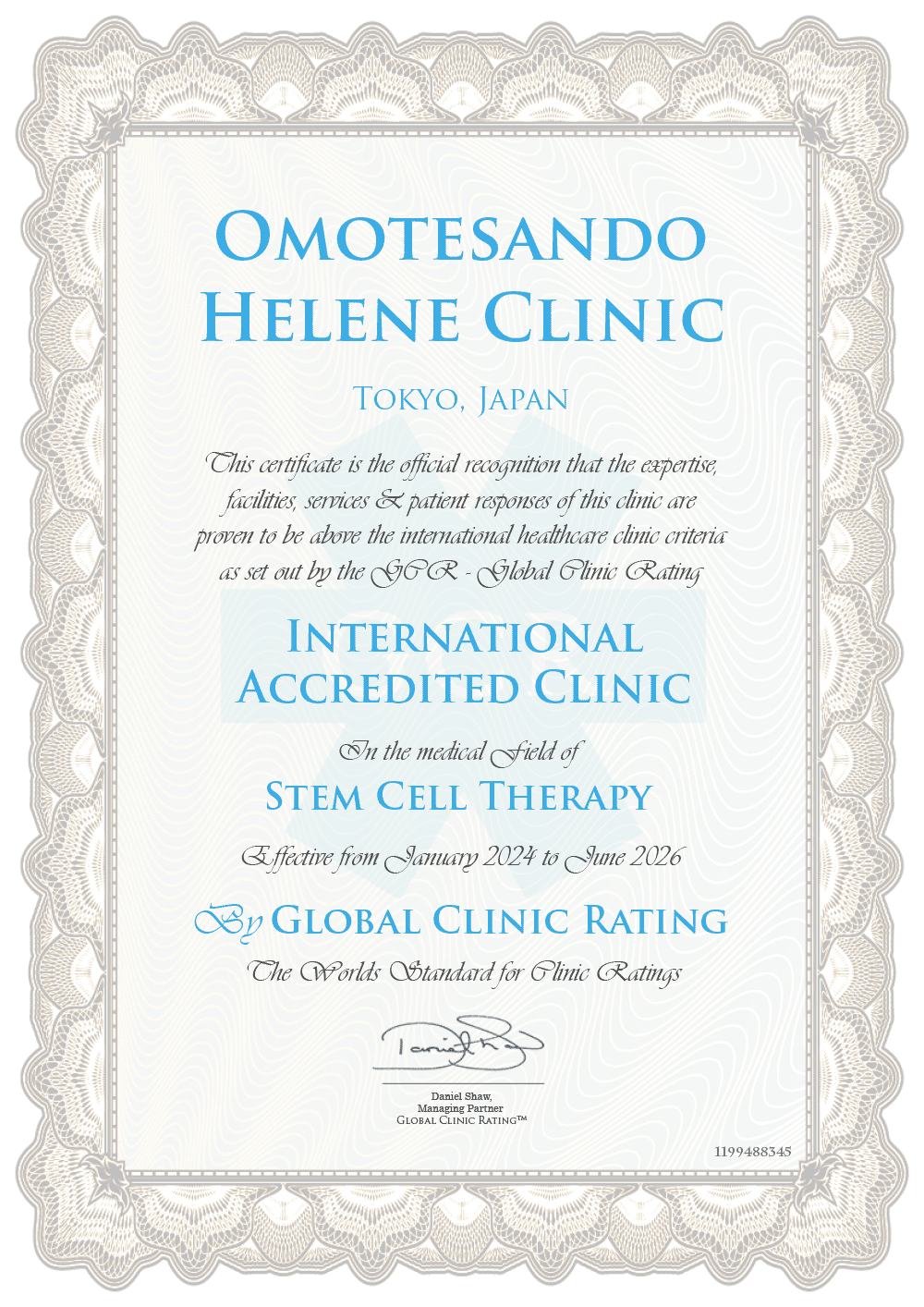
Helene Clinic Certificate
Official documentation verifying formal compliance with regulatory review standards and authorized clinical provision protocols.

Dr. Takaaki Matsuoka - Group CEO and Chief Medical Officer
Leading clinical governance, patient safety protocols, and individualized medical evaluations for international and domestic patients.
Patient Questions Answered
Frequently Asked Questions About Japan’s Regenerative Medicine Law
Click any question below to reveal detailed regulatory guidance, or connect directly with a medical coordinator to review your case.
1. Why did Japan enact the Act on Ensuring the Safety of Regenerative Medicine, etc.?
Enacted on November 25, 2014, the law was established to protect patients from unproven or poorly controlled cellular procedures while creating a clear, legally accountable pathway for safe regenerative therapies to be delivered in clinical practice.
2. How does Japan classify regenerative therapies into Type 1, Type 2, and Type 3?
Treatments are grouped by overall clinical risk: Type 1 covers high-risk technologies with limited human history (such as iPS or ES cells), Type 2 covers moderate-risk somatic stem cell protocols, and Type 3 covers lower-risk processed somatic cell applications.
3. Are autologous stem cells (from my own body) automatically considered low risk?
No. Risk classification depends on how the cells are cultured, processed, and administered—not solely whether they come from your own body. Many autologous adipose-derived stem cell protocols fall under Type 2 oversight and require specialized committee review.
4. What is a Certified Regenerative Medicine Committee?
It is an independent, government-accredited panel of physicians, cell-biology experts, legal specialists, and ethicists that audits a clinic’s proposed treatment plan for scientific validity, cell-processing safety, and ethical patient consent before government filing.
5. Can a Japanese clinic offer cellular therapies without notifying the government?
No. Offering regenerative procedures without first obtaining committee approval and formally submitting a Regenerative Medicine Provision Plan to the Ministry of Health, Labour and Welfare (or Regional Bureau) is a violation of Japanese law.
6. Does government acceptance of a provision plan guarantee my treatment will cure my condition?
No. Regulatory review verifies that the clinical protocol, cell manufacturing, and safety safeguards meet strict national standards, but individual biological responses vary and no medical law can guarantee specific clinical outcomes.
7. How are cell-processing laboratories regulated under this Act?
All cell culturing and processing must occur inside licensed Cell Processing Facilities (CPFs) that comply with strict sterility, contamination-prevention, traceability, and quality-control mandates audited by regulatory authorities.
8. What safety monitoring continues after a patient receives treatment?
Clinics must submit regular periodic reports on treatment numbers and patient safety outcomes to their certified committee and health authorities, and must immediately report any suspected treatment-related illnesses or infections.
9. What questions should international patients ask before booking a consultation in Tokyo?
Ask whether the specific therapy is backed by an accepted MHLW provision plan, which risk tier (Type 1, 2, or 3) it falls under, where the cells are processed, what side effects exist, and what follow-up support is provided once you return home.
10. How can I verify whether a clinic’s proposed care plan fits my personal health history?
Share your complete medical records, current medications, and diagnostic imaging during a direct physician evaluation so the medical team can assess suitability, explain realistic expectations, and provide written informed consent.
Have specific questions about your eligibility or registered clinical protocols?
Ask a Specialist About Your Case ?
























Share this listing