

Clinical follow-up and lab review
Testosterone Monitoring: Hormone Re-Test After Starting
Testosterone monitoring means repeating blood tests after treatment starts. The Endocrine Society advises a first check at 3 to 6 months, then yearly (guideline, 2018). At Healthi Life in Bangkok, a hormone re-test with physician review costs THB 12,000 and re-runs the baseline testosterone mapping panel.
01 / Key facts
Core monitoring intervals, lab markers, and menu details
Structured follow-up helps align lab markers, symptoms, and safety checks across every stage of treatment. Below is a summary of key guidelines and clinic menu details for men on a testosterone or peptide protocol.
| Item | Fact | Source |
|---|---|---|
| First check | 3 to 6 months after starting testosterone, then about yearly | Endocrine Society guideline, 2018 |
| Blood count | Hematocrit is checked at baseline, at 3 to 6 months and yearly; a value above 54% prompts action | Endocrine Society guideline, 2018 |
| Prostate | PSA and prostate review follow age-based guidance | Endocrine Society and AUA guidelines, 2018 |
| Re-test at Healthi Life | THB 12,000, a repeat of the testosterone mapping panel plus physician review | Healthi Life men's hormone menu |
| Who it is for | Men on a testosterone or peptide protocol | Healthi Life men's hormone menu |
| Remote option | International guests can complete review consultations remotely | Healthi Life men's hormone menu |
02 / Why is testosterone monitoring needed?
Tracking physiological shifts, safety markers, and treatment response
Monitoring is needed because treatment changes the body in ways that a symptom diary cannot show. The Endocrine Society guideline states that men on testosterone should be evaluated at intervals to check symptoms, side effects and blood levels, and that the dose is adjusted to bring testosterone into a mid-normal range.
Three risks are tracked in blood tests. Testosterone can raise the red blood cell count, which thickens the blood. It can affect the prostate, so PSA is reviewed on the schedule that suits the man's age and risk. It can suppress the brain's own signal, which reduces sperm production and shrinks the testicles.
Monitoring also answers a plain question: is the treatment doing what it was started to do? If symptoms have not changed and levels are in range, the physician may look for another cause. If levels are still low, the dose or route may need to change.
At Healthi Life Longevity Center in Bangkok, the men's hormone menu describes hormone optimization as iterative: measure, treat, re-test, adjust. It states that a re-test is recommended after the loading phase and periodically afterward.
Iterative cycle
Measure, treat, re-test, adjust—pairing lab numbers with how treatment is working.
Three tracked risks
Red blood cell elevation, age- and risk-guided PSA review, and reduced sperm production or testicular size.
03 / When should testosterone be re-tested?
Guideline schedules, dosing cycle timing, and earlier checks
The usual first check is 3 to 6 months after starting treatment, and then once a year if things are stable. The Endocrine Society guideline gives this timing, and adds that levels should be checked at a point in the dosing cycle that suits the product used.
The American Urological Association guideline gives a similar pattern. It advises measuring testosterone at about 2 to 3 months after starting, then at 6 to 12 month intervals, and checking hematocrit and PSA on a schedule (Mulhall et al., 2018). The two guidelines differ in the exact weeks, which is one reason physicians set the schedule for each man.
Timing relative to the dose matters. Injections produce a peak soon after the dose and a trough before the next. A level taken at the peak reads high, and a level at the trough reads low. A physician needs to know when the last dose was taken to interpret the number. Gels and other forms have their own timing rules.
Earlier re-tests are reasonable when a man has new symptoms, a dose change, swelling in the legs, chest pain, breathlessness or a change in the red blood cell count.
04 / Which tests are repeated?
Panels, thresholds, and expected hormone shifts
A monitoring panel normally repeats total testosterone, and often free testosterone and SHBG when the total result is hard to read. It adds hematocrit and hemoglobin, and PSA when it applies. Estradiol is checked when symptoms such as breast tenderness appear, since testosterone can convert to estrogen.
The Endocrine Society guideline says that hematocrit above 54% should lead to stopping treatment until it falls, then restarting at a lower dose or with another product. It also advises considering bone density in men with osteoporosis risk, and a review of symptoms such as sleep apnea, which testosterone can worsen.
At Healthi Life, the re-test repeats the testosterone mapping panel, which the menu lists as total and free testosterone, DHEA-S, cortisol, estradiol, SHBG, FSH, LH and a full thyroid panel (TSH, free T3 and free T4). A physician reviews the results with the man and decides on the next step. Blood counts and PSA are ordered when the physician judges they are needed.
LH and FSH usually fall during testosterone treatment, because the brain senses that testosterone is available and lowers its signal. That is an expected effect, not a fault, and the physician reads it in that light.
05 / How much does a hormone re-test cost in Bangkok?
Published pricing for re-testing and baseline mapping
At Healthi Life, a hormone re-test with physician review costs THB 12,000. The menu describes it as a re-run of the testosterone mapping panel plus a physician review, using a blood draw and a consultation.
| Option | Price (THB) | Menu note |
|---|---|---|
| Hormone Re-Test and Physician Review | THB 12,000 | Re-run of the testosterone mapping panel plus physician review |
| Male Performance and Testosterone Mapping (baseline) | THB 12,000 | Includes physician consultation, results in about 5 days |
The baseline mapping panel and the re-test have the same listed price, so a man can compare before and after on the same set of markers.
Side-by-side comparison
Both the baseline mapping panel and the re-test carry a listed price of THB 12,000, supporting like-for-like tracking on the same markers.
06 / Peptide protocols, safety evidence, and limits
What monitoring covers across protocols, trial findings, and clinical boundaries
What does monitoring look like for peptide protocols? The Healthi Life menu places the same re-test at the end of both the testosterone pathway and the peptide pathway. It states that the re-test is for all men on a testosterone or peptide protocol, to confirm that levels are moving toward target and to adjust dose or frequency.
The physician chooses what to follow for each peptide, for example hormone levels or blood pressure, and combines the result with symptoms, since a number on its own does not show benefit.
The evidence behind these peptides in men is limited compared with the evidence for testosterone replacement. That is another reason to measure and review rather than continue by habit.
What does recent safety evidence say? Large trial data bear on monitoring. The TRAVERSE trial followed 5,246 men with low testosterone and high cardiovascular risk. Testosterone replacement was not worse than placebo for major cardiovascular events, and the treated group had more atrial fibrillation, acute kidney injury and pulmonary embolism (Lincoff et al., NEJM 2023). Trial averages; individual results vary and are not guaranteed.
Those findings leave follow-up in place: a physician watches symptoms, blood counts and blood pressure, and who stops treatment when risks outweigh benefits. Men with heart disease, untreated sleep apnea or prostate disease need individual advice before and during treatment.
Risks and limits: A re-test shows a number at one moment. It does not prove that treatment is helping, and it cannot predict future risk. Laboratories differ, and a value near the edge of a range may need repeating. Self-adjusting doses based on a test is unsafe, and this article gives no dosing advice.
Treatment that continues without follow-up carries avoidable risk. A man who has started testosterone elsewhere and travels to Bangkok can ask a physician about a review, but the clinic will need his previous results and prescription details to interpret anything.
07 / Questions to ask any clinic
Six practical questions before or during follow-up
Clear questions help confirm timing, lab scope, safety thresholds, and follow-up options with your treating physician or prospective clinic.
- When will my first re-test be, and at what point in the dose cycle?
- Which markers will be repeated, including hematocrit and PSA?
- What result would make you lower the dose or stop?
- How are fertility and sperm count handled during treatment?
- Can the review be done remotely if I live abroad?
- What does each re-test cost, and is the physician review included?
Provider & Certificate Overview
Clinic, Physicians, and Certificate

Healthi Life Longevity Center
Bangkok facility offering men's hormone monitoring, testosterone mapping re-tests, peptide protocol reviews, and remote review consultations for international guests.

Dr. Sarassawadee Suwanjinda, MD (Dr. Petch)
Physician profile associated with hormone evaluation and clinical review.

Dr. Napat Hunsajarupan, MD (Dr. First)
Physician profile associated with clinical care and consultation.
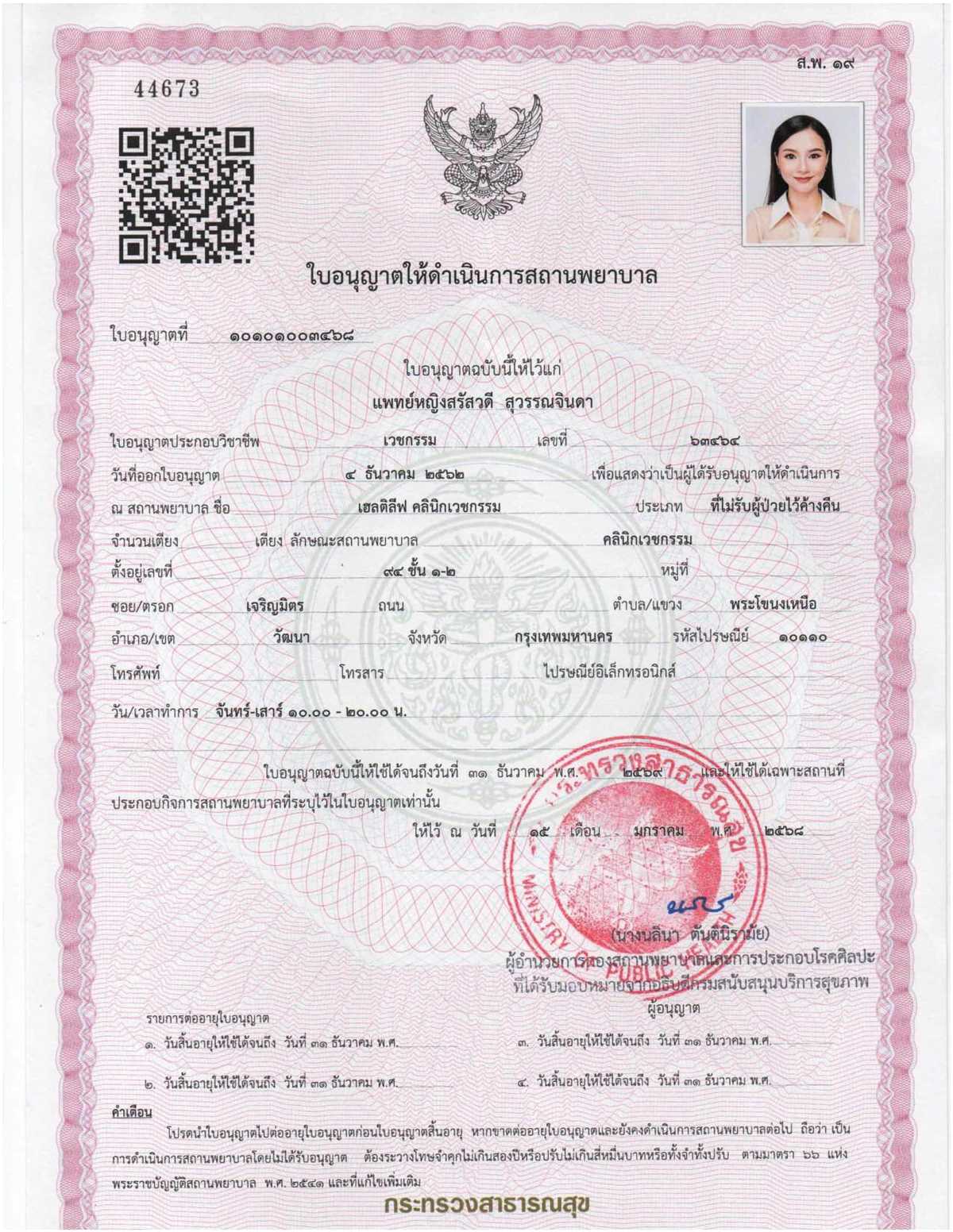
Healthi Life Longevity Center Certificate
Documentation certificate image on file for the center.
08 / FAQ
Frequently asked questions
How often should testosterone be checked on treatment?
The Endocrine Society advises a first check 3 to 6 months after starting, then about once a year if stable. The American Urological Association suggests an earlier first check at 2 to 3 months. A physician sets the schedule, and checks sooner if symptoms or side effects appear.
How much is a hormone re-test in Bangkok?
At Healthi Life, the Hormone Re-Test and Physician Review costs THB 12,000. It repeats the testosterone mapping panel and includes a physician review. The baseline mapping panel carries the same listed price. The clinic's full list is on its price list page.
What blood tests are done during testosterone monitoring?
Total testosterone is the core test, often with free testosterone and SHBG. Hematocrit is checked because testosterone can raise red blood cell count, and PSA is reviewed by age and risk. Healthi Life's re-test repeats its full mapping panel, and the physician orders extra tests if needed.
Can I do the review remotely if I live abroad?
The Healthi Life men's hormone menu says international guests can complete review consultations remotely. A blood draw still has to be done somewhere, so ask the clinic how results from another laboratory are handled. The physician confirms what is possible at the consultation.
What happens if my hematocrit is too high?
The Endocrine Society guideline advises stopping testosterone if hematocrit goes above 54%, then restarting at a lower dose or with another product once it has fallen. A physician also checks for sleep apnea and other causes. Never change a dose without advice from the prescriber.
Do I need monitoring if I take a peptide instead of testosterone?
Yes. Healthi Life's menu recommends a re-test and physician review for all men on a testosterone or peptide protocol. The aim is to confirm hormone levels, check side effects and adjust the plan. Peptides have less long-term evidence in men, which makes follow-up more useful.
References
1. Bhasin S, Brito JP, Cunningham GR, et al. Testosterone therapy in men with hypogonadism: an Endocrine Society clinical practice guideline. J Clin Endocrinol Metab 2018;103:1715-1744. https://doi.org/10.1210/jc.2018-00229
2. Mulhall JP, Trost LW, Brannigan RE, et al. Evaluation and management of testosterone deficiency: AUA guideline. J Urol 2018;200:423-432. https://doi.org/10.1016/j.juro.2018.03.115
3. Lincoff AM, Bhasin S, Flevaris P, et al. Cardiovascular safety of testosterone-replacement therapy. N Engl J Med 2023;389:107-117. https://doi.org/10.1056/NEJMoa2215025
This article is for information only and does not replace a medical consultation.




























Share this listing