


Japan's Medical Tourism to Hit $11.62B by 2034 at 28% CAGR
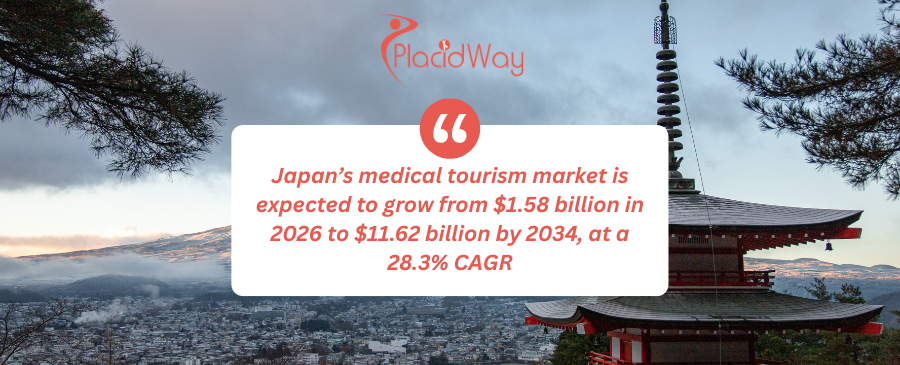
Driven by the soaring demand for advanced cancer treatment in Japan, the medical tourism market is poised to skyrocket from $1.58 billion in 2026 to $11.62 billion by 2034. This massive 28.3% CAGR reflects profound international trust in Japanese healthcare innovation and precision medicine.
The Explosive Growth of Medical Tourism in Japan by 2034
The trajectory of the healthcare travel sector in East Asia is undergoing a monumental transformation, with Japan emerging as the undisputed powerhouse for specialized clinical care. Financial forecasts indicate an unprecedented surge, projecting that the medical tourism market in the region will expand from an estimated $1.58 billion in 2026 to a staggering $11.62 billion by 2034. This phenomenal 28.3% Compound Annual Growth Rate (CAGR) is not a mere statistical anomaly; it is a clear reflection of a global paradigm shift where international patients prioritize cutting-edge technological intervention, extreme clinical precision, and holistic preventative care over traditional domestic health services.
Several converging macroeconomic and healthcare trends are fueling this explosive growth. First, the aging populations in neighboring developed nations, combined with a rising middle class seeking premium healthcare, have created massive regional demand. Furthermore, favorable currency exchange rates and the active promotion of medical visas by the Japanese government have dramatically lowered the barrier to entry for international health travelers. As global healthcare networks become more interconnected, discerning patients are bypassing extensive waiting lists in their home countries to access immediate, elite-level treatments in modern Japanese medical hubs.
Did You Know?
Japan currently boasts the highest number of MRI and CT scanners per capita in the world. This unrivaled access to advanced diagnostic imaging is a primary reason why international patients flock to the country for early disease detection, significantly improving long-term survival rates for complex illnesses.
Why International Patients Seek Health Screening in Tokyo
At the core of the nation's healthcare philosophy is the concept of preventative medicine, most famously embodied in the "Ningen Dock" system. This comprehensive, highly intensive medical checkup goes far beyond a standard annual physical. Thousands of medical tourists actively seek comprehensive health screening in Tokyo to experience this meticulous, full-body diagnostic evaluation. Utilizing advanced PET-CT scans, deep-tissue MRIs, exhaustive tumor marker blood panels, and sophisticated genetic testing, Japanese specialists can detect microscopic cellular anomalies years before they develop into symptomatic diseases.
The allure of undergoing preventative health checks in this bustling metropolis is amplified by the seamless integration of world-class hospitality. Leading diagnostic centers operate less like traditional clinical environments and more like luxury wellness retreats. Patients are guided through their multi-day screening itineraries by dedicated, multi-lingual medical concierges, ensuring an entirely stress-free experience. The profound peace of mind achieved by knowing one's health status with absolute, technologically backed certainty is a primary driver behind the billions of dollars flowing into the medical tourism sector.
Pioneering Advanced Cancer Treatment and Regenerative Medicine
While diagnostics draw healthy patients seeking longevity, critical care demands are driving an influx of high-acuity medical travelers. Japan has cemented its reputation as a global leader in oncology, specifically through the development and commercialization of heavy-ion radiotherapy (carbon ion therapy). This revolutionary cancer treatment targets deep-seated, complex tumors with hyper-focused radiation that causes lethal damage to cancer cells while leaving surrounding healthy tissue almost completely unharmed. Patients facing challenging prognoses domestically are increasingly traveling to access these multi-million-dollar cyclotron facilities, which remain incredibly rare on a global scale.
Simultaneously, the progressive legal framework surrounding the Act on the Safety of Regenerative Medicine has transformed the country into a sanctuary for cellular therapies. International demand for stem cell therapy in Osaka and surrounding regions has skyrocketed, attracting patients seeking interventions for neurodegenerative diseases, orthopedic joint deterioration, and anti-aging protocols. Because the government has implemented a fast-track approval process for demonstrably safe regenerative therapies, medical tourists in Japan can legally access scientifically rigorous, advanced stem cell treatments years before they achieve FDA or EMA approval in Western jurisdictions.
Navigating the Economics: The True Value of Healthcare in Japan
Unlike medical travel destinations positioned primarily as budget alternatives, Japan operates in the premium healthcare tier. However, when comparing the sheer quality, technological sophistication, and clinical outcomes, the value proposition is extraordinary. In countries like the United States, uninsured or out-of-network complex procedures—such as robotic-assisted tumor resections or multi-day comprehensive cancer diagnostics—can easily bankrupt a family. In contrast, Japanese healthcare pricing is strictly regulated by the government, meaning even premium international packages are insulated from the predatory inflation seen in Western medical billing.
When international patients factor in the costs of highly specialized procedures, Japan frequently emerges as a highly competitive option. The transparent pricing models favored by Japanese medical institutions mean that the initial quote encompasses diagnostics, surgical fees, facility usage, and standard post-operative care without hidden surprises. Below is an analytical look at the overarching value markers that differentiate this market from other global alternatives.
The Hyper-Advanced Medical Infrastructure Driving Japan's Boom
To understand the projected $11.62 billion valuation by 2034, one must look at the immense capital being injected into Japanese medical infrastructure. The nation is actively pioneering the concept of the "Smart Hospital," where artificial intelligence, robotics, and big data are seamlessly integrated into the patient experience. AI-assisted imaging software acts as a secondary pair of eyes for radiologists, drastically reducing human error in early cancer detection. In the surgical suites, robotic platforms for micro-surgeries operate with tremor-free precision, enabling minimally invasive procedures that cut standard recovery times in half.
Beyond the high-tech operating rooms, the infrastructure of patient care is deeply rooted in "Omotenashi"—the traditional Japanese philosophy of wholehearted hospitality. Premium medical facilities dedicated to international travelers feature private recovery suites designed to emulate high-end Ryokans (traditional inns). Automated pharmacy dispensaries, biometric security for patient privacy, and customized nutritional plans curated by culinary masters ensure that the clinical environment is not just sterile and efficient, but deeply restorative and psychologically uplifting.
"Japan's projected 28.3% compound annual growth rate is not merely a statistical anomaly; it is a testament to the country's unmatched mastery of precision medicine. As the market scales toward an astonishing $11.62 billion by 2034, we are seeing a massive shift. Discerning global patients are no longer just looking for cost savings—they are crossing oceans to access highly regulated regenerative therapies, robotic oncology, and an infrastructure of preventative care that simply does not exist anywhere else in the world."
— Pramod Goel, CEO of PlacidWay
Safety First: Stringent Regulations and Board Certification in Japan
A primary concern for any patient traveling internationally for healthcare is safety and regulatory oversight. In this regard, the Japanese medical sector operates under some of the most rigorous and inflexible regulatory frameworks on the planet, heavily monitored by the Ministry of Health, Labour and Welfare (MHLW). The pipeline to becoming a fully credentialed, board-certified specialist in Japan requires over a decade of exhaustive academic study, grueling residency programs, and continual peer-reviewed evaluations. There is absolute zero tolerance for clinical negligence, resulting in some of the lowest hospital-acquired infection rates and highest surgical success rates globally.
For international patients seeking advanced regenerative medicine in Japan, this strict regulatory environment provides immense peace of mind. Unlike loosely regulated clinics found in some other medical tourism hubs, Japanese clinics offering stem cell and gene therapies must adhere to the stringent Act on the Safety of Regenerative Medicine. Facilities must pass comprehensive government audits, and biological materials are processed in highly controlled, certified cellular manufacturing laboratories. This obsessive commitment to clinical safety ensures that medical tourists receive therapies that are both cutting-edge and definitively secure.
Did You Know?
The World Health Organization consistently ranks Japan's healthcare system in the global top ten. Furthermore, Japan holds one of the highest 5-year survival rates for localized stomach, lung, and colon cancers, a direct result of their technologically superior preventative screening programs and highly refined surgical techniques.
The Strategic Role of PlacidWay in Japan's Medical Travel Surge
Despite the profound medical advantages, navigating a healthcare journey to East Asia independently can present immense logistical challenges. Language barriers, the intricacies of obtaining a specialized Japanese Medical Stay Visa, and the difficulty of transmitting medical records securely across borders can overwhelm patients. This is where specialized medical tourism facilitators play an indispensable role in unlocking the $11.62 billion market potential.
Acting as a critical bridge between international patients and elite Japanese healthcare providers, PlacidWay removes the friction from cross-border medical travel. By maintaining a meticulously vetted network of internationally accredited, English-speaking medical centers, PlacidWay ensures that patients are perfectly matched with the precise specialists their condition requires. From organizing initial virtual consultations and translating complex diagnostic files, to securing ground logistics and specialized medical translation services on-site, PlacidWay guarantees that patients can focus entirely on their treatment and recovery, rather than administrative stress.
What to Expect During Your Medical Journey and Recovery in Japan
The patient journey in Japan is meticulously engineered to promote rapid physical and psychological healing. Upon arriving for procedures such as robotic surgery in Tokyo or comprehensive diagnostics, patients are enveloped in a healthcare ecosystem that prioritizes serenity. Hospital rooms often feature large windows overlooking curated Zen gardens, providing the calming influence of nature. The dietary programs are uniquely tailored, utilizing macrobiotic principles and nutrient-dense traditional Japanese cuisine designed specifically to reduce cellular inflammation and accelerate post-operative recovery.
As patients transition from acute care to the recovery phase, the integration of Japan’s rich cultural wellness practices becomes a cornerstone of the healing process. Where medically appropriate, recovery itineraries may incorporate supervised stays at wellness resorts featuring mineral-rich hot springs (onsen) and traditional physiotherapy. Before receiving final medical clearance to fly home, patients undergo exhaustive follow-up consultations and are provided with detailed, translated medical dossiers to share with their primary care physicians domestically. This flawless, end-to-end continuum of care is exactly why Japan is positioned to dominate the premium medical tourism sector for the next decade.



.png)

.png)

.png)
.png)



Share this listing