
Dr. Fernando Giovanella: Dental Clinic in Blumenau, Brazil
Losing multiple teeth or facing severe jawbone atrophy can drastically alter a person's life, influencing not only their ability to chew and speak comfortably but also their overall facial structure and self-confidence. Traditional dentures have long served as a standard solution for full-arch tooth replacement, yet they come with well-documented drawbacks, including slipping, discomfort, and reduced chewing efficiency. Over the past few decades, implant-supported fixed prostheses have revolutionized restorative dentistry, offering patients permanent, non-removable teeth that function much like natural ones.
However, fixed implant prostheses present a hidden challenge that is rarely discussed prior to treatment: the loss of facial volume and lip support. When natural teeth and alveolar bone are lost, the upper lip and the base of the nose lose their natural underlying support matrix. While traditional dentures feature a pink acrylic flange that artificially restores this lost support, fixed implant prostheses eliminate this flange to allow for proper oral hygiene. Without careful reverse planning, patients who transition from dentures to fixed implants may discover that their smile looks restored, yet their lower face appears sunken, prematurely aged, or deflated. At Dental Clinic in Blumenau Brazil, Dr. Fernando Giovanella addresses this critical clinical dilemma through groundbreaking, peer-reviewed techniques in digital dentistry, oral surgery in Brazil, and full-arch rehabilitation.
Video Chapters & Quick Navigation
A Revealing Clinical Experiment: The 3D Printed Flange Test
To understand the biological and aesthetic impact of tooth and bone loss on the lower third of the face, Dr. Fernando Giovanella conducted a unique clinical experiment directly inside his practice at Dental Clinic in Blumenau Brazil. Using state-of-the-art intraoral and extraoral 3D scanning technologies, he digitalized a complete maxillary denture worn by a patient to capture its exact three-dimensional architecture and geometric contours. Next, using advanced computer-aided design software, he digitally removed half of the labial flange from the virtual model while preserving the existing tooth arrangement and occlusal dimensions.
This modified digital file was then fabricated using a biocompatible 3D printing resin and temporarily evaluated inside the patient's mouth. The clinical result was immediate and striking. At [00:00:21], the experiment clearly demonstrates that on the side where the labial flange was eliminated, the patient's face displayed noticeable hollowing, deepening of the nasolabial fold, and an aged overall appearance. Close-up clinical observation revealed that the absence of the flange drastically compromised support in the paranasal region. This experiment conclusively proved that placing a fixed full-arch prosthesis without a flange can compromise lip support in specific facial anatomies, leading to aesthetic dissatisfaction even when the teeth themselves appear perfectly aligned.
The Hidden Secret of Facial Support: Why the Flange Matters
When individuals undergo dental treatment in Blumenau Brazil for complete tooth replacement, their primary visual focus is almost always on the teeth—their shade, shape, length, and symmetry. However, from an anatomical perspective, the soft tissues of the midface depend heavily on the underlying osseous structures and the anterior border of the jaw. When teeth are lost, bone resorption occurs rapidly, causing the maxilla to recede upward and backward. Traditional removable acrylic dentures compensate for this structural deficit through their labial flange, which acts as an internal scaffolding for the upper lip and the base of the nose.
As explained by Dr. Fernando Giovanella at [00:01:08], the flange is often considered an unappealing or bulky component of a removable denture, yet it serves as a vital structural foundation for facial harmony. It supports the lip line, fills the anatomical trough between the nostril base and the upper mouth, and preserves a youthful facial contour. When a patient replaces removable dentures with standard dental implants in Brazil, the traditional acrylic flange is discarded. In patients with significant bone resorption, removing this structural support causes the facial tissues to collapse inward, accentuating peri-oral wrinkles and causing the lower face to appear prematurely aged.
Key Anatomical Functions of the Labial Flange
- Provides essential structural support for the upper lip, maintaining natural lip fullness and border definition.
- Fills the subnasal and paranasal volume loss that naturally follows maxilla bone resorption.
- Prevents deep crease formation, such as premature nasolabial folds and marionette lines around the mouth.
- Restores the correct aesthetic profile angle between the nose, lip, and chin.
The Clinical Challenge: Hygiene vs. Facial Aesthetics
A natural question that arises for both clinicians and patients is why dental surgeons do not simply add a labial flange to fixed full-arch implant bridge designs. The fundamental answer lies in biological health and oral hygiene maintenance. Unlike removable dentures, which can be taken out of the mouth after meals for comprehensive brushing and soaking, a fixed implant-supported bridge is permanently screwed onto dental implants and remains in the mouth continuously.
| Restoration Type | Facial Volume & Lip Support | Hygiene & Maintenance Considerations |
|---|---|---|
| Traditional Removable Denture | High lip support provided by acrylic flange; fills underlying bone deficits completely. | Easy external cleaning when removed, but susceptible to slipping, reduced bite force, and ongoing bone loss. |
| Standard Fixed Implant Bridge | Variable lip support; may cause facial hollowing or sunken lips in patients with severe bone loss. | Smooth, convex, easy-to-clean undersurface; protects peri-implant gums when designed correctly. |
| Flanged Fixed Implant Bridge (Unfavorable) | Restores facial volume artificially over missing bone areas. | Extremely difficult to clean; traps food debris beneath fixed flanges, increasing risk of infection and implant failure. |
As noted at [00:02:40], placing a fixed prosthesis with a deep flange creates an insurmountable cleaning barrier. The acrylic overlap wraps around the soft tissue like a saddle, creating unreachable voids where food particles and bacterial plaque accumulate. Over time, this chronic entrapment causes halitosis, recurring mucosal inflammation, peri-implant mucositis, and severe peri-implantitis, which can ultimately destroy bone support and result in total implant loss. Therefore, standard full-arch fixed bridges require a smooth, convex, ridge-lap base designed specifically to allow easy passage of interdental brushes, superfloss, and water flossers.
Why Facial Fillers Are a Temporary Mask, Not a Structural Solution
Faced with facial collapse after receiving fixed implant restorations, many patients seek cosmetic interventions such as hyaluronic acid fillers or facial fat grafting. While dermal fillers add temporary subcutaneous volume, they fail to solve the underlying anatomical deficiency. As Dr. Fernando Giovanella points out at [00:03:27], injectable gels expand soft tissue volume, but they cannot replace hard structural support at the bone and tooth level.
Relying on facial fillers to compensate for a missing skeletal foundation creates ongoing financial and physical burdens. Fillers metabolize over several months, requiring repeated injections for life without ever addressing the root cause of the collapsed lip profile. True aesthetic rejuvenation in complex full-arch rehabilitation demands restoring deep structural framework support rather than simply camouflaging soft tissue defects from the outside.
Rethinking Full-Arch Rehabilitation: Reverse Planning & Digital Dentistry
To overcome the historical conflict between hygiene and facial support, oral surgery in Brazil has advanced significantly through digital workflows and reverse prosthetic design. Traditionally, implant dentistry focused primarily on placing fixtures wherever bone mass was densest, leaving the final prosthetic structure as an secondary consideration. In cases of severe upper jaw bone atrophy, implants were frequently placed far back in the palatal region, resulting in thick, bulky prostheses that hampered speech, impaired tongue space, and complicated daily hygiene.
At Dental Clinic in Blumenau Brazil, Dr. Fernando Giovanella revolutionized his clinical philosophy by implementing strict reverse planning protocols. At [00:05:49], he explains that instead of asking where bone exists to hold an implant, the modern approach begins by determining where the teeth and lips must ideally sit to achieve optimal facial harmony. Using 3D facial scans, cone-beam computed tomography (CBCT), and virtual surgical simulations, the complete treatment plan is engineered from the outside of the face inward—from the lips to the prosthetic tooth positions, and finally to the ideal three-dimensional orientation of each individual implant.
The Outside-In Digital Planning Workflow
- 3D Facial Scanning & Profile Analysis: Captures natural lip support, smile height, and facial contours in static and dynamic states.
- Virtual Smile & Prosthetic Setup: Computes ideal tooth position, inclination, and arc dimensions to restore natural lip projection without artificial flanges.
- CBCT & Bone Mapping: Integrates the virtual prosthetic design with 3D bone radiology to evaluate anatomical trajectories and internal planes.
- Surgical Guide Fabrication: Translates the digital plan into millimeter-precise surgical execution for optimal implant angulation and mechanical stability.
Peer-Reviewed Scientific Breakthrough: Publication in the Journal of Prosthetic Dentistry
Developing a novel clinical technique requires rigorous scientific validation beyond individual observational success. Through extensive computer simulations, biomechanical evaluations, and refined surgical modifications, Dr. Fernando Giovanella developed a specialized internal plane modification technique for implant placement. This technique allows clinicians to position implants in a way that provides structural support for the upper lip while maintaining a slender, flangeless, hygiene-friendly prosthesis design.
To evaluate this new methodology impartially, Dr. Fernando Giovanella submitted his research to the prestigious Journal of Prosthetic Dentistry (JPD)—one of the world's most influential and rigorous peer-reviewed journals in prosthodontics and reconstructive dentistry. As detailed at [00:08:40], after undergoing double-blind peer review by international experts in full-arch rehabilitation, the scientific manuscript was accepted and published. This peer-reviewed publication confirms that the surgical modification aligns with biological principles, biomechanical safety, and long-term tissue stability, offering a recognized pathway forward for patients seeking full-arch dental treatment in Blumenau Brazil.
Restoring Natural Facial Fullness with Slender, Cleanable Restorations
The clinical outcomes enabled by this peer-reviewed surgical approach mark a significant paradigm shift in full-arch oral surgery in Brazil. Patients no longer face an uncomfortable compromise between choosing a removable denture with good lip support or a fixed implant bridge that leaves the lower face looking sunken. By re-engineering the implant trajectory relative to the facial soft tissues, the fixed restoration achieves natural facial volume and lip projection comparable to what a full flange originally provided.
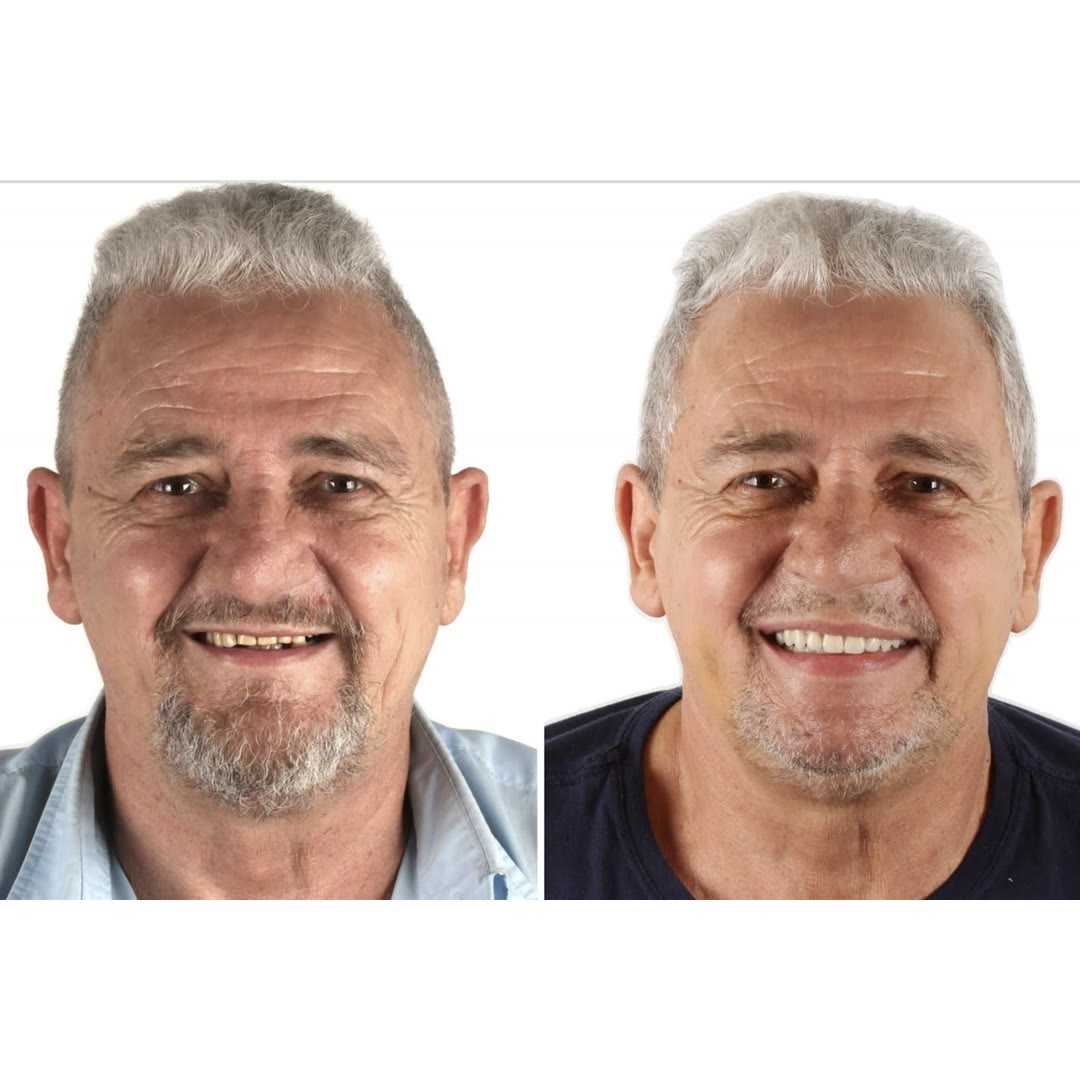
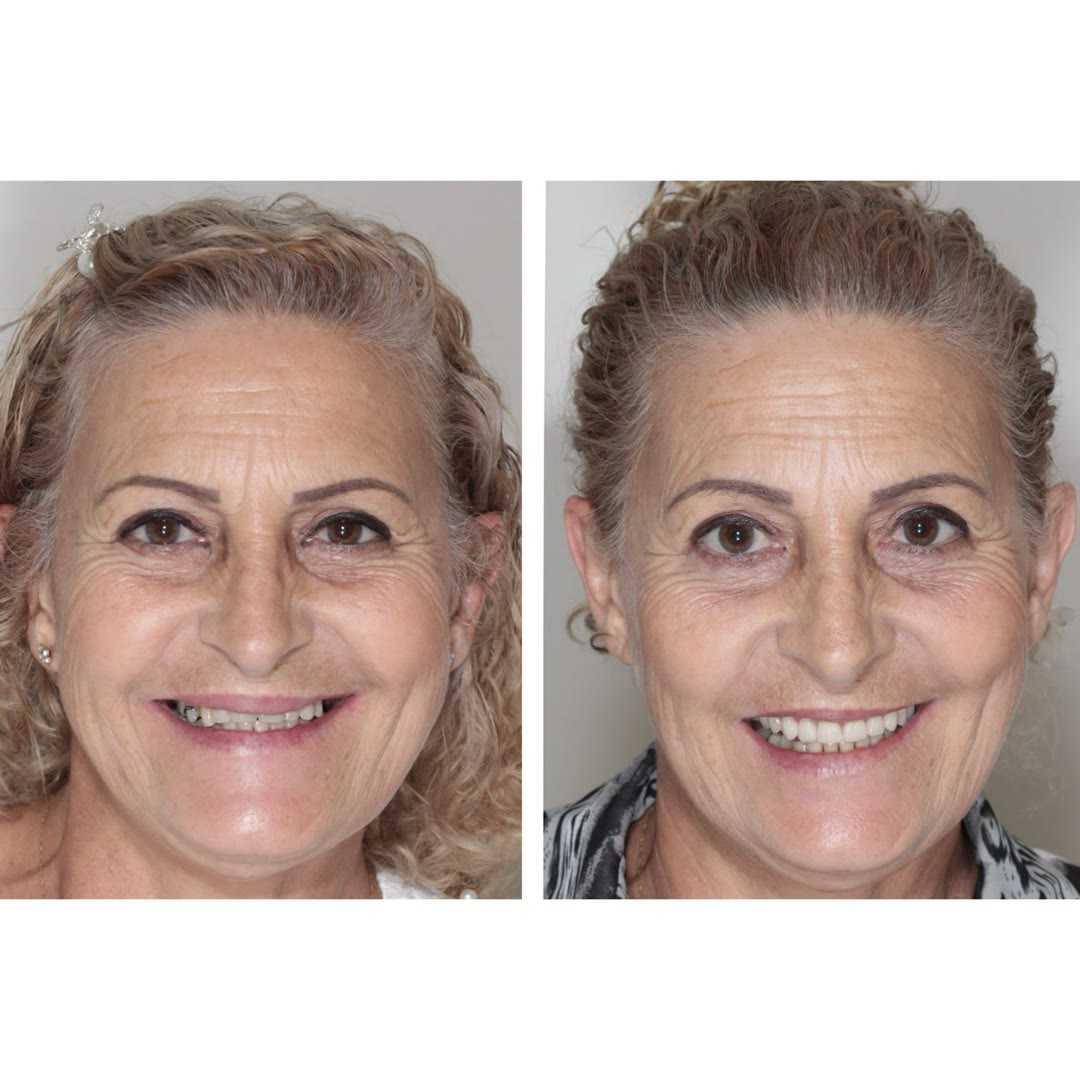
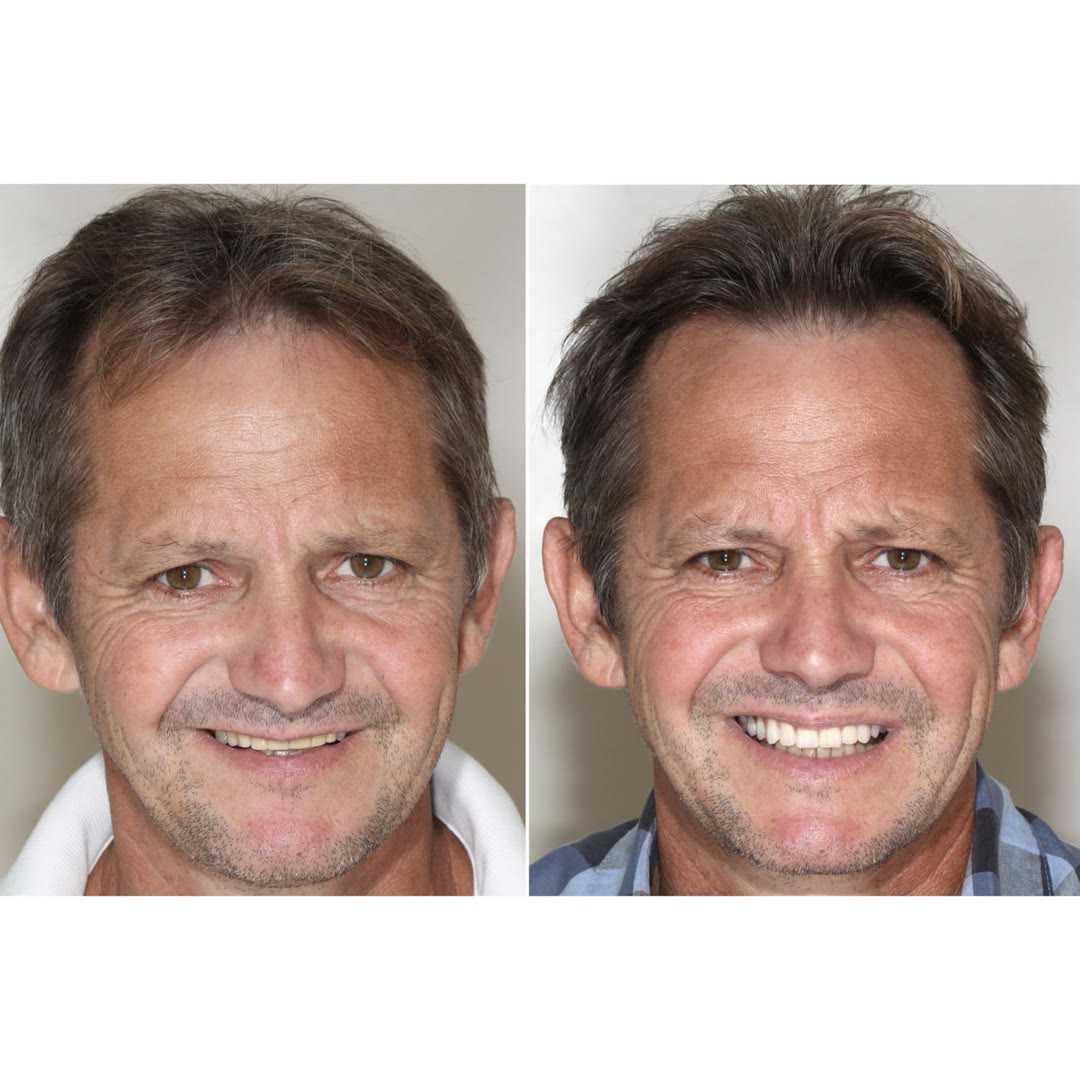
At [00:09:18], clinical comparison photos demonstrate the aesthetic transformation. The patient receives a fixed full-arch prosthesis that provides superior facial fullness without the bulk or speech interference of traditional palatal acrylic setups. The prosthesis features a thin, delicate profile with a completely smooth undersurface that allows for straightforward daily brushing, flossing, and long-term peri-implant health maintenance.
World-Class Dental Care at Dental Clinic in Blumenau Brazil
Located in the state of Santa Catarina, Blumenau is recognized internationally for its high quality of life, modern infrastructure, and advanced medical and dental technology centers. Dental Clinic in Blumenau Brazil stands at the forefront of advanced implantology, serving local patients as well as international visitors seeking premium dental implants in Brazil under the expert guidance of Dr. Fernando Giovanella.
By combining academic research, digital 3D workflows, and personalized patient care, the clinic provides comprehensive solutions for complex full-arch atrophy, failing teeth, and full-mouth rehabilitation. Whether you require initial diagnostic evaluations, specialized oral surgery in Brazil, or advanced prosthodontic reconstructions, the team is dedicated to restoring both function and natural facial aesthetics through evidence-based dentistry.
Ready to Restore Your Smile and Facial Harmony?
PlacidWay Medical Tourism connects you with top-rated specialists for Dental Implants in Brazil. Experience peer-reviewed, state-of-the-art dental treatment in Blumenau Brazil tailored to your exact aesthetic and functional needs.
GET A FREE QUOTEView Full Video Transcript
[00:00:00] Look at this interesting clinical experiment that I conducted here at the clinic. I scanned a complete denture to transfer its three-dimensional geometry to the computer.
[00:00:07] Then, I digitally removed half of the flange, printed this modified version using biocompatible 3D resin, and placed it in the patient's mouth.
[00:00:18] The result was impressive. The side of the face where the flange had been removed showed a visible hollowing, making that area look much older.
[00:00:29] Notice in this close-up how the absence of the flange significantly affected the support of the paranasal region.
[00:00:35] This experiment shows that, in some patients, placing a fixed prosthesis without a flange compromises lip support and leads to an aesthetic failure.
[00:00:48] Just imagine the situation. You invest in dental implants to get rid of your dentures, dreaming of a beautiful smile and a younger appearance, only to discover that, in the end, your face looks older and more sunken.
[00:01:01] It feels like a nightmare, but it happens more often than you might imagine, and the culprit has a name: a small, hidden secret that only dentures have.
[00:01:10] You know that little border on your denture that many people consider unattractive? It has a name. It's called a flange, and it's your face's best friend.
[00:01:18] While everyone focuses on the teeth, the flange works quietly in the background. It acts like a facial foundation, supporting the lips.
[00:01:28] Not just the lips, but especially the entire base of the nose. It fills the area between the nose and the mouth and helps maintain the youthful contours of the face.
[00:01:37] Without a flange, the face loses support and can literally appear sunken.
[00:01:44] Now, here's the problem. When you replace your dentures with implants and an implant-supported prosthesis, the flange disappears.
[00:01:50] And do you know what happens in some patients? Their faces literally deflate. Wrinkles become more noticeable, the lips sink inward, and you suddenly look several years older.
[00:02:01] The flange is essential for maintaining facial harmony and preventing premature aging around the mouth in certain patients.
[00:02:13] You might be wondering, why not simply add this flange to the implant-supported prosthesis, right? To the fixed full-arch prosthesis?
[00:02:20] That's an excellent question, and the answer is simple and crucial: hygiene.
[00:02:27] You remove a denture from your mouth to clean it. An implant-supported prosthesis, however, is screwed into place and remains fixed. You clean it while it is in your mouth.
[00:02:37] A fixed, screw-retained implant prosthesis with a flange would become a nightmare to clean because it would overlap the gums, almost like a saddle wrapping around them.
[00:02:47] Imagine trying to brush an area that is impossible to reach every day. This can cause unpleasant breath, recurring gum inflammation, and, in the worst cases, even lead to implant loss.
[00:03:01] A well-designed fixed full-arch prosthesis has a smooth, convex base. However, in some patients, this design reduces lip support.
[00:03:11] So, you might be thinking, "Doctor, how do we solve this problem?" Many people try to address it with facial fillers based on hyaluronic acid or similar substances.
[00:03:20] These are gels injected beneath the skin. They can work in some situations, yes, but not in every case.
[00:03:27] They add volume, but they don't provide structural support. They last only a few months, require touch-ups, and become a recurring expense for the rest of the patient's life.
[00:03:37] If the problem is a lack of support for the lips and the base of the nose, adding filler only masks the underlying cause. The right approach is to restore deep structural support, not simply add volume.
[00:03:48] So, doctor, what is the solution? That's the key question. The good news is that there is a solution, and you're about to understand what it is. I'll explain how it works.
[00:03:58] But first, I want to discuss another problem, which may be even worse and more common.
[00:04:03] This other critical, rarely discussed problem is the position of the implants relative to where the teeth of the implant-supported prosthesis need to be.
[00:04:13] Look, when you lose your teeth, the bone gradually disappears. It shrinks year after year. When it's time to place implants, the dentist needs to find where the remaining bone is.
[00:04:25] Sometimes so much bone has been lost that even a bone graft may not be sufficient. That's why we avoid bone grafting in full-arch cases. But that's a topic for another video.
[00:04:34] For many patients, the remaining bone is located quite far back, away from where the teeth naturally used to be.
[00:04:41] To compensate for this distance, in some cases, the prosthesis needs to be large and bulky, especially behind the front teeth.
[00:04:48] This can make the area near the roof of the mouth, known as the palatal region, very thick. This doesn't happen in every patient.
[00:05:02] In others, however, it can lead to extreme results like this. This makes cleaning more difficult and, guess what, it can also interfere with speech.
[00:05:12] These problems can occur with implant-supported prostheses in general. But in a particularly challenging case like this, adapting to the prosthesis can be even harder.
[00:05:18] Many professionals, including those trained as recently as last year, have been taught to focus on the bone and the implants, but they sometimes forget the most important thing: the final result for the patient.
[00:05:31] I made this mistake many times in the past, too. It literally kept me awake at night. That's when I completely changed my approach.
[00:05:39] Instead of asking where I could place an implant in the bone, I started asking where the prosthesis needed to be for the result to be ideal. We dentists call this reverse planning.
[00:05:49] This approach has been widely studied and implemented for single-tooth implants and even full-mouth rehabilitation cases with good bone availability.
[00:05:57] But when there is severe bone loss in the jaw, this was literally a blind spot.
[00:06:03] The focus was on trying to achieve immediate loading by identifying where the bone was densest, while the final prosthetic result was left for later, with the attitude of "we'll make it work somehow." This is what we know as anchorage techniques.
[00:06:17] Using the tools of digital dentistry, I began running countless simulations for my cases. I believe that everything can be improved.
[00:06:24] I started consistently prioritizing the best implant positioning, with an almost obsessive focus on the aesthetic and functional results of the prosthesis.
[00:06:34] I questioned everything that had been considered standard in the field, including established techniques. One of the main ones was palatal implant placement, a concept that I myself had advocated for more than 15 years.
[00:06:47] With this technique, we place implants farther back, where the remaining bone is still intact. The difference between the implant position and the position where the teeth should be was always compensated for with a prosthesis that was often thick and bulky.
[00:07:04] With the same rigor that I had always applied to securing these implants and finding the best bone site to enable immediate loading and benefit the patient, I also began pursuing superior prosthetic outcomes.
[00:07:19] In some cases, the answer was right there. In others, finding a solution required time and persistence.
[00:07:26] Even in complex cases, I explored different possibilities through simulations in a digital environment. And during one of these experiments, an unexpected possibility emerged.
[00:07:34] If we always follow the same map, we will only discover what has already been discovered. It was a new and unprecedented approach, but one that could be supported by related scientific studies.
[00:07:44] Before applying it clinically, I sought scientific evidence and implemented the concept gradually. It began to show promising results.
[00:07:57] To obtain a more impartial assessment, I shared the idea with fellow dentists who also work with full-arch rehabilitation.
[00:08:05] The consensus was that the surgical modification was consistent with the biological and biomechanical principles described in the scientific literature.
[00:08:12] Even so, I wasn't satisfied. I sought a more rigorous evaluation.
[00:08:17] I submitted the work to the Journal of Prosthetic Dentistry (JPD), one of the most prestigious journals in prosthodontics and full-mouth rehabilitation.
[00:08:25] It is indexed and has a relatively high impact factor. It is also an official publication of several international societies, providing an editorial platform traditionally reserved for innovative contributions with particular clinical relevance.
[00:08:40] After the article underwent a blinded peer-review process, conducted by three international specialists, the manuscript was accepted and published.
[00:08:48] I want to emphasize that this is not the finish line, but the starting point. When a mind opens up to a new possibility, it rarely returns to its original size.
[00:09:02] Today, digital dentistry allows us to plan from the outside of the face inward, from the face to the prosthesis, and from the prosthesis to the implants, bringing together genuine lip support, natural contours, and a thin, easy-to-clean prosthesis.
[00:09:16] Remember the case at the beginning of the video, where I demonstrated the loss of lip support with a prosthesis without a flange?
[00:09:23] Well, here is the result. Here is the before photo alongside the final result using our new approach.
[00:09:30] This patient has a fixed full-arch prosthesis, an implant-supported prosthesis without a flange. The facial support is excellent, with facial fullness even better than what the denture provided.
[00:09:42] This represents a major paradigm shift. Best of all, the prosthesis is thin, delicate, and comfortable.
[00:09:48] With a publication in the Journal of Prosthetic Dentistry, we open the door to rethinking how we can improve our own clinical practice, not only in terms of occlusion, but especially in restoring facial fullness.
[00:10:01] The result is excellent facial support, comparable to what a flange provides, without the bulk that compromises hygiene.
[00:10:08] I emphasize that this approach is still evolving. It represents a paradigm shift that places aesthetic and functional outcomes first.
[00:10:14] We can combine the facial support provided by a flange, which helps prevent premature aging and facial hollowing, with the convenience of a thin, fixed implant-supported prosthesis that is easy to clean.
[00:10:28] This is achieved through a type of internal plane, involving a modification in implant placement. The technical details are beyond the scope of this video.
[00:10:35] If you are a patient and would like to benefit from this approach, contact us to arrange an in-person assessment.
[00:10:41] If you are a dentist and want to implement these advances, stay tuned. We will soon open a specialized training course on digital workflows for severely atrophic jaws.
[00:10:51] Finally, our commitment is to continuous improvement, grounding our practice in distinctive techniques and scientific innovation, whether through treating private patients or providing educational activities.
[00:11:02] A big hug, everyone. See you in the next video.





















Share this listing