
If you are considering prostate cancer treatment in Tijuana because you want to avoid major surgery or conventional radiation, it is important to separate promising research from treatments supported by established clinical evidence. Radiofrequency ablation, or RFA, can destroy selected prostate tissue using thermal energy, but major international guidelines still consider prostate RFA an investigational focal-treatment approach rather than routine standard care.
The phrase “killer cell antibodies” also needs clarification. It is not a standard guideline-defined prostate cancer treatment. Research is exploring ways to use antibodies, natural killer cells and immune-cell engagers against prostate cancer targets such as PSMA, but much of this work remains preclinical or early-stage. Before traveling to Tijuana, confirm exactly what treatment is being proposed, its regulatory status and the evidence supporting it for your stage of cancer.
Quick Summary of Prostate Cancer Therapy in Tijuana
- RFA status: Radiofrequency ablation is being studied as a focal treatment for selected localized prostate cancers, but evidence remains limited compared with surgery and radiotherapy.
- Guideline position: The European Association of Urology describes prostate RFA as being in an early phase of evaluation and recommends other less-established ablative modalities only within well-designed prospective trials.
- “Killer cell antibodies”: This is not a standard medical treatment category. Relevant research includes NK-cell-directed antibodies, bispecific killer-cell engagers and antibody-assisted NK-cell therapy.
- 2025 research: Anti-PSMA antibodies combined with natural killer cells showed activity in laboratory, organoid and mouse models of castration-resistant prostate cancer, but that does not establish clinical effectiveness in patients.
- Who may be considered for focal therapy: Carefully selected men with localized, MRI-visible disease may be evaluated, but candidacy requires biopsy-confirmed risk assessment and specialist review.
- Mexico verification: Check the facility's applicable COFEPRIS authorization, the doctor's professional license and specialty certification, and the regulatory status of any device, biologic or experimental intervention.
- Cost: No authoritative standardized price for combined RFA and NK-cell/antibody prostate therapy in Tijuana is available. Request an itemized patient-specific quotation rather than relying on a package headline.
What Does Prostate Cancer Treatment in Tijuana Need to Address First?
Your treatment should be based on the biology and extent of the prostate cancer, not simply on which technology is available. Important factors include PSA level, biopsy findings, International Society of Urological Pathology Grade Group, MRI results, clinical stage, life expectancy and whether cancer has spread beyond the prostate.
Some prostate cancers grow slowly enough for active surveillance, while others require definitive local or systemic treatment. A treatment described as minimally invasive is not automatically safer or more appropriate for your cancer.
| Clinical Factor | What Doctors Evaluate | Why It Matters |
|---|---|---|
| PSA | Current level and change over time | Contributes to risk assessment but cannot determine treatment alone. |
| Biopsy | Grade Group, number and location of positive cores | Confirms cancer aggressiveness and distribution. |
| Multiparametric MRI | Location and extent of suspicious lesions | Especially important when focal treatment is being considered. |
| Staging | Disease inside or outside the prostate | A local ablation cannot adequately address widespread metastatic disease. |
| General health | Age, urinary function, cardiovascular health and other conditions | Affects treatment risks and potential benefits. |
How Does Radiofrequency Ablation Work for Prostate Cancer?
Radiofrequency ablation uses electrical energy delivered through a probe to generate heat within targeted tissue. The resulting temperature increase damages cells within the planned treatment area.
In focal prostate therapy, the intention is to destroy the clinically significant tumor and a surrounding treatment margin while leaving more uninvolved prostate tissue intact. This differs from radical prostatectomy, which removes the prostate, and whole-gland radiotherapy, which treats the entire gland.
MRI and biopsy information are used to determine whether there is a suitable focal target.
An ablation probe is positioned to deliver energy into the planned treatment region.
Radiofrequency energy produces heat intended to cause controlled tissue destruction.
PSA, MRI and repeat biopsy may be required because untreated prostate tissue remains.
What Does Current Evidence Say About Prostate RFA?
Research shows that prostate RFA is technically possible, but available studies are much smaller and shorter than those supporting established prostate cancer treatments. A prospective development study of bipolar focal RFA enrolled only 21 men, with 20 ultimately receiving treatment.
That early study reported encouraging short-term ablation findings, but its small size and limited follow-up prevent it from proving long-term cancer control. This distinction matters when patients are comparing focal RFA with treatments supported by decades of outcome data.
| Treatment Approach | Evidence Position | Patient Consideration |
|---|---|---|
| Active surveillance | Established strategy for appropriately selected lower-risk disease | Avoids immediate treatment while monitoring for clinically meaningful progression. |
| Radical prostatectomy | Established definitive local therapy | Provides whole-gland removal but carries urinary and sexual-function risks. |
| Radiation therapy | Established definitive therapy in appropriate risk groups | Multiple radiation strategies exist and may be combined with hormonal therapy. |
| HIFU or cryotherapy focal treatment | More extensively studied focal approaches, but guideline restrictions remain | Long-term comparative oncological evidence remains less mature than standard treatment. |
| Radiofrequency ablation | Early evaluation | Should not be assumed equivalent to better-established therapies. |
What Are “Killer Cell Antibodies” in Prostate Cancer Therapy?
“Killer cell antibodies” is not a standard guideline term for one recognized prostate cancer treatment. The phrase may be used informally to describe several different experimental immunotherapy concepts involving natural killer cells, antibodies or molecules designed to connect immune cells to cancer cells.
Natural killer cells, usually shortened to NK cells, are immune cells capable of destroying abnormal cells. Antibodies may potentially help NK cells recognize a tumor through a process called antibody-dependent cellular cytotoxicity.
| Research Concept | How It Works | Current Prostate Cancer Status |
|---|---|---|
| NK-cell therapy | Uses natural killer cells to attack malignant cells. | Investigational for prostate cancer. |
| Anti-PSMA antibody + NK cells | Antibody binds PSMA while NK cells contribute immune-mediated killing. | 2025 evidence includes preclinical laboratory, organoid and mouse studies. |
| Bispecific killer-cell engagers | Designed to connect an NK-cell receptor with a tumor-associated target. | Developmental research; not established standard prostate cancer treatment. |
| CAR-NK cells | Genetically engineered NK cells are designed to recognize a tumor target. | Early clinical research is underway internationally. |
Can NK-Cell Antibody Therapy Be Combined With RFA for Prostate Cancer?
There is currently insufficient high-quality evidence to establish combined prostate RFA plus so-called killer-cell antibody therapy as a standard treatment protocol. Each component must therefore be evaluated separately rather than assuming that combining them improves cancer control.
Researchers studying other cancers have investigated whether local tumor destruction can interact with immune responses, but a biological rationale is not the same as evidence of clinical benefit. Patients should ask for prostate-cancer-specific human data supporting the exact combination being offered.
Questions to Ask About Combined RFA and Immune Therapy in Tijuana
- What is the exact name of the immune treatment?
- Is it an antibody, NK-cell infusion, cell engager or another biologic?
- Which prostate cancer target does it recognize?
- Has the exact treatment been studied in human prostate cancer?
- Has the exact combination with RFA been studied prospectively?
- Is the treatment standard care or investigational?
- What COFEPRIS authorization applies?
- Is there a registered clinical-trial protocol?
- What conventional treatment alternatives have been discussed?
Who Might Be Considered for Focal Prostate Therapy in Tijuana?
Focal treatment generally requires a clearly characterized localized cancer that can be mapped within the prostate. It is not simply selected because a patient wishes to avoid surgery.
Modern evaluation commonly requires multiparametric MRI together with targeted and systematic biopsy information. Specialists also consider PSA, Grade Group, prostate size, tumor volume, location and whether disease appears elsewhere in the gland.
Factors That May Support Evaluation
- Biopsy-confirmed localized prostate cancer
- Clearly mapped clinically significant lesion
- MRI and biopsy findings that correspond
- No evidence of metastatic disease
- Acceptable urinary and general health status
- Understanding that repeat biopsy or treatment may be needed
Reasons RFA May Be Inappropriate
- Metastatic prostate cancer requiring systemic management
- High-risk disease unsuitable for experimental local ablation
- Poorly mapped or widespread multifocal disease
- Insufficient diagnostic testing
- Inability to complete structured surveillance
- Expectation that focal treatment eliminates future monitoring
What Are the Risks of Prostate Radiofrequency Ablation?
Focal therapy aims to reduce treatment of healthy prostate tissue, but this does not make RFA risk-free. Thermal treatment occurs near the urethra, bladder, rectum, neurovascular structures and urinary sphincter, so accurate targeting and monitoring are important.
| Potential Issue | Why It Matters | Follow-Up Consideration |
|---|---|---|
| Urinary symptoms | Swelling or tissue injury may temporarily affect urination. | Report difficulty urinating or worsening symptoms. |
| Urinary infection | Instrumentation can introduce infection risk. | Fever or systemic symptoms require assessment. |
| Sexual-function changes | Nearby neurovascular tissue may be affected depending on treatment location. | Discuss baseline function and expected risks beforehand. |
| Residual cancer | Cancer may remain inside or outside the treated zone. | Post-treatment MRI and biopsy may be required. |
| Retreatment | Focal therapy does not guarantee that no further treatment will be needed. | Future focal or radical treatment may become necessary. |
How Does Focal Therapy Compare With Standard Prostate Cancer Treatment?
The best comparison depends on cancer risk rather than invasiveness alone. For some lower-risk cancers, active surveillance may avoid treatment entirely. For higher-risk localized disease, surgery or radiation can provide established definitive treatment pathways.
| Option | Typical Role | Evidence Maturity | Major Consideration |
|---|---|---|---|
| Active surveillance | Selected low-risk and some favorable intermediate-risk patients | Established | Requires structured PSA, imaging and biopsy monitoring. |
| Radical prostatectomy | Definitive localized treatment | Long-term evidence | Urinary and sexual-function risks must be considered. |
| External-beam radiotherapy | Definitive localized or locally advanced treatment | Long-term evidence | May be combined with androgen deprivation depending on risk. |
| Brachytherapy | Selected localized cancers | Established in appropriate patients | Suitability depends on cancer risk and urinary characteristics. |
| Focal RFA | Selected localized tumor under investigation | Limited | Long-term comparative cancer-control evidence remains insufficient. |
| NK-cell/antibody strategies | Advanced immunotherapy research | Investigational | Exact intervention and clinical evidence must be verified. |
What Do Recent Prostate Cancer Statistics in Mexico Show?
Prostate cancer remains a major cancer concern among older men in Mexico. INEGI's cancer statistics published in January 2025 reported that prostate cancer was the leading cause of cancer mortality among Mexican men aged 60 years and older in the underlying 2023 mortality data.
A separate 2025 peer-reviewed analysis predicted approximately 8,100 prostate cancer deaths in Mexico during 2025 and an age-standardized mortality rate of 9.72 per 100,000, compared with 10.60 per 100,000 in 2020. These are population-level estimates and cannot predict the outcome of an individual patient.
Prostate Cancer Mortality Rate in Mexico: 2020 vs. 2025 Prediction
*2025 value is a statistical prediction, not an observed final national count. Source: Cancer mortality predictions for 2025 in Latin America with focus on prostate cancer.
Predicted 2025 Prostate Cancer Mortality by Age in Mexico
50–59
60–69
70–79
80+
Rates are predicted deaths per 100,000 within each age group. They demonstrate the strong association between prostate cancer mortality and older age but do not measure treatment eligibility.
Who Travels to Baja California for Medical Treatment?
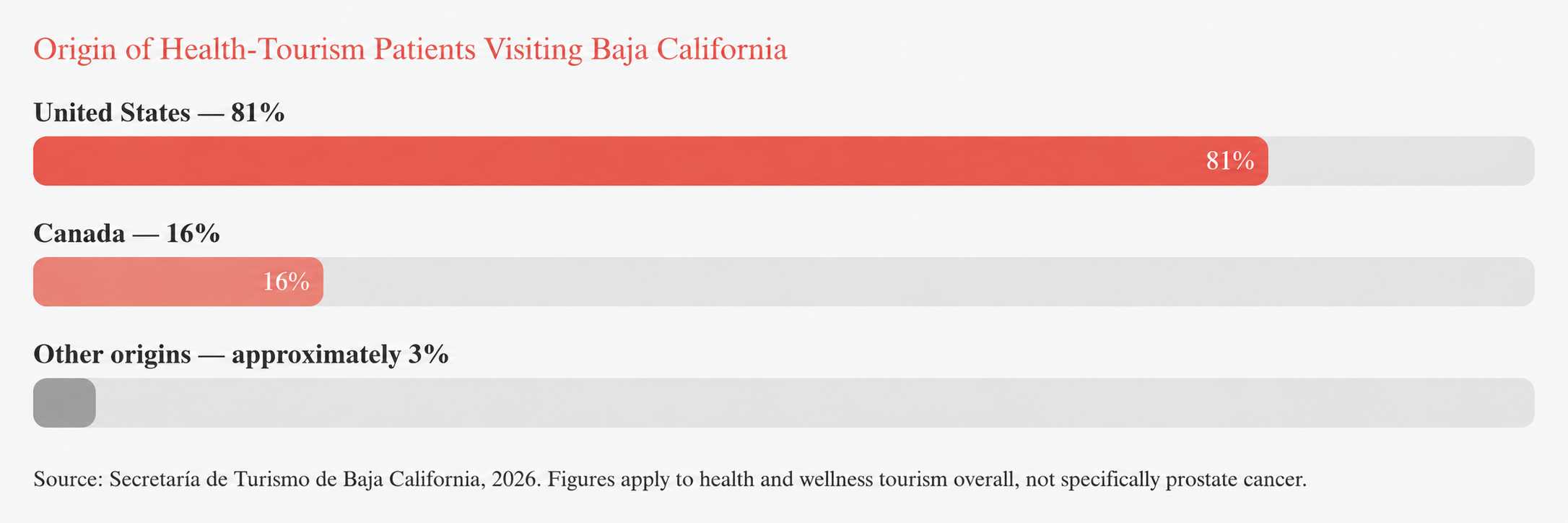
Tijuana's proximity to the United States makes it accessible to North American patients seeking private medical care. Baja California's Secretaría de Turismo reported in 2026 that the state receives approximately 2.8 million health and wellness visitors annually across multiple specialties, including oncology.
The same state tourism source reported that 81% of health-tourism patients come from the United States, particularly California, Arizona and Nevada, while 16% come from Canada. These figures describe health tourism overall and should not be interpreted as prostate cancer or RFA patient statistics.
How Is Prostate Cancer Care Regulated in Tijuana, Mexico?
Mexican healthcare establishments performing surgical procedures are subject to federal health regulation. COFEPRIS publishes requirements for sanitary licensing of healthcare establishments and maintains information on registered medical devices.
In August 2026, COFEPRIS also introduced a public viewer intended to make current medical-device registrations easier to verify. Patients considering RFA should ask for the exact manufacturer and model of the ablation equipment and verify its regulatory status where applicable.
| What to Verify in Tijuana | Documentation or Authority |
|---|---|
| Healthcare facility | Applicable COFEPRIS sanitary license or operating authorization |
| Treating physician | Professional and specialty credentials through Mexico's Dirección General de Profesiones |
| Specialist certification | Relevant CONACEM-recognized specialty certification where applicable |
| RFA equipment | Applicable COFEPRIS medical-device registration |
| Experimental immune therapy | Exact biologic status and clinical-research authorization when applicable |
| Health-tourism provider registration | Baja California health and wellness tourism registration when applicable |
Baja California's health-tourism registration system also requires medical specialists applying for the program to provide professional and specialty credentials, including specialty certification documentation recognized through CONACEM.
How Should You Choose a Prostate Cancer Doctor in Tijuana?
Choose the medical team based on prostate oncology expertise and transparent evidence rather than the novelty of the technology. A doctor proposing focal ablation should be able to explain why focal therapy is preferable to surveillance, surgery, radiotherapy or other established options in your specific case.
Tijuana Prostate Cancer Doctor Verification Checklist
- Verify the physician's professional license.
- Verify specialist training in urology or urologic oncology.
- Confirm relevant specialty-board certification.
- Ask how many focal prostate procedures the physician performs.
- Ask specifically how many prostate RFA procedures have been performed.
- Request the physician's patient-selection criteria.
- Ask how MRI and biopsy findings are mapped before treatment.
- Ask how treatment margins are determined.
- Request the surveillance protocol after RFA.
- Ask who manages urinary, infectious or other complications.
- Confirm access to hospital-level emergency care.
- Obtain a written alternative-treatment discussion.
How Much Does Prostate Cancer RFA Cost in Tijuana?
A reliable standardized current price for prostate RFA combined with NK-cell or antibody treatment in Tijuana is not available from authoritative government or guideline sources. Providing a single price without identifying the exact procedure and biologic intervention would therefore be misleading.
Costs may change depending on diagnostic testing, anesthesia, equipment, hospital use, pathology, immune treatment, laboratory preparation, accommodation and postoperative surveillance.
| Potential Cost Component | Why It May Be Needed | Current Pricing |
|---|---|---|
| Urology consultation | Cancer and candidacy review | Provider-specific |
| Pathology review | Confirmation of Grade Group and diagnosis | Provider-specific |
| Multiparametric MRI | Tumor mapping | Varies |
| Repeat biopsy | May be necessary before focal treatment | Varies |
| RFA procedure | Local tumor ablation | Patient-specific quotation required |
| NK-cell or antibody intervention | Only if medically and regulatorily appropriate | No standardized authoritative price available |
| Post-treatment surveillance | PSA, MRI, biopsy and specialist follow-up | Varies over time |
What Should International Patients Plan Before Treatment in Tijuana?
Cancer treatment abroad requires a continuity plan before you cross the border. Your physician at home should receive enough information to understand what was performed and how follow-up will be managed.
Before Traveling to Tijuana
- Obtain the full biopsy pathology report.
- Bring MRI images, not only the written report.
- Document PSA history.
- Confirm clinical stage and Grade Group.
- Request a second opinion when treatment is experimental.
- Verify the facility and physician.
- Request written regulatory information.
- Obtain a complete cost estimate.
Before Returning Home
- Obtain the operative or procedure report.
- Record the exact RFA equipment used.
- Obtain details of any biologic treatment.
- Request complication and emergency instructions.
- Confirm the next PSA date.
- Confirm when repeat MRI is expected.
- Clarify whether repeat biopsy is planned.
- Send records to your home urologist.
Frequently Asked Questions About Prostate Cancer Treatment in Tijuana
Is radiofrequency ablation a standard treatment for prostate cancer?
No. RFA has been investigated as a focal treatment for selected localized prostate cancers, but major international guidance considers it an early-evaluation modality. Patients should understand the limitations of long-term evidence before comparing it with established surgery or radiation.
What are killer cell antibodies for prostate cancer?
“Killer cell antibodies” is not one recognized guideline-defined prostate cancer treatment. The phrase may refer to experimental strategies involving antibodies, natural killer cells or immune-cell engagers. Ask the provider for the exact scientific name and evidence.
Are anti-PSMA antibodies combined with NK cells proven for prostate cancer?
Not as routine clinical treatment. A 2025 study reported promising results using an anti-PSMA antibody with natural killer cells in laboratory, organoid and mouse models of castration-resistant prostate cancer. Preclinical activity does not establish effectiveness in patients.
Can RFA cure localized prostate cancer?
RFA should not be described as a guaranteed cure. Early studies show that focal radiofrequency treatment can ablate selected lesions, but residual or recurrent cancer can occur inside or outside the treated area and long-term comparative evidence remains limited.
Who may qualify for focal prostate RFA?
Potential candidates require specialist assessment of localized disease, MRI findings, biopsy Grade Group, lesion distribution, PSA and general health. Patients with metastatic or unsuitable high-risk disease generally require other treatment strategies rather than focal ablation alone.
Will I still need biopsies after prostate RFA?
Possibly. Focal therapy leaves untreated prostate tissue behind, so PSA alone may not establish whether clinically significant cancer remains. Follow-up strategies can include PSA testing, multiparametric MRI and protocol-driven repeat biopsy depending on the treatment program.
Is focal therapy better than prostate surgery?
There is not enough evidence to say focal RFA is generally better than radical prostatectomy. The treatments have different goals, risks and evidence bases. Your cancer risk, life expectancy, urinary function and priorities should guide the comparison.
How much does prostate RFA cost in Tijuana?
No authoritative standardized Tijuana price is available for prostate RFA, particularly when combined with experimental immune treatments. Ask for an itemized written quotation covering diagnostics, procedure fees, anesthesia, hospitalization, medications, follow-up and potential additional treatment.
How can I verify a prostate cancer clinic in Tijuana?
Confirm the facility's applicable sanitary authorization, verify the doctor's Mexican professional and specialty credentials, check relevant medical-device registration and request regulatory documentation for any experimental biologic or cellular intervention being proposed.
Is an experimental prostate cancer treatment automatically unsafe?
No, but experimental means that important questions about effectiveness or risks remain unanswered. Proper investigational treatment should have clear scientific rationale, informed consent, regulatory oversight, transparent eligibility criteria, adverse-event management and an appropriate clinical-research framework.
Should I get a second opinion before traveling to Tijuana?
A second opinion is particularly valuable when you are considering a nonstandard or investigational cancer treatment. Ask an independent urologic oncologist to review your pathology, MRI, stage, treatment alternatives and the evidence supporting the proposed intervention.
What records should I bring for prostate cancer treatment in Mexico?
Bring your pathology report, biopsy details, MRI images, PSA history, staging tests, medication list and previous treatment records. If available, include molecular or genetic testing and written opinions from your home urologist or oncologist.
Compare Prostate Cancer Treatment Options in Tijuana With PlacidWay
If you are researching prostate cancer treatment in Tijuana, PlacidWay can help you request information from healthcare providers, compare proposed treatment approaches, understand estimated costs and organize questions about physician credentials, RFA technology and the regulatory status of any immune-based therapy.
Because focal RFA and NK-cell or antibody approaches do not carry the same evidence status as established prostate cancer treatments, discuss any proposed plan with a qualified urologic oncologist before making a treatment decision.
Medical Disclaimer for Prostate Cancer Treatment
Disclaimer: This information is for educational purposes only and does not replace professional medical advice. Always consult a qualified healthcare provider before making medical decisions.
References for Prostate Cancer Therapy and RFA
- Prostate Cancer Treatment Guidelines – European Association of Urology
- Prostate Cancer Treatment (PDQ) – National Cancer Institute
- Focal Radio-Frequency Ablation in Localized Prostate Cancer – National Cancer Institute
- Outcomes of Focal Therapy for Localized Prostate Cancer: 2025 Systematic Review and Meta-analysis – PubMed
- Anti-PSMA Antibody and Natural Killer Cells for Castration-Resistant Prostate Cancer – PubMed, 2025
- Healthcare Establishment Regulation – COFEPRIS
- Medical Device Registration Viewer – COFEPRIS, 2026
- Cancer Mortality Statistics in Mexico – INEGI, 2025








.png)
.png)

.png)



.jpg)

.png)









Share this listing