
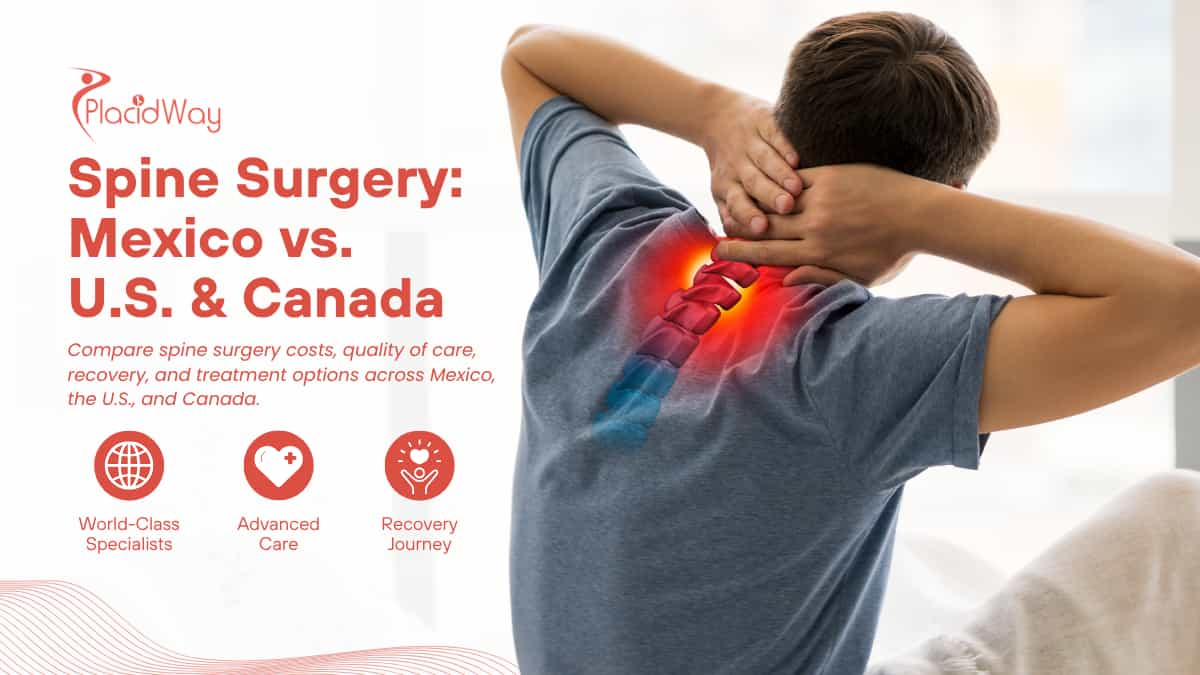
When back or neck pain reaches the point where surgery is being considered, comparing Mexico, the U.S., and Canada involves more than choosing a destination. This guide compares spine surgery access, care standards, recovery support, and follow-up considerations across all three countries.
The safest choice depends on the right procedure, a qualified surgeon, a properly licensed hospital, realistic recovery planning, and a clear plan for complications and follow-up after returning home.
Quick Summary: Mexico vs. the U.S. and Canada for Spine Surgery
- Mexico current spine-care average: about $9,850, with the current verified category ranging from $9,500–$10,200; procedure-specific estimates vary much more widely.
- Mexico procedure examples: microdiscectomy about $5,000–$8,000, laminectomy $6,000–$9,500, artificial disc replacement $12,000–$18,000, and 1–2 level spinal fusion $14,000–$20,000.
- U.S. self-pay examples: current MDsave pricing averages about $15,778 for outpatient laminectomy/laminotomy/discectomy, $33,984 for outpatient cervical fusion, and roughly $42,098–$47,526 for outpatient versus inpatient lumbar fusion.
- Canada: medically necessary hospital and physician services are generally publicly insured for eligible residents, so there is usually no comparable direct surgical package price.
- Canada wait-time example: British Columbia reported a 6.1-week median and 26.1 weeks for 90% of completed adult spinal/back surgeries in March–May 2026. This is provincial, not Canada-wide.
- Mexico hospital verification: confirm the exact operating facility holds the required COFEPRIS-05-034 surgical licence.
- Surgeon verification: in Mexico verify the appropriate orthopedic or neurosurgical specialty board; in the U.S. use ABOS/ABNS; in Canada check provincial licensure and Royal College specialist status where applicable.
- Travel caution: spine surgery plus long-distance travel can increase blood-clot and continuity-of-care risk; hospital discharge is not automatic clearance to fly.
What Patients Are Really Comparing: Mexico vs. the U.S. and Canada
The comparison is not simply cheap versus expensive. Mexico is usually a private self-pay pathway, the U.S. combines insurance and private cash pricing, and Canada generally funds medically necessary hospital and physician care for eligible residents through provincial or territorial plans.
That means the same dollar table can be misleading. A U.S. patient with strong insurance may owe much less than the published cash price. A Canadian patient may owe no direct surgical fee for insured care but may care more about access time and provider choice. A Mexico patient usually pays the private package price directly.
The right comparison is therefore your real out-of-pocket cost, the time until surgery, the surgeon's procedure-specific expertise, hospital capability, implant or hardware quality, rehabilitation access, and what happens if you develop a complication after you return home.
| Decision factor | Mexico | United States | Canada |
|---|---|---|---|
| Typical pathway | Private self-pay medical travel | Insurance, Medicare/Medicaid, employer coverage or self-pay | Provincial/territorial public insurance for eligible medically necessary care |
| Direct surgery price | Usually quoted as package or private estimate | Varies widely by hospital, network and insurance | Usually no direct patient charge for insured medically necessary hospital/physician care |
| Scheduling | Often arranged directly after medical review | Depends on insurer authorization, surgeon and facility | Depends on province, referral pathway and surgical priority |
| Provider choice | Private comparison across cities and hospitals | Broad private choice, constrained by insurance network for many patients | Choice varies by province and referral system |
| Follow-up | Split between Mexico team and home clinicians | Usually domestic | Usually within domestic health system |
| Travel burden | International travel | Usually domestic | Usually domestic unless choosing care abroad |
Spine Surgery Cost Comparison by Procedure
Procedure type is the biggest reason spine-surgery cost vary. A microdiscectomy removes disc material compressing a nerve, a laminectomy decompresses the spinal canal, an artificial disc replaces a diseased disc, and fusion joins vertebrae using bone graft and often screws, rods, cages, or other hardware.
Mexico's current 2026 pricing shows the expected step-up in cost as implants and complexity increase. In the U.S., current self-pay marketplaces show a similar pattern, but with substantially higher averages for many fusion procedures.
Canada should not be represented as a private sticker price for most eligible residents. When the operation is medically necessary and insured by the provincial plan, the patient generally does not receive a direct hospital or physician bill for the core surgery.
| Procedure | Mexico 2026 planning estimate | U.S. current self-pay example | Canada cost context |
|---|---|---|---|
| Microdiscectomy / discectomy | $5,000–$8,000 | Outpatient laminectomy/laminotomy/discectomy average about $15,778; range $9,020–$46,006 | Usually publicly insured when medically necessary for eligible residents |
| Laminectomy / decompression | $6,000–$9,500 | Included in current back-surgery self-pay category averaging about $15,778 outpatient | Usually publicly insured when medically necessary |
| Artificial disc replacement | $12,000–$18,000 | Cash pricing varies substantially by hospital and device | Coverage depends on provincial clinical criteria and medical necessity |
| Spinal fusion, 1–2 levels | $14,000–$20,000 | Outpatient lumbar fusion average about $42,098; inpatient average about $47,526 | Usually publicly insured when medically necessary |
| Scoliosis / complex reconstruction | $20,000–$35,000 | Often materially higher because of long surgery and extensive hardware | Publicly funded when eligible and medically necessary; access depends on specialized programs |
Current Spine Surgery Price Comparison
Selected 2026 Mexico midpoints compared with current U.S. self-pay averages for broadly comparable procedures.
The U.S. discectomy/laminectomy category uses the same MDsave back-surgery average; fusion uses the current outpatient lumbar-fusion average. These are planning comparisons, not identical contracts.
Histogram of Current U.S. Self-Pay Spine Averages
Four current MDsave national averages grouped into $10,000 price bands.
Values: $15,778 outpatient back surgery, $33,984 outpatient cervical fusion, $42,098 outpatient lumbar fusion, and $47,526 inpatient lumbar fusion.
Spine Surgery Cost in Mexico: What the Quote Should Include
Mexico's current verified spine-care category averages about $9,850, but procedure-specific surgery can cost much more than that headline average. Current estimates range from about $5,000–$8,000 for microdiscectomy to $14,000–$20,000 for 1–2 level fusion and $20,000–$35,000 for scoliosis surgery.
The hardware line can be one of the largest variables. Current Mexico cost breakdowns estimate roughly $2,000–$8,000 for spinal implants and hardware, depending on the operation. A quote for fusion should identify the number of levels, screws, rods, cages, graft material, or artificial disc expected.
Ask whether surgeon, assistant, anesthesia, hospital nights, neuromonitoring, imaging, implant, medications, physiotherapy, and transfers are bundled. International flights, extended hotel stay, extensive outpatient rehabilitation, complication insurance, and companion expenses are often separate.
| Mexico cost component | Current planning range | What changes it |
|---|---|---|
| Surgeon fee | $2,500–$6,000 | Procedure, specialty expertise, complexity |
| Hospital / facility | $2,500–$5,500 | Length of stay, ICU, operating room resources |
| Hardware / implants | $2,000–$8,000 | Number of levels, cages, screws, rods, artificial disc |
| Anesthesia | $800–$1,500 | Duration and patient medical risk |
| Pre/post-op tests | $500–$1,200 | MRI, X-rays, labs, additional medical clearance |
U.S. Spine Surgery Costs: Why Cash Prices Vary So Widely
U.S. spine surgery cost vary because hospital setting, insurance contracts, implants, complications, and inpatient status can change the bill dramatically. Current self-pay marketplace data show outpatient laminectomy/laminotomy/discectomy averaging about $15,778, while outpatient lumbar fusion averages about $42,098.
Inpatient lumbar fusion is higher, averaging about $47,526 in the current MDsave dataset and ranging from $36,282 to $141,059. Cervical fusion currently averages about $33,984 outpatient and $32,483 inpatient in the same platform's available pricing.
Patients with insurance should not compare those numbers directly with their own likely out-of-pocket cost. CMS requires hospitals to publish discounted cash prices and other standard charges, and 2026 rules strengthened the standardization of hospital price files. Ask your insurer and hospital for a patient-specific estimate.
Canada Spine Surgery: Public Coverage and Real Wait-Time Context
For eligible Canadian residents, medically necessary hospital and physician services are generally publicly insured and provided without patient charges. The Canada Health Act requires provincial and territorial plans to cover medically necessary hospital and physician services, while each province determines medical necessity and delivers care.
That makes a private cash comparison misleading. A Canadian considering Mexico is usually comparing a self-pay private pathway abroad with publicly funded care at home. The trade-off may involve access time, surgeon choice, travel, and continuity rather than a direct Canadian surgical bill.
Wait times vary by province, hospital, surgeon and urgency. British Columbia's public wait-time system reported 1,483 adults waiting for spinal/back surgery as of May 31, 2026. For cases completed from March through May 2026, the median was 6.1 weeks and 90% were completed within 26.1 weeks. Those figures should not be generalized to all of Canada.
| Canada comparison point | What it means for patients |
|---|---|
| Medically necessary hospital/physician care | Generally insured for eligible residents under provincial or territorial plans |
| Direct surgical bill | Usually no patient charge for insured medically necessary core services |
| Wait time | Varies significantly by province, hospital, surgeon and urgency |
| BC current example | Median 6.1 weeks; 90% within 26.1 weeks for completed adult spinal/back surgery, Mar–May 2026 |
| Private or overseas care | May involve self-pay and different reimbursement rules; verify with your provincial plan before travel |
Quality of Spine Surgery Care in Mexico, the U.S. and Canada
Quality should be checked through the legal and specialty systems of each country rather than through marketing labels. In Mexico, verify the operating hospital's COFEPRIS surgical licence first. Then confirm whether the spine surgeon is an orthopedic spine surgeon or neurosurgeon and verify the corresponding specialty certification.
Mexico's Consejo Mexicano de Ortopedia y Traumatología provides certification for Orthopedics and Traumatology, while the Consejo Mexicano de Cirugía Neurológica provides certification and recertification for neurological surgery. A hospital may also hold current national certification through the Consejo de Salubridad General / SIMOCE.
In the U.S., orthopedic surgeons can be checked through ABOS and neurosurgeons through ABNS. In Canada, verify provincial medical licensure and specialist credentials; the Royal College Directory can help confirm Fellowship and certification information for participating specialists.
| Country | Surgeon verification | Hospital / facility check | Additional quality signal |
|---|---|---|---|
| Mexico | CMOT for orthopedic specialists; CMCN for neurological surgery, as applicable | COFEPRIS-05-034 surgical licence | CSG/SIMOCE certification when current |
| United States | ABOS orthopedic certification or ABNS neurosurgery certification | State licensure, hospital privileges, CMS Care Compare / hospital data | Accreditation and procedure-specific outcomes |
| Canada | Provincial/territorial medical regulator plus specialist credentials | Provincial hospital oversight | Royal College specialist status and local outcome programs |
Who Is a Reasonable Candidate for Spine Surgery?
Spine surgery should follow a clear diagnosis, not an attractive package price. Many patients with back or neck pain do not need surgery. The decision depends on the condition, neurological symptoms, imaging, severity, response to nonsurgical treatment, and whether the expected benefit outweighs the surgical risk.
Surgery may be considered for conditions such as nerve compression from a herniated disc, symptomatic spinal stenosis, instability, deformity, fracture, tumor, infection, or degenerative disease that has not responded adequately to appropriate conservative treatment. The exact indication differs by procedure.
International travel adds additional eligibility questions. You need enough mobility to travel safely, stable medical conditions, a realistic local recovery period, a companion when appropriate, and a home clinician willing to manage rehabilitation and urgent problems after you return.
| Candidate factor | Supports proceeding | Needs more review |
|---|---|---|
| Diagnosis | Symptoms, exam and imaging point to a specific surgically treatable condition | Pain source is unclear |
| Neurological status | Persistent or progressive nerve symptoms may support surgical review | Symptoms do not match imaging |
| Nonsurgical treatment | Appropriate options have failed or are unsuitable | Conservative care has not been adequately discussed |
| Medical fitness | Comorbidities are optimized | Active infection, uncontrolled diabetes, severe anemia or unstable disease |
| Travel readiness | Patient can remain locally and has support | No companion, no accessible lodging or no home follow-up |
| Expectations | Goal is realistic symptom/function improvement | Expectation of guaranteed pain elimination |
Recovery After Spine Surgery: Mexico vs. Home Care
The biological recovery process is similar in all three countries, but the logistics are very different for a medical traveler. After decompression or discectomy, walking often begins early and office work may resume within days to weeks for some patients. Fusion and complex reconstruction generally require a longer recovery.
AAOS guidance for lumbar spinal stenosis notes that some patients may return to office work within days to weeks and broader normal activity around two to three months, depending on the operation and individual recovery. Older or medically complex patients may need additional rehabilitation.
A patient who travels to Mexico must add hotel recovery, airport mobility and a flight or long drive before reaching home. That means discharge from the hospital should not be treated as automatic travel clearance.
| Timeframe | Biological / clinical process | Patient sensation | Activity level | Action required |
|---|---|---|---|---|
| First 1–3 days | Pain control, wound monitoring, neurological checks, early mobility | Pain, fatigue, stiffness | Short assisted walks | Meet discharge goals; monitor leg/arm strength and sensation |
| Days 4–14 | Early wound healing and mobility gains | Soreness, fatigue, muscle spasm | Progressive walking | Remain near surgeon until medically cleared for travel |
| Weeks 2–6 | Soft-tissue healing and conditioning | Pain should gradually improve; nerve symptoms may recover unevenly | Increasing daily activity | Follow restrictions and start/continue rehabilitation when prescribed |
| Weeks 6–12 | Fusion biology or functional recovery continues | Stiffness and fatigue may persist | Gradual return to work/activity | Review persistent or worsening neurological symptoms |
| Months 3–12 | Long-term fusion maturation and conditioning | Function may continue improving | Progressive strengthening | Continue imaging or follow-up when recommended |
Medical Travel Risks After Spine Surgery in Mexico
Medical travel adds risks that do not disappear because the operation went well. CDC's 2026 Yellow Book identifies infection, antimicrobial-resistant organisms, blood clots, and fragmented continuity of care as important medical-tourism concerns.
Travel itself matters. Surgery and long periods of sitting independently increase venous-thromboembolism risk. Spine patients may also have limited mobility, pain, or neurological weakness, which can make airport transfers and long drives harder than expected.
Before leaving Mexico, obtain the operative report, discharge summary, implant or hardware manufacturer and model, lot or serial information, imaging, laboratory results, medication list, wound instructions, rehabilitation plan and direct clinical contact information.
Patient Demographics and Travel Access: U.S. and Canada to Mexico
Reliable 2025–2026 national data identifying spine-surgery medical tourists to Mexico by age, gender and home country are not available. It would be inaccurate to convert general tourism numbers into medical-patient statistics.
The strongest current travel evidence shows why the U.S. and Canada are relevant source markets. Mexico's Tourism Ministry reported 20.603 million foreign tourists arriving by air in 2025, including 13.71 million U.S. residents and 2.8 million Canadian residents.
Those are general tourism figures, not spine patients. They demonstrate strong travel connectivity and familiarity with Mexico, but they do not tell us who undergoes spine surgery, what operations they receive, or their outcomes.
2025 Air Tourism to Mexico From the U.S. and Canada
Source: Secretaría de Turismo, 2025 foreign air-tourism arrivals. Spine-surgery-specific age, gender and nationality distributions: information not available.
How to Decide Between Mexico, the U.S. and Canada for Spine Surgery
The best pathway is the one that combines a correct diagnosis, an appropriately qualified surgeon, a capable hospital, a manageable cost, and reliable recovery support. Mexico may be attractive when private cash cost is the main barrier and the patient can verify the full surgical and follow-up pathway.
The U.S. may make more sense when insurance materially reduces out-of-pocket cost, complex tertiary resources are needed, or continuity with a local specialist is especially important. Canada may be preferable when publicly insured care is available within a clinically acceptable timeframe and the patient values domestic follow-up over faster private access.
Ask your local doctor for the diagnosis and alternatives before seeking quotes. Then compare the same operation, number of levels, implant or hardware, hospital setting, and rehabilitation requirements across destinations.
- What exact diagnosis is causing my symptoms?
- What happens if I continue nonsurgical treatment?
- Which operation, spinal levels and surgical approach are proposed?
- Is fusion necessary, or is decompression alone reasonable?
- Who is the operating surgeon, and how do I verify specialty certification?
- How many procedures exactly like mine does the surgeon perform each year?
- Which hospital will be used, and how do I verify its licence and emergency capability?
- Which implant, screws, rods, cage or artificial disc will be used?
- What exactly is included in the price?
- How long should I remain near the surgical team before travel?
- Who manages physiotherapy and imaging after I return home?
- What happens medically and financially if I develop infection, neurological symptoms or need revision surgery?
Frequently Asked Questions: Mexico vs. U.S. and Canada Spine Surgery
How much does spine surgery cost in Mexico in 2026?
Current verified spine-care pricing in Mexico averages about $9,850, with the broad category currently between $9,500 and $10,200. Procedure-specific estimates are wider: microdiscectomy about $5,000–$8,000, laminectomy $6,000–$9,500, artificial disc replacement $12,000–$18,000, and 1–2 level fusion $14,000–$20,000.
How much does spinal fusion cost in the United States?
Current MDsave self-pay data show outpatient lumbar fusion averaging about $42,098, with prices from $20,278 to $65,850. Inpatient lumbar fusion averages about $47,526 and ranges from $36,282 to $141,059. Insured patients may owe much less than these cash prices.
How much does spine surgery cost in Canada?
For eligible residents, medically necessary hospital and physician services are generally publicly insured, so there is usually no comparable direct surgical package price. Coverage details and medical-necessity criteria are determined by provincial and territorial plans.
How long is the wait for spine surgery in Canada?
There is no single Canada-wide spine-surgery wait. British Columbia reported a 6.1-week median and 26.1 weeks for 90% of completed adult spinal/back surgeries from March through May 2026. Other provinces, hospitals, surgeons and urgency categories can differ substantially.
Is spine surgery in Mexico safe for U.S. and Canadian patients?
It can be appropriate when the diagnosis is clear, the surgeon is properly credentialed and the hospital is licensed and equipped for the procedure. Patients should verify COFEPRIS surgical authorization, specialty certification, implant traceability, infection protocols, emergency resources and a home follow-up plan.
How do I verify a spine surgeon in Mexico?
First determine whether the doctor is an orthopedic spine surgeon or neurosurgeon. Verify current specialty certification through the appropriate Mexican board, such as CMOT for Orthopedics and Traumatology or CMCN for neurological surgery, then confirm hospital privileges and annual procedure volume.
How do I verify a spine surgeon in the United States?
Check state medical licensure and the relevant specialty board. Orthopedic surgeons can be verified through the American Board of Orthopaedic Surgery and neurosurgeons through the American Board of Neurological Surgery. Also confirm hospital privileges and procedure-specific experience.
How do I verify a spine specialist in Canada?
Verify the surgeon with the provincial or territorial medical regulator and review specialist credentials. The Royal College Directory can help confirm Royal College Fellowship and certification information for participating specialists. Hospital privileges and local outcome information should also be reviewed.
How long does recovery after spine surgery take?
Recovery depends on the operation. Some decompression or discectomy patients may return to desk work within days to weeks, while fusion and complex reconstruction take longer. Functional recovery commonly continues over several months, and fusion maturation can extend well beyond the early postoperative period.
When can I fly home after spine surgery in Mexico?
There is no universal safe flight date. Your surgeon should consider neurological status, wound healing, mobility, pain, blood-clot risk, medical conditions and flight duration. Surgery and prolonged travel independently increase clot risk, so hospital discharge should not automatically be treated as flight clearance.
What should a Mexico spine surgery package include?
A transparent quote should identify the surgeon, hospital, anesthesia, number of surgical levels, implants or hardware, neuromonitoring when needed, hospital nights, routine tests, medicines and early rehabilitation. Flights, hotel extensions, complication insurance and extensive outpatient therapy may be separate.
Which is better for spine surgery: Mexico, the U.S. or Canada?
There is no universal winner. Mexico may reduce private cash cost, the U.S. may offer stronger local continuity and insurance benefits, and Canada may provide publicly insured care for eligible residents. The best choice depends on diagnosis, urgency, medical risk, actual out-of-pocket cost, provider quality and aftercare.
Compare Spine Surgery Options in Mexico Carefully
PlacidWay can help you share imaging and medical records, compare current Mexico treatment estimates, and prepare questions about surgeons, hospitals, hardware, recovery, travel and package inclusions before requesting information.
Request InformationDisclaimer
Disclaimer: This information is for educational purposes only and does not replace professional medical advice. Always consult a qualified healthcare provider before making medical decisions.
References
- Surgical Facility Sanitary Licensing (COFEPRIS-05-034) – COFEPRIS
- Neurological Surgery Certification and Recertification – Consejo Mexicano de Cirugía Neurológica
- Hospital Price Transparency – Centers for Medicare & Medicaid Services
- How Publicly Funded Health Care Coverage Works – Health Canada
- Adult Spinal/Back Surgery Wait Times – Government of British Columbia
- Verify Neurosurgeon Certification – American Board of Neurological Surgery
- Lumbar Spinal Stenosis – American Academy of Orthopaedic Surgeons
- Medical Tourism – CDC Yellow Book 2026




























Share this listing