


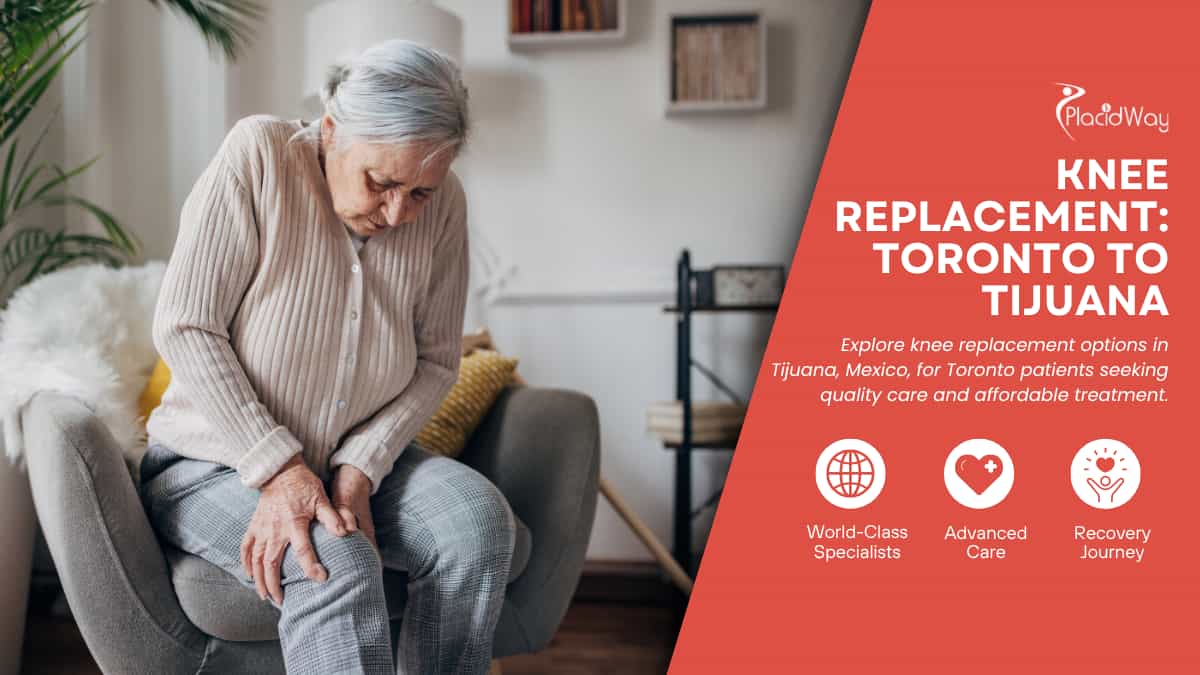
When knee pain limits walking, sleeping, working, or basic independence, waiting for surgery can feel like putting life on hold. Some Toronto patients compare private knee replacement surgery in Tijuana, where provider-listed packages currently range from approximately US$11,200 to US$14,500.
The operation is only one part of the decision. You also need to examine OHIP eligibility, implant documentation, surgeon certification, hospital licensing, rehabilitation, travel after major surgery, and who will manage your care after you return to Ontario. A lower price should never replace proper medical screening or a safe recovery plan.
Quick Summary: Toronto to Tijuana Knee Replacement
- Current Tijuana pricing: PlacidWay’s knee replacement listings show an average of $12,850 USD and a range of $11,200–$14,500. This category includes total or partial replacement listings, so confirm the exact procedure in writing.
- Current total knee packages: Two listed Tijuana options start at $11,200 and $14,500 USD, with different hospital stays, testing, rehabilitation, and exclusions.
- OHIP coverage: Elective treatment in Mexico will normally be self-funded unless Ontario grants written prior approval under narrow out-of-country coverage criteria.
- Travel route: A practical route is Toronto Pearson to San Diego followed by an arranged ground transfer to Tijuana. Air Canada currently operates a Toronto–San Diego service, but schedules must be reconfirmed.
- Credentials: Verify the surgeon’s general and specialist professional licences, current orthopedic certification through CMOT or CONACEM, and the hospital’s regulatory status.
- Recovery caution: Major surgery and long-distance travel both affect blood-clot risk. Do not book your return flight until the surgeon has reviewed your mobility, wound, swelling, and overall health.
- Aftercare: Arrange a Toronto family doctor, orthopedic contact, physiotherapist, medication plan, emergency instructions, and access to your complete surgical records before leaving Canada.
Why Toronto Patients Consider Knee Replacement in Tijuana
Toronto patients commonly begin looking outside Canada because they want greater control over timing, surgeon selection, hospital arrangements, and implant discussions. For someone living with advanced osteoarthritis, even a few additional months of pain can affect mobility, employment, sleep, and emotional well-being.
Canada’s national benchmark for a planned knee replacement is treatment within 26 weeks after the patient is ready for surgery. CIHI’s latest indicator data show that wait-time performance varies between provinces, hospitals, and priority levels. A national joint-replacement summary reported that 65% of hip and knee procedures met the six-month benchmark in 2025.
Earlier Scheduling
Private care may allow a patient to choose an available date after clinical evaluation and medical clearance.
Written Package Pricing
Some Tijuana providers combine the surgeon, implant, anesthesia, hospitalization, and early therapy into one quote.
Provider Choice
Patients may compare surgeons, implant systems, hospital facilities, rehabilitation support, and communication services.
Border Accessibility
Tijuana is beside San Diego, making it more accessible than many long-haul medical tourism destinations.
Keep the comparison fair: Publicly funded surgery in Ontario and private surgery in Mexico are different payment models. Compare the complete medical-travel expense with the clinical value of remaining in the Ontario system, not simply one Mexican package price against an assumed Canadian private price.
Knee Replacement Cost in Tijuana for Toronto Patients
Current PlacidWay listings place knee replacement in Tijuana at an average of $12,850 USD, with most listed quotes between $11,200 and $14,500. The pricing page covers both total and partial knee replacement, and the final amount varies by procedure, implant, patient anatomy, surgeon, and package scope.
The amount shown on a package page is not automatically your final bill. Your surgeon must first review your X-rays, diagnosis, medical history, previous operations, body weight, heart and lung health, diabetes control, medications, and whether one or both knees require treatment.
| Care Option | Patient Price Structure | Main Advantage | Important Limitation |
|---|---|---|---|
| Public knee replacement in Ontario | Medically necessary hospital and physician services are generally publicly funded for eligible OHIP patients | No private surgical package payment for covered care | Timing and provider choice depend on referral, priority, and local availability |
| Tijuana listed price range | $11,200–$14,500 USD | Private scheduling and bundled package options | Patient usually pays surgery and travel costs directly |
| Complete Toronto-to-Tijuana trip | Surgical package plus flights, transfers, hotel, companion, medication, equipment, and Canadian rehabilitation | Provides a more realistic financial plan | Final total is unavailable until medical and travel details are confirmed |
Current Tijuana Knee Replacement Package Prices
Pricing sources: current PlacidWay provider listings reviewed August 3, 2026. Prices are provider-supplied starting amounts and require a personalized written quotation.
Currency planning: Package prices are listed in U.S. dollars. Toronto patients should calculate the Canadian-dollar total using the exchange rate on the actual payment dates and include foreign transaction, bank-transfer, and financing fees.
What Current Tijuana Knee Replacement Packages Include
Package inclusions differ enough that patients should not compare prices without comparing the medical details. The following information comes from current provider listings and should be reconfirmed directly after the surgeon reviews your records.
| Package | Starting Price | Provider-Listed Inclusions | Provider-Listed Exclusions |
|---|---|---|---|
| Ortho Wellness package | $11,200 USD | One hospital night, surgery, anesthesiologist, knee implant components, and two physical therapy sessions | Travel, hotel, additional testing, unexpected treatment, and meals outside the clinic |
| Hospital CYNTAR package | $14,500 USD | Orthopedic consultation, standard preoperative evaluation, implant, surgical team, anesthesia, two to three hospital nights, early therapy guidance, and pre-departure follow-up | International travel, extended hotel, specialized home equipment, companion expenses, and long-term physical therapy |
The $11,200 listing specifically identifies one hospital night and two physical therapy sessions, while the $14,500 listing identifies two to three hospital nights, standard testing, and a pre-departure follow-up. Both require confirmation because individual medical needs can change the treatment plan.
Questions Every Written Knee Replacement Quote Should Answer
- Is the quote for total, partial, unilateral, bilateral, primary, or revision knee replacement?
- What implant manufacturer, model, bearing material, and fixation method are planned?
- Are the surgeon, assistant, anesthesiologist, hospital, operating room, and nursing fees included?
- How many hospital nights and local recovery nights are included?
- Are blood tests, ECG, chest imaging, X-rays, medical clearance, and medication included?
- What happens to the price if an additional hospital night becomes medically necessary?
- Does the package cover treatment of an infection, blood clot, fall, wound problem, or readmission?
- How many physical therapy sessions are included, and who pays for rehabilitation in Toronto?
- Is ground transportation between San Diego, the border, hotel, and hospital included?
- What is the cancellation, postponement, refund, and revision policy?
Will OHIP Pay for Knee Replacement Surgery in Mexico?
Most Toronto patients arranging elective knee replacement in Tijuana should expect to pay privately. OHIP may fund planned care outside Canada only when written prior approval is granted before treatment and all regulatory conditions are satisfied.
Ontario states that prior-approved care must take place in a licensed hospital or health facility, must not be experimental, and must be accepted in Ontario for the same medical circumstances. An identical or equivalent service must either be unavailable in Ontario, or the delay must create a risk of death or medically significant irreversible tissue damage.
| OHIP Question | Practical Answer |
|---|---|
| Can a patient apply alone? | An Ontario physician must determine the need and submit the prior-approval application with specialist confirmation and medical records. |
| Does a long wait automatically qualify? | No. The regulatory test concerns whether the delay could cause death or medically significant irreversible tissue damage. |
| Can approval be requested after surgery? | Planned care generally requires written approval before treatment. Without it, the patient is responsible for the cost except in defined emergency circumstances. |
| Are flights and hotels covered? | Travel, accommodation, and meals are generally not covered unless they form part of approved insured hospital services. |
Do not assume reimbursement: Obtain an official written OHIP decision before committing to surgery. A clinic’s statement that treatment “may be reimbursed” is not evidence of approval.
How to Travel from Toronto to Tijuana for Knee Surgery
A practical route is to fly from Toronto Pearson International Airport to San Diego International Airport and continue to Tijuana with a prearranged medical transfer. Pearson currently lists Air Canada service to San Diego, although seasonal schedules, frequency, and accessibility services can change.
Another option is flying from Toronto to Mexico City and connecting domestically to Tijuana International Airport. The best route depends on airfare, luggage, mobility, connection time, border arrangements, and whether the hospital provides accessible transportation.
| Route | How It Works | Mobility Consideration |
|---|---|---|
| Toronto to San Diego, then road transfer | Fly to San Diego and use an arranged driver through a land border crossing into Tijuana | Confirm wheelchair assistance, vehicle height, border wait plan, and space for the operated leg |
| Toronto to Mexico City to Tijuana | Enter Mexico by air and take a domestic connection to Tijuana International Airport | Adds an airport connection and may involve more walking or terminal transfers |
| Using Cross Border Xpress | CBX connects San Diego directly with Tijuana International Airport for ticketed TIJ airport passengers | It is not a general shortcut for a traveller arriving at San Diego airport without an eligible TIJ flight |
Cross Border Xpress is a dedicated pedestrian bridge between San Diego and Tijuana International Airport. Users need a flight boarding pass, CBX ticket, and valid travel documents. Its published average crossing time is 15–20 minutes, but this service applies specifically to airport passengers.
Toronto-to-Tijuana Travel Checklist
- Valid passport and confirmation of current Mexican entry requirements
- Hospital admission letter and surgeon contact information
- Digital and printed copies of X-rays, reports, medication list, allergies, and medical history
- Airline wheelchair or mobility assistance arranged before departure
- Accessible airport, border, hotel, and hospital transportation
- Companion travel plan for early postoperative assistance
- Travel insurance wording reviewed for planned surgery exclusions
- Emergency funds and a flexible return ticket
- Current Government of Canada travel advisory reviewed before departure
Destination safety: As of July 29, 2026, the Government of Canada advises travellers to exercise a high degree of caution in Mexico due to criminal activity and kidnapping. Conditions may change, so review the advisory again immediately before travel.
How to Verify a Knee Replacement Surgeon in Tijuana
A clinic profile or package page is not enough to verify an orthopedic surgeon. You should independently confirm both the doctor’s legal authority to practise and current specialist certification.
Mexico’s professional licence is called a cédula profesional. An orthopedic surgeon should be able to provide a general medical cédula and the relevant specialist cédula. Current orthopedic certification can also be checked through the Consejo Mexicano de Ortopedia y Traumatología and the CONACEM system. CMOT maintains a searchable register of certified orthopedic physicians.
| Credential or Trust Signal | What to Request | Why It Matters |
|---|---|---|
| General medical cédula | Full number and name exactly as registered | Confirms recognized medical education and professional registration |
| Specialist cédula | Orthopedics and traumatology specialist registration | Confirms the formal specialty qualification |
| CMOT or CONACEM certification | Current certification record and validity period | Provides an additional specialty competency check |
| Joint replacement experience | Annual primary, partial, bilateral, and revision knee case numbers | Shows whether knee arthroplasty is a routine part of the surgeon’s work |
| Hospital privileges | Written confirmation of where the surgeon performs knee replacement | Links the surgeon to an authorized operating facility |
| Outcome reporting | Infection, blood-clot, readmission, revision, and manipulation rates | Supports a more meaningful safety discussion than testimonials alone |
| Canadian aftercare cooperation | Records release, virtual follow-up, and communication with Ontario clinicians | Reduces gaps after the patient returns home |
Do not rely on the term “board-certified” alone: Ask which Mexican specialty board issued the certification, request the registration number, and confirm that the certification remains current.
How to Evaluate a Tijuana Hospital for Knee Replacement
A Tijuana hospital for knee replacement should be a properly authorized surgical facility with infection-control systems, trained nursing staff, diagnostic support, emergency capabilities, and access to higher-level care when necessary.
International accreditation may be an additional trust signal, but it is not legally required for every reputable Mexican hospital. National licensing, the operating team, patient selection, infection prevention, implant traceability, and complication management are more important than a logo displayed on a website.
Facility Authorization
Request the hospital’s operating licence or authorization and the name of the issuing Mexican health authority.
Operating-Room Safety
Ask about sterilization, antibiotic protocols, surgical-site infection surveillance, and environmental controls.
Emergency Resources
Confirm whether the hospital has an ICU, blood products, imaging, internal medicine, and emergency transfer capability.
Implant Traceability
Request the manufacturer, model, lot or serial details, labels, warranty information, and implant record.
Rehabilitation Support
Confirm when mobilization begins, who delivers therapy, and which functional goals must be met before discharge.
Complication Policy
Ask what medical and financial support applies to infection, readmission, extended hospitalization, or revision surgery.
Warning signs: Do not proceed when the provider will not identify the hospital, operating surgeon, implant, anesthesiologist, licence information, emergency plan, or complete written price before collecting a large deposit.
Knee Replacement Recovery Before Flying Back to Toronto
Recovery begins in the hospital with pain management, blood-clot prevention, wound monitoring, standing, assisted walking, and prescribed exercises. The amount of time required in Tijuana depends on your medical condition, mobility, wound, swelling, home support, and travel route.
AAOS advises patients to ask their doctor before air travel because immobility and pressure changes can increase swelling in the healing leg. The CDC identifies surgery within the previous three months as a blood-clot risk factor, especially when combined with travel lasting four hours or longer.
| Timeframe | Biological or Clinical Process | Patient Sensation | Activity Level | Action Required |
|---|---|---|---|---|
| First 24–72 hours | Inflammation and early wound healing begin | Pain, swelling, fatigue, and stiffness | Assisted standing and short walks | Follow pain, wound, circulation, and mobility instructions |
| Early local recovery | The incision continues healing while movement gradually improves | Swelling and tightness remain common | Frequent short walks and prescribed exercises | Remain close enough for wound and medical review |
| Before departure | The team evaluates early stability and complication signs | Fatigue and discomfort may increase with prolonged sitting | Safe transfers, walking, and basic self-care | Obtain written clearance and an individualized travel plan |
| First weeks in Toronto | Strength, motion, and wound healing progress | Soreness, stiffness, and variable swelling | Progressive household and therapy activity | Attend local follow-up and continue rehabilitation |
| Following months | Muscular strength, balance, and endurance continue improving | Intermittent swelling or fatigue may persist | Increasing low-impact activity | Maintain clinical follow-up and joint-safe exercise |
Before Your Return Flight, Confirm That You Have
- Written surgeon clearance for the planned route and flight duration
- A blood-clot prevention plan specific to your health and travel
- Wheelchair assistance and suitable seating confirmed with the airline
- Enough prescribed medication for travel and the first days in Toronto
- A walker or other mobility aid that meets airline requirements
- The operative report, discharge summary, implant labels, imaging, and laboratory results
- A wound-care plan and emergency contact number
- Confirmed Toronto physiotherapy and medical follow-up appointments
Risks of Knee Replacement and Medical Travel
Potential knee replacement complications include infection, blood clots, bleeding, stiffness, nerve or blood-vessel injury, implant loosening, instability, persistent pain, medical complications, and the possibility of revision surgery.
AAOS describes blood clots as one of the more common complications and reports that serious complications such as deep joint infection occur in fewer than 2% of patients overall. Your individual risk can be higher because of age, obesity, diabetes, smoking, previous clots, heart or lung disease, limited mobility, or other health conditions.
| Potential Problem | Planning Question | Possible Travel Consequence |
|---|---|---|
| Infection | Who evaluates the wound after discharge and after return to Toronto? | May require testing, antibiotics, readmission, or additional surgery |
| Blood clot | What prevention plan applies during local recovery and the flight? | May delay travel or require emergency assessment and treatment |
| Stiffness | How will therapy continue immediately after returning home? | May require extended therapy or another procedure |
| Fall or mobility problem | Is a companion available for transfers, luggage, and border movement? | May cause injury, implant damage, or delayed departure |
| Unexpected medical illness | Does the hospital have internal medicine, critical care, and transfer access? | May create substantial costs outside the original package |
Seek Urgent Medical Help for Warning Signs
- Increasing wound redness, warmth, drainage, swelling, or pain
- Persistent fever, chills, confusion, or feeling acutely unwell
- New calf pain, tenderness, redness, or one-sided leg swelling
- Sudden shortness of breath, chest pain, fainting, or coughing blood
- A fall, new instability, or sudden inability to bear weight
- A cold, pale, numb, or unusually painful foot
Canadian Knee Replacement Trends Relevant to Toronto Patients
Canada performed 175,242 hip and knee replacements during 2024–2025, a 5.3% increase from the previous year and a 26.5% increase from 2019–2020. Among knee replacements for osteoarthritis, 31.1% were performed as day surgeries.
Robotic-assisted technology represented 3.1% of Canadian hip and knee replacements in 2024–2025, compared with 1.9% in 2023–2024 and 0.8% in 2022–2023. These figures cover both hip and knee procedures and should not be used as an individual recommendation for robotic surgery.
Growth of Robotic-Assisted Hip and Knee Replacement in Canada
Source: Canadian Joint Replacement Registry Annual Report, 2024–2025. The percentages combine reported hip and knee replacements.
Patient demographics transparency: Reliable public data showing the age, sex, income, or Toronto neighbourhoods of patients travelling specifically from Toronto to Tijuana for knee replacement were not available. This article therefore does not present invented medical-tourism demographics.
Frequently Asked Questions About Toronto-to-Tijuana Knee Replacement
How much does knee replacement in Tijuana cost for a Toronto patient?
Current Tijuana listings show prices from $11,200 to $14,500 USD, with an average of $12,850 across the total-or-partial knee replacement category. Your complete budget must also include flights, accommodation, transfers, medication, equipment, companion expenses, and rehabilitation in Toronto.
Will OHIP reimburse elective knee replacement surgery in Mexico?
Elective treatment will generally be self-funded unless the Ontario Ministry of Health grants written prior approval. Approval criteria are narrow and include medical necessity, an appropriately licensed facility, accepted treatment, and unavailability or a medically dangerous delay in Ontario.
Is there a nonstop flight from Toronto to Tijuana?
A practical current route is Toronto to San Diego followed by an arranged ground transfer into Tijuana. Travellers may also connect through Mexico City to Tijuana. Airline routes change, so verify the current schedule before choosing a surgical date.
Can I use Cross Border Xpress after flying from Toronto to San Diego?
CBX is for eligible ticketed passengers travelling through Tijuana International Airport and requires a TIJ flight boarding pass, CBX ticket, and travel documents. It is not a general pedestrian shortcut for every passenger arriving at San Diego International Airport.
How long should I remain in Tijuana after knee replacement?
There is no universally safe number of days. Your surgeon should base departure clearance on wound condition, swelling, pain control, walking ability, blood-clot risk, medical stability, travel duration, and access to follow-up care after returning to Toronto.
Is it safe to fly after knee replacement surgery?
Air travel may increase swelling and requires prolonged sitting. Recent surgery also increases blood-clot risk. Do not fly until your surgeon clears you and provides individualized instructions about mobility, prescribed prevention, hydration, wound care, and warning signs.
What implant information should I receive in Tijuana?
Request the implant manufacturer, model, component sizes, material, fixation method, lot or serial information, labels, warranty information, and operative report. Keep digital and printed copies so Canadian clinicians can identify the implant during future imaging, treatment, or revision planning.
How do I verify a Tijuana orthopedic surgeon?
Verify the surgeon’s general and specialist cédula profesional, current CMOT or CONACEM certification, hospital privileges, knee replacement volume, complication protocol, and revision experience. Confirm credentials independently rather than relying only on a clinic profile or coordinator statement.
Does the Tijuana package include physical therapy in Toronto?
Usually not. Current packages may include only early therapy guidance or a limited number of sessions in Tijuana. Ask a Toronto physiotherapist to review the expected rehabilitation protocol and provide self-pay pricing before you leave for surgery.
Will Canadian travel insurance cover complications from planned surgery?
Many standard policies exclude planned medical treatment and complications related to it. Obtain written confirmation from the insurer explaining whether emergency treatment, hospitalization, evacuation, cancellation, companion expenses, and post-surgical complications are covered or excluded.
Who will provide follow-up care when I return to Toronto?
Arrange this before surgery. Your plan may involve a family doctor, physiotherapist, home-care provider, or Canadian orthopedic specialist. Confirm who will remove sutures or staples, review the wound, adjust rehabilitation, renew medications, and respond to complications.
Is the lowest-priced knee replacement package the best value?
Not necessarily. Compare the surgeon, implant, hospital resources, anesthesia, length of stay, tests, therapy, transportation, emergency support, complication policy, and Canadian aftercare. A higher package may cost less overall when it includes services excluded from a lower quote.
Compare Knee Replacement Options in Tijuana
PlacidWay can help you request personalized information, compare provider-listed package inclusions, organize questions about surgeon credentials and implants, and review the practical requirements of travelling from Toronto for treatment.
Request Knee Replacement InformationMedical Disclaimer
Disclaimer: This information is for educational purposes only and does not replace professional medical advice. Always consult a qualified healthcare provider before making medical decisions.
References
- OHIP Coverage While Outside Canada – Government of Ontario
- Wait Times for Knee Replacement – Canadian Institute for Health Information
- Hip and Knee Replacements in Canada, 2024–2025 – Canadian Joint Replacement Registry
- Travel Advice and Advisories for Mexico – Government of Canada
- Total Knee Replacement – American Academy of Orthopaedic Surgeons
- Activities After Total Knee Replacement – American Academy of Orthopaedic Surgeons
- Understanding Blood-Clot Risk With Travel – Centers for Disease Control and Prevention
- Certified Orthopedic Physicians Directory – Consejo Mexicano de Ortopedia y Traumatología
.png)
.png)

.png)
.png)









Share this listing