
If you are living in Germany and cancer treatment is becoming more complex, you may start looking beyond another chemotherapy cycle and asking whether your tumor has a molecular weakness that can be targeted. That question is important because targeted therapy is not simply a newer form of chemotherapy. Treatment may depend on biomarker testing, the exact cancer subtype, previous therapy and whether a particular medicine is licensed in Turkey. Before traveling, verify the oncology hospital's International Health Tourism Authorization, applicable TÜSKA accreditation status, your oncologist's registered specialty, the medicine's T?TCK status and a written cost plan covering treatment, testing and complication care.
Quick Summary: Chemotherapy and Targeted Cancer Therapy in Turkey
- Treatment difference: Chemotherapy broadly attacks rapidly dividing cells, while targeted therapy acts on particular proteins or molecular changes that help certain cancers grow.
- Who may benefit from targeted therapy: Patients whose tumors have a clinically relevant biomarker matched to an appropriate medicine. Not every cancer has an actionable target.
- Testing matters: Depending on your diagnosis, molecular testing may examine targets such as HER2, EGFR, ALK, BRAF, BRCA-related alterations or other cancer-specific markers.
- Turkey hospital checks: International patients should verify the facility's International Health Tourism Authorization and applicable Ministry of Health and TÜSKA requirements.
- Medicine verification: Ask for the exact generic drug, manufacturer, indication and current Turkish licensing information. T?TCK maintains a regularly updated list of licensed human medicinal products.
- Estimated cost: A reliable standardized USD price for chemotherapy or targeted cancer therapy in Turkey is not available because treatment varies significantly by drug, biomarker, cycle number, hospital setting and supportive care.
- Germany comparison: Many medically necessary cancer treatments are provided through Germany's health-insurance system. International private-pay treatment should therefore be compared with your actual German coverage rather than only a hospital's list price.
- Important caution: Do not travel for a targeted drug solely because a biomarker appears on a laboratory report. A qualified oncologist must determine whether the alteration is clinically actionable for your cancer.
Why German Cancer Patients Consider Chemotherapy and Targeted Therapy in Turkey
Patients generally begin looking internationally when their cancer journey becomes more complicated. You may be comparing another treatment opinion after progression, investigating biomarker-directed therapy, asking whether a drug is available elsewhere or considering private oncology care alongside options already offered in Germany.
Turkey has public, university and private hospitals providing oncology services, particularly in major medical centers. German citizens can also reach Turkish cities by relatively short direct flights compared with many long-distance medical-tourism destinations. Geography alone, however, does not establish that treatment in Turkey is clinically preferable.
- Seeking another medical-oncology opinion after cancer progression.
- Investigating whether updated biomarker testing changes treatment options.
- Comparing access to a specific targeted medicine.
- Reviewing combination treatment involving chemotherapy and targeted drugs.
- Considering a private treatment pathway after discussing German options.
- Wanting treatment in a setting where language, family connections or travel logistics may be manageable.
Chemotherapy vs Targeted Drug Therapy in Turkey: What Is the Difference?
Chemotherapy and targeted therapy are both systemic cancer treatments, but they work differently. Chemotherapy commonly interferes with rapidly growing and dividing cells. Because normal tissues can also contain fast-dividing cells, chemotherapy may affect bone marrow, hair follicles and the digestive tract.
Targeted therapy is a form of precision cancer treatment. It acts against particular molecules involved in cancer growth, survival or spread. Some targeted drugs are small molecules that work inside cells, while others are monoclonal antibodies that attach to targets on or around cancer cells.
| Feature | Chemotherapy | Targeted therapy |
|---|---|---|
| Main mechanism | Often damages or stops rapidly dividing cells. | Interferes with specific molecular pathways or proteins involved in cancer. |
| Biomarker required | Not necessarily. | Frequently required for treatment selection. |
| Administration | May be intravenous, oral or delivered by another route depending on regimen. | May be oral or intravenous depending on the medicine. |
| Selection | Based on cancer type, stage, treatment goal, health status and previous treatment. | Also depends on whether the relevant molecular target is present. |
| Side effects | Depend on the drugs used and can include blood-count suppression, nausea, fatigue and other effects. | Can include diarrhea, liver problems, skin reactions, high blood pressure and other drug-specific toxicities. |
These treatments are not mutually exclusive. Depending on your cancer, an oncologist may recommend chemotherapy together with a targeted drug, or treatment may move between different systemic approaches as your disease changes.
Biomarker Testing Before Targeted Cancer Therapy in Turkey
Biomarker testing is one of the most important steps before considering targeted therapy. It examines genes, proteins or other characteristics of your cancer that may influence whether a particular treatment is likely to help.
Testing may use stored tumor tissue from an earlier biopsy, a new biopsy, blood or other samples depending on the disease and test. Importantly, a mutation appearing on a report does not automatically mean a matching drug is proven for your cancer.
| Example biomarker | Cancer settings where it may be relevant | Question to ask |
|---|---|---|
| HER2 | Certain breast, gastric and other cancers. | Which test established HER2 status and which treatment indication applies? |
| EGFR | Certain non-small-cell lung cancers and other disease-specific settings. | Which EGFR alteration was detected? |
| ALK | A subset of lung cancers and selected other tumors. | Was the rearrangement confirmed using an accepted diagnostic method? |
| BRAF | Melanoma and selected thyroid, lung, colorectal and other cancers. | Which BRAF variant is present and does the proposed therapy match it? |
| BRCA-related alterations | Selected breast, ovarian, prostate, pancreatic and other treatment settings. | Is the finding somatic, inherited or both, and does genetic counseling apply? |
Biomarkers can also change as cancer evolves. If your molecular testing was performed years ago and the disease has since progressed through several therapies, your oncologist may discuss whether repeat tissue or liquid-biopsy testing could be clinically useful.
Which German Cancer Patients Might Consider Targeted Therapy in Turkey?
A targeted medicine should match a clinically meaningful cancer characteristic. Your eligibility cannot be determined from your country of residence, age or diagnosis alone. Treatment selection depends on tumor biology and the stage of your cancer journey.
For some cancers, biomarker testing is part of routine treatment planning. In other situations, broad genomic profiling becomes more relevant after cancer has spread, returned or stopped responding to standard treatment.
Newly Diagnosed Cancer
Some cancers require established biomarker testing before first-line systemic therapy is selected.
Cancer That Has Spread
Advanced disease may prompt more extensive molecular profiling when actionable biomarkers could alter systemic treatment.
Cancer That Returned
Recurrent disease may be retested because tumor biology can differ from an earlier specimen.
Treatment Resistance
Resistance mechanisms may appear during therapy and can sometimes influence the next treatment strategy.
A molecular result does not guarantee a useful drug
Biomarker testing can return a target with an established treatment, a target being studied in clinical trials, a variant with uncertain significance or no clinically useful target at all. Even when a medicine matches a biomarker, not every patient responds.
Your oncologist should explain whether the proposed treatment is approved for your cancer, used off-label, investigational or available only through a clinical trial.
German Cancer Demographics and Recent Statistics Relevant to Treatment Decisions
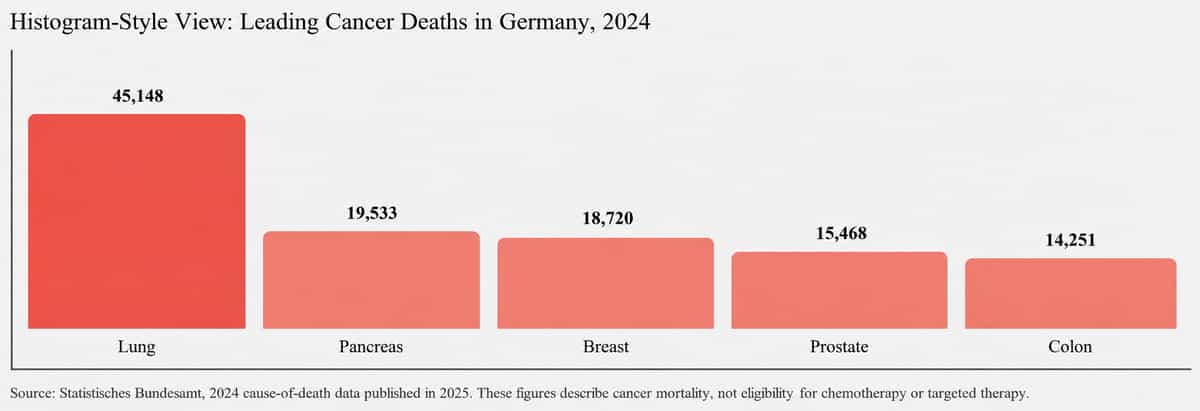
Cancer remains a major health issue in Germany. Deutsche Krebshilfe currently describes roughly 520,000 new cancer diagnoses per year, while the Federal Statistical Office reported 230,400 cancer deaths in 2024 in data published in February 2026.
For context, Destatis reported approximately 230,300 cancer deaths for 2023. Cancer remained Germany's second most common cause of death in the 2026 statistical review, and it accounted for 35.8% of deaths among people aged 35 to 74 in 2024.
Line Graph: Cancer Deaths in Germany, 2023-2024
Source: Statistisches Bundesamt releases published in 2025 and 2026. The near-flat line describes reported annual deaths and does not measure demand for treatment in Turkey.
Age and sex influence the population patterns of individual cancers, but neither determines whether you should travel for targeted therapy. Molecular findings, disease stage, treatment history, organ function and clinical evidence are more important for individual treatment selection.
How Cancer Treatment and Targeted Medicines Are Regulated in Turkey
German patients should verify two separate areas: whether the healthcare facility is authorized to treat international patients and whether the medicine being proposed has appropriate Turkish regulatory status.
Turkey's 2025 Regulation on International Health Tourism and Tourist Health establishes authorization and service requirements for institutions treating international patients. Hospitals, medical centers, laboratories and dialysis centers holding health-tourism authorization are also required to meet TÜSKA accreditation deadlines under the current framework.
| Turkish verification point | What to request | Why it matters |
|---|---|---|
| International Health Tourism Authorization | Ask the hospital to provide or display its current authorization information. | The 2025 regulation governs facilities offering care to international health tourists. |
| TÜSKA accreditation | Check the TÜSKA accredited-organizations database and applicable transition deadline. | National accreditation requirements were expanded in 2025. |
| T?TCK medicine status | Generic name, brand where relevant, manufacturer and licensing information. | The Turkish Medicines and Medical Devices Agency maintains updated licensed-product lists. |
| Oncology department capability | Medical oncology, pharmacy, laboratory, radiology, pathology and emergency support. | Targeted treatment requires more than drug availability alone. |
TÜSKA announced that health-tourism-authorized hospitals and certain other facilities must complete required accreditation by the applicable deadline. Patients should check current status rather than assuming that a provider's international marketing confirms compliance.
Chemotherapy and Targeted Therapy Costs in Turkey vs Germany
A single cancer-treatment price would be misleading because the cost can change dramatically with the medicine and treatment plan. An oral small-molecule targeted drug, an infused monoclonal antibody and multi-agent chemotherapy have very different cost structures.
No authoritative public source provides one standardized USD cost for chemotherapy or targeted cancer therapy for international patients across Turkish hospitals. A medically useful comparison therefore requires a patient-specific written treatment plan.
| Cost area | Turkey | Germany |
|---|---|---|
| Standardized total cost | Information not available as one authoritative national USD figure. | Patient responsibility depends on statutory or private insurance and the treatment pathway. |
| Biomarker testing | Request the exact test panel and laboratory charge. | Coverage depends on clinical indication and applicable insurance rules. |
| Cancer medicine | Confirm exact product and whether the quotation covers every planned cycle or prescription period. | Medically necessary prescribed treatment may be covered under Germany's insurance system subject to applicable rules. |
| Infusion and monitoring | May include facility, pharmacy, laboratory and physician charges. | Usually handled within the German treatment and insurance pathway when covered. |
| Travel | Flights, accommodation, caregiver expenses and extended stays may be additional. | International travel is not required for local treatment. |
Ask the Turkish hospital for an itemized cancer-treatment quotation
- Oncology consultation and pathology review.
- Biopsy or repeat tissue sampling when required.
- Molecular or biomarker testing.
- Imaging and staging.
- Exact chemotherapy or targeted drug.
- Number of planned cycles or treatment duration.
- Infusion, pharmacy and laboratory charges.
- Supportive medication.
- Emergency or inpatient care.
- Follow-up scans and consultations.
- Travel, accommodation, translation and caregiver expenses.
How German Patients Can Choose an Oncology Hospital in Turkey
A cancer hospital should be evaluated by its oncology infrastructure, not by photographs, package language or the size of its international-patient department. Targeted therapy can require complex pathology, molecular diagnostics, clinical pharmacy, infusion monitoring and rapid management of toxicity.
Ask the provider to explain exactly which department is responsible for your treatment and how urgent complications are handled outside normal clinic hours.
| Hospital check | Question to ask | Patient significance |
|---|---|---|
| Health-tourism authorization | “Can you provide your current International Health Tourism Authorization?” | Relevant to facilities serving international patients under Turkey's current framework. |
| TÜSKA status | “What is your current TÜSKA accreditation status?” | Allows independent checking against national accreditation records. |
| Molecular pathology | “Which laboratory performs my molecular tests and how is quality controlled?” | An incorrect biomarker result can lead to inappropriate treatment. |
| Multidisciplinary tumor board | “Will my case be reviewed by medical oncology, radiology, pathology, surgery or radiation oncology where appropriate?” | Cancer treatment decisions may require several specialties. |
| Emergency capability | “Where will I be treated if I develop fever, severe diarrhea, bleeding or breathing problems?” | Cancer-treatment complications can require urgent hospital assessment. |
International accreditation such as JCI may provide additional information when genuinely applicable, but it is not a substitute for Turkish licensing, TÜSKA requirements, specialist registration or oncology-specific capability.
How to Verify an Oncologist for Chemotherapy or Targeted Therapy in Turkey
Ask for the physician's full legal name, medical specialty and hospital affiliation before committing to treatment. Turkey's Ministry of Health manages physician and specialist registration, and the government's Doctor Information Bank provides an official verification route.
For systemic cancer treatment, the relevant physician will commonly be a medical oncology specialist. Academic titles, social-media visibility or international marketing should not replace verification of medical and specialist registration.
Ask whether the physician's medical-oncology specialization is officially registered with the Ministry of Health.
Experience with one tumor type does not automatically translate to expertise across every cancer.
The doctor should be able to explain the biomarker, evidence and regulatory status behind the recommended targeted drug.
Clarify who handles toxicity after hours and whether inpatient and ICU support are immediately available.
Questions for a Turkish medical oncologist
- What is my exact cancer subtype and stage?
- Which biomarker makes me eligible for this targeted therapy?
- What evidence supports this treatment for my situation?
- Is the medicine licensed in Turkey for this indication?
- Would you use the same treatment if I remained in Germany?
- Why are you recommending targeted therapy alone or together with chemotherapy?
- How will response be measured?
- What is the next option if the cancer progresses?
What the Cancer Treatment Journey in Turkey May Look Like
Your treatment schedule depends on the medicine and diagnosis. Some targeted therapies are taken orally over an extended period, while monoclonal antibodies and chemotherapy may require repeated hospital or outpatient infusions.
Do not assume the complete course can be finished during one short stay. Cancer treatment often requires repeat laboratory testing, imaging, toxicity monitoring and modification when side effects or progression occur.
| Timeframe | Clinical process | Patient sensation | Activity level | Action required |
|---|---|---|---|---|
| Before travel | Remote record review and preliminary eligibility assessment. | Depends on your cancer and current therapy. | Individual. | Send pathology, scans, treatment history and biomarker reports. |
| Initial Turkey assessment | Clinical review, possible pathology confirmation and additional testing. | Usually related to existing disease rather than assessment itself. | As tolerated. | Do not start treatment until the final plan is explained. |
| Active treatment | Chemotherapy, targeted medicine or combination therapy. | Highly drug-specific; fatigue and other effects may occur. | Follow oncology guidance. | Complete laboratory and toxicity monitoring as scheduled. |
| Response assessment | Clinical evaluation and appropriate imaging or other disease-specific monitoring. | Symptoms do not always reflect radiologic response. | Individual. | Ask how response and progression are formally defined. |
| After Germany return | Continued laboratory, toxicity and disease monitoring. | Some adverse effects may persist or emerge later. | Based on treatment and recovery. | Transfer complete records to your German oncology team. |
Side Effects and Emergency Risks During Cancer Therapy in Turkey
Targeted therapy can still cause serious side effects despite being more molecularly selective than conventional chemotherapy. The risk depends entirely on the drug, combination, cancer and your underlying health.
NCI notes that targeted therapies can cause problems including diarrhea, liver toxicity, impaired wound healing, blood-pressure changes and skin reactions. Individual medicines have additional risks that should be explained using the official prescribing information.
| Possible problem | Why it matters | Planning question |
|---|---|---|
| Low blood counts | Can increase infection, anemia or bleeding risk depending on treatment. | How often are blood counts checked? |
| Liver or kidney toxicity | Can require treatment interruption or modification. | Which laboratory tests are monitored? |
| Severe diarrhea or vomiting | Can cause dehydration and electrolyte abnormalities. | Who should I contact after hours? |
| Skin toxicity | Some targeted medicines cause significant rash or skin complications. | What symptoms require urgent review? |
| Cardiovascular effects | Certain therapies can affect blood pressure, heart function or clotting. | Do I need baseline or ongoing cardiac monitoring? |
Travel From Germany to Turkey During Chemotherapy or Targeted Therapy
Travel timing should be treated as a medical decision when you are receiving active cancer therapy. Low blood counts, infection, recent surgery, blood clots, anemia, dehydration or treatment toxicity can make travel inappropriate even when you already have appointments booked.
German citizens currently do not require a visa for stays in Turkey of up to 90 days within a 180-day period. Entry rules and travel advisories can change, so check the German Federal Foreign Office before departure.
| Before leaving Germany | Why you need it |
|---|---|
| Pathology report and slides/files when requested | Allows confirmation of diagnosis and biomarker interpretation. |
| PET/CT, CT, MRI and other imaging | Shows current disease distribution and treatment response. |
| Complete treatment history | Prevents unnecessary repetition and helps assess resistance. |
| Biomarker and genomic reports | Required to evaluate targeted therapy rationally. |
| Current medicines and allergies | Helps identify interactions and treatment risks. |
| German oncologist contact information | Supports continuity when clarification or follow-up is required. |
Before returning to Germany, obtain an English or German treatment summary whenever possible. It should list every drug by generic name, administration dates, laboratory results, complications, imaging and recommendations for the next cycle or assessment.
Frequently Asked Questions About Chemotherapy and Targeted Therapy in Turkey
Is targeted cancer therapy in Turkey the same as chemotherapy?
No. Chemotherapy commonly affects rapidly dividing cells, while targeted therapy acts against specific molecules or pathways involved in cancer growth. Some patients receive both treatments together. Your cancer type, stage, biomarkers, previous therapy and overall health determine which approach may be appropriate.
Can German patients receive chemotherapy in Turkey?
International patients can receive oncology care at appropriately authorized Turkish healthcare facilities when a treating team accepts their case. Before traveling, confirm the hospital's international health-tourism status, medical-oncology capability, exact treatment plan, medicine availability, monitoring requirements and emergency arrangements.
Do I need biomarker testing before targeted therapy in Turkey?
Often, yes. Many targeted therapies require a specific molecular or protein biomarker before treatment is appropriate. The required test depends on your cancer. A qualified oncologist should interpret the result and determine whether the detected biomarker is clinically actionable.
How much does targeted cancer therapy in Turkey cost?
There is no reliable standardized national USD price. Costs depend heavily on the exact medicine, biomarker testing, treatment duration, infusion fees, imaging, laboratory monitoring and complications. Request a patient-specific itemized quotation that identifies the exact medicine and number of planned treatment cycles.
Is cancer treatment automatically cheaper in Turkey than Germany?
Not necessarily from the patient's perspective. Eligible German patients may have medically necessary treatment covered through statutory or private insurance, while international care in Turkey may require private payment. Compare your true out-of-pocket costs, not only hospital prices or drug charges.
How can I verify a targeted cancer drug in Turkey?
Ask for the exact generic name, brand where relevant, manufacturer and indication. The Turkish Medicines and Medical Devices Agency, T?TCK, publishes regularly updated lists of licensed human medicinal products. Your oncologist should also explain whether the proposed use matches your cancer and biomarker.
How can German patients verify an oncology hospital in Turkey?
Check the facility's International Health Tourism Authorization and current TÜSKA accreditation status or applicable transition requirement. Also verify that the hospital has medical oncology, qualified pharmacy support, pathology, molecular testing access and emergency capabilities appropriate for your treatment.
How do I verify an oncologist in Turkey?
Ask for the doctor's full name and registered specialty. Turkey's Ministry of Health manages physician and specialty registration, and the government Doctor Information Bank provides a verification mechanism. Confirm that the specialist has relevant experience with your cancer and proposed systemic therapy.
Can I continue targeted therapy after returning to Germany?
Possibly, but continuity must be planned before treatment begins. Drug authorization, prescription rules, reimbursement and monitoring can differ between countries. Ask your German oncologist whether the medicine and follow-up plan can be continued after you return.
Does finding a genetic mutation mean targeted therapy will work?
No. Some mutations are actionable, some have uncertain significance and others have no proven treatment. Even an established biomarker-drug match cannot guarantee response. Treatment selection should consider clinical evidence, cancer type, disease stage and previous therapies.
Do German citizens need a visa for cancer treatment in Turkey?
German citizens currently do not need a visa for visits of up to 90 days within a 180-day period. Entry and security requirements can change. Check the current German Federal Foreign Office travel advice and Turkish entry rules before departure.
What should I ask before paying for chemotherapy or targeted therapy in Turkey?
Request your diagnosis, biomarker interpretation, exact drug, regulatory status, treatment rationale, number of cycles, monitoring plan, emergency arrangements and itemized costs in writing. Also clarify what happens financially and medically if treatment changes because of toxicity or progression.
Compare Cancer Treatment Options in Turkey
If you are in Germany and considering chemotherapy or targeted cancer therapy in Turkey, PlacidWay can help you request information, compare proposed treatment pathways and costs, and prepare questions about biomarker testing, medicine licensing, physician credentials, hospital authorization and follow-up. International treatment decisions should also be reviewed with a qualified oncology professional familiar with your diagnosis.
Disclaimer for Chemotherapy and Targeted Cancer Therapy
Disclaimer: This information is for educational purposes only and does not replace professional medical advice. Always consult a qualified healthcare provider before making medical decisions.
References
- Targeted Therapy to Treat Cancer – National Cancer Institute
- Biomarker Testing for Cancer Treatment – National Cancer Institute
- Cancer Mortality in Germany – Statistisches Bundesamt, 2026
- Efficient Oncology Treatment and Targeted Cancer Medicines – German Federal Ministry of Health
- Regulation on International Health Tourism and Tourist Health – Official Gazette of the Republic of Türkiye
- Healthcare Institutions Subject to TÜSKA Accreditation Requirements – TÜSKA
- Licensed Human Medicinal Products List – Turkish Medicines and Medical Devices Agency
- Turkey Travel and Entry Information – German Federal Foreign Office




















Share this listing