



You may be considering liposuction in Mexico because local self-pay surgery is expensive, clinic choices feel difficult to compare, or you want access to an experienced body-contouring surgeon without a long wait. Current PlacidWay clinic quotes generally range from $3,500 to $10,500, but a lower number is useful only when the surgeon holds a valid Mexican specialty credential and the operating facility has a current COFEPRIS license for surgical procedures. Your written quote should also explain anesthesia, compression garments, follow-up care and complication support.
Quick Summary of Liposuction in Mexico
- Estimated Mexico cost: approximately $3,500–$10,500, averaging near $7,000 across recent PlacidWay clinic quotes; exact pricing depends on treatment areas, technique, anesthesia and package inclusions.
- Safety priority: confirm a current COFEPRIS surgical-facility license and a named hospital-transfer or emergency plan before paying a deposit.
- Surgeon credential: verify a Mexican specialist professional license and current certification through CONACEM and the Mexican Council of Plastic, Aesthetic and Reconstructive Surgery.
- Ideal candidate: generally a healthy adult near a stable weight with localized fat, realistic expectations and enough skin elasticity for the planned contour.
- Early recovery: soreness, bruising, swelling and temporary numbness are common; many patients limit activity for the first week and return gradually under their surgeon’s instructions.
- Important caution: liposuction is body-contouring surgery, not an obesity treatment or a substitute for weight management, and it does not reliably correct loose skin or cellulite.
Why International Patients Consider Liposuction in Mexico
Patients mainly consider Mexico for proximity, a broad private surgical sector and access to package pricing. The latest ISAPS country data estimated 98,754 liposuction procedures in Mexico during 2024, making liposuction the country’s most common cosmetic surgical procedure in that survey. The same report found that international patients treated by participating Mexican plastic surgeons most frequently came from the United States, Canada and Colombia.
For American and Canadian patients, shorter travel routes can make consultations and follow-up visits more practical than long-haul cosmetic tourism. Border cities may be convenient for driving, while Mexico City, Guadalajara, Monterrey, Cancún and Mérida provide larger private-hospital markets. Convenience does not replace credential checks. Standards, staffing, emergency resources and aftercare can differ substantially between facilities in the same destination.
Common Reasons for Liposuction Travel to Mexico
- Lower or more predictable self-pay package quotes
- Direct flights or driving access from North America
- Availability of Spanish- and English-speaking coordinators
- Access to surgeons focused on body contouring
- Privacy while recovering away from home
Questions Liposuction Patients Should Resolve First
- Who will perform the surgery and anesthesia?
- Which facility license covers the operating room?
- How many body areas and liters are planned?
- How long must you remain in Mexico?
- Who manages complications after you return home?
What Liposuction in Mexico Can and Cannot Change
Liposuction removes selected deposits of subcutaneous fat through small incisions using a narrow tube called a cannula. It can refine areas such as the abdomen, waist, flanks, hips, thighs, upper arms, back, chest or under the chin. The goal is improved proportion and contour, not a specific scale weight.
Fat cells removed from treated areas do not regenerate in the same way, but remaining fat cells can enlarge if you gain weight. Skin also continues to age. A stable weight, realistic expectations and healthy habits help protect the contour, although no surgeon can guarantee a permanent appearance or perfect symmetry.
Liposuction in Mexico May Help With
- Localized fat resistant to diet and exercise
- Waist, flank or abdominal contour
- Disproportion between nearby body areas
- Selected male chest or submental fat concerns
- Contour refinement after stable weight loss
Liposuction in Mexico Does Not Reliably Treat
- Obesity or major weight reduction
- Cellulite or stretch marks
- Significant loose or hanging skin
- Visceral fat around internal organs
- Body-image distress without realistic goals
When loose skin is the main concern, your surgeon may discuss an abdominoplasty, arm lift, thigh lift or another skin-removal operation. Combining procedures can increase operating time and recovery demands, so the decision should follow an individualized risk assessment rather than a package promotion.
Liposuction Techniques and Treatment Areas in Mexico
The safest technique is the one a properly trained surgeon selects for your anatomy, treatment volume and medical history. Technology names can describe how fat is loosened or how the cannula moves, but no device replaces surgical judgment, anesthesia safety or a licensed operating room.
| Liposuction technique in Mexico | How it works | Potential use | Question to ask |
|---|---|---|---|
| Tumescent liposuction | A fluid solution is placed in the treatment area before suction. | Common foundation for many body areas. | How will fluid balance and blood loss be monitored? |
| Power-assisted liposuction | A vibrating cannula helps the surgeon move through tissue. | Larger or fibrous areas, depending on experience. | How often does the surgeon use this device? |
| Ultrasound-assisted liposuction | Ultrasound energy helps disrupt fat before removal. | Selected dense or previously treated areas. | What steps reduce thermal injury risk? |
| Laser-assisted liposuction | Laser energy is used before suctioning selected fat. | Small areas or selected contouring plans. | Is the device registered and who operates it? |
| Lipo 360 or high-definition liposuction | Describes circumferential or detailed sculpting rather than one universal technique. | Waist, torso or muscle-definition goals. | Which exact areas, volumes and techniques are included? |
Who May Be a Candidate for Liposuction in Mexico
A suitable candidate is generally healthy enough for elective surgery, near a stable weight and seeking contour improvement in defined areas. Skin elasticity matters because liposuction removes fat but does not remove excess skin. Your surgeon should assess whether your skin is likely to contract or whether another procedure would better address laxity.
A complete consultation should review previous surgery, allergies, medications, supplements, smoking or vaping, pregnancy history, clotting history and chronic conditions. Diabetes, heart or lung disease, anemia, obesity, untreated sleep apnea and previous blood clots may affect whether surgery is appropriate or how it should be performed. This does not automatically exclude every patient, but it requires careful medical clearance.
| Candidate factor | Why it matters for liposuction | What to prepare |
|---|---|---|
| Stable weight | Supports predictable contour planning. | Recent weight history and future goals. |
| Skin elasticity | Influences how the skin redrapes after fat removal. | Photos and in-person examination. |
| Smoking or vaping | Nicotine can impair blood flow and healing. | Be honest about current and recent use. |
| Clotting risk | Surgery, immobility and travel can increase clot risk. | Personal and family clot history. |
| Realistic expectations | Reduces pressure for unsafe volume or unnecessary combinations. | Specific areas and acceptable trade-offs. |
Liposuction Cost in Mexico and International Comparison
Recent PlacidWay clinic quote data places liposuction in Mexico at an average of about $7,000, with most quotes between $3,500 and $10,500. This is a planning range, not a guaranteed price. A single small area may cost less than circumferential liposuction, high-definition contouring or surgery combined with a tummy tuck or fat transfer.
The most important comparison is not Mexico versus another country on headline price alone. Compare the same number of areas, anesthesia type, operating facility, surgeon credentials, overnight monitoring and aftercare. The latest ASPS benchmark lists a $4,711 average surgeon fee for liposuction in the United States, but it excludes anesthesia, operating-room and related expenses, so it should not be treated as a total package price.
| Market | Published planning benchmark | What it may include | Comparison caution |
|---|---|---|---|
| Mexico | $3,500–$10,500; average near $7,000 from recent PlacidWay clinic quotes | May be procedure-only or a package with anesthesia, facility and follow-up | Confirm every inclusion in writing |
| United States | $4,711 average surgeon fee in the latest ASPS statistics | Surgeon’s professional fee only | Anesthesia and facility costs are additional |
| Canada | No single national all-inclusive benchmark | Private self-pay quotes vary by province and area count | Compare after converting currency and inclusions |
| United Kingdom | No standardized private national package benchmark | Usually private self-pay cosmetic surgery | Include travel and local follow-up in the comparison |
Typical Liposuction Package Items in Mexico
| Cost item | Often included? | Written confirmation needed |
|---|---|---|
| Surgeon and assistant fees | Usually | Names and procedure areas |
| Anesthesiologist | Often | Credential and anesthesia type |
| Operating room or hospital | Often | Facility name and license |
| Laboratory testing | Varies | Which tests and repeat-test charges |
| Compression garment | Sometimes | Number, size and replacements |
| Hotel and transfers | Package dependent | Dates, accessibility and refund terms |
| Complication or revision care | Often limited | Financial responsibility and time limits |
Common hidden costs include extra body areas, longer operating time, overnight admission, blood tests, cardiac clearance, larger garments, lymphatic massage, medication, caregiver support, date changes, emergency care and return travel. Do not pay until you receive a patient-specific, itemized quote and cancellation policy.
How to Choose a Licensed Liposuction Facility in Mexico
Liposuction should be performed in a facility authorized for surgical acts, not a beauty salon, hotel room or ordinary consultation office. COFEPRIS states that aesthetic surgical facilities must hold appropriate legal and technical documentation, meet infrastructure requirements and use qualified personnel. Ask for the facility’s complete legal name so you can match documents to the place where surgery will actually occur.
Mexico Liposuction Facility Verification Checklist
- Current Licencia Sanitaria para Actos Quirúrgicos issued through COFEPRIS or the competent health authority
- Current notice naming the facility’s responsible health professional
- Operating room compliant with relevant Mexican infrastructure requirements, including NOM-016-SSA3-2012
- Anesthesia service operating under applicable standards, including NOM-006-SSA3-2011
- Recovery area with appropriate monitoring, oxygen and emergency equipment
- Documented access to blood services, laboratory support, ambulance transport and a higher-capability hospital when needed
- Written infection-control, sterilization and emergency-transfer protocols
A current certificate from Mexico’s Consejo de Salubridad General can be an additional quality indicator for a hospital. International accreditation such as JCI or Temos can also support your review when genuinely applicable. Neither is a substitute for the mandatory local surgical license, and the absence of international accreditation does not automatically mean a properly licensed Mexican facility is unsafe.
How to Verify a Liposuction Surgeon in Mexico
The doctor should be a qualified specialist in plastic, aesthetic and reconstructive surgery, not simply a physician using the title “cosmetic surgeon.” Mexico requires specialist documentation for surgical specialty practice. COFEPRIS has specifically stated that a master’s degree in aesthetic surgery alone does not authorize someone to perform specialist plastic-surgery procedures.
Verify the surgeon by full legal name. Search for a professional medical license, a specialist professional license and current board certification through CONACEM and the Consejo Mexicano de Cirugía Plástica, Estética y Reconstructiva. Certification should be current rather than an old certificate displayed without a verifiable record.
| Surgeon trust signal | What to request | Why it matters |
|---|---|---|
| Specialist professional license | Full name and specialty license number | Confirms recognized specialty training |
| Current CONACEM/CMCPER certification | Searchable current status | Supports ongoing specialty competency |
| Liposuction experience | Annual case volume and techniques used | Shows procedure-specific practice |
| Hospital privileges or transfer access | Hospital name and emergency pathway | Clarifies escalation if complications occur |
| Revision and complication policy | Written terms and exclusions | Prevents assumptions about free corrective care |
| Before-and-after portfolio | Comparable body type and procedure areas | Helps assess style, while not guaranteeing your result |
During your consultation, ask who will make the incisions, perform the suction and close the wounds. Confirm whether trainees or assistants participate. Also verify the anesthesiologist’s specialist credentials and whether that professional remains present throughout the procedure.
What Happens During Liposuction Surgery in Mexico
Your surgical plan should identify the marked treatment areas, anesthesia type, expected duration, planned setting and postoperative monitoring. Depending on the extent of surgery and your health, liposuction may use local anesthesia with sedation, regional anesthesia or general anesthesia. The anesthesiologist and surgeon should explain why the selected approach is appropriate.
- Preoperative confirmation: the team reviews consent, identity, planned areas, allergies, tests and fasting status.
- Marking and anesthesia: the surgeon marks contours while you are positioned appropriately, and anesthesia monitoring begins.
- Fluid infiltration: a solution may be introduced to support fat removal and help control bleeding.
- Fat removal: the cannula is moved through selected layers while suction removes fat and the surgeon checks symmetry.
- Closure and garments: small incisions may be closed or left partly open for drainage, then dressings and compression are applied.
- Recovery monitoring: staff monitor breathing, circulation, pain, nausea, fluid status and the surgical areas before discharge or admission.
The volume removed should match your body size, medical condition and treatment setting. Large-volume liposuction and multiple combined procedures may require additional monitoring or hospital care. Avoid clinics that promise an extreme amount of fat removal before examining you.
Liposuction Recovery in Mexico and Safe Travel Timing
Recovery varies with the number of areas, volume removed, anesthesia, combined procedures, your health and the physical demands of your job. Early soreness, bruising, swelling, drainage and numbness are common. Compression garments are often used to support tissues and manage swelling, but the type and duration should come from your surgeon.
| Timeframe | Biological or clinical process | Patient sensation | Activity level | Action required |
|---|---|---|---|---|
| First 24–48 hours | Inflammation, fluid shift and early wound drainage | Soreness, tightness, fatigue and swelling | Short assisted walks; substantial rest | Stay with an adult caregiver and follow discharge instructions |
| Days 3–7 | Bruising and swelling remain active | Tenderness, stiffness and temporary numbness | Gentle walking; no strenuous activity | Attend in-person review before leaving the destination |
| Weeks 2–3 | Bruising improves; swelling begins reducing | More comfortable but not fully recovered | Possible desk-work return, depending on surgery | Continue garment and wound care as directed |
| Weeks 4–6 | Tissues continue settling and swelling declines | Mild firmness, numbness or uneven swelling may remain | Gradual return to exercise after clearance | Send follow-up photos or attend local review |
| Months 3–6 | Residual swelling and internal firmness continue resolving | Contour becomes easier to evaluate | Normal activity for many patients | Assess results only after adequate healing |
Do not schedule a flight based only on hotel checkout. Surgery and prolonged sitting independently increase blood-clot risk. The CDC advises medical tourists to discuss flight timing, postoperative mobility and clot prevention with both the treating surgeon and their home clinician. Patients undergoing abdominal surgery may be advised to avoid flying for at least 10 days, but your liposuction plan may require a longer stay.
Liposuction Risks in Mexico and Warning Signs
Liposuction has recognized surgical risks regardless of country. These include anesthesia complications, infection, bleeding, fluid accumulation, contour irregularity, persistent sensation changes, poor wound healing, skin injury, blood clots, pulmonary complications, damage to deeper structures and the possible need for revision surgery. Risk may increase with larger treatment volumes, longer operations, multiple combined procedures and significant health conditions.
| Potential liposuction issue | Risk-reduction question | Follow-up consideration |
|---|---|---|
| Infection | How does the facility manage sterilization and wound surveillance? | Know who reviews redness, drainage or fever |
| Blood clot or pulmonary embolism | How will my personal clot risk and travel schedule be assessed? | Plan mobility and urgent-care access |
| Contour irregularity or asymmetry | What result is realistic for my skin and anatomy? | Wait for swelling to settle before judging |
| Fluid collection | When are drains used and who can assess a possible seroma? | Confirm local drainage options after return |
| Skin or thermal injury | What device is used and how is heat exposure controlled? | Report blistering, discoloration or worsening pain |
Seek Urgent Medical Help After Liposuction in Mexico If You Develop
- Difficulty breathing, chest pain, coughing blood, fainting or a rapid irregular heartbeat
- New one-sided leg or arm swelling, warmth, redness or unexplained pain
- Heavy bleeding, confusion, severe weakness or inability to stay awake
- Fever with worsening redness, foul-smelling drainage or rapidly increasing pain
- Sudden abdominal swelling, persistent vomiting or severe symptoms that feel out of proportion
Do not wait for an international coordinator to reply when symptoms may be life-threatening. Use local emergency services, then inform the treating surgeon. Keep your operative report, medication list, implant or device information and clinic contact details accessible in English and Spanish.
Liposuction Patient Demographics and Mexico Procedure Trends
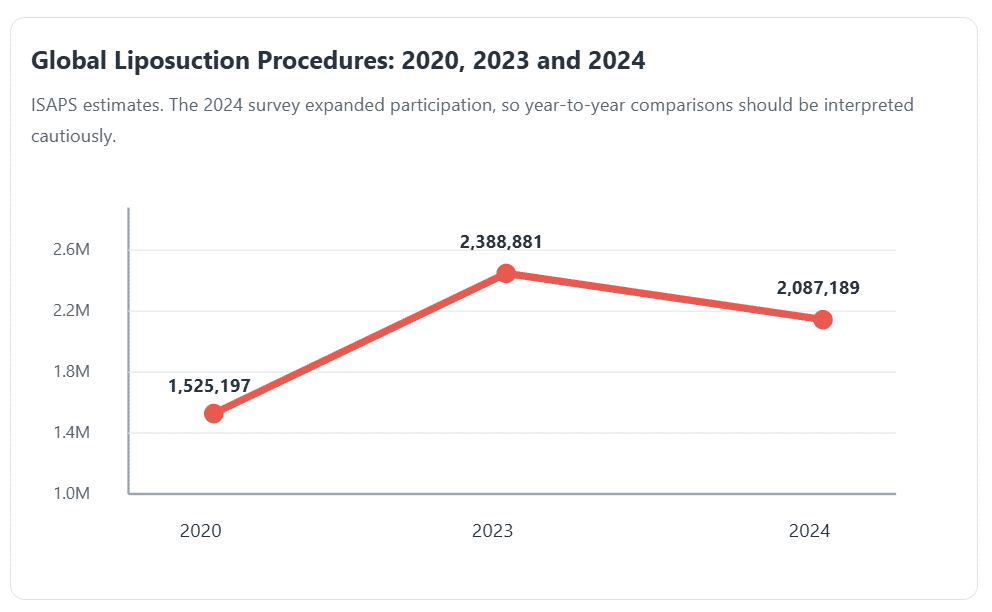
The latest available ISAPS survey, released in 2025 for procedures performed in 2024, shows that liposuction remains one of the world’s most common cosmetic operations. Mexico recorded an estimated 98,754 liposuction procedures, representing 13.5% of its cosmetic surgical procedures in the survey. These figures describe procedure volume, not safety, quality or individual outcomes.
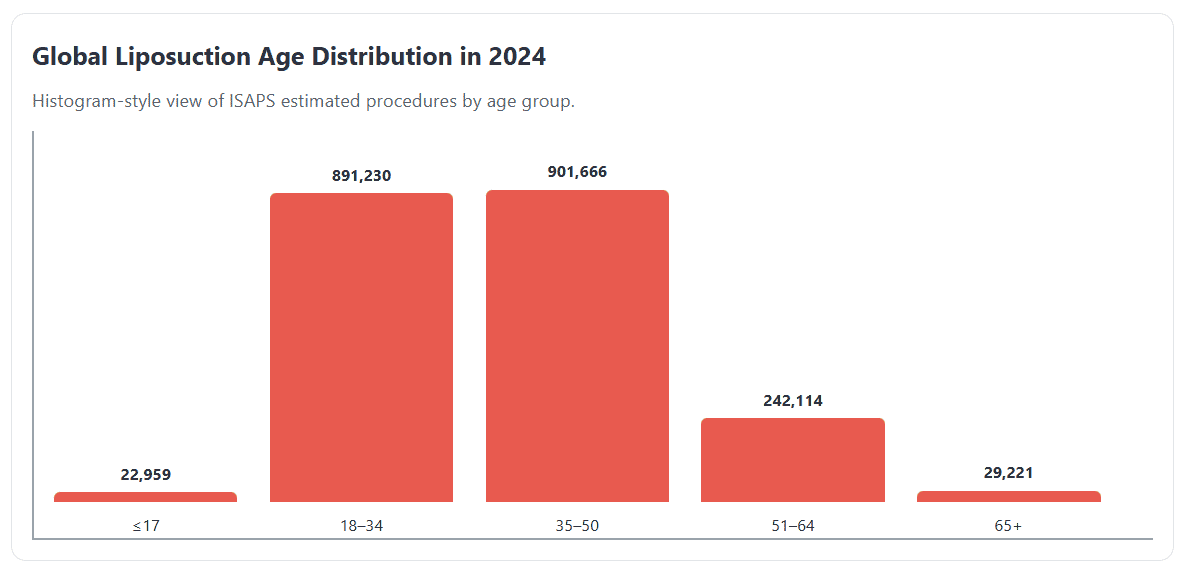
ISAPS estimated that women accounted for 85.9% of liposuction procedures worldwide and men for 14.1%. The largest age groups were 18–34 and 35–50, together representing most global procedures. These global demographics should not be used to decide candidacy; health status, anatomy, goals and risk assessment matter more than age or gender alone.
Estimated liposuction procedures in Mexico during 2024
Share of Mexico’s cosmetic surgical procedures represented by liposuction
Average foreign-patient share reported by surveyed Mexican plastic surgeons
Most frequently cited origins of international patients treated in Mexico
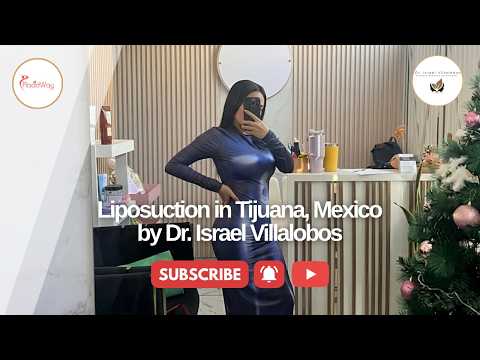
Liposuction in Mexico - Patient Success Story
Planning Liposuction Travel and Aftercare in Mexico
Treat the trip as a medical journey rather than a vacation. Swimming, alcohol, sun exposure, long tours and strenuous activity can interfere with healing. Choose accommodation with an elevator or minimal stairs, enough space for a caregiver, reliable transport and reasonable access to the operating facility.
| Planning stage | Liposuction travel action | Document to keep |
|---|---|---|
| Before deposit | Verify surgeon, facility, price, refund terms and emergency plan | Credential screenshots and itemized quote |
| Four to six weeks before travel | Discuss medical tourism and travel risk with your home clinician | Medical summary and medication list |
| Before departure | Confirm caregiver, flexible travel, insurance limitations and emergency funds | Travel policy and clinic contacts |
| Before leaving Mexico | Attend examination and obtain clearance for travel | Operative report, discharge summary and test results |
| After returning home | Keep scheduled follow-up and seek local care promptly for concerns | English-language records and follow-up plan |
Ask whether your domestic health insurance excludes complications from elective surgery abroad. Consider travel medical and evacuation coverage, while understanding that many policies also exclude planned procedures. Make sure you have funds and a realistic plan for unexpected admission, a delayed flight or local follow-up after returning home.
Liposuction in Mexico FAQs
How much does liposuction cost in Mexico in 2026?
Recent PlacidWay clinic quotes generally range from $3,500 to $10,500, with an average near $7,000. Your final cost depends on the number of areas, technique, operating time, anesthesia and facility. Confirm whether the quote is procedure-only or includes garments, tests, follow-up and accommodation.
Is liposuction in Mexico safe for international patients?
Liposuction can be performed safely, but no country or clinic can remove surgical risk. Safety depends on your health, a qualified plastic surgeon, a licensed facility, appropriate anesthesia, responsible procedure volume and reliable aftercare. Verify COFEPRIS licensing and current CONACEM/CMCPER surgeon certification before booking.
How do I verify a plastic surgeon for liposuction in Mexico?
Search the surgeon’s full legal name through Mexico’s professional-license system and the CONACEM specialist directory. Look for a specialist professional license and current certification through the Mexican Council of Plastic, Aesthetic and Reconstructive Surgery. Do not rely only on social-media followers, diplomas or clinic testimonials.
How long should I stay in Mexico after liposuction?
The stay should cover early recovery, at least one meaningful postoperative examination and surgeon clearance for travel. Many patients plan roughly seven to fourteen days, but larger-volume, abdominal or combined surgery may require longer. Your surgeon should individualize timing based on healing and blood-clot risk.
Can I fly home immediately after liposuction in Mexico?
Flying immediately is generally inappropriate because surgery and prolonged sitting can increase blood-clot risk. The CDC advises medical tourists to discuss flight timing with their clinicians, and abdominal surgery may require at least ten days before flying. Travel only after an in-person review and explicit clearance.
Is liposuction in Mexico a weight-loss procedure?
No. Liposuction is designed to reshape selected areas by removing localized subcutaneous fat. It is not a treatment for obesity, visceral fat or major weight loss. Patients usually achieve more predictable contouring when their weight is stable and their goals focus on proportion rather than kilograms.
What is the difference between liposuction and a tummy tuck in Mexico?
Liposuction removes selected fat through small incisions but does not remove a significant amount of loose skin. A tummy tuck removes excess abdominal skin and may repair separated abdominal muscles. Some patients need one procedure, while others may be considered for a carefully planned combination.
What should an all-inclusive liposuction package in Mexico include?
A package may include surgeon, anesthesiologist, operating room, routine testing, compression garment and local follow-up. Hotel, transfers, medication and caregiver support vary. Ask for an itemized document naming the operating facility and explaining exclusions, extra-area charges, cancellation terms and complication responsibilities.
When can I return to work after liposuction in Mexico?
Some patients with limited treatment and desk work return within one to two weeks, while larger-area surgery or physical work requires more time. Bruising and swelling often improve gradually over several weeks. Follow your surgeon’s restrictions rather than choosing a return date based only on travel plans.
Are liposuction results permanent?
Removed fat cells do not return in the same pattern, but remaining cells can enlarge with weight gain, and skin changes with age. Results may remain long lasting when you maintain a stable weight and healthy habits. Swelling can take months to resolve before the final contour is evaluated.
Can I combine liposuction with a BBL or tummy tuck in Mexico?
Combination surgery may be appropriate for selected patients, but it can increase operating time, blood loss, mobility limitations and clot risk. Ask why each procedure is needed, where fat will be placed, how long surgery will last and whether staging the operations would provide a safer plan.
What medical records should I bring home after liposuction in Mexico?
Request your operative report, anesthesia record, discharge summary, laboratory results, medication list, device information and written aftercare plan. Obtain records in English when possible. These documents help a local clinician understand exactly what was performed if you need routine follow-up or urgent complication care.
Compare Liposuction Options in Mexico With PlacidWay
PlacidWay can help you compare providers, understand different liposuction quotes, identify questions about surgeon credentials and facility licensing, and request information from clinics. Always complete an independent medical consultation before deciding whether surgery is appropriate.
Disclaimer: This information is for educational purposes only and does not replace professional medical advice. Always consult a qualified healthcare provider before making medical decisions.
.png)


.jpg)


.jpg)









Share this listing