


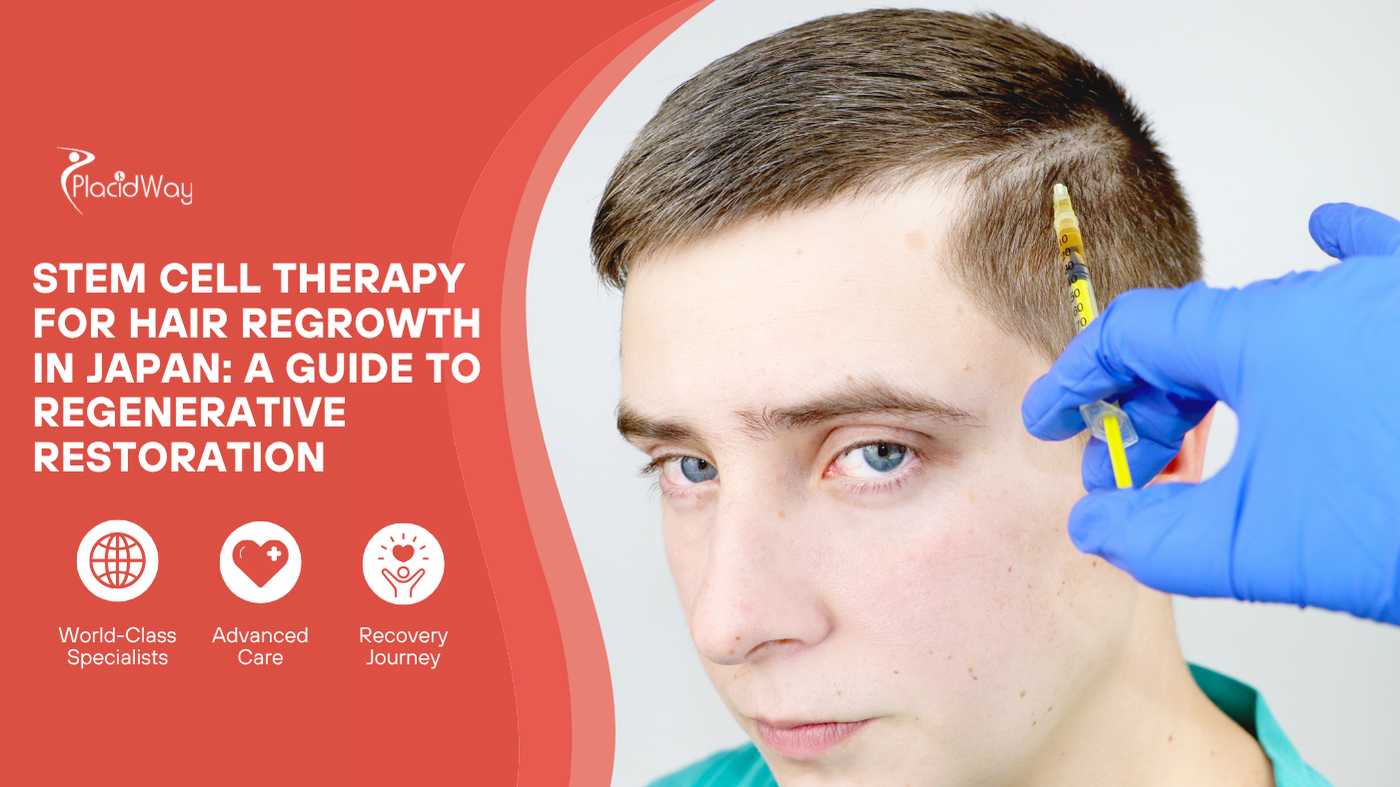
Quick Summary: Stem Cell Therapy for Hair Regrowth in Japan
- Cost: A reliable public nationwide price range for stem-cell-based hair procedures in Japan is not available. Request an itemized estimate in Japanese yen and USD before you travel.
- Evidence: Stem-cell-based hair restoration is not a single treatment. Evidence, expected benefit, and regulatory status depend on the product, procedure, and your diagnosis.
- Best starting point: A dermatologist should first identify whether you have pattern hair loss, alopecia areata, scarring alopecia, shedding after illness, or another cause.
- Safety: Ask about the source and processing of any cells or cell-derived product, infection prevention, local anaesthesia or sedation, emergency support, and realistic risks.
- Credentials to verify: Confirm the clinic’s Japanese medical licence, the physician’s medical registration and dermatology qualifications, and the treatment’s stated regulatory or research pathway.
- Important caution: Japan’s interest and regulation in regenerative medicine do not mean every marketed hair-regrowth procedure is proven or suitable for international patients.
Why international patients look to Japan for regenerative hair restoration
Japan is widely associated with biomedical research, careful product oversight, and advanced regenerative-medicine science. For some patients from the United States, Canada, Australia, Southeast Asia, and the Gulf region, that reputation makes Japan an appealing place to explore a hair-loss consultation or treatment abroad. Others are searching after standard options have not met their goals or after they have seen online claims about cell-based therapies.
Those motivations deserve respect, but they are not evidence that a particular clinic can regrow hair or reverse a specific disease. Public data showing how many international patients travel to Japan specifically for stem-cell-based hair treatment, their ages, genders, diagnoses, or outcomes are not available. Avoid letting marketing claims stand in for that missing information.
A reason to explore
You want a dermatologist-led assessment and a written explanation of all evidence-based hair-loss options, not only a regenerative procedure.
A reason to pause
You are being asked to book or pay before anyone has reviewed photographs, scalp findings, medical history, and the cause of your hair loss.
A realistic expectation
Even when a procedure is medically appropriate, hair changes are gradual and variable. No clinic can responsibly promise density, coverage, or a permanent result.
A well-planned consultation should leave you clearer about your diagnosis, alternatives, limitations, cost, and follow-up. It should not make you feel pressured to travel quickly because a treatment is described as exclusive or time-sensitive.
Your hair-loss diagnosis matters before any stem cell therapy in Japan
“Hair loss” describes several different conditions. Androgenetic alopecia, also called male- or female-pattern hair loss, is a common progressive form associated with genetic and hormonal factors. Alopecia areata is an autoimmune condition that can cause patchy loss. Telogen effluvium is diffuse shedding that may follow illness, stress, childbirth, surgery, nutritional change, or medication. Scarring alopecia can permanently damage follicles and needs prompt specialist evaluation.
These conditions do not have the same biology or the same evidence-based treatment pathway. A regenerative procedure promoted for pattern thinning may be unsuitable for autoimmune disease, active scalp inflammation, or scarring hair loss. If you have sudden shedding, scaling, pain, redness, pustules, eyebrow loss, or patchy bald areas, seek a dermatologist’s diagnosis rather than self-selecting a treatment online.
Why diagnosis changes the hair-restoration conversation| Hair-loss pattern | What a clinician needs to assess | Why it affects a regenerative option |
|---|---|---|
| Pattern hair loss | Pattern, duration, family history, scalp health, medicines, and expected progression. | Existing follicles may respond differently from areas with longstanding follicle loss. |
| Alopecia areata | Autoimmune activity, extent, nail changes, other conditions, and active inflammation. | The key issue is immune-driven disease control, not simply follicle stimulation. |
| Diffuse shedding | Recent illness, blood loss, stress, endocrine factors, diet, and medications. | Treating a reversible trigger may be more important than a procedure. |
| Scarring alopecia | Inflammation, symptoms, biopsy when clinically needed, and speed of progression. | Follicle destruction can be permanent; delay may reduce options. |
Bring recent scalp photographs, prior dermatology notes, laboratory results if available, medication lists, allergies, and a record of earlier treatments. This makes a remote or in-person consultation more clinically useful and reduces the risk of choosing care based on an incomplete picture.
What “stem cell therapy for hair regrowth” may mean in Japan
The phrase can refer to very different interventions. Some offers may involve a patient’s own tissue, cell-based preparations, conditioned media, extracellular vesicles or exosomes, platelet-rich plasma, scalp injections, or products marketed as stem-cell-derived. These are not interchangeable. Their biological rationale, manufacturing controls, evidence, risks, and legal status may differ substantially.
Stem cells can self-renew and develop into specialized cells in particular biological settings. In hair science, researchers are studying the hair follicle environment, dermal papilla cells, signalling pathways, inflammation, and tissue regeneration. Research interest does not establish that a commercial intervention will reactivate inactive follicles, create new follicles, or reverse each patient’s hair loss.
The International Society for Stem Cell Research advises that clinical translation should proceed with rigorous scientific, clinical, ethical, and regulatory oversight. It also warns that marketing unproven stem-cell interventions can endanger patient welfare. That is relevant whether you are comparing options at home or in Japan.
How regenerative hair treatments compare with established hair-loss care
Stem-cell-based hair restoration should be discussed alongside not instead of a full dermatology plan. The Japanese Dermatological Association’s guidance on male- and female-pattern hair loss describes evidence-based options for appropriate patients. Your own treatment options depend on sex, diagnosis, reproductive status, other health conditions, medication interactions, and personal goals, so this guide cannot tell you what you should use.
Hair transplantation is a surgical option for selected people with adequate donor hair and a stable treatment plan, while medical treatment can help some people slow pattern loss. Regenerative treatments may be offered as investigational or adjunctive options in some settings. A clinic should explain why it recommends one approach over another and what evidence supports the sequence.
A patient-friendly way to compare treatment categories| Category | What it is intended to address | Questions to ask |
|---|---|---|
| Dermatology assessment and standard care | Diagnosis, disease activity, and medically appropriate management. | What is the diagnosis? Which treatments have evidence for this condition? What monitoring is needed? |
| Hair transplantation | Redistribution of existing donor follicles in selected candidates. | Is donor supply adequate? Is hair loss stable? What are the surgical and cosmetic limitations? |
| Regenerative or cell-based intervention | Potentially influences the scalp or follicle environment, depending on the exact product and protocol. | Is it standard care, research, or another regulated pathway? What relevant human evidence and safety data exist? |
Beware of comparisons that call every non-surgical option “natural” or claim that it can replace medical diagnosis. The important comparison is not “natural versus medical”; it is whether there is credible, diagnosis-specific evidence and a clear plan to protect you from avoidable harm.
Japan’s regenerative-medicine oversight: what you should verify before booking
Japan has dedicated legal and regulatory frameworks for regenerative medicine. The Ministry of Health, Labour and Welfare and the Pharmaceuticals and Medical Devices Agency, commonly called PMDA, have important roles in the regulation and review environment for regenerative medical products. Japan also has a clinical-study registry that includes notifications under the Act on the Safety of Regenerative Medicine.
These frameworks are meaningful, but they do not turn a marketing claim into evidence for hair regrowth. A clinic should tell you whether your proposed care involves an approved regenerative medical product, a properly notified or reviewed clinical study, or another form of medical service. Ask for the exact treatment name, documentation, and an explanation you can understand before you pay a deposit.
Japan clinic and clinician verification checklist
- The legal name and address of the medical institution, and confirmation that it is authorised to provide medical care in Japan.
- The treating doctor’s full name, Japanese physician registration, specialty training, and role during the procedure.
- The exact product or preparation, its source, processing site, sterility or quality controls, and traceability process.
- The treatment pathway and, if research is claimed, a registry entry, ethics oversight information, and consent materials.
- A written complication protocol, emergency contact, hospital-transfer arrangement, and aftercare plan that works after international travel.
- An itemized quote, cancellation policy, medical-records policy, and the language in which consent and discharge information will be provided.
International accreditation may be useful information for some hospitals, but it does not replace Japanese licensing, a qualified dermatologist’s assessment, or credible evidence for the exact protocol. A current certificate does not prove that every service at a facility has the same level of evidence.
What stem cell therapy for hair regrowth in Japan may cost and how to compare quotes
Information not available: there is no dependable public national cost range for stem-cell-based hair regrowth treatment in Japan that can be used as a patient-specific estimate. Prices may vary based on the diagnosis, city, clinic setting, type and source of the preparation, laboratory work, injection or procedural technique, monitoring, number of sessions, and aftercare.
Ask each prospective clinic for the same scope of information. A lower procedure price may exclude tests, consultation, scalp imaging, medicines, local anaesthesia, follow-up, a companion’s needs, travel delays, or management of complications. If the recommended plan changes after in-person assessment, ask for a revised written estimate before agreeing to additional care.
What an itemized Japan hair-restoration quote should show| Cost area | Ask for details | Often overlooked |
|---|---|---|
| Assessment and diagnosis | Dermatology review, scalp examination, imaging, laboratory tests, and interpretation. | A needed in-person assessment after an online quote. |
| Procedure and product | Product/preparation, laboratory or processing, procedure room, clinician fees, medicines, and observation. | Additional sessions or an altered plan after your scalp review. |
| Aftercare and complications | Follow-up, remote review, medical records, and escalation arrangements. | Extra accommodation, emergency transfer, or care after return home. |
| Travel and practical support | Flights, lodging, local transport, translator, accessible travel, insurance, and companion costs. | Currency conversion, bank fees, refundable travel, and medical evacuation cover. |
Safety, recovery, and red flags after a hair-regeneration procedure in Japan
The risks depend on what is proposed. Any scalp injection or procedure can involve pain, swelling, bleeding, infection, allergic reaction, bruising, scarring, temporary shedding, or an unsatisfactory cosmetic outcome. A cell-based or biologically derived product may introduce additional questions about sourcing, processing, contamination controls, immune response, and long-term monitoring.
Recovery is not a standard timeline. Your clinician should say whether you can wash your hair, use topical products, exercise, drink alcohol, travel by air, and return to work based on the procedure you actually receive. Do not use generic social-media advice in place of the instructions given by the clinician responsible for your care.
A recovery plan should address more than the procedure day| Timeframe | Clinical focus | Action for you |
|---|---|---|
| Before treatment | Diagnosis, photographs, risk review, consent, and fit-to-travel assessment. | Share all medicines, allergies, conditions, and prior scalp procedures. |
| Procedure day | Product traceability, aseptic technique, observation, and discharge readiness. | Leave with written instructions, contact numbers, and a copy of your record. |
| Early recovery | Pain, swelling, wound or scalp changes, and any evolving adverse event. | Follow clinic advice and seek prompt local care if symptoms are severe or worsening. |
| Return home | Ongoing assessment and continuity with your home clinician. | Share procedure notes and follow-up plans with a clinician at home. |
Medical travel planning for hair treatment in Japan
A safe trip includes more than a clinic appointment. Before booking, check current entry, visa, health, medication, and travel-insurance information with official sources for your nationality. If you use prescriptions, carry them in original labelled containers, bring enough for your full trip plus a reasonable delay, and keep a written medication list in English and, where helpful, Japanese.
Ask whether the clinic can provide informed-consent documents, discharge instructions, invoices, and medical records in a language you understand. If it uses an interpreter, clarify whether the interpreter will be present for consent and aftercare not only for reception. A companion can be helpful if you have anxiety about travel, communication needs, or a procedure that may affect your ability to navigate the city safely the same day.
Before you pay a deposit, make sure you have
- A diagnosis-specific consultation and a copy of the proposed plan.
- Itemized treatment, travel, and aftercare costs with cancellation terms.
- Written details about the cell or cell-derived preparation and its pathway.
- A clear answer on emergency support, hospital transfer, and who follows you after you leave Japan.
- Travel insurance reviewed for exclusions involving planned care, complications, and medical evacuation.
- A home clinician or dermatologist who can receive your records and provide follow-up if needed.
Do not schedule your return flight so tightly that you cannot stay if your clinician advises additional observation. A medically appropriate decision may be to delay travel, choose local care, explore a formal study, or decide that the proposed procedure is not worth its uncertainty.
A patient-first way to decide about stem cell therapy for hair regrowth in Japan
Your goal may be fuller-looking hair, less shedding, a restored hairline, or simply a clearer understanding of what is happening. Start with a diagnosis and realistic goals, then compare the benefits, drawbacks, and evidence for all suitable options. A regenerative procedure is not automatically the most advanced choice just because it uses modern terminology.
A good decision can be to continue standard treatment, address a reversible trigger, consider transplantation, enter formal research, or do nothing for now. The correct next step is the one that respects your health, evidence, budget, and tolerance for uncertainty.
Frequently asked questions about stem cell therapy for hair regrowth in Japan
Is stem cell therapy for hair regrowth in Japan proven?
There is no single stem cell therapy for hair loss. Evidence depends on the exact product, cell source, processing, route, and diagnosis. Many regenerative hair interventions remain investigational or have limited evidence. Ask for research supporting the same intervention for your specific hair-loss condition before you consider treatment.
Can stem cell treatment regrow hair lost from androgenetic alopecia?
No clinic can responsibly guarantee hair regrowth for androgenetic alopecia. Pattern hair loss varies in duration, severity, follicle activity, and response to treatment. A dermatologist should discuss evidence-based care, transplantation where appropriate, and any regenerative proposal’s evidence, limits, risks, cost, and follow-up plan.
What is the cost of stem cell hair restoration in Japan?
A reliable public nationwide price range is not available. Cost can change with diagnosis, preparation, laboratory processing, number of sessions, procedure technique, monitoring, and travel. Request an itemized quote in yen and USD that identifies consultation, testing, procedure, aftercare, excluded costs, cancellation, and complication arrangements.
How do I verify a Japanese clinic offering regenerative hair treatment?
Verify the medical institution’s legal identity and authorization, the treating doctor’s registration and dermatology credentials, and the exact product and pathway offered. Request a written plan, consent documents, emergency process, aftercare details, and research or registry information if the intervention is described as a clinical study.
Are exosomes, conditioned media, PRP, and stem cells the same thing?
No. These terms may describe different biological materials or procedures with different sourcing, manufacturing, biological rationale, evidence, and risks. Do not accept a broad “stem cell” label as a product description. Ask exactly what will be used, how it is processed, and why it is proposed for your diagnosis.
How long should I stay in Japan after a hair-regeneration procedure?
There is no universal stay length. It depends on the procedure, anaesthesia or sedation, your health, the planned observation period, and the clinician’s travel guidance. Ask for discharge criteria, written warning signs, follow-up timing, and what happens if symptoms arise before your return flight.
What are the risks of scalp injections or cell-based hair procedures?
Risks vary, but can include pain, bleeding, swelling, bruising, infection, allergic reaction, scarring, temporary shedding, and cosmetic dissatisfaction. Cell-based preparations raise further questions about product sourcing, processing, contamination controls, immune reaction, and monitoring. Your clinician should explain risks specific to the proposed protocol.
Can I combine hair transplantation with regenerative therapy in Japan?
Combination care may be discussed in some settings, but suitability depends on diagnosis, donor hair, active disease, scalp health, and the evidence for each component. Ask the surgeon or dermatologist why each part is recommended, whether the timing is evidence-based, and what outcome uncertainty remains with the combination.
Will insurance cover regenerative hair treatment abroad?
Coverage varies and planned cosmetic or investigational care may be excluded. Before booking, ask your insurer in writing about treatment abroad, complications, emergency care, medical evacuation, cancellation, and follow-up after you return. Do not assume travel insurance covers a planned regenerative procedure simply because it covers travel illness.
What records should I take home from a Japanese hair clinic?
Request consultation notes, diagnosis, photographs or scalp assessments, consent documents, product and procedure details, medicines administered, discharge instructions, laboratory results where applicable, and follow-up contacts. Give these records to your local dermatologist or doctor so they can coordinate care if symptoms or questions arise.
Disclaimer
This information is for educational purposes only and does not replace professional medical advice. Always consult a qualified healthcare provider before making medical decisions.
References
- Clinical Translation of Stem Cell-Based Interventions – International Society for Stem Cell Research
- Policy: Marketing of Unproven Stem Cell Treatments – International Society for Stem Cell Research
- Regenerative Medical Products – Pharmaceuticals and Medical Devices Agency, Japan
- List of Approved Products: New Regenerative Medical Products – Pharmaceuticals and Medical Devices Agency, Japan
- Japan Registry of Clinical Trials – Ministry of Health, Labour and Welfare
- Guidelines for the Diagnosis and Treatment of Male-Pattern and Female-Pattern Hair Loss – PubMed
- Guidelines for the Diagnosis and Treatment of Male-Pattern and Female-Pattern Hair Loss – Japanese Dermatological Association
- Important Patient and Consumer Information About Regenerative Medicine Therapies – U.S. Food and Drug Administration
-(6).png)

.png)

.png)
-(2).png)
.png)
.png)


-1.png)









Share this listing