When persistent knee pain begins to limit walking, exercising, or navigating stairs despite conservative care, conversations with orthopedists eventually turn toward surgical options. At this juncture, patients across the UAE naturally begin asking: Are there other approaches worth investigating? Could regenerative medicine have a role? What is actually supported by evidence? This guide explores why Japan has become a premier destination for evaluating cellular therapies, helping UAE patients navigate choices beyond conventional knee surgery responsibly.
Quick Summary
Key Consideration
Summary Details
Target Condition
Knee Osteoarthritis (Mild to Moderate / Grade II–III non-surgical candidates)
Primary Cell Types Investigated
Autologous Adipose-Derived Stem Cells (ADSCs) & Bone Marrow MSCs
Regulatory Environment
Regulated under Japan's Safety of Regenerative Medicine Act (MHLW & PMDA)
Primary Objective
Modulating intra-articular inflammation, pain reduction, and mobility enhancement
Typical Evaluation Stay
3 to 7 days for clinical evaluation, cell processing, and intra-articular delivery
Cost Spectrum
$10,000 – $25,000 USD (Varies by cell harvesting, culturing, and protocol)
Featured Regenerative Centers in Japan
When considering international medical review for Stem Cell Therapy for Knee Osteoarthritis in Japan, evaluating clinic licensing, physician expertise, and formal Japanese regulatory submissions is essential. Below are leading accredited centers in Japan providing specialized cellular therapy programs:
Cell Grand Clinic
Location: Osaka, Japan
Cell Grand Clinic in Osaka provides advanced autologous stem cell treatments for joint conditions under Japan's MHLW regulatory oversight, offering tailored clinical evaluations and international patient support.
Helene Clinic is a pioneering cell therapy center in Tokyo, recognized for its comprehensive safety protocols, cell processing standards, and dedicated care for international medical travelers.
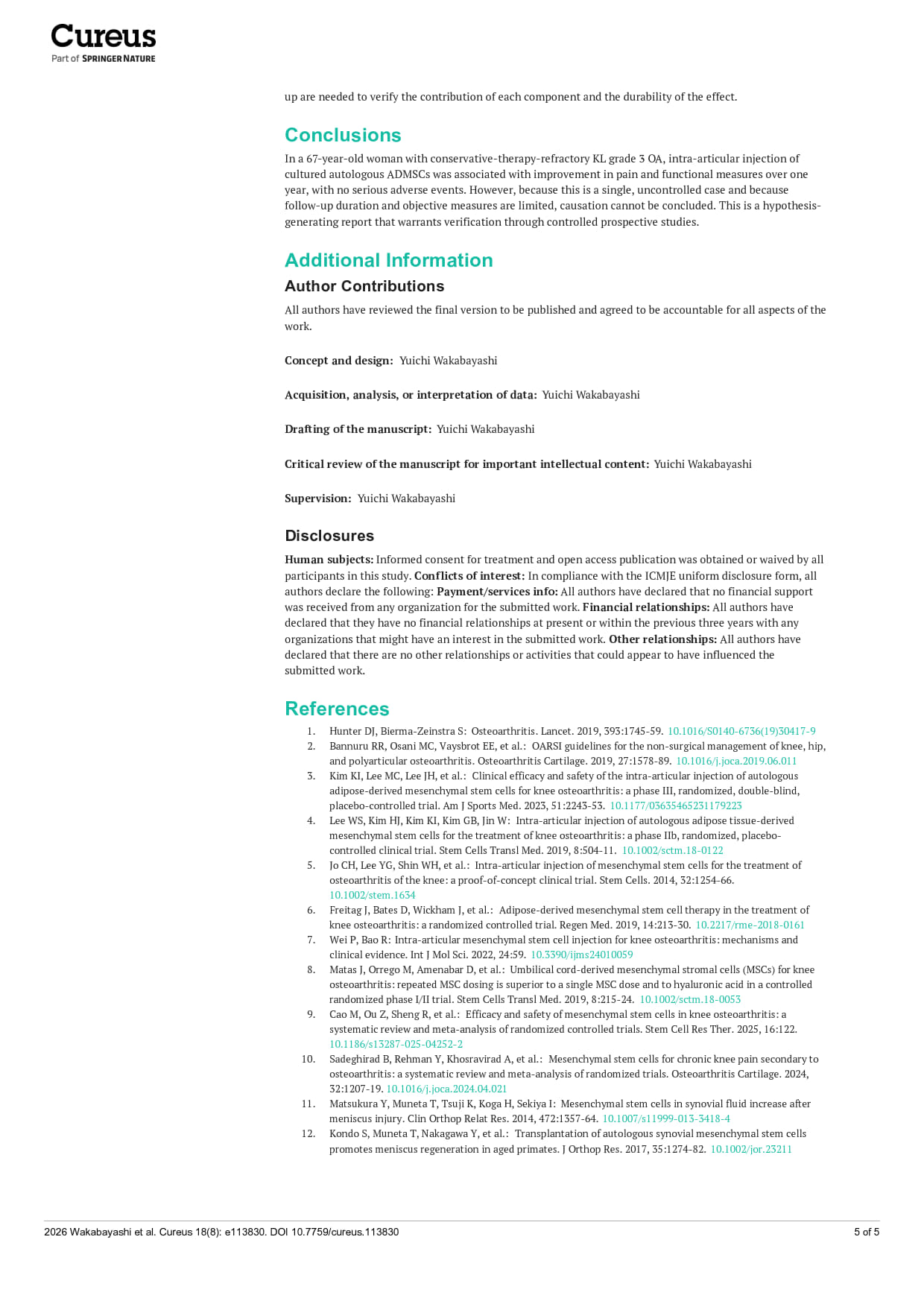
Reflecting this commitment to transparency, Dr. Wakabayashi’s one-year outcome report on adipose-derived stem cell therapy for knee osteoarthritis was published in the peer-reviewed medical journal Cureus in 2026 (DOI: 10.7759/cureus.113830), adding independently verifiable clinical documentation to the clinic’s growing body of research.
Symptomatic Improvement Following Intra-articular Injection of Cultured Autologous Adipose-Derived Mesenchymal Stem Cells in Kellgren-Lawrence Grade 3 Knee Osteoarthritis: A Case Report With One-Year Follow-Up
Page 1
Page 2
Page 3
Page 4
Page 5
Author: Yuichi Wakabayashi
Affiliation: Regenerative Medicine, Cell Grand Clinic, Osaka, Japan
Journal:Cureus
Year: 2026
Volume/Issue: 18(8)
Article: e113830
DOI: 10.7759/cureus.113830
Before Looking Abroad, Understand What Your Knee Is Actually Telling You
Evaluating non-surgical alternatives begins with a precise diagnosis. Knee pain is a symptom, not a standalone condition. Before exploring regenerative options in Japan, patients must establish whether knee discomfort stems strictly from cartilage breakdown or from co-existing joint conditions.
Is the Pain Really From Osteoarthritis?
It is vital to distinguish primary knee osteoarthritis (OA) from other structural or inflammatory etiologies, including isolated meniscus tears, ligamentous instability (ACL/MCL), inflammatory arthropathies (rheumatoid or psoriatic arthritis), patellar tendinopathy, or referred pain from the hip and spine.
Why Imaging and Symptoms Both Matter
An X-ray or MRI showing joint space narrowing does not always correlate directly with daily pain levels. A complete evaluation pairs radiographic evidence with weight-bearing physical examinations, range-of-motion assessments, and daily functional limitations.
How Severe Is the Joint Damage?
Determining joint disease severity (e.g., Kellgren-Lawrence Grading Scale I through IV) helps establish realistic expectations. Mild to moderate disease (Grades II and III) represents the primary focus of biological research, whereas end-stage bone-on-bone disease (Grade IV) frequently yields limited biological response.
Knee Pain Investigation Map
Evaluating knee osteoarthritis involves clinical assessment alongside appropriate imaging and consideration of symptoms and function. Source: American Academy of Orthopaedic Surgeons (AAOS).
The Point Where Surgery Enters the Conversation
Total Knee Arthroplasty (TKA) remains one of the most successful orthopedic procedures for end-stage joint destruction. However, the timing of surgery is a deeply personal decision.
When Conservative Treatment Is No Longer Enough
When physical therapy, weight management, oral anti-inflammatories, and hyaluronic acid injections stop offering adequate relief, patients face progressive functional declines and reduced quality of life.
What Knee Replacement Actually Addresses
Arthroplasty does not "heal" or "regenerate" natural joint tissues; it excises damaged articular cartilage and replaces joint surfaces with metal and polyethylene components. While effective, it carries surgical risks, recovery timelines, and finite implant lifespans.
Surgery Is Established — But Patients Can Still Ask Questions
Seeking second opinions or investigating cellular alternatives is a standard component of informed decision-making. Patients have the right to ask whether surgery is needed immediately, what biological options exist for their specific grade of disease, and what risks are involved with each path.
Why Some UAE Patients Start Researching Regenerative Medicine
Patients in Dubai, Abu Dhabi, and the broader Gulf region actively seek international medical options for several practical reasons:
Comprehensive Info
Desire to gather exhaustive clinical information before committing to major irreversible joint replacement.
Second Opinions
Seeking evaluations from leading global orthopedic and regenerative specialists outside home markets.
Emerging Science
Interest in biological interventions that target joint environment signaling rather than structural excision.
Regulated Access
Targeting destinations like Japan with formalized national oversight and strict clinical safety standards.
Editorial Note: Exploring a non-surgical option does not mean choosing it. Investigating biological care is simply a structured way to evaluate all viable options alongside a qualified physician.
Stem Cell Therapy: What Patients Are Actually Investigating
The term "stem cell therapy" is broad and often misused. Understanding cell origin, culturing methods, and delivery techniques is crucial when evaluating medical care.
Cell Source
Harvest Method
Biological Characteristics
Clinical Context in Japan
Autologous Adipose (ADSC)
Mini-liposuction (subcutaneous fat)
High cell yield, strong anti-inflammatory cytokine secretion
Widely used under MHLW Class II framework
Bone Marrow (BM-MSC)
Iliac crest bone marrow aspiration
Rich in chondrogenic growth factors and signaling proteins
Established autologous orthopedic protocol
Umbilical Cord (Allogeneic)
Screened donor umbilical tissue
Young cell population, zero donor harvesting site recovery
Subject to specific institutional approvals
What Are Researchers Hoping to Change Inside an Arthritic Knee?
Rather than physically regrowing a perfect new joint overnight, intra-articular mesenchymal stem cell injections are primarily studied for their biochemical impact on the joint environment:
Researchers studying cell-based therapies for knee osteoarthritis examine biological effects alongside clinical outcomes such as pain and physical function. Source: PubMed-indexed systematic review (PMC7852156).
The Evidence Question: Does Stem Cell Therapy Really Help Knee OA?
Evaluating clinical literature requires distinguishing pain management success from full structural cartilage restoration.
What Clinical Trials Have Reported
Multiple randomized controlled trials (RCTs) and systematic reviews report statistically significant reductions in VAS (Visual Analog Scale) pain scores and improvements in WOMAC (Western Ontario and McMaster Universities Osteoarthritis Index) functional scores compared to baseline at 6 and 12 months post-treatment.
Pain Improvement Is Not the Same as Cartilage Regeneration
While functional gains and pain relief are frequently documented, complete MRI-proven restoration of hyaline cartilage remains inconsistent across clinical trials.
What Remains Uncertain
Long-term durability past 24 to 36 months, optimal dosing parameters, exact cell culturing protocols, and defining ideal patient candidate profiles remain actively studied in global clinical trials.
Why Japan Becomes Part of the Conversation
Japan is internationally recognized for establishing a formal, nation-wide legal framework governing cellular medicine:
Japan Has Built a Dedicated Regenerative Medicine Framework
In 2014, Japan enacted the Act on the Safety of Regenerative Medicine (ASRM) alongside amendments to the Pharmaceuticals and Medical Devices (PMD) Act. This dual system created clear risk classification levels (Class I, II, and III) for stem cell administration.
The Framework Has Continued to Evolve
Japan's amended regenerative medicine safety framework took effect on May 31, 2025, with ongoing refinement by the Ministry of Health, Labour and Welfare (MHLW) to ensure cell quality control, patient consent standards, and adverse event reporting.
Crucial Regulatory Warning: Regulation and clinical effectiveness are two different questions. A clinic permitted to administer cells within Japan's legal safety framework does not mean the procedure is guaranteed to cure knee osteoarthritis for every individual.
Japan's Regenerative Medicine Framework — What UAE Patients Should Know
How Japan's Framework Fits Together
Japan uses dedicated regulatory frameworks for regenerative medicine practices and manufactured cellular products. Source: Japan Ministry of Health, Labour and Welfare (MHLW) and PMDA.
Coordinate follow-up schedule with home orthopedist in UAE
What Should a UAE Patient Ask a Japanese Clinic Before Paying?
Medical Questions
1. What is my exact OA grade?
2. What specific cell type will be used?
3. What cell dosage (count) is planned?
Regulatory Questions
4. What MHLW plan number applies?
5. Is cell processing done in a certified CPC?
6. Can you provide cell sterility reports?
Safety & Costs
7. What are the adverse event protocols?
8. What is the realistic outcome target?
9. What total costs are included?
The UAE Patient's Decision Checklist
“Before You Fly to Japan” Verification Checklist
Local UAE Diagnosis & MRI Confirmed
Japanese Clinic Remote Review Completed
Specific Cell Source & Culturing Explained
MHLW Regulatory Plan Verification Obtained
Realistic Outcome Expectations Set
Post-Treatment Rehabilitation Planned in UAE
Patients considering regenerative medicine should clarify treatment, regulatory pathway, risks, and follow-up plans before traveling. Sources: PMDA, MHLW, and U.S. FDA.
What About the United States FDA Position?
International medical travelers should recognize that regulatory frameworks differ significantly across international borders. The U.S. Food and Drug Administration (FDA) emphasizes that cellular therapies for orthopedic conditions like knee osteoarthritis remain investigational in the United States unless specific biologics license approvals (BLAs) are granted.
Why This Matters to an International Patient
Legal authorization in Japan under the ASRM framework reflects Japan's specific national legislative approach to regenerative medicine. Availability in one country does not imply approval in another.
Cost of Stem Cell Therapy for Knee Osteoarthritis in Japan
The cost of Regenerative Medicine for Knee Pain in Japancan vary considerably depending on the treatment protocol, type and number of cells used, cell processing or culturing requirements, physician fees, and the level of follow-up care provided. For international patients, the overall budget may also include flights, accommodation, local transportation, and follow-up expenses after returning home. The estimates below provide a general guide to the potential costs involved.
Flights (UAE to Tokyo/Osaka), hotel stay (5–10 days), local medical transport
$3,000 – $7,000
Follow-Up Care
Local physical therapy sessions, follow-up MRI scans upon return to UAE
$1,000 – $2,500
Please note: Prices are estimates and may vary depending on the clinic, treatment protocol, cell processing requirements, physician fees, length of stay, and individual patient needs. Patients should request a detailed, itemized quotation from the provider before making treatment or travel arrangements.
Frequently Asked Questions
1. Can UAE patients explore stem cell therapy in Japan before undergoing knee replacement?
Yes, many patients seek secondary reviews in Japan to explore whether biological interventions are appropriate for their disease stage before deciding on permanent joint replacement.
2. Is stem cell therapy for knee osteoarthritis proven to regrow damaged cartilage?
No. While studies show significant improvements in joint pain and functional mobility, complete structural regrowth of cartilage remains inconsistent across clinical trial literature.
3. Why are some UAE patients considering regenerative medicine before knee surgery?
Patients often seek non-surgical options to manage joint inflammation, delay surgical timelines, or preserve native joint structure when conservative care is no longer effective.
4. How is stem cell therapy for knee osteoarthritis regulated in Japan?
Cell therapies are regulated under Japan's Act on the Safety of Regenerative Medicine (ASRM), requiring clinics to submit treatment plans for review by accredited safety committees and the Ministry of Health, Labour and Welfare (MHLW).
5. Does Japan's regenerative medicine framework mean every stem cell treatment is proven effective?
No. Regulatory clearance under safety laws ensures clinical processing and facility safety standards, but individual clinical efficacy varies per patient condition.
6. What type of stem cells may be used for knee osteoarthritis treatment in Japan?
Autologous Adipose-Derived Stem Cells (ADSCs) and Bone Marrow Mesenchymal Stem Cells (BM-MSCs) are most commonly evaluated for orthopedic applications.
7. What medical records should UAE patients provide before traveling to Japan?
Patients should provide weight-bearing knee X-rays, high-resolution MRI scans, medical history, prior treatment records, and current medication logs.
8. How can UAE patients evaluate the evidence behind a Japanese stem cell treatment?
Request published clinical data from the specific clinic, verify their MHLW plan authorization number, and discuss findings with an independent orthopedist.
9. Can stem cell therapy eliminate the need for knee replacement?
In severe end-stage (Grade IV) bone-on-bone osteoarthritis, cell therapy cannot replace structural joint replacement. It is best suited for mild-to-moderate inflammatory joint disease.
10. What should UAE patients ask a Japanese clinic before choosing stem cell therapy?
Ask about cell counts, cell source, MHLW authorization details, safety monitoring protocols, total cost breakdowns, and post-treatment follow-up plans.
Make an Informed Choice for Your Knee Care!
Looking beyond surgery should mean looking more carefully — not simply looking for a different treatment. Compare accredited Japanese clinics, review medical credentials, and make an informed decision alongside qualified orthopedic specialists.
Disclaimer: This guide is for informational purposes only and does not constitute medical advice. Stem cell treatments for knee osteoarthritis remain subject to ongoing clinical investigation. Consult qualified orthopedic specialists prior to making decisions regarding international medical travel.
OverviewLearn why UAE patients with knee pain look beyond surgery and explore stem cell therapy for knee osteoarthritis in Japan for mobility and care options.
Request your Free Quote
×
Trusted Medical Tourism Platform Since 2007
60+
Countries
2k+
Clinics
19.5k+
Reviews
2.5k+
Qualified Doctors
1.1M+
Patients Served Since 2007
Explore Stem Cell Therapy: Stories, Testimonials, and Procedures
Watch in-depth videos covering everything from Stem Cell Therapy success stories to detailed procedure explanations. Learn what to expect and hear from real patients.



























Share this listing