
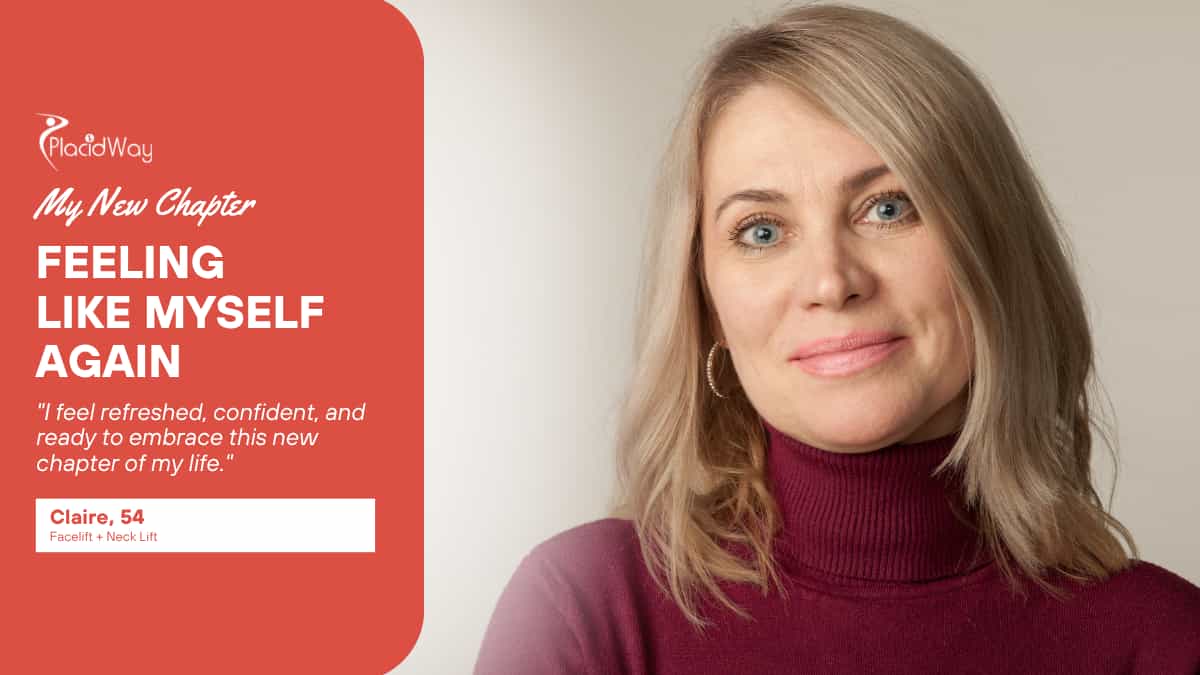
Patient Profile
Name: Claire Robertson
Age: 54
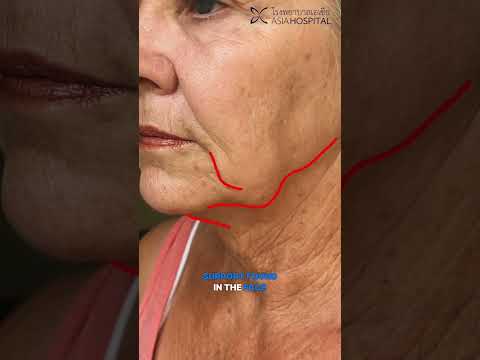
Condition: Age-related facial ptosis and skin laxity
Treatment: Facelift with possible neck lift and fat grafting
Destination: Bangkok, Thailand
Journey at a Glance
Main problems: Deepening nasolabial folds and marionette lines; Jowling and jawline definition loss; Loose, sagging skin on cheeks and neck; Crow's feet and forehead wrinkles
Previous care: Non-invasive options: Botox, dermal fillers, laser resurfacing (temporary results, recurring costs); Skincare escalation: High-end serums, cosmetic treatments, dermatology consultations; Psychological reframing: Accepting aging, self-affirmation work…
Travel driver: Cost savings (40–50% reduction) + shorter surgical wait times (2–4 weeks vs. 8–12 weeks locally) + access to surgeons with international credentials + privacy and recovery discretion + financial accessibility that removes guilt
Treatment explored: Facelift with possible neck lift and fat grafting
Personal goal: Bring her outward appearance closer to how energetic and capable she feels.
You began making quiet adjustments.
You delete the tags on social media before anyone else can see them.
You tilt your chin upward during video calls.
You invest in scarves you do not actually like.
You angle the rearview mirror away from your face at traffic lights.
You nod through meetings instead of speaking up.
You politely decline invitations to outdoor daytime events.
You spend longer in front of the bathroom mirror applying less effective makeup.
You sit with your back to the windows in restaurants.
You tell yourself it does not matter.
You realize you are lying to yourself.
"You look perfectly fine to me."
"We are all getting older, it is natural."
"I did not even notice those lines."
Your professional and social world has quietly become smaller.
The hardest part is not the daily discomfort or the anticipated cost, but the waiting.
This article follows a composite persona built from the real situations and questions Australian women face, rather than a specific clinical patient.
Claire Robertson is fifty-four and lives in suburban Sydney.
She manages regional accounts for a logistics firm.
She organizes the weekend tennis fixtures for her local club.
She handles the complex emotional architecture of an aging parent and two adult children.
She projects competence in every direction.
She no longer recognizes the face looking back at her.
How did things escalate to this point?
She explained the sagging away as temporary fatigue.
She assumed it was just a stressful quarter at work.
Botox.
Dermal fillers.
Laser resurfacing treatments.
High-end topical serums.
Dermatology consultations for skin laxity.
Acceptance mantras practiced alone in the car.
Surgical intervention, specifically a rhytidectomy, is typically considered when cutaneous aging and deep tissue ptosis progress beyond the capacity of non-invasive modalities to provide structural support.
"The structural sagging cannot be reversed with injectables."
When?
The private cosmetic surgery market in Australia is characterized by high out-of-pocket expenses and limited public funding, placing structural procedures entirely within the discretionary spending category.
But Claire Robertson does not experience the healthcare system as a national statistic.
She experiences it sitting in a boardroom where a junior colleague assumes she is nearing retirement.
"Let me take the lead on this new tech rollout."
She experiences it at a family wedding where the photographer asks her to step backward.
"If we just get the younger ones in the front row."
She experiences it at the pharmacy cosmetic counter.
"Have you considered something for mature skin?"
She has already tried to be patient.
She is not an impulsive shopper looking for a quick fix.
She spent eighteen months researching domestic options.
She gathered three separate quotes from local specialists.
She tracked the minor variations in their high fees.
She realized there is virtually no competitive price pressure in her home city.
She delayed the decision indefinitely while her dissatisfaction grew.
"I should be above caring about my jawline."
"It is just vanity and I need to let it go."
She notes a quiet shift in her default reaction:
She stopped appearing in photographs.
She realizes her perspective has fundamentally shifted from asking if she can tolerate this:
How much of my life am I prepared to organise around it?
What does the domestic alternative actually look like?
The domestic option is a recognized surgical facelift costing between AU$18,000 and AU$28,000.
Paying this fee would consume six months of her discretionary income.
It would require drawing down on the mortgage redraw facility.
It introduces a heavy burden of guilt alongside the physical recovery.
She sits at the kitchen table with her husband, Mark.
"We have the funds in the house account."
"But that money was meant for the renovations."
She knows the hard truth about local affordability:
It means taking from another pile.
The domestic option fails not because it is clinically deficient, but because it feels economically coercive.
She isn't searching for Bangkok yet.
How to fix jowls without surgery
Facelift recovery time
Why are facelifts so expensive in Sydney
Is it safe to get plastic surgery overseas
Bangkok facelift reviews
The concept of medical travel enters her algorithm.
"I am not going abroad just because something is cheaper."
Her instinct to distrust a bargain in surgery is entirely correct.
Price should not answer a medical question.
Why does this destination keep appearing?
Bangkok has deliberately positioned itself as a medical hub by integrating internationally accredited hospital facilities with surgical teams trained to global standards.
The narrative requires a specific reframing:
Countries do not perform operations.
Surgeons operate, clinical teams monitor, and hospitals facilitate care.
There are verifiable credentials to check, such as International College of Cosmetic Surgery memberships.
Current official guidance recommends conducting independent research and consulting with a domestic general practitioner before committing to any overseas procedure.
Her first question was: "How much?"
The surgical fee for a facelift in Thailand is commonly 40 to 50 percent lower than the Australian equivalent, though a comprehensive recovery package including flights and extended accommodation varies between THB 800,000 and 1,200,000, which is approximately AU$32,000 to AU$48,000 depending on exchange rates and hospital tier.
She remembers a familiar warning:
"You always get exactly what you pay for."
"What exactly am I getting?"
Are the pre-operative blood tests included?
Does this cover the anesthesiologist's fee?
Is the operating theater charged by the hour?
What happens if the surgery takes longer than planned?
Does the quote include the specific neck lift component?
Are compression garments provided?
Who pays for the post-operative medications?
How many nights in the hospital are covered?
Are the follow-up consultations billed separately?
Does this include airport transfers?
Is nursing care at the hotel part of the package?
What if I need an extra night of clinical observation?
The advertised number is only the beginning of the conversation.
What does a surgical facelift actually involve?
A surgical facelift involves elevating the skin, repositioning the underlying tissues and muscles, removing excess fat, and redraping the skin over the newly contoured facial structure.
It is a significant physical trauma requiring meticulous aftercare.
"How do I actually get home looking like this?"
The part the brochures rarely put on the front page.
Current aviation medicine guidance on flying after major surgery varies significantly, with some authorities recommending two weeks of ground recovery to mitigate deep vein thrombosis risks.
The variation itself is the lesson.
This constraint must be part of the plan before committing, not afterward.
"Wait. Does that mean I am stuck in a hotel room for weeks?"
Possibly, depending on your surgeon's clearance and your healing trajectory.
Who is changing the dressings on day four?
How do I wash my hair with sutures behind my ears?
What happens if a drain becomes dislodged?
Can I tolerate the local climate while wearing compression bandages?
Where is the nearest English-speaking pharmacy?
Who translates if the night nurse does not speak English?
How do I manage dietary restrictions in a foreign city?
What is the protocol for contacting the surgeon at 2:00 AM?
Are the hotel pillows suitable for sleeping upright?
How do I handle airport security with a swollen face?
This is not a holiday in any conventional sense.
Mark isn't just coming along.
Mark is the invisible second participant in this medical journey.
He will carry the luggage through crowded departure halls.
He will remember which medication is due at which hour.
He will notice if a swelling looks asymmetrical.
He will be responsible for navigating the logistics when Claire Robertson is too fatigued to care.
He needs to know exactly what the travel insurance covers regarding medical evacuation, as standard policies routinely exclude complications arising from elective cosmetic surgery.
He is part of the clinical recovery system too.
Then comes the uncomfortable conversation about risk.
Every surgical intervention carries inherent risks, including hematoma, infection, facial nerve injury, and adverse reactions to anesthesia (mayoclinic.org).
Claire Robertson learns to immediately distrust the marketing gloss:
"Completely safe."
"No risk."
"Guaranteed success."
Informed consent is not about hoping for the best:
It is about preparing for the worst.
Claire Robertson's questions become better.
Her initial questions were about pain and price.
Her new questions demand technical accountability.
How many times have you performed this specific technique?
Where did you complete your surgical fellowship?
What is your protocol for managing a post-operative hematoma?
Which hospital holds your surgical admitting privileges?
Is that facility equipped with an intensive care unit?
Who takes over my care if you are unavailable?
Can I speak to a previous Australian patient?
What type of anesthesia will be used?
Who is administering that anesthesia?
How do we handle complications once I am back in Sydney?
The final question must always be the hardest:
What would you see that would make you tell me not to proceed?
She does not only want someone willing to do it.
She wants someone willing not to.
Have I exhausted my options at home?
Australian patients have the right to request their complete medical files, seek secondary specialist opinions, and consult independent regulatory bodies regarding a practitioner's disciplinary history.
Are there alternative surgeons in different states?
Could the procedure be staggered over time?
Is there a clinical trial or training hospital option?
Have I asked my general practitioner for an unvarnished opinion?
Could financing locally be less stressful than traveling?
The evaluation requires absolute honesty:
Bangkok should be compared with Claire Robertson's real alternatives, not with a worst-case assumption about the Australian system.
The night before the decision.
The kitchen table is covered in documents again.
The medical history translation forms.
The hospital accreditation certificates.
The revised travel insurance policy terms.
The itemized surgical quote.
"Are we really doing this?"
"I think I finally know enough to say yes."
The research did not make them more afraid; it made them more capable of deciding.
What Claire Robertson actually wants isn't the procedure.
"Do you really want to go through all this surgery?"
She says she wants to look refreshed.
She actually wants to feel present in a room without apologizing for taking up space.
She wants to look at a photograph without analyzing her jawline.
She wants to present a proposal at work without worrying about the lighting.
She wants her external appearance to match her internal competence.
Not the rhytidectomy.
Not the deep-plane SMAS technique.
Not the luxury recovery hotel package.
Not Bangkok.
Visibility.
And underneath that:
Agency.
Bangkok might be the answer. It might not be.
She might decide the travel logistics are too demanding.
She might realize the financial savings do not offset her anxiety.
She might choose to finance the procedure in Sydney.
She might accept the visible aging and redirect her energy.
She might find a non-invasive compromise she can live with.
She might book the flights to Thailand with clear eyes and realistic expectations.
Any of those can be an informed decision.
The goal is not to persuade you to board a plane.
The goal is to ensure frustration does not make the decision for you.
Maybe you have stopped looking in the mirror.
Maybe you have multiple quotes sitting in a drawer.
Maybe you are tired of feeling invisible.
Maybe you resent the prices in your home city.
Maybe you are wondering if there is another way.
You do not need to decide today.
What exactly am I trying to fix?
What is my actual budget without touching the mortgage?
Who is going to support me during recovery?
How much medical risk am I willing to tolerate?
What are the credentials of the person holding the scalpel?
Am I running toward a solution or away from my reflection?
What happens if I simply do nothing?
You are no longer just comparing prices.
You are comparing paths forward.
Hope isn't the promise that everything will be fixed.
Hope is not a glossy brochure featuring a young model.
Hope is not blindly trusting a lower price tag.
Hope is not assuming an operation will mend every insecurity.
Hope is having enough information to make a decision that feels entirely yours.
You are capable of asking the hard questions.
You are capable of demanding verifiable credentials.
You are capable of walking away if something feels wrong.
You are capable of planning for the worst while aiming for the best.
You are capable of taking control of your own reflection.
You realize your default mindset has shifted:
From "I suppose I'll just have to keep waiting."
To "What other informed options do I have?"
PlacidWay — Your Way to Hope.
PlacidWay helps individuals explore international medical options, compare facility credentials, understand logistical constraints, and prepare the necessary questions for clinical consultations.
We do not provide medical advice, endorse specific procedures, or guarantee surgical outcomes.
For someone like Claire Robertson, exploring a surgical facelift in Thailand is not a promise of eternal youth; it is simply one structured route worth understanding fully.
Your Way to Hope.
This article is for educational and informational purposes only and does not recommend that any individual undertake cosmetic surgery or medical travel. Individual suitability, medical necessity, and surgical risk require comprehensive professional assessment. You should consult your own qualified clinician or medical adviser in your home system, verify the current regulatory status of any overseas facility independently, and obtain appropriate medical travel protection or insurance before making any healthcare decisions.
.png)
.png)





.png)
.png)

.jpg)
.jpg)
.jpg)
.jpg)








Share this listing