
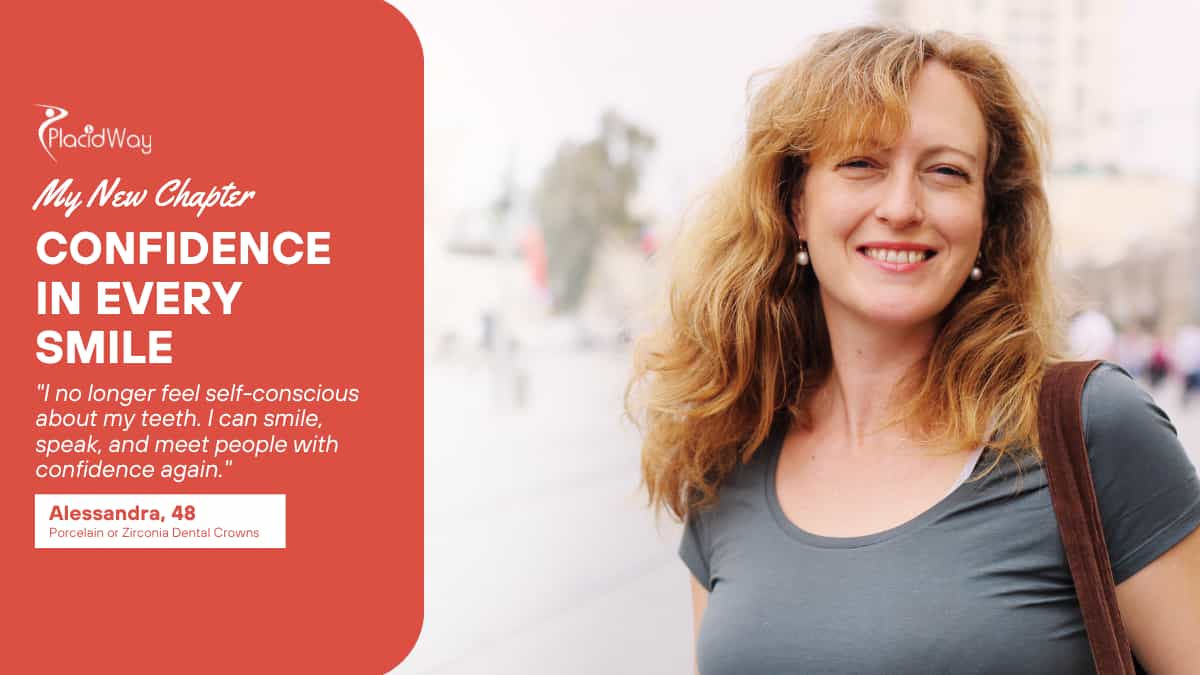
Patient Profile
Name: Alessandra Romano
Age: 48
Condition: Severe dental caries, tooth fracture or enamel erosion
Treatment: Porcelain or zirconia dental crown restoration
Destination: Zagreb, Croatia
Journey at a Glance
Main problems: Discolored, fractured, or severely decayed teeth requiring full coverage restoration; Visible tooth damage affecting professional appearance in client-facing roles; Sensitivity to temperature and pressure on compromised teeth; Aesthetic…
Previous care: Delaying crown treatment, managing with temporary fillings or bonding; Investigating Italian public dental services (long waits, limited restorative options); Requesting payment plans from private Italian dentists
Travel driver: Cost reduction (50–60% savings), shorter wait times (2–3 weeks vs. 6–8 weeks in Italy for complex cases), and access to high-volume cosmetic prosthodontists with advanced digital and aesthetic training
Treatment explored: Porcelain or zirconia dental crown restoration
Personal goal: Restore damaged front teeth, chew comfortably and protect the teeth from further deterioration.
You stopped smiling with your lips parted in photographs.
You learned to chew exclusively on the left side of your mouth.
You started covering your mouth with your hand when you laugh.
You turned your camera off on early morning client calls.
You declined the lunch invitation with the new regional director.
You checked the public health system wait times again.
You looked at your savings account balance and immediately closed the tab.
You asked your dentist if temporary bonding would hold for just one more year.
"You should just get it fixed," your colleague says.
"It is only money," your mother suggests.
"Does it hurt when you drink that?" your partner asks.
Your professional world has quietly become smaller.
The hardest part is not the temperature sensitivity or the price tag, but the waiting.
Meet Alessandra Romano
Alessandra Romano is not a real PlacidWay patient.
She is a fictional composite built entirely from the situations, constraints, and questions that Italian professionals face every day.
She is forty-eight years old and lives in Milan.
She directs regional sales meetings for a logistics firm.
She coordinates two teenagers' complicated athletic schedules.
She manages a household budget with exacting precision.
How she explained the problem away
For months, she simply pretended the damage was invisible.
Delaying the inevitable crown treatment.
Managing with temporary composite resins.
Investigating the Italian public dental services for restorative options.
Requesting extended payment plans from private local dentists.
Accepting visible cosmetic compromise rather than paying full price.
Asking her employer about dental insurance top-up options.
Severe tooth fracture and enamel erosion ultimately require full-coverage restorations to prevent further structural failure and preserve natural occlusal function.
The dentist's verdict arrived on a Tuesday afternoon:
"These two upper front teeth need full porcelain crowns."
She nodded slowly, staring at the ceiling tiles, left with only one question:
When?
In Italy's private sector, single ceramic or zirconia crowns commonly range between EUR 800 and 1,200 per unit, while the public health system largely limits restorative care to vulnerable demographics or acute emergencies.
But Alessandra Romano doesn't experience the two-tier health system as a national statistic.
She sits in the dentist's chair holding an estimate that equals a family vacation.
"We can finance this over twenty-four months," the receptionist offers.
She studies her reflection in the harsh lighting of the office restroom mirror.
"The discoloration is getting harder to hide," she thinks.
She reviews her annual insurance maximums on her phone while walking to the train.
"They only cover three hundred euros for major restorative work," she realizes.
She has already tried to be patient
Alessandra Romano is not an impulsive consumer looking for a quick cosmetic shortcut.
She waited six months for the temporary filling to inevitably fail.
She endured the sharp, breathless pain of drinking cold water.
She saved what discretionary income she could without compromising her daughter's university fund.
"I should be able to afford basic healthcare," she tells herself.
"I work too hard to have teeth falling apart," she admits quietly.
She used to ask if she could simply tolerate this, but now she asks:
How much of my life am I prepared to organise around it?
The nearer alternative
The most obvious choice is to simply pay the Milan clinic their standard rate.
The clinic is excellent, the dentist is familiar, and the logistics are effortless.
But spending EUR 2,400 out of pocket means cancelling the long-planned roof repair on their home.
"We have the money in the emergency account," Marco says at the kitchen table, reviewing the paperwork.
"Having the money isn't the same as being able to afford it," she replies.
She isn't searching for Zagreb yet
Her initial search queries were entirely domestic:
How long can a temporary crown last
Cheapest porcelain crowns Milan
Dental insurance waiting periods Italy
Zirconia crown cost Europe
Dentists in Zagreb reviews
The algorithms begin serving her advertisements for clinics in Croatia.
"I'm not going abroad just because something is cheaper," she tells Marco.
The instinct is entirely correct.
Why does Zagreb keep appearing?
Croatia's membership in the European Union requires strict alignment with European medical device directives and clinical care frameworks.
But the question is never whether a country is good.
Countries do not prepare teeth or mill zirconia.
Accredited prosthodontists do, clinical teams do, and specialized dental laboratories do.
There is something concrete and verifiable to investigate.
The Italian Ministry of Health explicitly advises citizens seeking cross-border healthcare to independently verify provider credentials and establish continuity of care protocols with a domestic physician.
Her first question was: "How much?"
Cross-border dental clinics in Zagreb indicate a cost for a single zirconia or porcelain crown generally falling between EUR 300 and 500, varying by laboratory material and diagnostic complexity.
She remembers the golden rule her father taught her:
"You always pay for cheap work twice."
"What exactly am I getting?"
Does this price include the initial digital consultation?
Are the panoramic x-rays billed as a separate line item?
Is the temporary crown included while the permanent one is milled?
What specific ceramic brand is the laboratory actually using?
Are the abutment preparations part of this base fee?
Do they use digital smile design or traditional physical impressions?
Is local anesthesia considered an extra expense?
Who pays for the revisions if the initial fit is wrong?
Does the warranty cover the material failure or the labor to replace it?
How long is the actual guarantee structurally valid?
Will I receive the materials passport for my medical records?
Are certified translations of my medical files included?
The advertised number is only the beginning of the conversation.
Numbers on a screen look neat, predictable, and manageable.
Human anatomy, however, rarely respects a predetermined spreadsheet.
The real test is what happens when you are finally sitting in the chair.
What does preparing a dental crown actually involve?
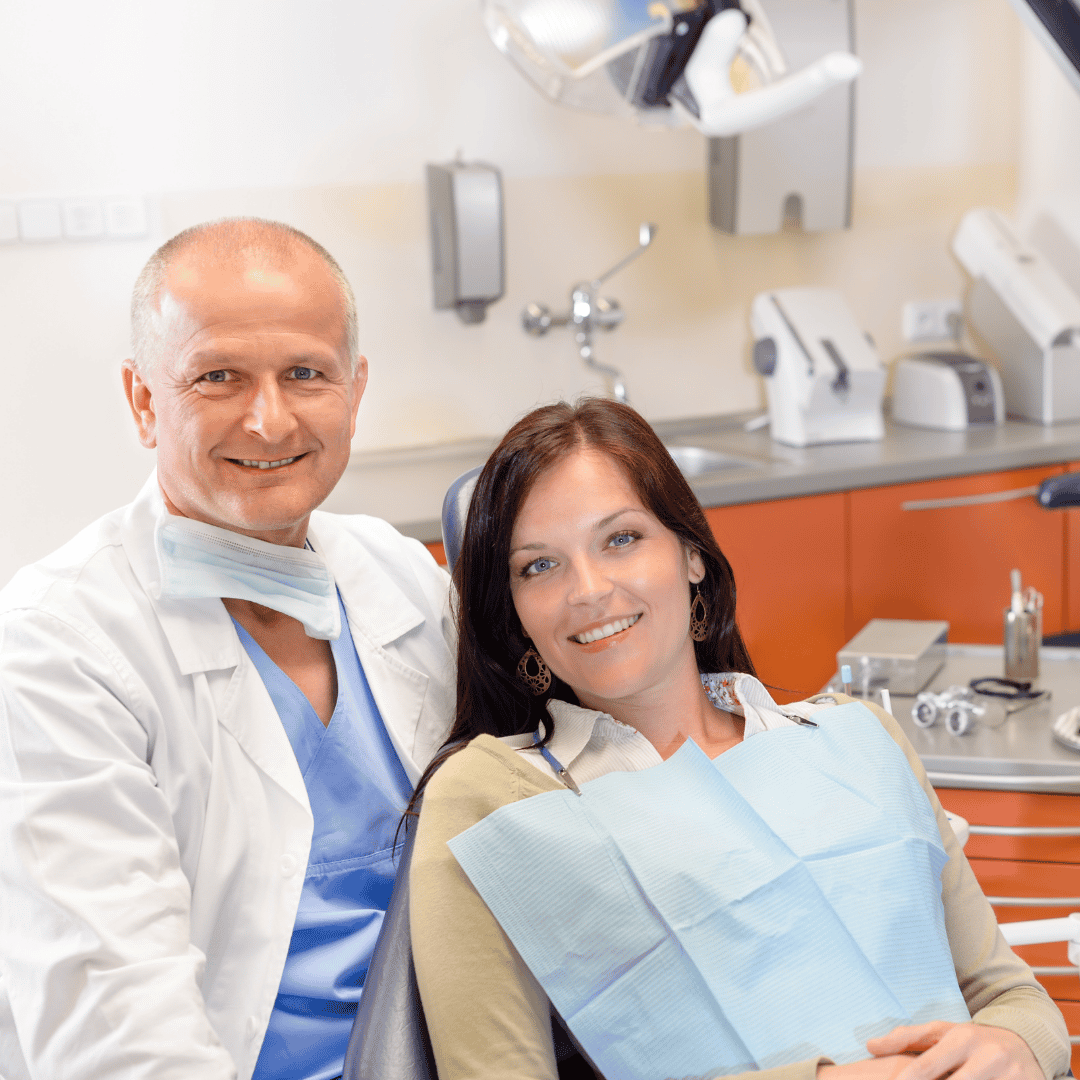
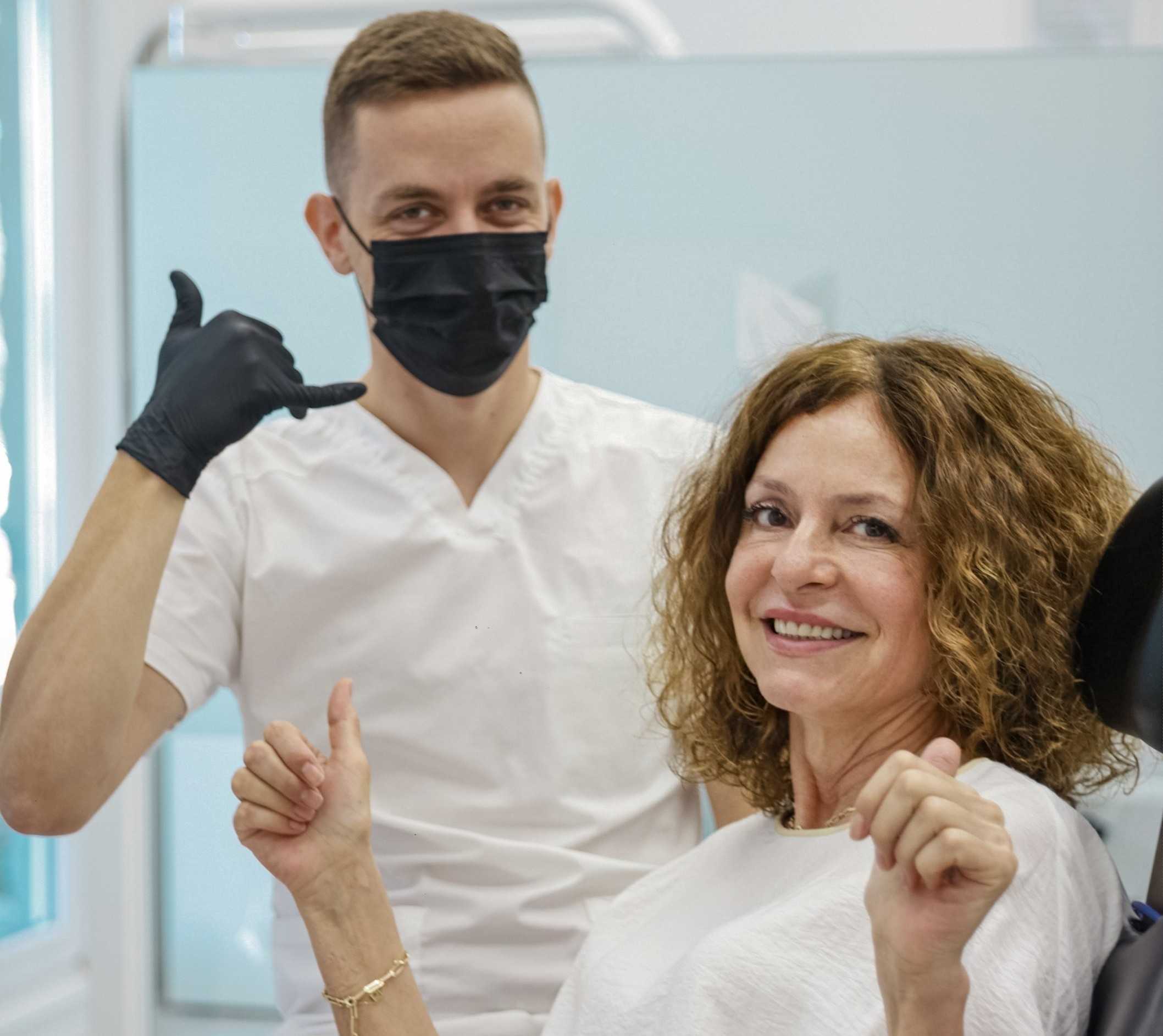
Preparing a tooth for a full-coverage crown involves removing the damaged enamel under local anesthesia, taking digital impressions, and placing a temporary restoration while the permanent ceramic unit is fabricated.
The clinical steps are identical whether performed in Milan or Zagreb.
This brings her to the logistical hurdle she had not fully considered:
"How many times do I have to make this drive?"
The part the brochures rarely put on the front page
Official guidance on clinical timelines varies depending on individual case complexity, and the variation itself is the lesson.
This physical constraint must be part of the plan before committing, not discovered afterward.
"Wait. Does that mean I might need to stay longer?"
Possibly, depending on laboratory turnaround times and your individual tissue response.
Where do I sleep if the temporary crown falls out on day two?
Can I comfortably drive five hours with lingering jaw numbness?
Who do I call at midnight if the gum sensitivity becomes unbearable?
Is the clinic open on weekends for emergency bite adjustments?
Do I need to take a full week off work or just two strategic days?
Will my Italian dentist agree to check the healing margins next month?
What if the final porcelain color doesn't perfectly match my adjacent teeth?
Will the border guards need specific medical documentation?
How do I manage meals in a foreign hotel with temporary cement?
Do I need a companion to share the driving burden back to Milan?
This isn't tourism in the usual sense.
Marco isn't just coming along
He is the invisible second participant in this entire endeavor.
He will carry the luggage when she shouldn't strain her jaw muscles.
He will remember the postoperative instructions she forgets while groggy.
He will notice if her bite seems visibly off when she tries to eat dinner.
He will be responsible for navigating unfamiliar toll roads in the dark.
He needs to know exactly who to call if she develops an unexpected fever.
Standard travel insurance policies commonly exclude complications arising from planned cross-border medical treatments (ivass.it).
He is part of the care system too.
Then comes the uncomfortable conversation about risk
All dental restorations carry inherent risks of nerve irritation, pulp necrosis, or secondary caries developing beneath the crown margin over time.
Alessandra Romano learns to distrust certain phrases instantly:
Completely safe.
No risk.
Guaranteed success.
Informed consent means understanding much more than the hoped-for outcome.
Alessandra Romano's questions become better
She used to ask if the procedure would hurt.
She used to ask if the clinic was cheap.
Now she asks:
What is your protocol for managing unexpected root canal needs?
How many full-mouth reconstructions do you perform monthly?
Can I speak with an Italian patient you treated last year?
What happens if the crown cracks three months from now?
Do you use magnification loupes or microscopes for marginal fit?
Who handles the emergency if I am already back in Italy?
Will you share the digital treatment plan with my local dentist?
Which specific brand of zirconia do you mill?
What is the infection control protocol in your sterilization room?
Are your specialists board-certified prosthodontists?
What would you see in my x-rays that would make you tell me not to proceed?
She doesn't only want someone willing to do it.
She wants someone willing not to.
Have I exhausted my options at home?
Under European cross-border healthcare directives, Italian residents may seek reimbursement for certain necessary treatments abroad, though administrative hurdles and public system wait lists make prior authorization complex.
Could we prioritize the most damaged tooth this year?
Is there a less expensive material suitable for this specific location?
Will you agree to handle my routine cleanings if I go abroad for the crowns?
Can we map out a three-year phased treatment plan?
Are there any university dental hospitals in Lombardy taking restorative cases?
The fairness principle she adopts is clear:
Traveling to Zagreb should be compared with Alessandra Romano's real alternatives, not with a worst-case assumption about the Italian dental system.
The night before the decision
The same kitchen table is now covered in documents.
A printed email thread from the Zagreb clinic coordinator.
The panoramic x-ray file loaded onto a USB drive.
A route map printout showing the drive through Slovenia.
The revised household budget spreadsheet.
"It feels different now that we have all the answers," she says, stacking the papers.
"You actually look relieved," Marco notes.
The research didn't make them more afraid; it made them more capable of deciding.
What Alessandra Romano actually wants isn't a porcelain crown
"Are you excited to finally get your teeth fixed?" her sister asks.
She nods and says yes, because that is what you are expected to say.
But what she actually wants is to:
Restore two upper front teeth with natural-looking crowns in one trip without depleting her annual dental budget.
Speak in a management meeting without monitoring her upper lip.
Bite into an apple without a second thought.
Smile naturally in family photographs again.
Not a dental procedure.
Not a block of milled zirconia.
Not a discounted medical package.
Not a road trip to Croatia.
Freedom.
And underneath that:
Dignity.
Zagreb might be the answer. It might not be.
She decides the driving distance is simply too stressful for recovery.
She discovers her tooth requires an extraction rather than a crown.
She negotiates a phased payment agreement with her Milan dentist instead.
She cannot find a clinic in Croatia that communicates transparently enough for her comfort.
She prefers to delay the cosmetic upgrade and focus only on managing the pain.
She reviews the logistics, verifies the credentials, prepares the contingency plan, and confidently books her consultation.
Any of those can be an informed decision.
Price should not answer a medical or technical question, and the goal of exploring options is never to blindly persuade.
The goal is to make sure frustration doesn't make the decision for them.
What happens next
Maybe you've stopped eating on the left side of your mouth entirely.
Maybe you've practiced smiling without parting your lips.
Maybe you've stared at a dental estimate and felt completely defeated.
Maybe you've opened a new browser tab to search for alternatives abroad.
Maybe you've wondered if traveling for healthcare is a brilliant idea or a terrible mistake.
You do not need to decide today.
What exactly does my Italian insurance policy actually cover?
Who will manage my follow-up care if I travel?
How long can my current temporary solution safely last?
What are the credentials of the specific prosthodontist?
How do I handle the logistical stress of a medical trip?
What happens if I simply do nothing for another year?
What is the true cost of delaying this treatment?
Ultimately, you are not just comparing prices, you are comparing:
Paths forward.
Hope isn't the promise that everything will be fixed
Hope isn't the promise of a flawless Hollywood smile.
Hope isn't a guarantee that the procedure will be devoid of discomfort.
Hope isn't a cheap package deal found on the internet.
Hope is having enough information to make a decision that feels like yours.
You know what to ask.
You know what to avoid.
You know your clinical requirements.
You know your financial boundaries.
You know you have valid choices.
You stop saying:
"I suppose I'll just have to keep waiting."
You start asking:
What other informed options do I have?
PlacidWay — Your Way to Hope.
PlacidWay helps patients explore international healthcare options, compare clinical facilities, and prepare the right questions for consultations. We do not provide clinical advice or deliver medical outcomes. For someone like Alessandra Romano, traveling to Zagreb isn't a promise, it is one route worth understanding.
Your Way to Hope.
This article is educational and does not recommend that any individual undertake cross-border medical travel. Individual clinical suitability and risk require professional assessment. Readers should consult their own dentist or medical adviser, verify current regulatory status independently, and obtain appropriate travel and medical protection or insurance.
.png)


.png)

.png)
.png)
.png)


.png)
.png)
.png)








Share this listing