Patient Profile
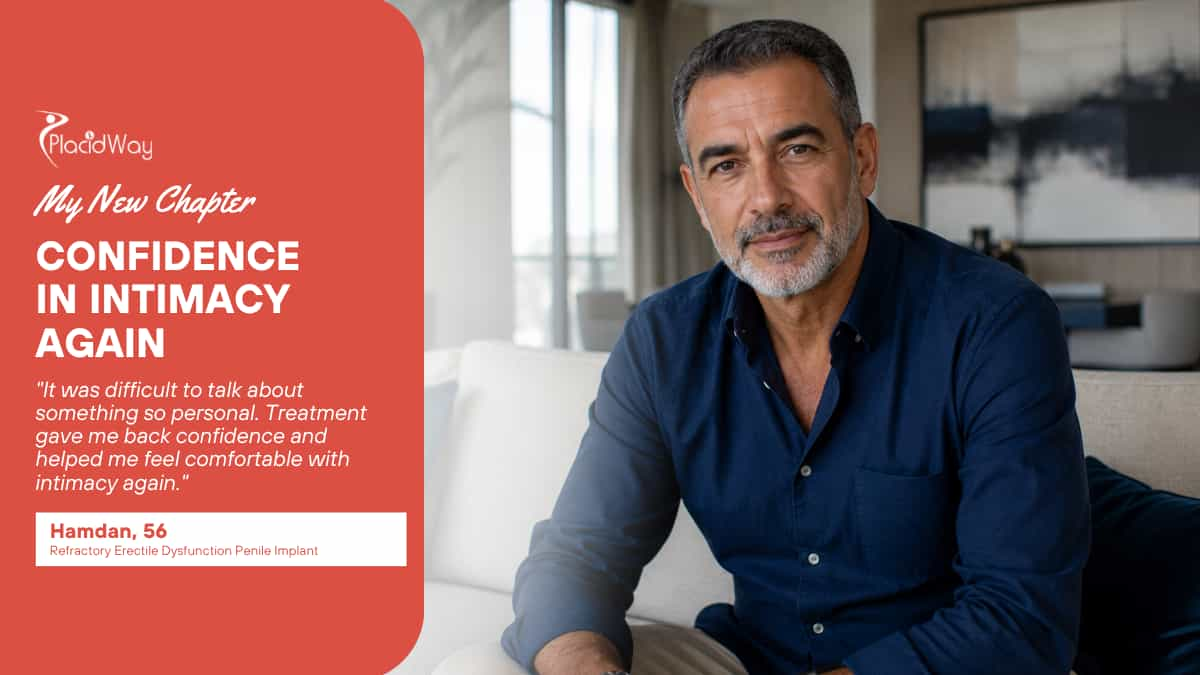
Name: Hamdan Al-Falasi
Age: 56
Condition: Refractory erectile dysfunction with possible Peyronie's disease or fibrosis
Treatment: Inflatable or malleable penile implant surgery
Destination: Berlin, Germany
Journey at a Glance
Main problems: Complete or severe erectile dysfunction despite oral medications (sildenafil, tadalafil); Penile fibrosis or Peyronie's disease limiting natural function; Psychological distress and loss of sexual confidence; Relationship strain and withdrawal from…
Previous care: Oral phosphodiesterase-5 inhibitors (sildenafil, tadalafil, vardenafil) with diminishing or no effect; Injectable therapies (alprostadil, papaverine) with poor tolerance or results; Vacuum erection devices (low comfort, inconsistent results)
Travel driver: Discreet access to world-class surgical expertise combined with absolute confidentiality and privacy protections unavailable in the home market, where reputation and social standing are at risk
Treatment explored: Inflatable or malleable penile implant surgery
Personal goal: Restore sexual function and intimacy through discreet, specialist-led care.
You stop initiating.
You blame the stress of the board meetings.
You mention fatigue.
You start going to bed a little later than she does.
You research supplements on your phone in the parking garage.
You clear your browser history before going inside.
You try the little blue pill.
You try taking two.
You pretend not to notice when it stops working.
You avoid the look in her eyes.
"You've been working so late recently."
"Maybe we should just take a holiday."
"Is there something you aren't telling me?"
You watch as your marriage slowly reorganizes itself around an unspoken absence.
Your world has quietly become smaller.
The hardest part is not the shame, but the waiting.
Hamdan Al-Falasi is not a real PlacidWay client.
He is a fictional composite built from the situations and questions UAE men face when navigating severe erectile dysfunction.
He is fifty-six years old and lives in Dubai.
He directs logistics for a shipping conglomerate.
He reads profit and loss statements over morning espresso.
He negotiates container rates with steady authority.
He navigates the tight-knit social networks of the Emirates with effortless grace.
He explained the initial failures as dehydration.
He blamed the long-haul flights to Singapore.
Sildenafil. Tadalafil. Vardenafil. Herbal tonics. Acupuncture. Couples therapy. Vacuum devices. Alprostadil injections. Silence.
When pharmaceutical options and intraurethral therapies fail to produce satisfactory erections, clinical guidelines recommend considering surgical intervention via penile prosthesis implantation. This definitive procedure is normally evaluated only after reversible therapies have proven ineffective or intolerable for the patient.
Eventually, the urologist delivers the verdict:
"The medication is no longer responding."
When?
Roughly 15% of men experience severe erectile dysfunction by age 50, and rates of medication non-response approach 30% in clinical populations. But Hamdan Al-Falasi doesn't experience the clinical failure rate as a national statistic.
He experiences it sitting on the edge of the mattress, staring at the floor.
"It's fine, Hamdan Al-Falasi, we're just tired."
He experiences it in the pharmacy, hoping the clerk doesn't recognize his surname.
"We can order the stronger dosage for tomorrow."
He experiences it in the executive washroom, splashing cold water on his face.
"Are you ready for the board presentation?"
He has already tried to be patient.
Men in his position are often mischaracterized as impatient consumers seeking quick fixes.
Hamdan Al-Falasi spent two years carefully increasing dosages.
He endured the sharp ache of localized injections.
He read every medical forum available in private browsing mode.
He waited for a spontaneous improvement that never arrived.
"I just need to give it more time."
"Maybe the next prescription will be different."
He stopped asking if he could tolerate this:
How much of my life am I prepared to organise around it?
The nearer alternative is closer than he thinks.
Dubai possesses highly capable private hospitals and specialized clinics.
He could schedule the implant procedure twenty minutes from his office.
But the medical community here is intimately connected.
Social standing and professional reputation blur together in the waiting rooms.
He knows the board members who fund the facilities.
He knows the families of the administrative staff.
The local system fails him not on medical competence, but on the absolute guarantee of discretion.
"We have the premier insurance package, Hamdan Al-Falasi."
"It isn't about whether we can afford the surgery here."
He isn't searching for penile implants yet.
Why does sildenafil stop working after five years?
Severe ED alternative treatments Dubai.
How much does ED surgery cost privately?
Most discreet urology clinics in Europe.
Berlin slowly emerges on his screen.
"I'm not flying to Germany just because they have nice hospitals."
The instinct is entirely correct.
Why does Berlin keep appearing on his screen?
Under strict European health data regulations, patient confidentiality is absolute and legally shielded from foreign employer or insurance inquiries.
The question is never whether a destination country is generally acceptable.
Countries do not perform microvascular urological surgery.
Surgeons do.
Hospitals do.
Clinical teams do.
There is a concrete operational history to verify.
Health authorities explicitly advise patients traveling abroad for treatment to independently verify the specific surgeon's credentials and seek advice from their local general practitioner first.
His first question was: "How much?"
The surgical package for an inflatable penile prosthesis typically falls between USD 16,000–22,000, varying significantly based on the specific device model, the surgical center's fees, and required postoperative stays.
Price should not answer a complex medical question.
He remembers a piece of advice from his father:
"You pay for the silence as much as the skill."
"What exactly am I getting?"
Does this include the specific brand of three-piece inflatable device?
Are the preoperative cardiology clearances billed separately?
How many nights in the clinic are covered?
Is the anesthesia fee included?
What happens if the surgical time overruns?
Does the package cover the removal of existing fibrosis?
Are hotel accommodations for the recovery week included?
Who pays for the surgical assistant?
Is there a revision clause if the device fails mechanically?
Are airport transfers provided discreetly?
Will the medical notes be translated into English or Arabic?
Does this include the pain management medication upon discharge?
What is the cost of follow-up consultations via telehealth?
Are the taxes embedded in the final quote?
The advertised number is only the beginning of the conversation.
The spreadsheet does not tell the whole story.
Financial transparency is merely the foundation of medical trust.
You must understand the mechanics of the intervention itself.
What does a penile implant actually involve?
The procedure requires placing two inflatable cylinders inside the penis, a fluid reservoir under the abdominal wall, and a pump mechanism inside the scrotum, allowing the patient to manually control an erection.
"How do I hide the recovery?"
The part the brochures rarely put on the front page.
Postoperative recovery involves substantial localized swelling, significant discomfort during the initial activation phases, and strict limitations on physical movement.
Official guidance on returning to desk work varies widely from one to three weeks.
The variation itself is the lesson.
This logistical constraint must be part of the plan before committing, not backward-engineered afterward.
"Wait. Does that mean I cannot carry my own luggage home?"
Possibly, depending on the precise timeline of your return flight.
Who will lift my suitcase off the carousel in Dubai?
How do I explain a three-week absence to the executive board?
What if the airport security scanner detects the pump?
Will I be able to sit comfortably in a business class seat?
How often will I need to ice the surgical site in the hotel?
Can I wear my normal tailored trousers during the flight?
What happens if a surgical drain leaks in the hotel lobby?
Who changes the dressings on day four?
Will the hotel staff know why I am walking with a changed gait?
How do I hide the pain medication from my business partner?
What if I develop a fever over the weekend in Berlin?
This isn't medical tourism in the usual sense.
Amira isn't just coming along for the flight.
She is the invisible second participant in the surgical process.
She will memorize the medication schedule.
She will manage the room service orders when he cannot stand.
She will watch for signs of localized infection.
She needs to know exactly what the emergency protocol looks like if something goes wrong in a foreign city.
Many standard travel insurance policies explicitly exclude complications arising from elective surgeries undertaken abroad.
She is part of the care system too.
Then comes the uncomfortable conversation about risk.
Surgical interventions for erectile dysfunction carry risks of mechanical device failure, severe pelvic infection, erosion of the device through the skin, and changes in penile sensation or length.
He learns to immediately distrust certain marketing phrases:
Completely safe. No risk. Guaranteed success. The best.
Informed consent means understanding far more than the hoped-for outcome.
Hamdan Al-Falasi's questions become better.
He no longer asks if he can tolerate the condition.
He stops asking how much of his life he must organize around it.
What is your personal infection rate for this specific procedure?
How many primary implantations did you perform last year?
Which brand of prosthesis do you use most frequently, and why?
What happens if the cylinder sizing is miscalculated during surgery?
Do you perform the surgery yourself or supervise a fellow?
What is your protocol if an infection develops after I fly home?
How will you communicate with my urologist in Dubai?
What percentage of your patients require mechanical revisions within five years?
Do you use a no-touch surgical technique to minimize bacterial transfer?
What specific anatomical factors make my case more difficult?
He prepares his final question for the consultation:
What would you see on my chart that would make you tell me not to proceed?
He doesn't only want someone willing to do it.
He wants someone willing not to.
Have I exhausted my options at home?
Patients in the UAE have the right to request comprehensive second opinions and access their complete, unredacted medical dossiers before seeking care elsewhere.
Are there any newly approved intraurethral therapies we haven't tried?
Would a different phosphodiesterase type 5 inhibitor yield better results now?
Is there a domestic surgeon who specializes exclusively in prosthetics?
How frequently does this hospital perform this exact surgery?
Can my medical privacy be mathematically guaranteed here?
What is the specific escalation path if I decline surgery?
Berlin should be compared with Hamdan Al-Falasi's real alternatives, not with a worst-case assumption about the UAE healthcare system.
The night before the decision arrives quietly.
He sits at the same kitchen table.
The translated surgical consent form. The itemized clinic invoice. The flight itineraries. The device manufacturer's warranty card. The post-operative restriction guidelines.
"It looks like a lot of work just to feel normal again."
"It is hard work, but we know what the work is."
The research didn't make them more afraid; it made them more capable of deciding.
What Hamdan Al-Falasi actually wants isn't the device.
"What are you hoping to get out of this trip?"
A successful medical procedure.
He really wants this:
Schedule a consultation with a Berlin andrologist, undergo penile implant surgery.
He wants to close the hotel room door and not worry about who is watching.
He wants to look at his wife without a wall of silent apology between them.
He wants to stop organizing his evenings around pharmaceutical timing.
Not the silicone cylinders. Not the titanium components. Not the premium medical package. Not the flight to Germany.
It always comes down to:
Control.
And underneath that:
Dignity.
Berlin might be the answer, or it might not be.
He might decide the recovery window is too long.
He might learn his anatomical presentation adds too much risk.
He might balk at the logistical complexity of the travel.
He might find a surgeon in Dubai whose discretion he finally trusts.
He might choose to accept the condition and focus on other forms of intimacy.
Any of those can be an informed decision.
The goal is not to persuade.
The goal is to make sure frustration doesn't make the decision for him.
Now you look at your own paperwork.
Maybe you've stopped opening the browser tabs entirely.
Maybe you've thrown away the last box of pills.
Maybe you've started sleeping in the guest room.
Maybe you've convinced yourself that this is just what getting older means.
Maybe you are tired of pretending it doesn't hurt.
You do not need to decide today.
What exactly is my clinical threshold for surgery?
Who is managing the logistics of my recovery?
How much domestic privacy am I actually willing to sacrifice?
What happens if I delay this for another two years?
Who can I trust to evaluate a foreign surgeon's credentials?
Is my reluctance based on medical risk or social fear?
Am I choosing a clinic, or am I choosing an outcome?
You don't just need price lists.
You need paths forward.
Hope isn't the promise that everything will be fixed.
Hope is not a glossy brochure promising eternal youth.
Hope is not an unverified testimonial on a clinic website.
Hope is not a surgical quote that looks too good to be true.
Hope is having enough information to make a decision that feels like yours.
You gather the clinical records.
You ask the abrasive questions.
You refuse the easy assurances.
You verify the privacy protocols.
You take the time required.
You stop telling yourself:
"I suppose I'll just have to keep waiting."
And you start asking:
What other informed options do I have?
PlacidWay — Your Way to Hope
PlacidWay helps individuals safely navigate the logistics of international medical travel by providing a platform for exploration, comparison, understanding, and preparation. We do not provide clinical advice, and we never pressure patients toward a specific medical intervention. For someone like Hamdan Al-Falasi, surgery in Berlin isn't a promise, it is simply one structured route worth understanding thoroughly.
Your Way to Hope.
Medical disclaimer
This article is for educational purposes only and does not recommend that any individual undertake surgical procedures or travel abroad for medical care. Individual suitability, mechanical longevity, and surgical risk require direct professional assessment. You should always consult your own local clinician or qualified medical adviser, independently verify current regulatory status and medical credentials, and obtain appropriate travel and medical protection or insurance before making healthcare decisions.
























Share this listing