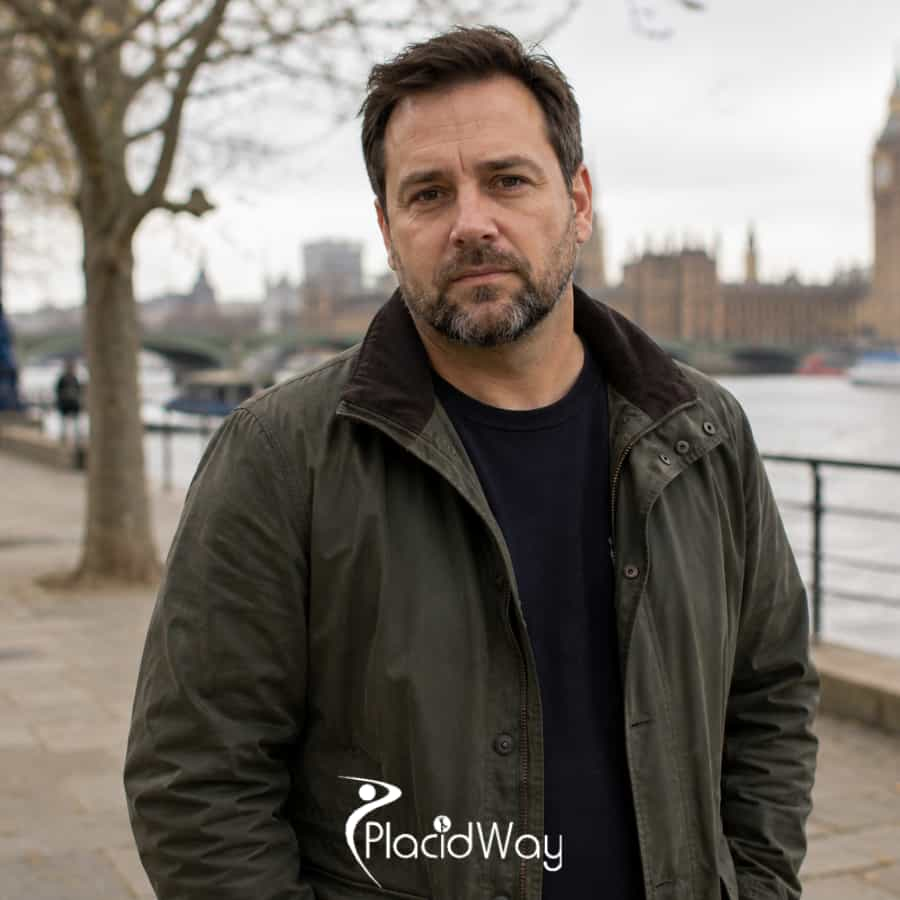
The Custody Visits He Was Losing: Oliver Price’s Heroin Addiction Residential Rehabilitation Story from the United Kingdom to Spain

Publish date: Modified date: Medically reviewed by: Dr. Hector Mendoza on Aug 31, 2026 Author: Iqra Naseer

Oliver Price’s Heroin Addiction Residential Rehabilitation Story 

Patient Profile

Name: Oliver Price

Age: 38

Condition: Heroin-related Opioid Use Disorder

Treatment: Medically supervised detoxification and 60-day residential rehabilitation

Destination: Cadiz, Spain

Journey at a Glance

Main problems: Compulsive drug-seeking behavior and loss of control over use; Severe withdrawal symptoms (sweating, body aches, anxiety, insomnia); Deteriorating physical health (abscesses, infections, malnutrition); Cognitive impairment and memory loss

Previous care: Multiple referrals to NHS GP; placed on waiting lists; Private counseling (unsustainable cost); Methadone or buprenorphine maintenance programs (temporary symptom management, not resolution)

Travel driver: Waiting list collapse in NHS; cost-prohibitive private UK treatment; psychological need to break environmental triggers through geographic separation; faster access to intensive, evidence-based residential care

Treatment explored: Medically supervised detoxification and 60-day residential rehabilitation

Personal goal: Return home drug-free, restart custody visits and re-enter employment.

You know exactly how many milligrams keep the sickness away.

You have started hiding the physical decline under heavy clothing.

You memorise the operating hours of local crisis clinics.

You map out your mornings strictly around withdrawal symptoms.

You calculate precisely how much money is missing from the joint account.

You practice looking steady in the bathroom mirror.

You lie about why you cannot take the children swimming.

You measure your life in appointments that get repeatedly cancelled.

"I just need a few more weeks to sort this out."

"We cannot keep doing this cycle."

"Your daughter is starting to notice."

Your world has quietly become smaller.

The hardest part of this endurance is not the physical pain or the financial drain, but the endless waiting.

Meet Oliver Price.

Oliver Price is not a real PlacidWay client.

He is a fictional composite built entirely from the exact situations and questions UK adults face when navigating opioid dependency.

He is thirty-eight years old and lives in Manchester.

He used to manage logistics for a regional freight company.

He coached Sunday league football on wet winter mornings.

He cooked dinner for his family every Tuesday and Thursday.

He paid his mortgage on time.

He told himself it was under control.

He convinced himself the initial prescription painkillers were just a temporary crutch.

He transitioned to heroin when the clinic stopped prescribing.

He hid the foil.

He managed the sickness.

He missed the promotion.

He lost the spare bedroom.

He sat in the NHS GP waiting room staring at the floor.

He filled out the endless assessment forms.

He attended the mandatory local group sessions.

He waited for the referral to clear.

Standard clinical pathways in the UK frequently rely on community-based methadone or buprenorphine maintenance to physically stabilise patients while they wait for scarce inpatient residential beds to become available.

His clinical assessment concluded with the only answer the system had left:

"Approved for residential rehabilitation."

When?

The systemic reality collides with the living room.

Wait times for residential addiction treatment in certain NHS trusts can extend from six to twelve months due to severe funding constraints and inpatient bed shortages across the country.

But Oliver Price does not experience the healthcare system as a national statistic.

He experiences it as sweating through his bedsheets at three in the morning while trying to self-detox.

"You promised you were tapering off this time."

He experiences it as staring at his phone on a Thursday afternoon, willing a withheld hospital number to call with an admission date.

"They said they might have a bed by November."

He experiences it as Sarah standing in the hallway holding their seven-year-old daughter's coat, refusing to stay the weekend.

"I am giving you three months to get inside a clinic."

Oliver Price has already tried to be patient.

He is not an impatient consumer looking for a quick, effortless fix.

He has exhausted the local community drug and alcohol service.

He has tapered his dosage until his joints ached and his vision blurred.

He has flushed his supply down the toilet at midnight in a burst of resolve.

He has walked in the rain to buy it again by noon.

"I cannot detox in the same environment where I use."

"I just need a supervised medical ward to get through the first week."

His foundational question has fundamentally shifted:

From "Can I tolerate this?" to "How much of my life am I prepared to organise around it?"

The domestic alternative demands a sacrifice he cannot make.

Private rehabilitation in the UK exists and offers excellent clinical standards, but it demands an immediate financial liquidation that breaks most families.

A comprehensive 28-day intensive inpatient stay routinely costs between GBP 15,000 and GBP 35,000.

He stares at the savings account balance that was supposed to be a deposit for his daughter's university fund.

"We could remortgage the flat if we absolutely had to."

He knows there is one unavoidable reality:

Having the equity isn't the same as being able to survive without it.

He isn't searching for Spain yet.

His late-night internet searches begin as quiet attempts to understand his symptoms and local alternatives.

How to manage heroin withdrawal safely at home.

Private rehab costs North West England.

NHS residential rehab average waiting list length.

Cheapest inpatient addiction treatment UK.

Fast admission rehab abroad.

He stares at the search bar and types the unspoken fear:

The search results begin offering intensive residential programs in Cadiz, Spain.

"I am not going abroad just because something is cheaper."

He is entirely right to be sceptical of healthcare marketed solely on geographic pricing.

Why does Cadiz keep appearing in the clinical results?

Spain has integrated addiction treatment into its highly regulated private healthcare sector, mandating strict medical licensing for residential therapeutic facilities.

The central reframe is that the question is never whether an entire country is medically competent.

Countries do not manage complex opioid withdrawals.

Clinical teams do.

Facilities with rigorous, verifiable protocols do.

The UK government explicitly advises citizens seeking medical treatment abroad to thoroughly research specific providers and consult their domestic medical team before travelling.

His very first question was the financial one.

Treatment in a regulated Spanish facility typically involves indicative costs of EUR 100 to EUR 150 per day, varying based on the requirement for medically assisted detoxification and the intensity of psychiatric support.

He states plainly to himself that price should never answer a clinical question, and that the goal of comparing these numbers is not to persuade anyone to board a flight.

The advertised daily rate is merely an opening proposition:

You get what you pay for in this life.

"What exactly am I getting?"

Fifteen things the advertised price may or may not cover.

Is the medical detox supervised twenty-four hours a day by nursing staff?
Are the initial psychiatric assessments conducted by EU-licensed doctors?
Does the daily rate include trauma-informed cognitive behavioral therapy?
Are the therapeutic group sessions conducted in native English?
What happens financially if I experience severe complicated withdrawal requiring external hospitalization?
Is buprenorphine induction included in the initial quoted cost?
Who specifically manages the transition from the medical detox wing to residential therapy?
Are nutritional rehabilitation and baseline blood panels standard inclusions?
Does the facility enforce a strict mobile phone blackout period during the first week?
How many individual, one-on-one therapy sessions are guaranteed per week?
Is family counseling facilitated over secure video calls included in the package?
Are airport transfers from Jerez or Seville handled directly by clinical staff?
What is the specific ratio of psychiatric nurses to residential patients?
How is the medication tapering schedule adjusted if I struggle with insomnia?

The advertised number is only the beginning of the conversation.

The numbers on the screen are just the perimeter.

He must understand the underlying methodology.

The medical timeline dictates everything that follows.

What does this residential process actually involve?

Residential opioid treatment requires a medically managed transition away from physical dependence followed immediately by intensive, structured psychological intervention.

The clinical evidence clearly suggests that treating the physical withdrawal without aggressively addressing the environmental and psychological triggers drastically increases the probability of immediate relapse upon return.

"How do I actually manage the logistics of getting on a plane like this?"

The part the glossy brochures rarely put on the front page.

Travelling internationally while experiencing active opioid dependency or managing early withdrawal introduces severe logistical, legal, and physical complexities.

Airlines enforce varying regulations regarding passengers travelling with prescribed controlled substances, and Spanish customs require specific formalized documentation for any maintenance medications carried across borders.

The fact that these operational rules vary so widely is the lesson itself.

This logistical constraint must be solved deliberately before committing to a departure date, not improvised nervously at airport security.

"Wait. Does that mean I could be turned away at the border?"

Possibly, depending on how your pre-admission stabilization and medical documentation are managed by your UK physician.

Who holds my physical passport during the first week of medical detox?

Will the clinic legally inform the British consulate if I demand to leave against medical advice?

Can I legally discharge myself and simply walk out into a foreign city?

How do I pay for incidental items without access to my bank cards?

Who communicates my daily medical status to Sarah?

What happens practically if a co-occurring medical emergency requires transfer to a local public hospital?

How is my discharge summary translated and securely transmitted back to my NHS GP?

Will my UK doctor automatically accept the Spanish prescribing notes for ongoing aftercare?

Who coordinates my return flight home when my physical tolerance to opioids has completely dropped?

This is not tourism in any usual sense of the word.

Sarah isn't just coming along for the journey.

Sarah will remain in Manchester, but she invisibly carries the heaviest administrative and emotional burden.

She will manage the frantic phone calls if the first days of intensive therapy become overwhelming.

She needs to know the exact escalation protocols if clinical communication abruptly ceases.

Standard travel insurance routinely excludes coverage for travel undertaken specifically for medical treatment or rehabilitation, requiring specialized medical indemnity policies.

She is a critical part of the clinical care system too.

Then comes the uncomfortable conversation about risk.

The most acute risk during opioid rehabilitation is the severely lowered tolerance upon discharge, which makes any subsequent relapse highly lethal without immediate intervention.

He actively distrusts facilities that lean on hollow assurances:

Completely safe. No risk. Guaranteed success. The ultimate cure.

Informed consent means understanding the mechanism of failure just as clearly as the hoped-for outcome.

Oliver Price's questions become sharply better.

His initial queries were born of sheer panic and desperation.

Now, his questions to the intake coordinators in Cadiz are clinical and precise:

What is your specific protocol for managing acute post-acute withdrawal syndrome?
How do you physically handle a patient who attempts to smuggle substances onto the ward?
Can you provide the verifiable licensure numbers for your lead psychiatric consultant?
What is your exact operational procedure if a patient requires emergency intubation?
How many UK patients have you treated specifically for heroin dependency this calendar year?
Can you outline the mandatory aftercare handover documents you send to my UK physician?
Do you primarily use methadone or buprenorphine for the acute inpatient detox phase?
Are you medically equipped to manage underlying cardiac issues that flare up during withdrawal?
What clinical metrics do you use to measure successful program completion?
What would you see in my medical history that would make you tell me not to proceed?

He requires the ultimate concession from a private facility:

A clinical team willing to turn him away if he is not a suitable candidate.

He does not only want a facility willing to take his money.

He desperately wants a clinical team willing to refuse him if he is not a suitable candidate.

Has he actually exhausted his options at home?

Patients within the NHS have statutory rights to request alternative treatment providers if wait times exceed maximum clinical thresholds, though specialized residential rehab is often subject to strict local funding board approvals rather than blanket patient choice.

Has my primary care physician exhausted all available expedited referral pathways?

Is there an intensive outpatient day-program available immediately in Manchester?

Could a short-term private detox bridge the gap to an NHS residential bed?

Will the local authority fund a placement outside my immediate postcode?

What legally happens to my place on the NHS waiting list if I seek private treatment abroad?

Cadiz should be compared with Oliver Price's real alternatives, not with a worst-case assumption about the home system.

The night before the decision.

The kitchen table is covered in paperwork.

The translated clinic registration documents. The detailed emails from the admissions coordinator. The specialized medical travel insurance policy. The thick printout of his NHS medical records. The draft flight itinerary to Andalusia.

"You actually look like you know what you are doing."

"I know exactly what I am doing."

The extensive research did not make them more afraid; it made them more capable of deciding.

What Oliver Price actually wants isn't a facility in Spain.

"Are you just buying a holiday in Spain to avoid the real work?"

"No, I am buying a cheaper rehab bed so I can survive."

He wants his daughter to look at him without hesitation.
He wants to wake up without the suffocating panic of withdrawal.
He wants to confidently stand in the kitchen and make breakfast.

Complete a 60-day residential program, return to UK drug-free, restart custody visits, re-enter employment.

Not a luxury Spanish villa. Not a fast-track detox package. Not a medical tourism vacation. Not the temporary absence of pain.

He strips away the noise to isolate the true objective:

Control.

And underneath that:

Agency.

Cadiz might be the answer. It might not be.

He reviews the facility's credentials and decides the distance from home is too destabilising for his recovery.

He discovers an expedited NHS day-program has opened up locally and chooses to stay in Manchester.

He determines the specialized travel insurance is simply too complex to arrange in his current physical state.

He speaks to the Spanish psychiatric lead and feels deeply uncomfortable with the proposed medication taper.

He realises he cannot safely manage the logistics of international travel while actively managing withdrawal symptoms.

He finds a local private clinic offering a sliding scale fee and elects to remain in the UK.

He verifies the licenses, coordinates the handover with his GP, secures the funding, and actively books the admission.

Any of those distinct paths can be an informed decision.

State plainly that price should not answer a strategic question, and that the goal is not to persuade.

The goal is to make sure your sheer frustration does not make the decision for you.

The view from your kitchen table.

Maybe you are staring at an NHS waiting list that stretches far into next winter.

Maybe you are calculating exactly how many weeks of sick leave you have left before the disciplinary hearings begin.

Maybe you are listening to your partner pack a suitcase in the bedroom next door.

Maybe you are physically exhausted from trying to taper down on your own.

Maybe you are terrified of losing your job if you confess to human resources that you need inpatient care.

You do not need to decide today.

What exactly is my clinical diagnosis and recommended treatment duration?

How long is the actual, verified wait time for local residential care in my borough?

What physical risks do I face if I delay treatment by another six months?

Are there private UK facilities that offer unadvertised payment plans?

Does my GP support a medically supervised international placement?

Who will manage my local aftercare when I return with zero tolerance?

Can I legally and safely travel in my current physical condition?

You are not just comparing prices across borders.

You are comparing viable paths forward.

Hope isn't the promise that everything will be fixed effortlessly.

Hope is not the promise that everything will be fixed by a sunny climate.

Hope is not a glossy brochure showing empty beaches and smiling staff.

Hope is not ignoring the severe medical reality of opioid withdrawal.

Hope is having enough verified information to make a decision that feels like yours.

The capability to ask difficult clinical questions without feeling intimidated. The capability to demand transparency regarding treatment protocols. The capability to involve your local doctor in international plans. The capability to protect your family from immediate financial ruin. The capability to stop hiding the problem.

The sentence changes permanently:

"I suppose I'll just have to keep waiting."

To:

"What other informed options do I have?"

PlacidWay — Your Way to Hope.

PlacidWay helps individuals and families explore international medical options, compare facility credentials, understand complex treatment pathways, and prepare the rigorous questions required for cross-border care.

We do not provide clinical advice or deliver medical outcomes.

For someone in Oliver Price's position, seeking rehabilitation in Cadiz is not a guaranteed promise of recovery, it is one heavily structured route worth exploring and understanding thoroughly.

Your Way to Hope.

Medical disclaimer

This article is strictly educational and does not recommend that any individual undertake international travel for addiction treatment. Individual clinical suitability, withdrawal management, and medical risk require comprehensive professional assessment. The reader must consult their own primary care clinician or addiction specialist, verify current domestic and international regulatory status, and obtain appropriate medical travel protection before making any healthcare decisions.


The Custody Visits He Was Losing: Oliver Price’s Heroin Addiction Residential Rehabilitation Story from the United Kingdom to Spain

About Article

  • Treatment: Addiction Treatment
  • Country: Spain
  • Overview This educational overview follows Oliver Price, a composite British patient exploring Heroin Addiction Treatment in Cadiz, Spain. It summarizes daily-life effects, previous care and why treatment abroad is being considered. Candidacy, safety, recovery and follow-up remain central to informed decision-making.

Trusted Medical Tourism Platform Since 2007

60+
Countries
2k+
Clinics
19.5k+
Reviews
2.5k+
Qualified Doctors
1.1M+
Patients Served Since 2007