The Treatment Approval That Could Not Outwait the Cancer: George Whitaker’s Metastatic Non-Small-Cell Lung Cancer Immunotherapy Story from the United States to Mexico

Publish date: Modified date: Medically reviewed by: Dr. Orhan Sencan on Aug 31, 2026 Author: Aamina Bibi

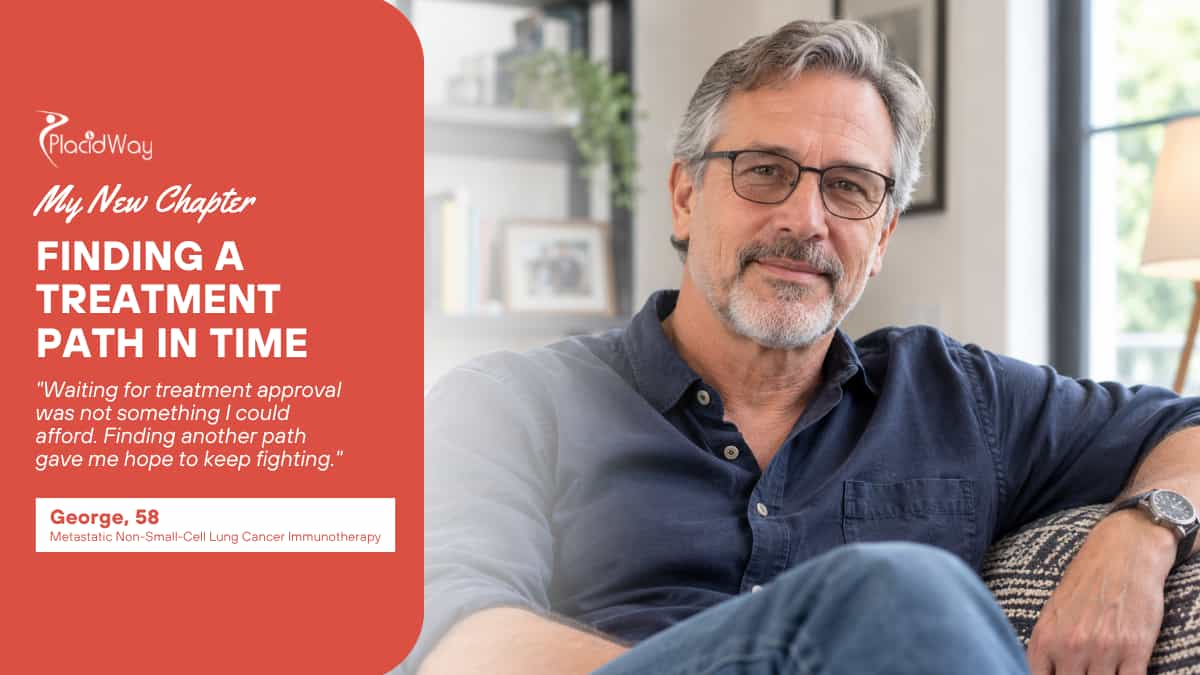
George Whitaker’s Metastatic Non-Small-Cell Lung Cancer Immunotherapy Story 

Patient Profile

Name: George Whitaker

Age: 58

Condition: Metastatic non-small-cell lung cancer after a limited response to chemotherapy

Treatment: Biomarker-guided immune checkpoint inhibitor therapy

Destination: Tijuana, Mexico

Journey at a Glance

Main problems: Rapid disease progression despite previous treatment; Fatigue, pain, reduced mobility and psychological distress; Persistent or difficult-to-manage side effects from prior treatments; Declining performance status and overall quality of life

Previous care: Repeated insurance authorization and coverage appeals; Second opinions with U.S. oncologists and academic medical centers; Exploration of clinical trial options, with screening requirements and eligibility limitations

Travel driver: Proximity to Southern California and access to international oncology providers offering additional treatment options and specialist evaluation

Treatment explored: Biomarker-guided immune checkpoint inhibitor therapy

Personal goal: Access an oncology-reviewed immunotherapy plan without losing critical time to authorization delays.

You started by giving up the morning walk.

It was just fatigue, you told yourself.

Then you gave up carrying the heavy groceries in from the driveway.

Then you stopped committing to weekend plans with friends.

You let the back garden overgrow.

You accepted the dull, spreading ache in your ribs as a permanent fixture.

You stopped checking your weight on the bathroom scale.

You started taking the wooden stairs one step at a time.

You let the voicemail box fill up without checking it.

You stopped asking your doctor for a definitive timeline.

"You just need to rest a bit more today," your daughter says.

"Take it easy this weekend," your spouse offers.

"We can always take that trip next year," your sister promises.

Your world has quietly become smaller.

The hardest part is not the physical pain or the mounting cost, but the waiting.

Meet George Whitaker.

George Whitaker is not a real patient of PlacidWay.

He is a fictional composite built entirely from the exact situations, constraints, and questions American families face every day.

He is fifty-eight and lives in a mid-sized suburb outside Columbus, Ohio.

He runs a commercial HVAC business with three vans and five employees.

He quotes large ventilation jobs, climbs steel ladders onto warehouse roofs, and manages payroll at his kitchen island on Friday nights.

He knows how to solve complex mechanical problems with his hands.

He carries a high-deductible health plan because he is self-employed.

He has spent his whole adult life fixing things that break.

The problem refused to be explained away.

First it was a lingering cough he blamed on fiberglass dust from a renovation site.

Then a persistent, tight shortness of breath.

A clinic visit.

A referral.

A scan.

A biopsy.

Metastatic non-small cell lung cancer.

Conventional chemotherapy left him violently exhausted and produced only a marginal reduction in the primary tumor size.

When conventional treatments fail to halt progression, oncologists frequently recommend immune checkpoint inhibitors, a class of drugs that block proteins like PD-1 or CTLA-4 to help the patient's own immune system recognize and attack hidden cancer cells. This advanced therapy is often the standard of care for metastatic solid tumors that do not respond to initial chemotherapy regimens.

His local oncologist submitted the urgent authorization request for a combination immunotherapy regimen.

Three weeks later, the insurance company's letter arrived in the mail:

"Coverage denied pending further step-therapy documentation."

When?

The system is built on structural delays.

Prior authorization requirements now delay care for an estimated 94 percent of physicians, with many oncologists reporting that these administrative barriers routinely stretch critical treatment start times by four to twelve weeks. For a patient with a rapidly progressing disease, a twelve-week administrative delay consumes a massive percentage of their remaining treatment window.

But George Whitaker doesn't experience the American healthcare system as a national statistic.

He experiences it sitting on hold with a pharmacy benefit manager for forty-five minutes while his chest physically aches.

"I need to transfer you to authorizations," the automated voice says.

He experiences it watching his wife organize a thick blue binder of medical records on the kitchen island.

"They claim they never received the fax," she tells him.

He experiences it waking up at three in the morning in a cold sweat, calculating how many weeks he has left if the tumor keeps growing.

"I can't just sit here waiting," he whispers to the dark ceiling.

He has already tried to be patient.

People navigating advanced cancer are rarely impatient consumers or careless medical shoppers.

George Whitaker appealed the insurance denial twice through the standard portals.

He spent days collecting clinical notes to prove he had exhausted front-line chemotherapy.

He joined a waitlist for a second opinion at a major academic medical center six weeks away.

He applied for a pharmaceutical manufacturer's patient assistance program.

He screened for three different domestic clinical trials.

He discovered he was ineligible for two and the third was located four states away with no travel stipend.

He consulted an oncology social worker about grant programs, only to find the funding pool was completely exhausted for the year.

He delayed starting an alternative, less effective therapy just to keep his system clean while fighting the insurance board.

"I am following all their rules."

"Why is my life worth less than a paperwork error?"

The question he used to ask was:

"Can I tolerate this?"

Now the question is:

"How much of my life am I prepared to organise around it?"

The nearer alternative comes with impossible math.

He could theoretically bypass the insurance denial and pay cash out of pocket in the United States.

The local clinic quoted him well over USD 35,000 for a single cycle of the combination therapy.

His oncologist's protocol requires doses every three weeks.

They would have to liquidate his entire retirement account by the third month.

They would have to take a second mortgage on the house just to fund the facility fees.

"We can pull the money from the business account," his wife says quietly over coffee.

"That money is payroll for the guys," he replies.

Affording something on paper is fundamentally different from being able to afford it in reality.

He isn't searching for Tijuana yet.

He sits at his laptop on a Tuesday evening while the house is quiet.

Appealing immunotherapy denial step therapy.

How fast does non-small cell progress without treatment.

Grants for nivolumab out of pocket.

Cost of cancer treatment abroad.

Immunotherapy clinics near San Diego.

He reads a forum post from a woman in Arizona who drove across the border for her husband's targeted infusions.

He closes the tab immediately.

"I'm not going abroad just because something is cheaper."

That instinct is completely correct.

Price alone should never answer a complex medical or strategic question.

Why does Tijuana keep appearing in the research?

Tijuana borders Southern California and hosts several internationally accredited hospitals equipped with specialized oncology wards that administer FDA-approved checkpoint inhibitors without requiring prior authorization. Many of the lead oncologists practicing in these facilities completed fellowships at major academic institutions in the United States or Europe.

The realization forces a necessary shift in perspective.

The question is never whether a country is good at medicine.

Countries do not administer complex infusions.

Oncologists do.

Nursing teams do.

Clinical pharmacists do.

There is something highly concrete to verify.

The Centers for Disease Control and Prevention explicitly advises Americans seeking care abroad to thoroughly research the destination facility's accreditation and consult their domestic provider beforehand to ensure continuity of care.

His first question was: "How much?"

The indicative cost for a cycle of checkpoint inhibitor therapy in Tijuana ranges from USD 12,000–25,000, depending heavily on the specific drug combination, patient weight, and necessary supportive medications. This figure typically covers the drug itself and basic administration, though exact pricing varies by facility.

It is a fraction of the US cash price, but still a small fortune for a working family.

"You get what you pay for, unless you don't know what you're buying," his father used to tell him.

"What exactly am I getting?"

Is the initial medical consultation included in that cycle price?

Are baseline blood panels and specific biomarker tests billed separately?

Is the medication sourced directly from the original pharmaceutical manufacturer?

Can the pharmacy provide the lot numbers and original packaging before the infusion begins?

Is the hospital administration fee rolled into the drug price or tacked on later?

What about the intravenous premedications required for infusion reactions?

Who flushes and manages the port-a-cath if I already have one implanted?

Are follow-up imaging scans performed on-site or at a third-party clinic?

Does the quote cover emergency hospitalization if I have a severe immune response?

Is there a dedicated, English-speaking medical liaison in the room with me?

Are ground transfers from the San Diego airport across the border included?

What happens financially if my blood counts are too low on infusion day to proceed?

Will the hospital refund the cycle cost if my domestic oncologist advises me I am too sick to travel?

The advertised number is only the beginning of the conversation.

What does checkpoint immunotherapy actually involve?

Immune checkpoint inhibitors are administered intravenously, typically taking thirty to ninety minutes per infusion, with treatment cycles repeating every two to four weeks depending on the specific approved protocol. While they do not cause hair loss like traditional chemotherapy, they carry a unique and serious side effect profile.

Patients routinely experience profound fatigue, skin rashes, or joint pain.

More severe immune-mediated adverse events can dangerously inflame the lungs, liver, intestines, or endocrine system.

This clinical reality means a patient must be monitored continuously between cycles.

Which leads directly to the massive logistical question George Whitaker had not yet considered.

"Where am I between treatments?"

The geography becomes the therapy.

He cannot just drive to a foreign hospital for an afternoon and forget about it.

He has to cross an international border while carrying a heavy, exhausting disease burden.

The travel logistics are effectively part of the medical protocol.

The part the brochures rarely put on the front page.

The unglamorous operational reality dictates the true cost of care.

Some patients fly into San Diego, cross into Tijuana for the morning infusion, stay overnight in a nearby hotel, and fly home the next day.

Others must remain in the city for several weeks to monitor for delayed immune toxicities.

Official travel and health guidance varies significantly on whether actively immunocompromised patients should board commercial flights immediately following treatment interventions. Oncologists must evaluate flight risks on a case-by-case basis.

That variation itself is the lesson.

This physical constraint must be part of the plan before committing, not afterward.

"Wait. Does that mean I have to live in a hotel?"

Possibly, depending on the Mexican clinic's requirements and your domestic oncologist's advice.

Where is the hotel located relative to the oncology ward?

Does the standard room have a reliable refrigerator for supportive medications?

Is the bathroom fully accessible if I am severely fatigued after the drip?

Can the air conditioning be controlled locally to manage sudden fever chills?

How secure is the immediate neighborhood for a short evening walk?

Who is preparing my meals if my spouse is stuck at the hospital pharmacy?

Is there a stable internet connection for critical telemedicine calls back home?

What is the exact process for calling an English-speaking nurse at two in the morning?

How quickly can an ambulance navigate from the hotel lobby to the emergency room?

Does the specialized medical visa lane at the border apply to return trips between cycles?

This isn't medical tourism in the usual sense.

His wife isn't just coming along.

She is the invisible second participant.

She is the project manager, the financial auditor, and the crisis negotiator.

She will carry the heavy binder of translated medical records through customs.

She will monitor his temperature in the hotel room while he sleeps.

She will notice when his breathing changes or his skin develops a rash.

She will be the one communicating with their terrified adult children back in Ohio.

She needs to know exactly what the emergency escalation path looks like if something goes wrong.

Standard US health insurance policies, including Medicare, generally do not provide coverage for hospital services or emergency medical evacuations received outside the United States. This places the financial and logistical burden of an emergency entirely on the family.

She is part of the care system too.

Then comes the uncomfortable conversation about risk.

Immunotherapy carries a risk of severe autoimmune reactions, and managing these sudden complications requires immediate access to high-dose corticosteroids and specialized critical care. A clinic offering advanced biological drugs must also offer advanced biological rescue protocols.

George Whitaker learns to distrust anyone who tries to minimize this reality.

He learns to walk away when he hears certain phrases:

Completely safe. No risk. Guaranteed success.

Informed consent means understanding far more than the hoped-for outcome.

The goal is never to persuade a patient to accept a risk they cannot manage.

George Whitaker's questions become better.

He no longer asks if they simply have the drug.

He no longer asks if it is cheaper than Ohio.

During a video consultation with a Mexican oncologist, he asks entirely different questions.

Who exactly administers the infusion, a certified oncology nurse or a doctor?
How many cycles of this specific combination has your team supervised this year?
Where do you source your pembrolizumab or nivolumab?
Can I see the cold-chain transport documentation for the vials?
If I develop immune-mediated pneumonitis, do you have a pulmonary specialist on staff?
Is your intensive care unit equipped to manage a severe cytokine release syndrome?
Will you collaborate directly with my oncologist in Ohio?
What format do you use to share my imaging and bloodwork with my home team?
If my disease progresses despite this therapy, how do we transition my palliative care back home?
What would you see in my chart that would make you tell me not to proceed?

He doesn't only want someone willing to do it.

He wants someone willing not to.

Have I exhausted my options at home?

Before booking anything, a patient must verify their domestic rights.

Under the Affordable Care Act and many state laws, patients have the right to request an expedited external review by an independent medical board if their life or health is in immediate jeopardy due to a coverage denial. Sometimes this external pressure forces the insurer's hand.

George Whitaker sits down with his Ohio oncologist one last time.

Is there any other combination on formulary we haven't tried yet?

Can we request a peer-to-peer review with the insurance medical director today?

If I travel to Mexico for cycle one, will you continue my routine scans when I return?

Will my local hospital treat an immune-related adverse event without penalizing my care plan?

Will you review the Mexican clinic's proposed protocol before I leave?

He needs to compare apples to apples.

Tijuana should be compared with George Whitaker's real alternatives, not with a worst-case assumption about the home system.

The night before the decision.

It is the same kitchen island.

Now it is covered in completely different documents.

A printed PDF of the clinic's Joint Commission International accreditation.

A translated biography of the lead medical oncologist.

A spreadsheet mapping the flight costs, hotel rates, and clinical fees.

A detailed list of emergency contacts in San Diego.

A clear agreement from his local doctor to provide follow-up care.

"I think we have everything we need to decide," his wife says.

"I think we do," he answers.

The intensive research didn't make them more afraid.

It made them more capable of deciding.

What he actually wants isn't the medication.

His brother calls and asks him what he is hoping to get out of this.

The expected answer is a miracle cure.

The real answer is:

TO WALK HIS DAUGHTER DOWN THE AISLE IN OCTOBER.

To finish rebuilding the transmission on the vintage truck in the garage.

To wake up without that sharp pain in his ribs.

To sit on the back porch with his wife without talking about cancer.

He doesn't want the checkpoint inhibitor.

He doesn't want the cold IV drip.

He doesn't want the medical travel package.

He doesn't want Tijuana.

He wants:

TIME.

And underneath that:

CONTROL.

Tijuana might be the answer. It might not be.

He might look at the travel logistics and realize his fatigue is simply too severe to manage the flights.

He might secure an expedited insurance appeal approval at the eleventh hour.

He might decide the financial risk of an uninsurable, out-of-network complication is too high for his family to bear.

He might discover a new domestic clinical trial opening next week just an hour away.

He might choose to pivot to palliative care and maximize the comfort of his remaining time at home.

Or he might verify the clinic, talk to the foreign oncologist, book the tickets, and take back his treatment timeline.

Any of those paths can be a profoundly informed decision.

The goal isn't to persuade him to cross the border.

The goal is to make sure frustration doesn't make the decision for him.

This is your research.

Maybe you are holding a denied appeal letter right now.

Maybe you are looking at your spouse sleeping and wondering what else you can do.

Maybe you are quietly terrified of running out of time.

Maybe you are exhausted by the endless phone calls to billing departments.

Maybe you are considering options you never thought you would entertain.

You do not need to decide today.

Are you medically fit to travel?

Does your local oncologist support this exploration?

Have you quantified the total logistical cost beyond the drug itself?

Are you looking exclusively at internationally accredited facilities?

Do you know who will manage your complications if they arise?

Do you understand the risks of the therapy itself?

Are you running toward a solution, or just running away from a broken system?

You are not just comparing prices.

You are comparing paths forward.

Hope isn't the promise that everything will be fixed.

Hope is not a glossy clinic brochure.

Hope is not a naive guarantee of a cure.

Hope is not ignoring the severe medical risks.

Hope is having enough hard information to make a decision that feels like yours.

It is knowing exactly what questions to ask.

It is knowing how to measure a facility's safety objectively.

It is understanding your own physical and financial boundaries.

It is refusing to be passively managed by an insurance queue.

It is taking the next rational step.

You used to think:

"I suppose I'll just have to keep waiting."

Now you can ask:

"What other informed options do I have?"

PlacidWay — Your Way to Hope.

We help individuals navigate the complexity of global healthcare by providing the tools to explore options, compare international facilities, understand logistical realities, and prepare the right questions. We do not provide clinical advice or direct medical services.

For someone facing a difficult choice between prohibitive domestic waitlists and progressive health decline, looking abroad isn't a promise of a cure—it is one route worth understanding thoroughly.

Your Way to Hope.
MEDICAL DISCLAIMER

This article is strictly educational and does not recommend that any individual undertake checkpoint immunotherapy or travel abroad for medical care. Individual clinical suitability, disease progression status, and procedural risk require direct professional assessment. The reader must consult their own independent clinician or primary care adviser, independently verify the credentials and current regulatory status of any foreign provider, and obtain appropriate travel and medical complication insurance before making any healthcare decisions.


The Treatment Approval That Could Not Outwait the Cancer: George Whitaker’s Metastatic Non-Small-Cell Lung Cancer Immunotherapy Story from the United States to Mexico

About Article

  • Treatment: Cancer Treatment
  • Country: Mexico
  • Overview This educational overview follows George Whitaker, a composite American patient exploring Cancer Immunotherapy in Tijuana, Mexico. It summarizes daily-life effects, previous care and why treatment abroad is being considered. Candidacy, safety, recovery and follow-up remain central to informed decision-making.

Trusted Medical Tourism Platform Since 2007

60+
Countries
2k+
Clinics
19.5k+
Reviews
2.5k+
Qualified Doctors
1.1M+
Patients Served Since 2007