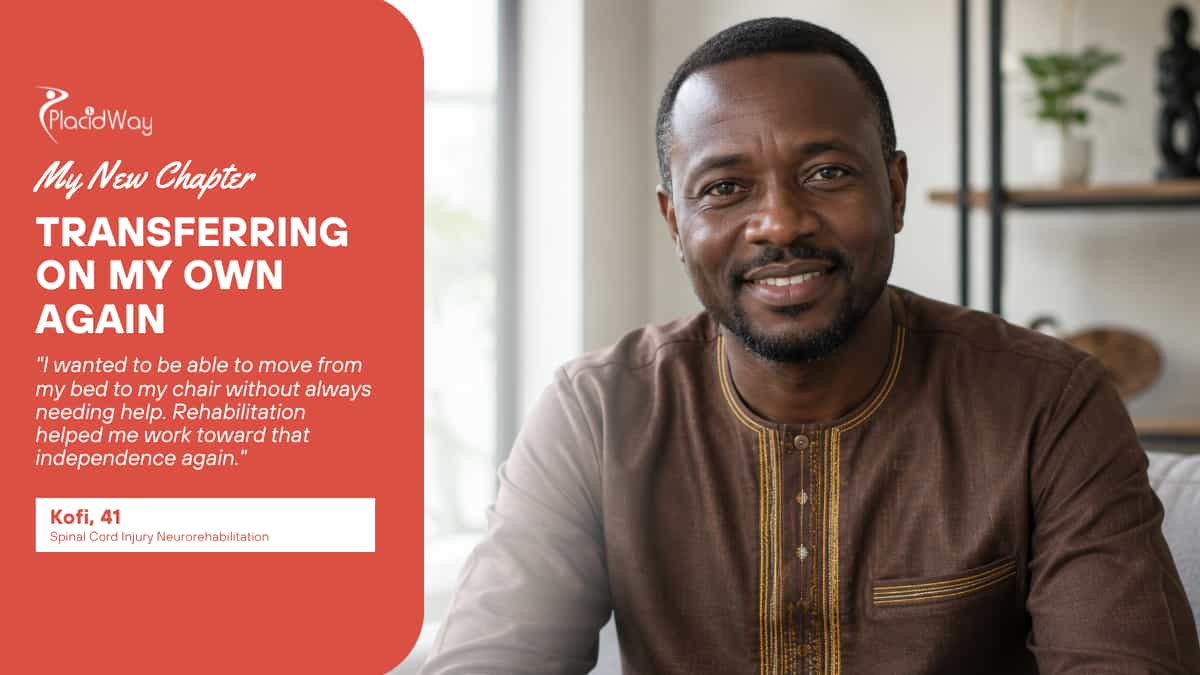
The Transfer He Wanted to Make Alone: Kofi Mensah’s Spinal Cord Injury Neurorehabilitation Story from Ghana to India

Publish date: Modified date: Medically reviewed by: Dr. Raul Valenzano on Aug 31, 2026 Author: Aamina Bibi

Kofi Mensah%e%%s Spinal Cord Injury Neurorehabilitation Story

Patient Profile

Name: Kofi Mensah

Age: 41

Condition: Traumatic spinal cord injury with paraplegia

Treatment: Advanced Stem Cell Therapy (Mesenchymal Stem Cell Protocol) integrated with comprehensive neurorehabilitation

Destination: Bengaluru, India

Journey at a Glance

Main problems: Partial or complete loss of motor function below injury level; Loss of sensation in lower limbs or trunk; Bladder/bowel dysfunction; Chronic neuropathic pain

Previous care: Local hospital trauma stabilization only; Traditional/spiritual healers or unproven remedies; Minimal home-based care from untrained family members without biological intervention

Travel driver: Absence of SCI-specialized regenerative protocols and advanced cellular laboratories; threat of permanent disability and loss of livelihood without intervention

Treatment explored: Intrathecal and intravenous Mesenchymal Stem Cell (MSC) therapy combined with robotic gait training

Personal goal: Reduce neuroinflammation, transfer more independently, and regain enough function to return to meaningful work.

You started by giving up the heavy lifting.

Then you stopped driving.

You let your colleagues take the field shifts.

You stopped carrying the groceries.

You started spending more hours in the armchair.

You accepted that your feet felt like dead wood.

You stopped trying to use the stairs.

You agreed to move the mattress to the ground floor.

"Just rest for now," your brother told you.

"Let the doctors do their work," your manager said.

"We will manage somehow," your spouse whispered.

Your world has quietly become smaller.

The hardest part is not the immobility, but the waiting for an intervention that actually addresses the cellular damage.

We need to meet Kofi Mensah

Kofi Mensah is not a real PlacidWay patient.

He is a fictional composite built from the situations and questions spinal cord injury patients in West Africa face every day.

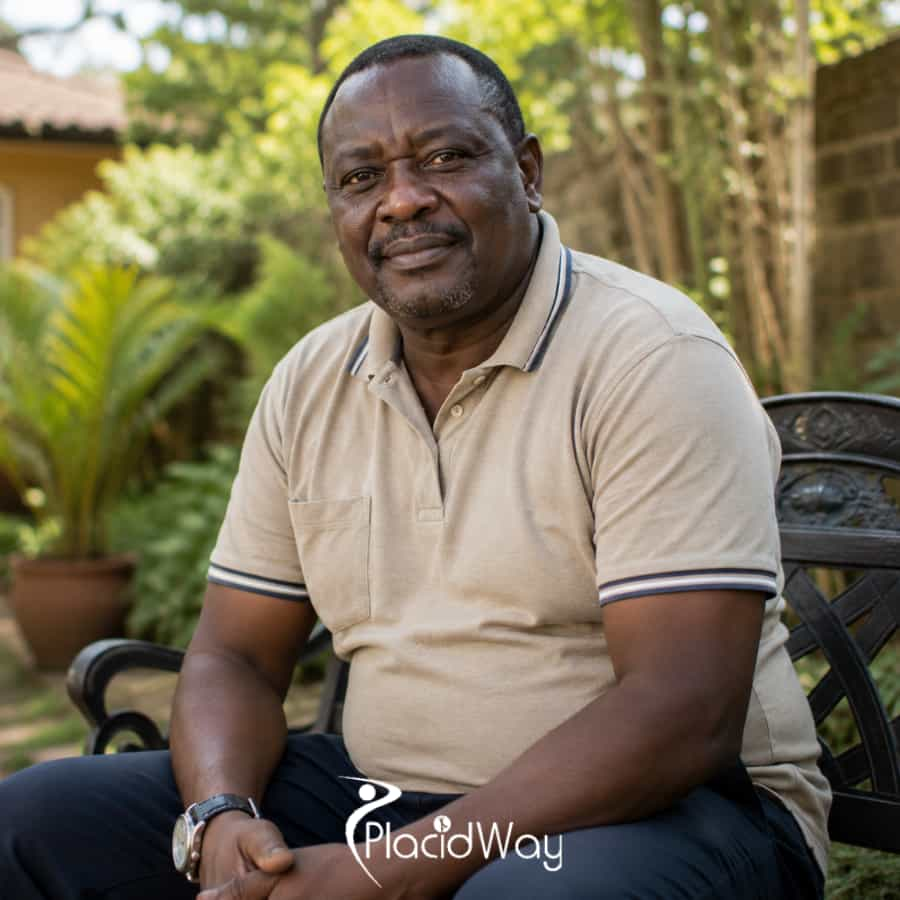
Kofi Mensah is forty-one and lives in Accra.

Before the scaffolding collapsed on his construction site, he managed a team of fifteen builders.

He drove a manual pickup truck through endless traffic.

He lifted his young daughters onto his shoulders.

He walked across unsecured concrete beams without looking down.

Now he lies on a mattress in his living room.

He stares at the ceiling fan.

He waits for someone to help him sit up.

He finds ways to explain the deterioration away

At first, he assumes the numbness will pass.

He spends two weeks in the local trauma ward.

He is stabilized.

He is discharged.

He rests.

He drinks herbal mixtures his aunt brings.

He pays a local physiotherapist to massage his legs.

He watches videos about nerve regeneration and stem cells.

He waits for a bed at the regional rehabilitation center.

According to global health guidelines, comprehensive spinal cord injury care requires early, multidisciplinary intervention to prevent secondary complications and maximize neuroplasticity. A consulting neurologist finally reviews his scan and delivers the verdict:

"You have a complete injury, and we lack the regenerative therapies and specialized rehabilitation here to reverse it."

When will they be available?

The numbers say one thing, but Kofi Mensah lives something else

Up to 80% of individuals with spinal cord injuries in low- and middle-income countries do not have access to the specialized care and advanced biologics they require for basic functional recovery. But Kofi Mensah doesn't experience the healthcare system as a national statistic.

He experiences it when he tries to shift his weight to avoid pressure sores.

"My back is burning again," he tells Ama.

He experiences it when the catheter bag needs emptying at three in the morning.

"I have it, just stay still," she says, rubbing her eyes.

He experiences it when his former boss stops by with an envelope of cash instead of a work schedule.

"Take your time getting better," the man says, looking at the floor.

He has already tried to be patient

It is a mistake to assume people seeking medical care abroad are simply impatient shoppers looking for a quick fix.

Kofi Mensah spends six months following every instruction he is given.

He spends his savings on private scans.

He joins online groups for paralyzed adults exploring cellular medicine.

He documents his leg spasms in a notebook.

"I am doing everything right," he thinks.

"Why am I getting worse?"

The question he asks himself shifts:

From "Can I tolerate this?" to "How much of my life am I prepared to organize around finding a biological breakthrough?"

The nearer alternative is failing on a technicality

The domestic alternative is to wait for the local system to build capacity.

There is a general physiotherapy clinic across town.

They have parallel bars and a static bicycle.

They do not have regulated cell-culturing laboratories or specialized clinical trials for spinal cord injuries.

They do not have robotic gait trainers to pair with cellular injections.

Ama sits at the kitchen table with a stack of medical bills.

"We could sell the car to pay for private sessions," she says.

"Having the cash isn't the same as affording a biological result," Kofi Mensah replies.

They cannot afford to spend their final reserves on therapy that lacks the advanced biologics necessary to actively stimulate neural repair.

He isn't searching for Bengaluru yet

He begins typing into his phone at night:

Spinal cord injury stem cell recovery

How to regenerate nerves after spinal injury

Stem cell therapy for paraplegia cost

Mesenchymal stem cells spinal cord India

Stem cell rehabilitation centers in Bengaluru

He reads a forum post about a Kenyan patient who traveled to Bengaluru for intensive cellular therapies combined with neurorehabilitation.

His immediate reaction is defensive.

"I'm not going abroad just because experimental science is available there."

That instinct is entirely correct.

Why does Bengaluru keep appearing in the search results?

Bengaluru has quietly become a global hub for neurological rehabilitation and regenerative medicine, housing both specialized state institutes and advanced private cellular laboratories.

The reason is structural, rooted in a massive volume of complex trauma cases and a subsequent investment in specialized biologics and neuroplasticity protocols.

But the reframe is vital here.

The question is never whether a destination is good.

Countries do not inject stem cells.

Subspecialist clinical teams and certified laboratories do.

There is always a specific facility, a specific medical director, and a specific protocol to verify.

Current guidance advises patients seeking cross-border regenerative healthcare to consult their domestic specialists to ensure the proposed treatment aligns with strict international safety standards.

His first question was: 'How much?'

An intensive, multi-week stem cell therapy and neurorehabilitation program in Bengaluru carries an indicative cost of USD 12,000–25,000, which varies significantly based on the cellular dosage, the number of intrathecal injections, and the inclusion of robotic-assisted therapy.

His father used to tell him:

"The price depends on how long you want to keep the rain out."

"What exactly am I getting?"

Does this include the intrathecal stem cell injections?

Is the cellular product expanded in a certified clean-room environment?

Does the laboratory provide a certificate of analysis verifying cell viability?

Are the cells autologous or from umbilical cord Wharton's Jelly?

Does the fee cover the specialized robotic gait training post-injection?

Are the bowel and bladder management protocols overseen by a neuro-urologist?

Is psychological counseling integrated into the physical therapy schedule?

Does the package include accommodation that is actually wheelchair accessible?

Are my caregiver's meals and training included?

What happens if I develop a severe immune reaction during the first week?

Who pays for the translation or local transport?

Will I receive a detailed home-exercise program upon discharge?

The advertised number is only the beginning of the conversation.

He writes these questions down in a ledger.

He circles the ones about cell viability.

He realizes he is no longer just waiting.

What does biological and functional restoration actually involve?

Standard physiotherapy attempts to maintain muscle tone, whereas advanced regenerative protocols aim to alter the biological environment of the injury.

This involves the precise administration of highly concentrated mesenchymal stem cells—often via intrathecal injection into the spinal canal—to modulate neuroinflammation, secrete neurotrophic factors, and potentially support remyelination.

This cellular therapy must then be immediately paired with high-repetition robotic gait training to exploit the spinal cord's awakened neuroplasticity. It is exhausting, highly specialized, and requires a coordinated team of neurologists, cellular biologists, and physical therapists.

Then comes the logistical hurdle.

"How do I actually get on the plane after spinal injections?"

The part the brochures rarely put on the front page

The brochures show patients smiling on parallel bars, but they rarely show the reality of navigating an international airport in a wheelchair with a neurogenic bladder and a fresh lumbar puncture.

Official guidance regarding fitness to fly after intrathecal injections involves strict monitoring for spinal headaches and potential immune reactions.

The variation itself is the lesson.

This constraint must be part of the care plan before committing to travel, not discovered afterward.

"Wait. Does that mean I might be denied boarding?"

Possibly, depending on your stabilization status, recent spinal procedures, and the airline's medical clearance policies.

Who submits the medical clearance forms to the airline?

Do we need to purchase an extra seat for leg elevation?

How will I handle catheterization during a nine-hour flight?

Is the medical visa process handled by the clinic, or am I on my own?

Will the airport transfer in Bengaluru accommodate a non-ambulatory passenger?

Is the guesthouse bathroom adapted for a shower chair?

Are the doorways wide enough for a customized wheelchair?

Who manages my pain medication during the journey?

What happens if my pressure sores worsen from sitting on the plane?

How do we get to the clinic from the hotel every morning?

This isn't tourism in the usual sense.

Ama isn't just coming along for the ride

She is the invisible second participant in this medical journey.

She will carry the luggage, push the chair over unfamiliar curbs, and remember the daily medication schedule.

She will sit in the therapy room learning how to safely perform transfer techniques and monitor for signs of spinal fluid leaks after the injections.

She needs to know exactly what the escalation protocols are if Kofi Mensah develops deep vein thrombosis or an adverse immune reaction.

International medical travel insurance rarely covers experimental treatments or preexisting conditions without explicit, documented riders.

She is part of the care system too.

Then comes the uncomfortable conversation about risk

Intercontinental travel combined with cellular injections carries significant, measurable risks, including deep vein thrombosis, severe urinary tract infections, failure of the cells to engraft, and spinal headaches.

Kofi Mensah learns to filter out clinics that refuse to discuss these realities.

He learns to distrust specific phrases on glossy websites:

Completely safe. You will walk again. Guaranteed success.

Informed consent means understanding the absolute worst-case scenarios and the distinct possibility of biological non-responsiveness, not just the hoped-for outcome.

Kofi Mensah's questions become sharper and more clinical

He stops asking if a clinic is good and starts asking how a clinic operates:

What is your specific protocol for testing cell viability?
Do you use fluoroscopic guidance for the intrathecal injections?
How do you measure functional and biological improvement objectively?
Can I speak with a former patient from West Africa about their experience with this cell protocol?
What happens if the cells fail to yield any motor or sensory improvement?
Are your robotic devices calibrated for patients of my height and weight?
Who is legally responsible if I suffer an adverse reaction to the donor cells?
What is the step-down care plan for when I return to Accra?
Will your team collaborate with my local physiotherapist via video call?
What specific complication would cause you to pause my therapy?
What would you see in my medical records that would make you tell me not to travel?

They do not only want someone willing to provide the therapy.

They want someone willing not to.

Have I actually exhausted my options at home?

It is essential to confirm what domestic capacity actually exists before assuming international travel is the only route.

Patients have the right to request comprehensive case reviews and seek secondary referrals within their national system.

Are there any domestic clinical trials for cellular therapies that I might qualify for?

Can my local clinic manage the intense physiotherapy required after the stem cell infusion?

Is there a domestic neuro-urologist who can manage my ongoing bladder care?

Can I hire a private neuro-physiotherapist for intensive daily home sessions instead?

Would those domestic costs ultimately exceed the price of traveling?

Medical travel to Bengaluru should be compared with Kofi Mensah's real alternatives, not with a worst-case assumption about the Ghanaian system.

The night before the decision feels different

They sit at the kitchen table again.

The surface is covered in printed emails and handwritten notes.

The medical clearance form from the airline.

The detailed stem cell injection schedule from the Bengaluru clinic.

The quote for the specialized travel insurance.

The contact details of a Nigerian patient who completed the same program.

"I know exactly how hard this is going to be," Kofi Mensah says.

"That is why I am packing the heavy braces," Ama replies.

The research didn't make them more afraid; it made them more capable of deciding.

What Kofi Mensah actually wants isn't a medical package

His brother visits and asks if the Indian doctors are going to make him walk normally again.

Kofi Mensah gives the expected answer about hoping for the best.

The real answer is much smaller, and much harder:

Regain enough motor function to transfer independently and return to some form of work.

To use the toilet without his wife's assistance.

To sit at a desk for eight hours without unbearable nerve pain.

To load his own wheelchair into a modified vehicle.

Not the medical tourism package. Not the cellular vials. Not the specialized rehabilitation center. Not the flight to Bengaluru.

Control.

And underneath that:

Agency.

Bengaluru might be the answer, but it might not be

You do not have to go.

You might decide the travel logistics are too dangerous for your current physical state.

You might realize the biological risks of the cell therapy outweigh the potential gains.

You might decide to wait for an NGO-sponsored rehabilitation mission.

You might determine that the financial risk to your family is too great.

You might choose to adapt your home and focus entirely on wheelchair independence.

Choosing any of these paths after conducting rigorous, unsentimental research is a victory of informed consent.

Any of those can be an informed decision.

The goal here is not to persuade you to purchase a plane ticket.

The goal is to make sure that frustration does not make the decision for you.

The choice ahead of you

Maybe you have spent hours staring at a ceiling fan.

Maybe you have drained your savings on therapies that merely rub the surface of paralyzed muscles.

Maybe you have watched your spouse age five years in six months.

Maybe you are tired of being told to just accept your new reality without exhausting biological options first.

You do not need to decide today:

What exactly is my local clinic missing?

Who can independently review my MRI to confirm cellular viability?

What is the functional goal I am actually trying to reach?

Am I physically stable enough to sit on an airplane?

Who will support my caregiver during this process?

What does failure look like?

What is the plan for when I return home?

You are not just comparing prices.

You are comparing paths forward.

Hope isn't the promise that everything will be fixed

Hope is not a glossy brochure showing a smiling patient walking out of a hospital.

Hope is not the blind belief that a foreign clinic has magical technology.

Hope is not avoiding the conversation about risks and biological complications.

Hope is having enough accurate, unvarnished information to make a medical decision that actually feels like yours.

You can read the clinical guidelines.

You can interview the overseas neuro-biologist.

You can calculate the true cost of logistics.

You can ask the hard questions about risk.

You can decide to stay home, or you can decide to pack your bags.

You are capable of evaluating medical credentials. You are capable of asking difficult logistical questions. You are capable of demanding transparency from international laboratories. You are capable of protecting your own physical future. You are capable of saying no if the terms do not align with your safety.

From "I suppose I'll just have to keep waiting."

To:

"What other informed options do I have?"

PlacidWay — Your Way to Hope

We help patients and their families explore international medical options, compare facility credentials, understand regenerative protocols, and prepare the exact questions they need to ask specialists abroad.

We do not provide clinical advice, nor do we diagnose conditions or guarantee rehabilitation outcomes.

For someone like Kofi Mensah, exploring specialized cellular therapy in Bengaluru isn't a promise of walking again, it is one rigorous route worth understanding thoroughly.

Your Way to Hope.

Learn More
Medical disclaimer

This article is strictly educational and does not recommend that any individual undertake cross-border medical travel or specific regenerative procedures. Individual medical suitability, procedural risk, and cellular viability require comprehensive professional assessment. Always independently verify current medical credentials, institutional regulatory status, and obtain appropriate medical travel protection or insurance prior to traveling abroad for healthcare.

The Transfer He Wanted to Make Alone: Kofi Mensah’s Spinal Cord Injury Neurorehabilitation Story from Ghana to India

About Article

  • Treatment: Orthopedic/Knee Surgery
  • Country: India
  • Overview This educational overview follows Kofi Mensah, a composite Ghanaian patient exploring Spinal Cord Injury Rehab in Bengaluru, India. It summarizes daily-life effects, previous care and why treatment abroad is being considered. Candidacy, safety, recovery and follow-up remain central to informed decision-making.

Trusted Medical Tourism Platform Since 2007

60+
Countries
2k+
Clinics
19.5k+
Reviews
2.5k+
Qualified Doctors
1.1M+
Patients Served Since 2007