
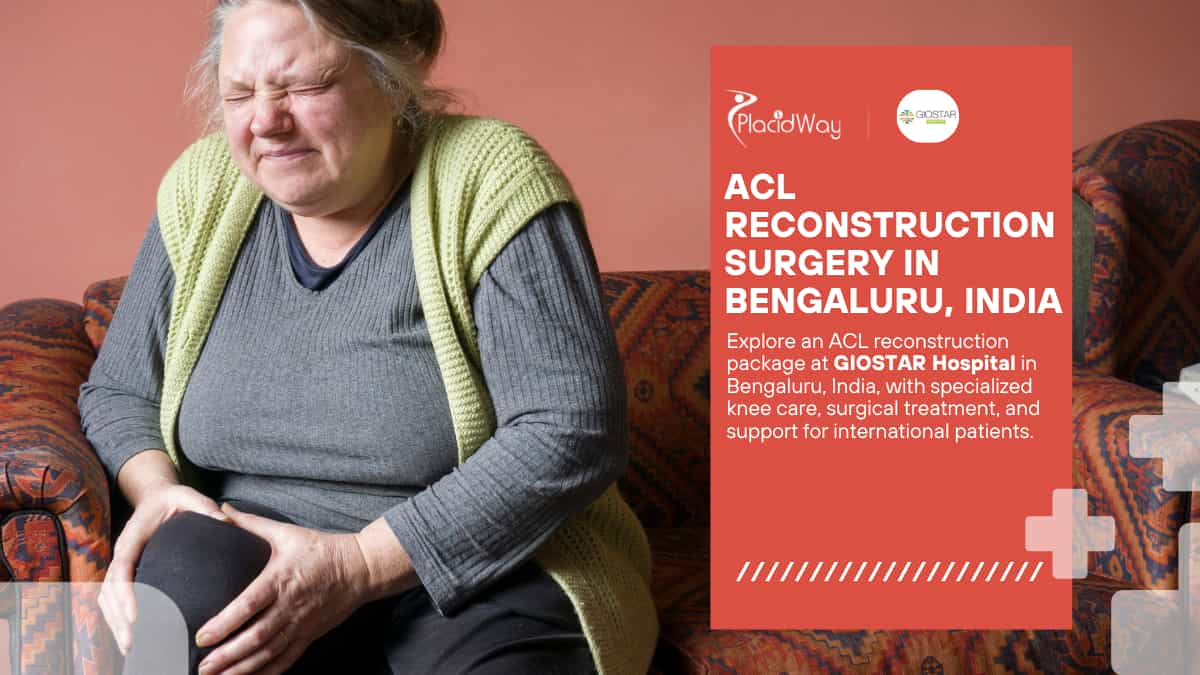
A torn ACL can make everyday movements, sports, and activities that require quick changes in direction difficult. ACL reconstruction surgery in Bengaluru, India may be considered when a specialist determines that surgical treatment is appropriate, with the choice of technique depending on the injury and individual knee condition.
Before booking, patients should review the surgeon’s experience, hospital facilities, surgical approach, rehabilitation plan, and follow-up arrangements to understand the full treatment pathway.
Key Things to Know Before Planning ACL Reconstruction in Bengaluru
- Starting package price: $4,000, subject to individual assessment and the final surgical plan.
- Treatment purpose: ACL reconstruction aims to restore functional stability to a knee affected by an anterior cruciate ligament tear.
- Surgery is not automatic: Not every ACL tear requires reconstruction; symptoms, instability, activity goals, associated injuries, and response to rehabilitation matter.
- Graft choice varies: Patellar tendon, hamstring tendon, quadriceps tendon, or donor tissue may be considered depending on the individual case.
- Rehabilitation matters: Surgery is only one stage of treatment. Structured physiotherapy and progressive strengthening are central to recovery.
- International travel requires planning: Confirm the operating surgeon, exact surgical facility, postoperative review, travel clearance, and rehabilitation arrangements before departure.
ACL Reconstruction Surgery Package Cost in Bengaluru, India
The starting price supplied for this ACL reconstruction package is $4,000. Prices for orthopedic surgery can vary substantially between countries and individual hospitals. The figures below should therefore be treated as planning estimates rather than quotes.
| Country | Indicative ACL Surgery Cost Range | Planning Consideration |
|---|---|---|
| United States | $15,000–$35,000+ | Charges can vary with insurance, surgeon, facility, graft, imaging, and rehabilitation. |
| United Kingdom | $8,000–$15,000+ | Private-sector costs vary according to hospital and treatment requirements. |
| Australia | $8,000–$18,000+ | Private charges depend on surgeon, hospital, insurance arrangements, and rehabilitation. |
| India | Package starts from $4,000 | Final cost depends on medical assessment, graft, fixation, facility charges, and associated knee treatment. |
Note: International comparison figures are approximate planning ranges rather than standardized national prices. Request an itemized quote for your individual treatment before making a financial or travel decision.
Estimated $4,000 Package Cost Breakdown
The ACL reconstruction surgery cost in Bengaluru, India can vary depending on the surgical technique, graft type, surgeon and hospital fees, anesthesia, diagnostic tests, rehabilitation, and individual medical needs. Request an itemized quote to confirm what is included in the package and which services may cost extra.
| Procedure Item | Estimated Allocation | Description |
|---|---|---|
| Orthopedic assessment | $150 | Clinical evaluation and surgical planning. |
| Imaging and preoperative tests | $300 | Allowance for required imaging review and routine preoperative investigations. |
| ACL reconstruction procedure | $1,600 | Estimated surgical component of the package. |
| Graft and fixation materials | $700 | Estimated allowance; actual materials vary by technique. |
| Anesthesia and facility services | $900 | Estimated anesthesia, operating-room, and related facility costs. |
| Early postoperative care | $200 | Initial review, wound assessment, and postoperative planning. |
| Initial rehabilitation planning | $150 | Early mobility and rehabilitation instructions. |
| Estimated Starting Total | $4,000 | Illustrative allocation of the supplied starting package price. |
The breakdown above illustrates how a $4,000 package could be distributed and is not a provider-issued itemized quotation. Obtain the actual written breakdown before booking.
What May Be Included in the ACL Reconstruction Package?
- Orthopedic consultation and clinical knee assessment
- Review of MRI and available medical records
- Routine preoperative investigations when specified
- ACL reconstruction surgery
- Surgeon and operating-room services included in the confirmed quotation
- Anesthesia services when stated in the final package
- Standard graft or fixation materials specified in the treatment plan
- Immediate postoperative monitoring
- Initial mobility or physiotherapy guidance
- Postoperative review before departure when scheduled
Package inclusions can change according to the selected graft, facility, associated injuries, and individual medical requirements. Ask for written confirmation rather than assuming that every item above is included.
What Is Usually Not Included?
- International or domestic airfare
- Passport, visa, and travel-document expenses
- Hotel accommodation unless specifically stated
- Meals and personal expenses
- Travel insurance or medical travel insurance
- Treatment for unrelated medical conditions
- Additional surgery for unexpected or separately diagnosed knee problems
- Extended hospital admission beyond the agreed package
- Long-term physiotherapy after returning home
- Emergency treatment or readmission not covered by the written agreement
- Additional medications, imaging, implants, or tests not included in the confirmed quotation
Who May Be a Candidate for ACL Reconstruction?
Surgical candidacy depends on more than an MRI showing an ACL tear. An orthopedic specialist should consider symptoms, knee stability, activity requirements, associated injuries, overall health, and rehabilitation goals.
- Patients with a clinically confirmed ACL tear
- People experiencing recurrent episodes of the knee giving way
- Athletes or active individuals who want to return to activities involving cutting, pivoting, or rapid directional changes
- Patients with certain combined ligament, meniscus, or cartilage injuries
- Individuals whose knee instability continues despite appropriate nonsurgical management
- Patients medically fit for anesthesia and surgery
- People able and willing to participate in prolonged postoperative rehabilitation
Medical Records to Prepare Before Traveling
- Recent knee MRI images and radiology report
- X-rays or other knee imaging if available
- Previous orthopedic consultation notes
- Previous physiotherapy or rehabilitation records
- Details of previous knee operations or injuries
- Current medication and supplement list
- Known allergies
- Relevant medical and surgical history
- Recent laboratory results if already completed
- Any existing anesthesia or medical-clearance documentation
How Does ACL Reconstruction Surgery Work?
ACL reconstruction is performed to restore stability after an anterior cruciate ligament tear. Rather than simply stitching most torn ACLs together, the surgeon generally reconstructs the ligament using a tendon graft that is positioned to perform the stabilizing role of the damaged ACL.
Possible graft sources include the patient's hamstring, patellar tendon, or quadriceps tendon. Donor tissue can also be considered in selected circumstances. Age, activity level, associated injuries, graft characteristics, and surgeon-patient discussion all influence graft selection.
Important: An ACL tear does not automatically mean you need surgery. Functional instability, sporting requirements, associated knee damage, symptoms, and response to rehabilitation should be considered before deciding on reconstruction.
Step-by-Step ACL Reconstruction Procedure
- Clinical confirmation: The orthopedic surgeon reviews symptoms, knee stability, MRI findings, previous treatment, health history, and activity goals.
- Anesthesia: Anesthesia is administered according to the planned operation and individual medical assessment.
- Arthroscopic examination: A small camera allows the surgeon to inspect the knee and assess the ACL, menisci, cartilage, and related structures.
- Graft preparation: The selected tendon graft is prepared. When an autograft is used, tissue is obtained from the patient's own tendon.
- Preparing the graft pathway: The surgeon creates tunnels or sockets in the tibia and femur according to the reconstruction technique.
- Graft placement: The prepared graft is positioned to reproduce the stabilizing function of the ACL.
- Fixation: The graft is secured using fixation devices appropriate to the selected technique.
- Final assessment and closure: Graft position, tension, movement, and knee stability are assessed before the incisions are closed.
ACL Reconstruction Treatment Timeline in Bengaluru
How Long Should You Stay in Bengaluru?
There is no universal number of days that is appropriate for every international ACL patient. Your stay should allow enough time for surgery, early recovery, postoperative assessment, mobility planning, and medical clearance for onward travel.
- Remain available for the postoperative examination recommended by your surgeon.
- Make sure pain is reasonably controlled and you can move safely with any prescribed walking aid.
- Ask when prolonged car or air travel is appropriate after your operation.
- Use accessible accommodation that reduces unnecessary stair climbing during early recovery.
- Avoid building strenuous tourism activities into the immediate postoperative period.
- Collect your operative report, discharge summary, rehabilitation protocol, medication information, and relevant imaging before departure.
- Arrange orthopedic and physiotherapy follow-up in your home country before leaving India.
Travel note: Long-distance travel after surgery can involve prolonged immobility. Your treating team should assess your individual blood-clot risk and determine when travel is medically appropriate.
Recovery and Rehabilitation After ACL Reconstruction
Recovery is a staged process. Progress depends on the graft, additional knee procedures, swelling, range of motion, muscle strength, rehabilitation participation, and individual healing. A patient who has also undergone meniscus repair may receive different restrictions from someone who had isolated ACL reconstruction.
| Stage | Rehabilitation Focus | What to Remember |
|---|---|---|
| Immediate recovery | Pain and swelling control, safe mobility, knee extension, and gentle movement. | Follow weight-bearing and brace instructions. |
| Early rehabilitation | Range of motion, quadriceps activation, walking pattern, and basic strength. | Associated meniscus treatment can change restrictions. |
| Strength phase | Progressive strength, balance, endurance, and neuromuscular control. | Progress should be based on function and clinical assessment. |
| Advanced rehabilitation | Running, jumping, agility, and sport-specific exercises when appropriate. | Do not advance solely because pain has disappeared. |
| Return to sport | Functional testing, strength assessment, movement quality, and progressive sports exposure. | Medical clearance and objective readiness matter more than a fixed date alone. |
Risks and Possible Complications
ACL reconstruction is surgery, so complications are possible even when appropriate precautions are taken. The following list is not exhaustive, and your individual risk profile should be discussed with your orthopedic and anesthesia teams.
- Infection
- Bleeding or significant swelling
- Blood clots
- Knee stiffness or loss of motion
- Persistent pain
- Graft failure or recurrent instability
- Donor-site pain with some autografts
- Nerve or blood-vessel injury
- Problems involving fixation materials
- Persistent weakness or functional limitations
- Need for further knee surgery
- Complications related to anesthesia
Seek urgent medical advice for symptoms such as difficulty breathing, chest pain, significant calf swelling or pain, fever, increasing wound redness, drainage, uncontrolled pain, or a sudden deterioration in your condition.
Expected Results After ACL Reconstruction
ACL reconstruction aims to improve functional knee stability and support a return to appropriate physical activities. Many patients may regain greater confidence in the knee after surgery and rehabilitation, but outcomes vary and cannot be guaranteed.
- Knee stability may improve as the graft incorporates and rehabilitation progresses.
- Muscle strength and movement control require progressive rehabilitation.
- Return to running or sports should occur only after appropriate clinical and functional assessment.
- Meniscus or cartilage damage may influence symptoms and recovery.
- Some patients may continue to experience pain, stiffness, weakness, or instability.
- The reconstructed ACL can be injured again.
- ACL reconstruction does not guarantee a return to the patient's previous sporting level.
About the GIOSTAR Bengaluru Treatment Location
The package information identifies GIOSTAR in Bengaluru, Karnataka, India as the treatment provider. Before traveling, patients should obtain the exact name of the orthopedic surgeon and the hospital or surgical facility where the ACL reconstruction will actually be performed.
- Provider identified for the package: GIOSTAR
- Destination: Bengaluru, Karnataka, India
- Treatment: ACL reconstruction surgery
- Supplied starting price: $4,000
- Operating surgeon: Confirm the surgeon's name, orthopedic qualifications, professional registration, and role in your procedure before booking.
- Surgical facility: Request the exact hospital name and independently verify applicable licensing or accreditation.
- Written surgical plan: Confirm the graft, fixation approach, associated procedures, hospital services, rehabilitation, complication arrangements, and follow-up.
No specific surgeon credential or hospital accreditation is asserted here because sufficient independently verified information about the surgeon and operating facility was not supplied.
Frequently Asked Questions About ACL Reconstruction in Bengaluru
How much does ACL reconstruction surgery cost in Bengaluru?
Does every ACL tear require surgery?
Is the torn ACL simply stitched together?
Which graft is used for ACL reconstruction?
Do I need an MRI before ACL surgery?
Can ACL reconstruction and meniscus repair be done together?
Can I walk after ACL reconstruction?
When can I return to sports?
How long should I remain in Bengaluru after surgery?
What should I verify before booking ACL surgery abroad?
References
- American Academy of Orthopaedic Surgeons — ACL Injury: Does It Require Surgery?
- American Academy of Orthopaedic Surgeons — Management of Anterior Cruciate Ligament Injuries Clinical Practice Guideline
- Johns Hopkins Medicine — Anterior Cruciate Ligament (ACL) Injury or Tear
- NHS — Knee Ligament Surgery
- Centers for Disease Control and Prevention — Medical Tourism
Medical Disclaimer
This content is for general educational and informational purposes and does not replace medical advice, diagnosis, or treatment from a qualified healthcare professional. Suitability for ACL reconstruction, graft selection, travel clearance, recovery, and rehabilitation must be determined through individual medical assessment.
























Share this listing