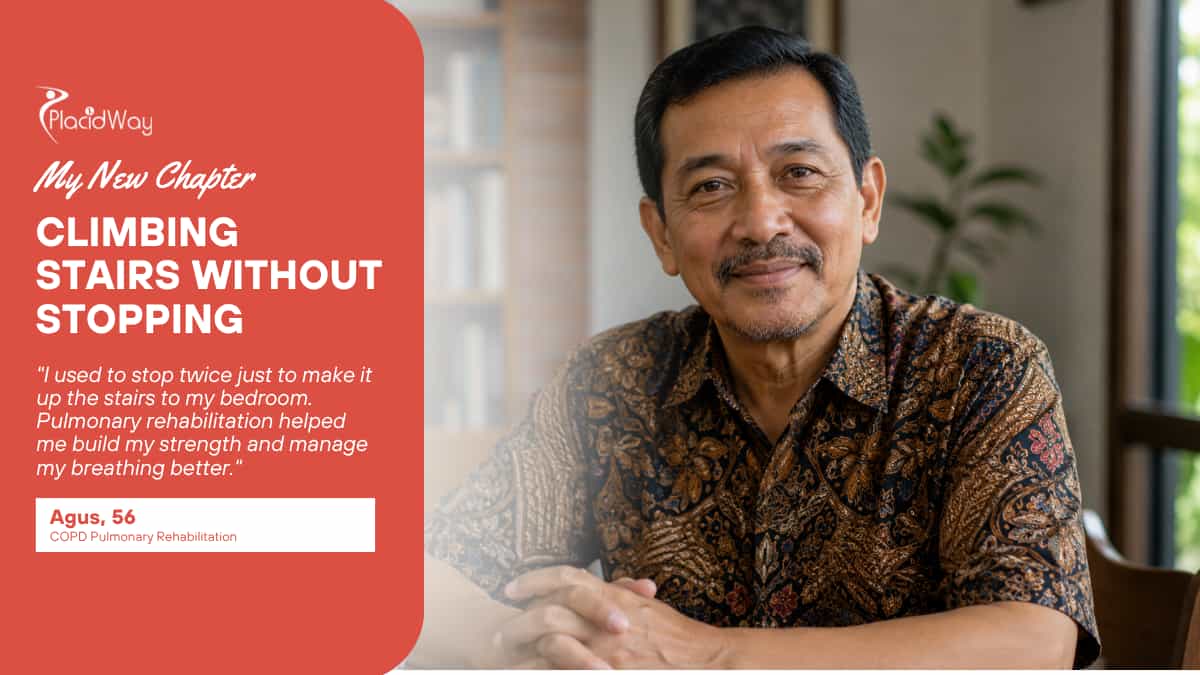
The Bedroom Stairs He Had to Stop Twice to Climb: Agus Pratama’s COPD Pulmonary Rehabilitation Story from Indonesia to Malaysia

Publish date: Aug 28, 2026 Medically reviewed by: Dr. Lokesh Tiwary on Aug 28, 2026 Author: Jacob Smith

Agus Pratama’s COPD Pulmonary Rehabilitation Story 

Patient Profile

Name: Agus Pratama

Age: 56

Condition: Chronic Obstructive Pulmonary Disease (COPD)

Treatment: Advanced pulmonary assessment, medication optimization and structured pulmonary rehabilitation

Destination: Kuala Lumpur, Malaysia

Journey at a Glance

Main problems: Persistent shortness of breath during light activity; Chronic productive cough with sputum; Recurrent respiratory infections and exacerbations; Exercise intolerance and fatigue

Previous care: Multiple visits to local general practitioners and under-resourced pulmonologists; Self-medication with OTC inhalers and traditional remedies; Informal pulmonary rehabilitation or breathing exercises at home

Travel driver: Specialist availability + Advanced diagnostics + Affordable cost + Shorter wait times + Proximity + Established medical tourism pathway

Treatment explored: Advanced pulmonary assessment, medication optimization and structured pulmonary rehabilitation

Personal goal: Climb the stairs with less breathlessness and regain confidence in everyday activity.

You stop carrying the heavy grocery bags from the market.

You pause on the landing before tackling the final flight of stairs to your bedroom.

You tell your grandchildren you would rather sit on the porch and watch them play.

You stop agreeing to social visits that require walking from a distant parking lot.

You quietly reorganize your morning routine to avoid rushing.

You memorize the exact locations of sturdy chairs in every room of your house.

You convince yourself that taking a taxi for three blocks is just a practical choice for a man your age.

You accept that coughing for twenty minutes is simply how mornings must begin.

"Take it easy today, Pak."

"We can just stay in this weekend."

"Let me get that for you."

Your world has quietly become smaller.

The hardest part is not the physical exhaustion, nor the accumulating pharmacy bills, but the endless waiting.

Meet Agus Pratama, a man whose life used to require no effort.

Agus Pratama is not a real patient of PlacidWay or any medical facilitation agency.

He is a fictional composite built entirely from the specific clinical situations, financial anxieties, and logistical questions Indonesian respiratory patients face every day.

He is fifty-six years old and lives in a modest residential neighborhood in Jakarta.

Before his lungs began to fail, his life was ordinary and competent.

He managed inventory on a humid factory floor for twenty-two years without missing a shift.

He lifted heavy wooden crates without hesitation.

He walked two miles to the mosque every Friday in the midday heat.

He repaired the corrugated roofing on his family home by himself.

He explained the breathlessness away for as long as he could.

He blamed the persistent morning cough on the Jakarta street dust.

He bought menthol lozenges.

He tried over-the-counter reliever inhalers.

He drank ginger and turmeric infusions.

He rested his forearms on his knees to force air into his tightening chest.

He slept propped up on three pillows.

Clinical guidelines establish that when a patient presents with chronic progressive dyspnea and recurrent exacerbations, a definitive spirometry assessment is required to stage the disease and initiate long-acting bronchodilator therapy.

His local general practitioner delivered the assessment:

"You need a comprehensive lung function test and structured rehabilitation."

Agus Pratama asked a single question:

When?

He does not experience the healthcare system as a national statistic.

The national healthcare infrastructure faces documented constraints regarding respiratory specialist density, resulting in severe regional disparities in access to advanced diagnostic imaging and structured pulmonary rehabilitation programs.

But Agus Pratama does not experience these limitations as abstract demographic data.

He experiences them while staring at a pharmacy receipt that just consumed twenty percent of his monthly pension.

"They only had the generic reliever in stock today."

He experiences them while sitting on a hard plastic chair in a crowded clinic corridor for four hours.

"The doctor can see you for five minutes now."

He experiences them while watching his wife carry a heavy cooking gas cylinder through the front door because he physically cannot.

"I've got it, just sit and rest."

He has already tried to be patient.

He is not a careless shopper looking for a quick fix.

He paid out of pocket for a premium private clinic consultation that yielded no new diagnostic data.

He waited three months for a public system referral that was subsequently rescheduled due to specialist unavailability.

He dutifully attempted to follow generic breathing exercises on a cracked smartphone screen.

He restricted his own movements exactly as his family instructed.

I am doing everything they asked.

Why is my stamina only getting worse?

His foundational question shifted:

From "Can I tolerate this?" to:

How much of my life am I prepared to organise around it?

The nearer alternative is complicated by a fragmented system.

The immediate alternative is to continue navigating the private specialist network in Jakarta.

The facilities are undeniably modern.

The physicians are highly competent.

The fundamental issue is the fragmented nature of the care pathway and the unpredictable sequence of costs for uncoordinated tests.

Siti sits at the kitchen table with a calculator and a stack of clinic brochures.

"We have the savings to pay for the private scan."

"But we do not have the savings to pay for the scan, and the physical therapy, and the wrong medication regimen again."

He isn't searching for Kuala Lumpur yet.

He is searching for answers to immediate physical problems.

Why is my sputum dark in the morning

Pulmonary rehabilitation exercises at home

Cost of HRCT scan Jakarta private hospital

Best pulmonologist in Southeast Asia

COPD treatment packages Malaysia

When the algorithms begin suggesting medical travel across the Malacca Strait, his immediate reaction is defensive.

"I am not getting on an airplane just because a scan is cheaper across the water."

That skepticism is entirely justified.

Price should never be the mechanism that answers a fundamental medical question.

Why does Kuala Lumpur keep appearing in his research?

The destination continues to appear because of a deliberate structural alignment in regional medical logistics.

Malaysia has actively centralized its private healthcare framework to attract international patients, developing highly integrated clinical pathways particularly for cardiology, orthopedics, and respiratory medicine.

The critical reframing is understanding that countries do not treat respiratory disease.

Clinical teams treat respiratory disease.

Hospitals administer diagnostic protocols.

There is a concrete operational reality to verify before making any travel arrangements.

Independent research should always be conducted to verify specialist credentials, and any international treatment plan must be discussed with a domestic healthcare provider before commitment.

His first question was: "How much?"

Current private hospital data indicates that comprehensive COPD assessment packages in Kuala Lumpur commonly range between USD 1,500–3,500.

This indicative figure fluctuates based on the necessity of high-resolution computed tomography, the inclusion of cardiac screening, and the immediate need for exacerbation stabilization.

Agus Pratama remembers his father's advice regarding tools and machinery: "A cheap price for the wrong answer is still too expensive."

"What exactly am I getting?"

Twelve things the advertised price may or may not cover.

Does this include the initial pulmonologist consultation?
Is the full-body plethysmography billed separately?
Who physically interprets the HRCT scan?
Are arterial blood gas tests part of the standard battery?
Does the package cover the physical therapy assessment?
How many pulmonary rehabilitation sessions are included in this rate?
Is sputum culture testing billed additionally?
Are the newly prescribed maintenance inhalers included in this fee?
What happens if the tests reveal a concurrent cardiac issue?
Will I be charged extra for translated medical reports?
Does this cover airport transfers to the medical facility?
Are follow-up teleconsultations priced into the initial bundle?

The advertised number is only the beginning of the conversation.

What does a comprehensive pulmonary assessment actually involve?

A comprehensive pulmonary assessment requires objective measurement of airflow limitation, lung volume capacities, and gas exchange efficiency.

The standard protocol typically involves advanced spirometry with bronchodilator reversibility testing, specialized imaging to detect emphysema or bronchiectasis, and a six-minute walk test to establish baseline exercise tolerance.

These diagnostics dictate the subsequent optimization of inhaled corticosteroids and long-acting bronchodilators.

The medical explanation is straightforward.

The logistical reality introduces a very different set of hurdles.

"How do I manage the physical strain of travel?"

The medical travel industry rarely highlights the sheer physical endurance required to navigate international airport terminals with compromised lungs.

Aviation regulations regarding supplemental oxygen in commercial cabins vary significantly between regional carriers, and current guidance states that this variation itself is the most critical lesson for traveling patients.

This constraint must be solved before committing to any clinical package, never afterward.

"Wait. Does that mean I might be denied boarding?"

Possibly, depending on your baseline oxygen saturation and the specific airline's medical clearance policies.

How far is the walk from the check-in counter to the departure gate?

Can the airline guarantee continuous wheelchair assistance?

How does cabin pressurization affect my current shortness of breath?

Is the hotel in Kuala Lumpur located on a steep incline?

Does the accommodation have elevators that reliably function?

How far is the hospital entrance from the taxi drop-off point?

Who carries the luggage if Siti cannot manage both suitcases?

Are my prescribed emergency medications legal to carry across the border?

What is the local air quality index near the recovery hotel?

This is not medical tourism in the usual sense.

Siti isn't just coming along on a vacation.

She is the invisible second participant in the clinical journey.

She will carry the thick medical dossiers.

She will remember the precise dosages of the morning medications.

She will notice the subtle changes in his breathing rhythm during the night.

She is the one who needs to know exactly what to do if an exacerbation occurs in a foreign hotel room.

Any patient traveling internationally for care must secure specialized medical travel insurance that explicitly covers pre-existing condition exacerbations.

She is part of the care system too.

Then comes the uncomfortable conversation about risk.

Air travel and exposure to novel environments inherently increase the risk of acute respiratory exacerbations and hospital-acquired infections in severely obstructed patients.

Agus Pratama has learned to immediately distrust specific promotional phrases:

Completely safe. No risk. Guaranteed success.

Informed consent requires understanding the potential complications as clearly as the hoped-for outcome.

Agus Pratama's questions become better as he learns more.

He stops asking if the hospital lobby is nice.

He starts asking how they manage clinical failure.

What happens if my lung function is too poor for the standard rehabilitation protocol?
Do you have an intensive care unit on-site if I suffer an acute exacerbation?
Who takes responsibility for my care the moment I land back in Jakarta?
Will you write a formal handover letter to my local general practitioner?
How many moderate-to-severe COPD patients does this specific specialist treat monthly?
Are the inhalers you prescribe available for purchase in Indonesian pharmacies?
What happens if the HRCT scan reveals a malignancy instead of just COPD?
What would you see on my diagnostic results that would make you tell me to go home without treatment?

He does not only want a physician willing to treat him.

He wants a physician willing not to.

Have I exhausted my options at home?

The final phase of preparation involves looking backward.

Patients enrolled in the national health insurance program have the right to request a second opinion or escalate their care pathway if standard treatments fail to control their symptoms.

Have I requested a referral to a different regional hospital?

Have I explicitly asked my local pulmonologist if there are private rehabilitation clinics nearby?

Have I inquired about out-of-pocket spirometry testing within my own city?

Is the wait time for a public CT scan actually as long as I assume it is?

Can my current doctor coordinate with a specialist in Kuala Lumpur?

The fairness principle must be applied:

Kuala Lumpur should be compared with Agus Pratama's real alternatives, not with a worst-case assumption about the Indonesian healthcare system.

The night before the decision brings a strange calm.

The kitchen table is covered again.

Medical records from the local clinic.

Printed email correspondences with the international patient center.

Passports with ample validity.

Spreadsheets detailing the cost of flights, hotels, and clinical packages.

"It feels very real now."

"It feels like we finally have a map."

The intense research did not make them more afraid.

It made them more capable of deciding.

What Agus Pratama actually wants isn't the medical package.

His brother calls and asks a simple question.

"Don't you just want the new imported inhalers?"

He expects Agus Pratama to agree.

But that is not the goal.

Complete pulmonary function testing, receive a clear diagnosis, and return home with a managed rehabilitation plan.

He wants to climb his own stairs without stopping twice.

He wants to walk to the mosque on Fridays without fear.

He wants his wife to stop looking at him with quiet panic every time he coughs.

Not the medical travel package. Not the discounted diagnostic scan. Not the modern hospital lobby. Not a trip to Kuala Lumpur.

Breath.

And underneath that:

Autonomy.

Kuala Lumpur might be the answer, or it might not be.

He might look at the required flight logistics and decide the physical toll is too high.

He might realize the cost of ongoing maintenance medications sourced abroad is unsustainable.

He might locate a newly opened pulmonary rehabilitation center in Surabaya instead.

He might decide his current local care, while imperfect, is the safer option for his specific stage of decline.

He might proceed with the trip, fully aware of the clinical risks and the operational burdens.

Any of those can be an informed decision.

The objective is not to persuade you to cross a border for care.

The objective is to ensure that frustration does not make the decision for you.

The next steps belong to you.

Maybe you have stopped carrying the groceries entirely.

Maybe you are tired of spending your pension on inhalers that do not seem to work.

Maybe you are watching your independence slowly slip away.

Maybe you are just exhausted from waiting for the system to notice you.

You do not need to decide today.

What exactly is my current lung function capacity?

Why am I still experiencing exacerbations on this medication?

Where can I find structured pulmonary rehabilitation?

What will this disease look like in three years if I change nothing?

Who can give me an objective assessment of my current stage?

Is the nearest advanced diagnostic equipment in my city or in another country?

How much longer am I willing to wait?

The search is not just for better prices.

It is for paths forward.

Hope isn't the promise that everything will be fixed.

Hope isn't the promise that your lungs will revert to what they were twenty years ago.

Hope isn't a guaranteed cure for a chronic progressive disease.

Hope isn't a glossy brochure promising an effortless medical vacation.

Hope is possessing enough concrete information to make a medical decision that finally feels like yours.

It is understanding the exact nature of your condition.

It is knowing what clinical interventions are actually possible.

It is seeing the logistical steps required to access them.

It is recognizing that you still have choices.

The shift in perspective was permanent:

You are capable of evaluating options. You are capable of asking difficult questions. You are capable of demanding transparency. You are capable of protecting yourself. You are capable of saying no.

From I suppose I'll just have to keep waiting.

To What other informed options do I have?

PlacidWay — Your Way to Hope.

PlacidWay helps patients and families explore international medical options, compare facility credentials, understand logistical requirements, and prepare the rigorous questions needed for a cross-border consultation.

We do not provide clinical advice, and we explicitly do not guarantee medical outcomes.

For someone in Agus Pratama's situation, seeking advanced respiratory care in Kuala Lumpur is not a guaranteed promise; it is simply one highly structured route worth understanding deeply.

Your Way to Hope.

Medical disclaimer

This article is for educational purposes only and does not recommend that any individual undertake medical travel or alter their current treatment plan. Individual suitability and risk require professional clinical assessment. Readers must consult their own physician or healthcare adviser, verify the current regulatory status of any international facility, and obtain appropriate medical travel protection or insurance prior to making healthcare decisions.

The Bedroom Stairs He Had to Stop Twice to Climb: Agus Pratama’s COPD Pulmonary Rehabilitation Story from Indonesia to Malaysia

About Article

  • Treatment: Chronic Diseases
  • Country: Malaysia
  • Overview This educational overview follows Agus Pratama, a composite Indonesian patient exploring COPD Treatment in Kuala Lumpur, Malaysia. It summarizes daily-life effects, previous care and why treatment abroad is being considered. Candidacy, safety, recovery and follow-up remain central to informed decision-making.

Trusted Medical Tourism Platform Since 2007

60+
Countries
2k+
Clinics
19.5k+
Reviews
2.5k+
Qualified Doctors
1.1M+
Patients Served Since 2007