A Familiar Street Suddenly Felt Foreign: A South Korean Family’s Alzheimer’s Stem Cell Therapy in Tokyo

Publish date: Modified date: Medically reviewed by: Dr. Alejandro Fernando on Sep 14, 2026 Author: Pinki Sharma

South Korean Family’s Alzheimer’s Stem Cell Therapy in Tokyo

Patient Profile

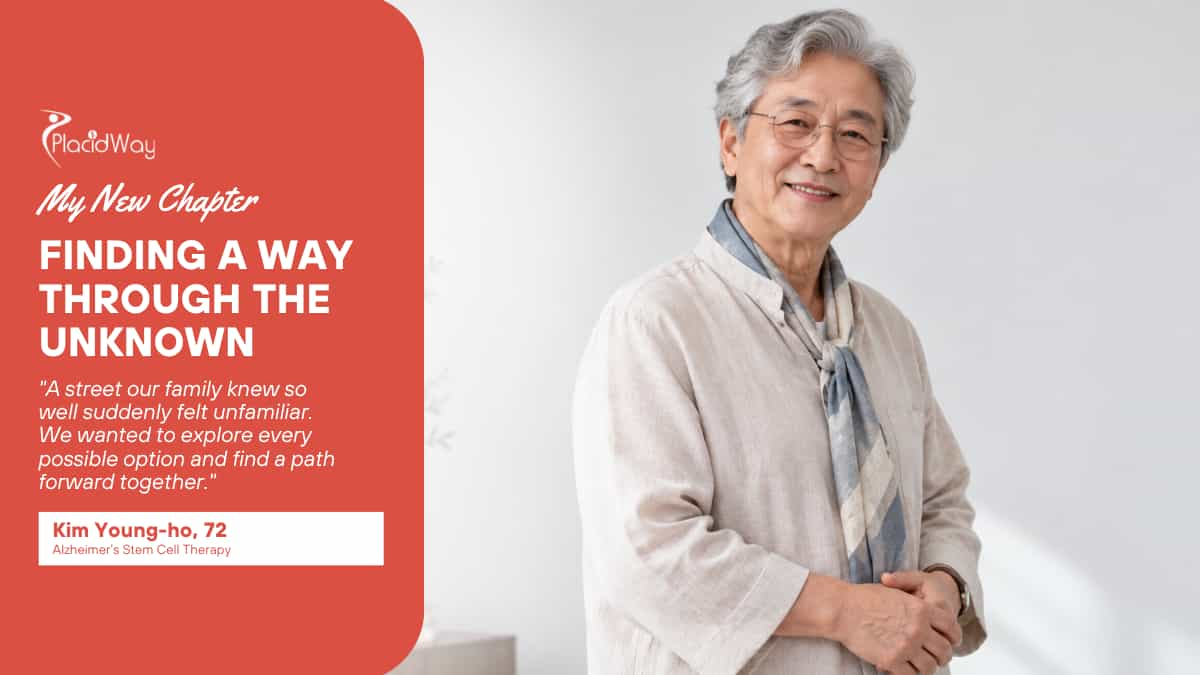
Name: Kim Young-ho

Age: 72

Condition: Early-to-moderate Alzheimer's Disease

Treatment: Stem Cell Therapy (Intravenous/Intrathecal)

Destination: Tokyo, Japan

Provider: Helene BioMed Group

Journey at a Glance

Main problems: Progressive memory loss, disorientation in familiar places, inability to manage daily finances independently, loss of executive function.

Previous care: Standard pharmacological management with cholinesterase inhibitors, cognitive stimulation day programs, private caregiving attempts.

Travel driver: Facing an 18-month waitlist for specialized geriatric neurology interventions in South Korea while watching cognitive decline accelerate.

Treatment explored: Autologous stem cell protocols targeting neuroinflammation and potential neural protection.

Personal goal: Slow the progression of cognitive decline and preserve daily independence for as long as possible.

You started by taking over the utility bills.

Then you quietly unplugged the stove when you left the house.

You hid the car keys inside a locked drawer.

You labeled the kitchen cabinets with brightly colored tape.

You hired someone to sit in the living room for four hours a day.

You installed cameras near the front door.

You learned how to sleep with one ear listening for footsteps in the hallway.

You stopped making plans that take you more than twenty minutes away.

"He is just getting a little forgetful."

"It happens to everyone as they age."

"You are doing a wonderful job taking care of him."

Your world has quietly become smaller.

The hardest part is not the physical exhaustion or the financial drain, but the quiet terror of just sitting in the waiting room of inevitable decline.

Meet the family trying to hold back time.

Ji-yoon is not a real patient client, but a fictional composite built from the exact circumstances, fears, and questions South Korean families face when Alzheimer's enters their homes.

She is a fifty-two-year-old architectural designer living in Seoul, managing her own teenage children while caring for her father.

Her father, Kim Young-ho, was a civil engineer who spent forty years calculating structural loads and building bridges across the Han River.

He used to review his pension statements with a red pen and a ruler.

He used to walk three miles every morning before brewing the family's tea.

The escalation happens behind closed doors.

They blamed the first missed appointments on simple fatigue.

Then came the day he could not remember how to turn on the television.

Memory clinics.

Neurology assessments.

Memantine prescriptions.

Donepezil dosages.

Adult day care waitlists.

Current domestic guidelines rely heavily on cholinesterase inhibitors to manage symptoms, offering little in the way of disease-modifying regeneration while families wait for specialized geriatric placements .

The doctor looked at the MRI, prescribed another symptom-manager, and delivered the verdict:

"We can only try to manage his comfort."

Ji-yoon looked at the calendar and thought of one word:

When?

The healthcare system expects her to wait.

South Korea faces a rapidly aging population, creating severe bottlenecks in advanced neurological care where specialized public hospital consultations can carry delays of up to eighteen months .

But Ji-yoon does not experience this capacity shortage as a national demographic statistic.

She experiences it when Kim Young-ho stands at the intersection one block from their apartment building.

"I do not know which way is home."

She experiences it when he looks at his eldest granddaughter across the dinner table.

"Who is this polite young lady?"

She experiences it when she finds him staring at a stack of unopened mail in the dark.

"The numbers just do not make sense anymore."

She has already tried to be patient.

There is an assumption that people who seek medical interventions abroad are simply impatient consumers unwilling to accept a doctor's word.

Ji-yoon is not careless.

She has spent two years navigating the domestic system, dutifully filling pill boxes and attending cognitive stimulation sessions.

She has paid private caregivers out of pocket until her savings began to erode.

She has sat on hold with national health insurance offices for hours.

"I am doing everything I am supposed to do."

"But he is fading right in front of me."

Her internal dialogue began to shift:

From "Can I tolerate this decline?"

To "How much of my father's remaining mind am I prepared to sacrifice while we wait?"

The conventional alternative feels like surrender.

The next logical step offered by domestic specialists is a secure memory care institution.

These facilities provide physical safety, locked doors to prevent wandering, and round-the-clock symptom observation.

But they do not claim to repair the brain.

Moving Kim Young-ho into an institution means accepting that his cognitive baseline will only ever move downward.

She sits at the kitchen table with her husband, looking at the brochures for private nursing homes.

"We have the money to pay for this facility."

"But I cannot afford to watch him disappear inside it."

She isn't searching for experimental options yet.

Her late-night internet searches do not begin with medical tourism.

They start with frustration.

Why is donepezil no longer working.
Private geriatric neurologist available Seoul.
Alternative treatments for early Alzheimer's.
Stem cell therapy for memory loss.
Cost of Alzheimer's stem cell treatment Japan.

The algorithm begins showing her clinics in Tokyo, focusing heavily on regenerative medicine and mesenchymal stem cell protocols.

Her immediate reaction is appropriately guarded.

"I am not flying him abroad just because some clinic makes a glossy website."

Her instinct is entirely correct.

Price should not answer a clinical question about a vulnerable patient's brain health.

Why does Tokyo keep appearing in her research?

Japan has established specific expedited regulatory pathways for regenerative medicine, allowing private clinics to offer cultured stem cell therapies under government oversight while research continues .

This legal framework makes Tokyo accessible to international patients seeking interventions that remain locked in clinical trials in South Korea or the United States.

But Ji-yoon must understand a crucial distinction:

Japan does not administer stem cells.

Specific clinics, specific laboratory technicians, and specific neurologists do.

Organizations like Helene BioMed Group operate within this regulated environment, but the presence of regulation does not remove the need for strict personal scrutiny.

Global authorities advise patients to verify the exact source of the cells, the laboratory standards, and the qualifications of the administering physician before committing to any regenerative therapy .

Her first question was predictably about the money.

The indicative cost of an autologous stem cell protocol for neurodegenerative conditions in Tokyo generally ranges between USD 50,000–80,000, heavily dependent on the number of cell expansions and the method of administration .

This figure represents a staggering sum of money for a therapy that cannot promise a cure.

She hears her father's old voice in her head.

"Never buy a bridge without seeing the concrete poured."

"What exactly am I getting?"

Twelve things the advertised price may or may not cover.

Does this price include the initial tissue extraction?
Is the laboratory cell expansion handled in-house or outsourced?
Are we paying for intravenous infusion, intrathecal injection, or both?
How many millions of cells are guaranteed in the final dose?
Does the clinic provide specialized neurological monitoring during the procedure?
What happens if the cell cultivation fails?
Are airport transfers and translation services handled by the clinic?
Will there be a Korean-speaking nurse on staff during the extraction?
Does the price cover post-treatment biomarker testing?
Are hotel accommodations for the three-week cultivation period included?
Who pays for emergency care if an adverse reaction occurs?
Is there a structured follow-up protocol once we return to Seoul?

The advertised number is only the beginning of the conversation.

What does the procedure actually involve?

Mesenchymal stem cell therapy for Alzheimer's typically involves harvesting cells from the patient's own adipose tissue or bone marrow, isolating and multiplying them in a laboratory over several weeks, and reintroducing them into the body.

The therapeutic goal is not to instantly restore lost memories, but to reduce neuroinflammation, modulate the immune response, and potentially stimulate the brain's remaining neural pathways .

This requires physical stamina from an elderly patient who may already be confused.

Ji-yoon realizes the medical science is only half the battle.

"Wait. Does that mean...?"

Possibly, depending on how Kim Young-ho handles unfamiliar environments.

The logistics of moving a patient with cognitive decline across international borders are daunting.

The true challenge is managing his anxiety.

The part the clinical brochures rarely put on the front page.

Traveling for medical care with an Alzheimer's patient is an operational marathon.

Official guidance on medical travel varies wildly, with some health bodies advising strict domestic adherence while others acknowledge the right to cross-border care .

That variation itself is the lesson.

These constraints must be built into the foundation of the plan before booking a flight, not managed on the fly in a foreign city.

How will he handle the sensory overload of Narita or Haneda airport?

Will he attempt to wander out of the hotel room in Tokyo at night?

How do you explain the blood draw to someone who might forget why they are in a clinic?

What happens if he becomes agitated during the intrathecal injection process?

Can the clinic legally administer mild sedatives if he panics?

Who translates his distress if the translator steps out of the room?

Are the clinic floors secure to prevent a disoriented patient from leaving?

What dietary adjustments are required, and can he eat familiar food?

How long must he lie completely still after the procedure?

How do we manage his routine domestic prescriptions while abroad?

This is not tourism in the usual sense.

The silent partner on the airplane.

Ji-yoon is not just bringing her father.

She is acting as the primary medical proxy, the logistical coordinator, and the emotional anchor in a foreign country.

She will be the one holding his hand when he does not recognize the nurses.

She will be the one monitoring his temperature back at the hotel room after the infusion.

She must verify that their specialized medical travel insurance explicitly covers complications arising from planned regenerative therapies, as standard policies routinely exclude them .

She is part of the clinical system too.

Then comes the uncomfortable conversation about risk.

Stem cell therapy is not magic, and administering it to a fragile neurological system carries inherent biological risks, including infection, localized bleeding, or severe immune reactions .

Ji-yoon learns to immediately distrust any clinic that uses specific phrases.

Completely safe. No risk. Guaranteed memory restoration. Cure.

Informed consent means understanding the possibility that they could spend eighty thousand dollars, endure the stress of travel, and see absolutely no change in the trajectory of his decline.

Her questions for the clinic become sharper.

She stops asking if it will work, and starts asking how Helene BioMed Group operates.

What objective cognitive baselines do you measure before accepting his deposit?
Are the cells cultured in an ISO-certified laboratory facility?
Do you test the final cell batch for chromosomal abnormalities before infusion?
What is your documented protocol if he suffers a seizure during the procedure?
How many early-stage Alzheimer's patients have you treated in the last calendar year?
Can you connect me with a previous South Korean family who underwent this protocol?
What specific post-treatment symptoms require immediate emergency room visitation?
How do you transfer his procedural medical records back to our neurologist in Seoul?
Do you administer the cells via a peripheral vein or directly into the spinal canal?
What would you see in his pre-treatment blood work that would make you cancel the procedure?

She doesn't only want someone willing to do it.

She wants someone willing not to.

Have I genuinely exhausted my options at home?

Before booking any flights, patients retain the right to demand a comprehensive review of clinical trial eligibility within their own country's research hospitals .

Are there domestic trials for monoclonal antibodies we haven't explored?

Can we access a private geriatric psychiatrist for behavioral management rather than just a neurologist?

Would modifying his home environment buy us another safe year?

Are we traveling out of medical necessity, or out of caregiving exhaustion?

Is the domestic waitlist actually eighteen months, or is that just for one specific hospital?

Do not put a parent on a plane just because the waitlist at home is intolerable.

Tokyo should be compared with Kim Young-ho's real alternatives, not with a worst-case assumption about the South Korean system.

The night before the decision.

The kitchen table is covered again.

The domestic neurologist's pessimistic notes. The translated Japanese clinic protocols. The bank statements. The medical travel insurance policy documents.

"We know exactly what happens if we stay."

"Now we know what happens if we go."

The research did not make them more afraid; it made them more capable of deciding.

What Ji-yoon actually wants isn't a syringe of stem cells.

When relatives ask why she is considering Tokyo, they assume she is chasing a miracle cure.

She knows her father will never engineer a bridge again.

What she actually wants is for him to recognize his granddaughter's face for one more year.

She wants him to be able to use the bathroom without terror.

She wants to delay the day the locked institution becomes mandatory.

She wants to know she fought for him.

Not a medical package. Not an experimental intervention. Not a flight to Haneda airport. Not a laboratory culture.

Time.

And underneath that:

Dignity.

Stem cell therapy might be the answer. It might not be.

You might evaluate the logistics and decide the travel would cause him too much distress.

You might run out of financial runway.

You might consult your domestic neurologist and find a new clinical trial opening in Seoul.

You might realize his cognitive decline has already progressed beyond the point where experimental interventions make sense.

Sometimes the most loving and courageous decision a family can make is staying home.

Or you might verify the clinic, secure the funds, arrange the specialized travel, and board the plane with eyes wide open to the risks.

Any of those can be an informed decision.

The goal of this process is not to persuade you to travel for treatment, it is to make sure blind frustration doesn't make the decision for you.

The choice you do not have to make today.

Maybe you have been staring at his unused car keys.

Maybe you have been avoiding calls from his siblings because you have no good news to share.

Maybe you are tired of being told to be patient.

Maybe you are terrified of making the wrong choice for someone who can no longer choose for themselves.

Maybe you just want to know you are leaving no stone unturned.

You do not need to decide today.

Who regulates the clinic you are looking at?

What is the source of their stem cells?

How will your parent handle the flight?

What does your local doctor say about his specific eligibility?

What is the contingency plan if he becomes agitated?

Are you prepared for the possibility of no cognitive improvement?

What does success actually look like for your family?

You are no longer just looking at prices.

You are evaluating paths forward.

Hope isn't the promise that the past will return.

Hope is not a glossy brochure promising a cure.

Hope is not pretending the disease isn't happening.

Hope is not spending money blindly out of guilt.

Hope is having enough structured information to make a decision that feels like yours.

You know how to ask the hard questions. You know how to protect his safety. You know how to filter out the noise. You know how to demand verification. You know his limits, and your own.

You have moved from "I suppose we just have to keep waiting on the list."

To:

"What other informed options do we have?"

PlacidWay — Your Way to Hope.

We help patients and their families explore medical options, compare international providers, and prepare the rigorous questions required for cross-border care. We do not provide clinical advice, and we cannot guarantee medical outcomes.

For a family like Kim Young-ho's, traveling to Tokyo isn't a promise of a cure—it is one regulated route worth understanding deeply before making a choice.

Your Way to Hope.

Medical disclaimer

This article is entirely educational and does not recommend that any individual undertake stem cell therapy or travel for medical procedures. Individual suitability and clinical risks require direct professional assessment. Readers should always consult their own qualified clinician or domestic specialist before making care decisions, verify current regulatory status in any destination country, independently confirm the credentials of any foreign provider, and obtain appropriate medical travel protection or insurance.

A Familiar Street Suddenly Felt Foreign: A South Korean Family’s Alzheimer’s Stem Cell Therapy in Tokyo

About Article

  • Translations: EN KO JA ZH
  • Treatment: Stem Cell Therapy
  • Country: Japan
  • Overview Kim Young-ho’s family notices missed payments, disorientation and a growing need for supervision as Alzheimer’s disease advances. Standard medication and cognitive programs have not stopped the decline, so they review a Tokyo-based stem cell option. Caution is central because the therapy is experimental; evidence, consent capacity, treatment burden, adverse events, caregiving logistics and ongoing specialist care all need careful discussion.

Trusted Medical Tourism Platform Since 2007

60+
Countries
2k+
Clinics
19.5k+
Reviews
2.5k+
Qualified Doctors
1.1M+
Patients Served Since 2007