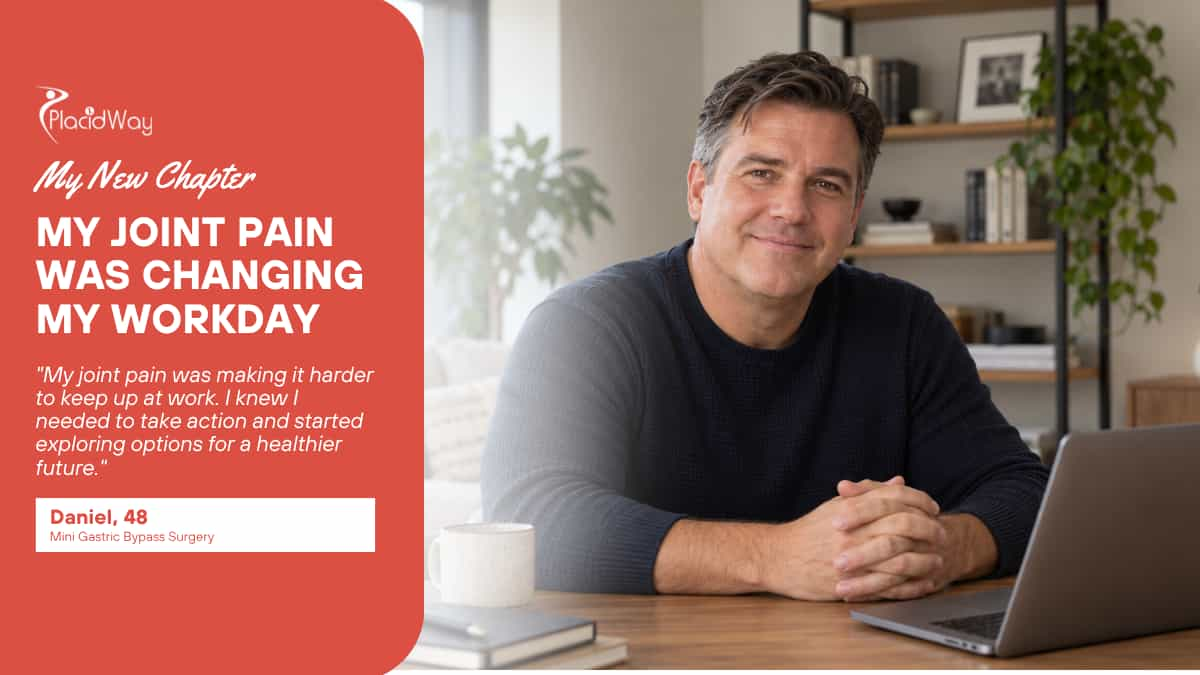
Patient Profile
Name: Daniel Brooks
Age: 48
Condition: Morbid obesity with sleep apnea and deteriorating joint mobility
Treatment: Mini Gastric Bypass
Destination: Tijuana, Mexico
Journey at a Glance
Main problems: Severe joint pain impacting employment; chronic shortness of breath; inability to engage in physical activities with family.
Previous care: Multiple failed commercial diets; private nutrition consultations; exhausted insurance appeals ending in flat denials based on "elective" clauses.
Travel driver: Inability to afford USD 25,000–35,000 out-of-pocket costs in the U.S. combined with accelerating physical decline.
Treatment explored: A minimally invasive bypass procedure offering shorter operative times and substantial excess weight loss.
Personal goal: Regain the autonomy to work and live without constant physical limitations.
You start parking a little closer to the cart return.
You memorize which chairs in the breakroom have sturdy armrests.
You quietly decline invitations to restaurants with narrow booths.
You buy shoes that do not require bending over to tie.
You stop standing in the yard to talk to the neighbors.
You pretend you are not out of breath when answering the phone.
You laugh off the knee pain as an unavoidable part of getting older.
You nod politely when people offer unprompted advice.
"You should really try getting more steps in."
"Have you considered cutting out bread?"
"I just want you to be around for the kids."
Your physical world has quietly become smaller.
The hardest part is not the daily joint pain, but the waiting.
Reclaiming Mobility After Obesity: How American Patients Are Turning to Mini Gastric Bypass in Tijuana When U.S. Wait Times and Costs Block the Path Forward
Meet Daniel Brooks.
Daniel is not a real patient of any particular clinic.
He is a fictional composite built from the exact situations, financial constraints, and midnight questions that thousands of Americans face every year.
He is forty-eight years old and works at a manufacturing plant in Kentucky.
Before the weight took over, his life was built on physical competence.
He hoisted engine blocks off the line without thinking twice.
He crouched under the porch to fix the plumbing on weekends.
He stood in the river for six hours at a time casting fishing lines.
Now, his employment is threatened by an inability to stand for a full shift.
The escalation of a failing strategy.
For years, Daniel explained the slowing down as a natural consequence of middle age.
He told himself he just needed to find the right routine.
Weight Watchers. Keto. Private nutritionists. Gym memberships. Prescription appetite suppressants.
The standard medical intervention for a BMI over 40 with severe comorbidities is bariatric surgery, often recommended when behavioral modifications fail to produce sustained weight loss . This procedure alters the digestive tract to restrict food intake and modify gut hormones, providing a metabolic reset rather than simply restricting calories.
Daniel's doctor submitted the paperwork with full confidence it would be approved.
The response arrived three weeks later in a thin white envelope.
"Your insurance considers this an elective procedure."
His doctor told him they could try appealing, but the process might take a year.
Daniel looked at his swollen ankles and asked one word:
When?
The statistics do not explain the daily reality.
Severe obesity affects more than forty percent of adult Americans, yet fewer than one percent of eligible candidates actually undergo bariatric surgery each year due to systemic coverage barriers and high out-of-pocket costs .
But Daniel does not experience the healthcare system as a national statistic.
He experiences it sitting on the edge of the bed waiting for his knees to stop throbbing.
"I just need a minute before we head down."
He experiences it skipping the company picnic to avoid the folding chairs.
"I've got too much yard work to catch up on."
He experiences it watching his grandson run toward the driveway while his own feet remain planted on the porch.
"Slow down so grandpa can see you."
He has already tried to be patient.
Daniel is not an impulsive consumer looking for a shortcut.
He documented his meals diligently for six straight months.
He paid out of pocket for the required psychiatric evaluation.
He gathered the letters of support from his primary care physician.
He submitted the complex appeal forms exactly as instructed.
He waited on hold with the claims department during his lunch breaks.
"I played entirely by their rules."
"They are just waiting for me to give up."
The exhaustion shifts the nature of his problem:
From "Can I tolerate this?" to "How much of my life am I prepared to organise around it?"
The domestic route hits a wall.
Paying out of pocket in the United States fails on a deeply practical level.
It isn't that the local hospital lacks the skill or the technology.
It is that draining his retirement account to afford a USD 30,000 procedure leaves his family exposed to a different kind of ruin.
He sits at the kitchen table with his wife, Sarah, looking at the financing brochures.
"We could take out a second mortgage."
"Trading our home equity for a surgery doesn't make us safer."
He isn't searching for Tijuana yet.
how to appeal insurance denial for bariatric surgery
cheapest self pay gastric bypass near me
is mini gastric bypass covered by insurance
medical loans for weight loss surgery
bariatric surgery cost in mexico
The algorithm responds to his frustration by suggesting clinics in Baja California.
"I'm not going abroad just because something is cheaper."
That hesitation is the mark of a responsible adult.
Why does Tijuana keep appearing in the search results?
Cross-border medical travel is frequently driven by structural disparities in healthcare pricing rather than a lack of domestic clinical competence, with Mexico maintaining federal regulatory frameworks for specialized surgical facilities .
The necessary reframe requires looking past the geography:
Countries do not perform operations.
Surgeons do.
Clinical teams do.
Hospitals do.
There is always something concrete and verifiable to investigate.
Patients considering medical travel should independently verify facility accreditation and consult a domestic professional regarding their specific medical history .
His first question was exactly what yours would be: How much?
A mini gastric bypass in Tijuana currently costs an indicative USD 4,500–7,500, a figure that varies depending on the surgeon's specialized experience, the hospital's tier, and the complexity of the patient's existing comorbidities .
Daniel hears his father's voice in his head.
"If a deal looks too good, you are the one paying for it."
"What exactly am I getting?"
Twelve things the advertised price may or may not cover.
Does this price include the pre-operative cardiovascular clearance?
Is the anesthesiologist's fee billed separately?
Who pays if I need to stay an extra night in the intensive care unit?
Are the anti-nausea medications covered for the journey home?
Does the package include ground transport from the San Diego airport?
What happens if my BMI requires a different surgical approach once they begin?
Is the post-operative leak test standard or an add-on charge?
Are the surgical staples approved by recognized medical authorities?
Who coordinates my care if I experience a complication in the hotel?
Does the clinic employ a dedicated bariatric nutritionist?
How many follow-up virtual consultations are actually included?
Am I paying extra for the post-surgery compression garments?
The advertised number is only the beginning of the conversation.
What does a mini gastric bypass actually involve?
The mini gastric bypass is a laparoscopic procedure that creates a narrow stomach tube and bypasses a significant portion of the small intestine, resulting in both restriction of food volume and decreased calorie absorption . It generally involves a shorter operative time and a lower risk of internal herniation compared to a traditional Roux-en-Y gastric bypass.
"How am I supposed to get home?"
The part the sales decks rarely put on the front page.
The operational reality of cross-border surgery is highly unglamorous.
Post-operative travel protocols vary significantly, with some authorities suggesting a minimum wait of five days before flying, while other clinical bodies recommend ten days to mitigate thrombosis risks .
The variation itself is the lesson.
This constraint must be part of the plan before committing, not afterward.
"Wait. Does that mean I'm recovering in a hotel room?"
Possibly, depending on the specific discharge protocol of your chosen clinic.
Who changes the surgical dressings on day three?
Where do I get liquid protein that I can actually tolerate?
How do I manage the surgical drains while riding in a shuttle van?
What if the pain medication makes me too nauseous to walk?
Can the hotel kitchen accommodate a strict clear liquid diet?
How do I communicate with the night nurse if I do not speak Spanish?
Who translates my surgical notes into English for my doctor back home?
Where is the nearest emergency room if I start running a high fever?
Will my current health insurance cover emergency repatriation?
Who physically carries my luggage through customs at the border?
This isn't tourism in any traditional sense.
Sarah isn't just coming along.
She is the invisible second participant in this entire endeavor.
She will actually carry the heavy bags across the border.
She will remember the complex medication schedule when Daniel is too tired.
She will notice the slight changes in his breathing while he sleeps.
She will be responsible for translating the discharge paperwork into a practical daily routine.
She needs to know exactly what to do if something goes wrong at two in the morning.
Standard domestic health insurance policies commonly exclude treatment for complications arising from elective surgeries performed outside the national borders .
She is part of the care system too.
Then comes the uncomfortable conversation about risk.
All bariatric surgeries carry inherent risks, including staple line leaks, pulmonary embolisms, marginal ulcers, and severe long-term nutritional deficiencies if dietary supplements are not strictly maintained .
Daniel learns to entirely distrust certain phrases:
Completely safe. No risk. Guaranteed success.
Informed consent means understanding more than the hoped-for outcome.
Price should never answer a medical question.
Daniel's questions become better.
He moves past simply asking if he can afford it.
What is your specific protocol if a staple line leaks on day two?
Which intensive care unit do you transfer patients to in an emergency?
How many mini gastric bypass procedures did you perform this month?
What is your rate of conversion to open surgery?
Who precisely will administer the anesthesia?
Are your surgical instruments single-use or sterilized in-house?
How do you handle post-operative bleeding once I cross the border?
Will I be given my complete medical file on a physical drive?
Do you have an established relationship with any U.S. follow-up providers?
What dietary deficiencies do your patients struggle with most at year two?
He does not only want a clinic willing to do the operation.
He wants a surgeon willing not to.
Have I exhausted my options at home?
Patients facing insurance denials hold the right to request an independent external medical review and to demand a peer-to-peer physician evaluation before a final coverage determination is rendered .
Is there a different billing code that accurately reflects my sleep apnea severity?
Would participating in a six-month supervised weight loss program change the denial?
Can you refer me to a domestic surgeon who operates on a sliding scale?
Is there a clinical trial currently accepting patients in our state?
If I go to Mexico, will you agree to manage my long-term blood work?
The fairness principle requires honesty:
Tijuana should be compared with Daniel's real alternatives, not with a worst-case assumption about the domestic system.
He sits at the kitchen table late into the night.
The screen glow illuminates a stack of printed medical files.
The desperation has finally been replaced by diligence.
The night before the decision.
The table is completely covered in documents.
The printed federal travel guidelines. The detailed hotel recovery map. The comprehensive list of emergency border contacts. The surgeon's medical license verification records. The translated clinical discharge protocols.
"I actually understand what they are going to do to my stomach."
"You sound like yourself again."
The research didn't make them more afraid; it made them more capable of deciding.
What Daniel actually wants isn't surgery.
"Do you just want to be thin?"
The expected answer is to lose a hundred pounds.
The real answer:
To walk from the truck to the factory floor without stopping.
He wants to tie his work boots without holding his breath.
He wants to sit in a normal restaurant booth on date night.
He wants to sleep through the night without a machine forcing air into his lungs.
Not the titanium staples. Not the altered intestine. Not the medical tourism package. Not a trip to Mexico.
The goal is:
Autonomy.
And underneath that:
Dignity.
Tijuana might be the answer. It might not be.
He might discover his heart cannot safely tolerate the anesthesia.
He might realize he cannot afford the necessary time off for a cross-border recovery.
He might find a local surgeon willing to establish a manageable payment plan.
He might finally win his third domestic insurance appeal.
He might decide the logistical risk simply outweighs his current physical pain.
Or he might thoroughly vet a clinic, arrange a concrete recovery plan, and cross the border with his eyes wide open.
Any of those can be an informed decision.
The goal is not to persuade you to undergo a procedure in another country.
The goal is to make sure frustration doesn't make the decision for you.
You do not need to decide today.
Maybe you've stopped looking in mirrors below your neck.
Maybe you've memorized exactly where every sturdy chair in the office is located.
Maybe you've quietly given up your favorite hobbies because the physical toll is too high.
Maybe you've hidden another diet failure from the people who love you.
Maybe you've accepted a smaller life because the alternative feels impossibly expensive.
You do not need to decide today.
What exactly does my insurance policy exclude?
Who will manage my blood panels next year?
What is my absolute budget for unexpected complications?
Who is traveling with me?
How long can I realistically take away from work?
Am I prepared to follow a rigid vitamin regimen forever?
What happens if I simply do nothing?
You are not just researching prices.
You are researching paths forward.
Hope isn't the promise that everything will be fixed.
Hope is not an Instagram photo of a smaller waistline.
Hope is not a surgical package marketed as a vacation.
Hope is not the illusion that a complex operation carries zero risk.
Hope is having enough information to make a decision that feels like yours.
It is knowing your options.
It is recognizing your boundaries.
It is demanding transparency.
It is refusing to be rushed.
It is trusting your own judgment.
It is the quiet shift from:
You are capable of evaluating medical credentials. You are capable of asking difficult logistical questions. You are capable of demanding transparency from international coordinators. You are capable of protecting your own physical future. You are capable of saying no if the terms do not align with your safety.
"I suppose I'll just have to keep waiting."
To:
"What other informed options do I have?"
PlacidWay — Your Way to Hope.
We help individuals explore alternative medical routes, compare accredited international facilities, and understand exactly what questions they need to ask before making a choice. We do not provide clinical advice or perform medical procedures. For someone like Daniel Brooks, a mini gastric bypass in Tijuana is not a guaranteed promise; it is one potential route worth understanding clearly.
Your Way to Hope.
Medical disclaimer
This article is entirely educational and does not recommend that any individual undertake cross-border bariatric surgery or any specific medical procedure. Individual suitability and surgical risks require rigorous professional assessment. The reader should always consult their own domestic clinician or medical adviser, verify the current regulatory status of any international facility, and obtain appropriate medical travel insurance before committing to treatment abroad.






























Share this listing