
Tijuana is entering a new phase of medical tourism.
For more than a decade, the city’s medical travel story was relatively easy to understand. Its proximity to California, lower treatment costs, large network of private medical providers and established reputation for dental care, cosmetic surgery and bariatric procedures made it one of the most visible cross-border healthcare destinations in North America.
But the market that enters 2027 is different from the market that drove Tijuana’s rapid expansion earlier in the decade.
Patient demand has shifted. Some historically strong procedures have slowed. New specialties are attracting attention. U.S. patients are becoming more deliberate about how they select providers. Border friction, safety perceptions, insurance limitations and new treatment alternatives are changing why people travel and what they expect when they arrive.
For PlacidWay, these changes point toward a broader conclusion:
The next era of medical tourism in Tijuana will not be won simply by offering more procedures at lower prices. It will be driven by a deeper understanding of consumer demand, consumer intent, verified provider capability and the complete patient journey.
“Tijuana does not have a shortage of medical providers. The challenge for the next stage is helping patients understand which provider is appropriate for their particular medical need, why they should travel, what evidence they should evaluate and what happens after they return home. Medical tourism is moving from a price-comparison market toward a healthcare decision market.”
— Pramod Goel, CEO & Founder, PlacidWay
Tijuana Enters 2027 After Two Years of Market Adjustment
The starting point for understanding 2027 is recognizing what happened during 2024, 2025 and 2026.
Tijuana's medical tourism market experienced a significant slowdown beginning in late 2024 and extending through 2025. Local industry representatives reported declines exceeding 50% in some areas, attributing the contraction to a combination of weaker consumer economics, political uncertainty, regional security perceptions and confusion surrounding border and immigration policies.
During the first part of 2026, the broader tourism market remained soft. Tijuana tourism representatives reported that medical tourism had fallen sharply compared with previous periods and emphasized the city's dependence on visitors from Southern California.
By the middle and latter part of 2026, however, signs of stabilization appeared. Industry representatives reported approximately 25% year-over-year improvement during portions of the year, although volumes remained below the exceptional levels reached several years earlier.
This distinction matters.
Tijuana is recovering, but it is not simply returning to the old market.
The composition of demand itself is changing.
The Scale of Baja California's Health Tourism Market Remains Significant
Despite recent volatility, Baja California remains one of Mexico's most important health and wellness tourism regions.
The Baja California Secretaría de Turismo reported in July 2026 that the state receives approximately 2.8 million health-tourism visitors annually, generating an estimated economic impact exceeding US$2 billion. According to the state, about 81% of patients come from the United States, especially California, Arizona and Nevada, while approximately 16% come from Canada.
Other industry organizations have published larger estimates, so exact market-size figures should be interpreted cautiously because counting methodologies can differ.
What is less disputed is the importance of the U.S. market.
Tijuana's geography remains one of its greatest advantages.
Patients in Southern California do not necessarily need to plan a conventional international medical trip involving long-haul flights, extended vacations and complex connections. For many, Tijuana can function much more like a neighboring healthcare market.
That creates the foundation for what PlacidWay sees as a major 2027 opportunity:
Tijuana can evolve from a medical tourism destination into a more integrated cross-border healthcare ecosystem.
The 2027 Opportunity Map
PlacidWay expects the strongest opportunities to emerge not from one procedure but from several changes in patient behavior occurring simultaneously.
Opportunity 1: Dental Care Remains the Foundation — But Complexity Will Matter More
Dental tourism remains one of Tijuana's strongest cross-border medical categories.
In late 2025, the Colegio de Cirujanos Dentistas de Tijuana estimated that international medical travelers represented approximately 65% to 70% of patients at some local dental practices. The organization also emphasized the need for continued investment in technology, digital dentistry and modern equipment to remain competitive with California providers.
Dental demand is therefore unlikely to disappear.
What may change is the type of demand.
Simple price comparisons for individual crowns or routine dental work will remain part of the market, but greater opportunities may come from higher-complexity cases such as:
- Multiple dental implants;
- Full-mouth rehabilitation;
- Implant-supported restorations;
- All-on-4 and full-arch treatment;
- Complex restorative dentistry;
- Patients requiring staged treatment;
- Older patients with significant dental deterioration;
- Patients combining oral surgery and prosthodontic care.
These patients do not simply ask:
“How much is a dental implant in Tijuana?”
Their underlying questions are often:
- Who is qualified to treat my case?
- How many trips will I need?
- What implant system will be used?
- Can my existing bone support implants?
- Who handles complications?
- How will follow-up work when I return to the United States?
That is consumer intent.
And it is much more valuable than a generic procedure keyword.
Dental will remain a Tier 1 Tijuana opportunity, but providers that demonstrate treatment planning, technology, credentials, case suitability and continuity of care are likely to differentiate themselves more effectively than providers competing almost entirely on price.
Opportunity 2: Bariatric Surgery Will Need a New Business Model
Perhaps no major Tijuana medical-tourism segment illustrates market disruption more clearly than bariatric surgery.
Baja Health Cluster leadership reported in July 2026 that bariatric surgery volumes had declined by approximately 50% to 70% from previous levels, with increased use of GLP-1 weight-management medications identified as a major factor.
The same concern remained visible in October 2026, when the cluster again identified bariatric contraction, border delays and changing U.S. conditions as factors affecting medical-tourism flows.
This is unlikely to be solved simply by promoting gastric sleeve surgery more aggressively.
The patient's decision tree has changed.
Previously, a prospective patient might have compared:
Diet attempts → Bariatric surgery options → U.S. price versus Mexico price.
The modern pathway may include:
Lifestyle management → GLP-1 medications → Medication response → Medication affordability → Side effects → Long-term adherence → Bariatric evaluation → Surgery → Postoperative metabolic management.
The 2027 opportunity is therefore broader than surgery
Tijuana providers could increasingly compete around metabolic health pathways, including:
- Obesity evaluation;
- Medically supervised weight management;
- Bariatric eligibility assessment;
- Nutritional support;
- Bariatric surgery for appropriate candidates;
- Revision surgery;
- Postoperative nutrition;
- Long-term metabolic follow-up.
For PlacidWay, bariatrics should therefore no longer be analyzed only by searches for “gastric sleeve Mexico.”
Consumer intent analysis needs to understand where the person is in the obesity-treatment journey.
“When technology or medication changes the patient's options, marketing the old procedure harder is not a strategy. Providers have to understand why patients are choosing differently. The opportunity is to follow the patient's problem, not defend a procedure category.”
— Pramod Goel, CEO & Founder, PlacidWay
Opportunity 3: Orthopedics Could Become One of Tijuana's Most Important Growth Categories
One of the clearest shifts visible during 2026 has been increased attention toward orthopedics, traumatology and spine care.
Baja California medical-tourism organizations reported increasing demand for traumatology, orthopedics, spine surgery, general surgery and related specialties, including demand associated with U.S. coverage and affordability pressures.
By September 2026, regional reporting continued to identify orthopedics and traumatology among the specialties attracting international patients.
This creates an important 2027 opportunity.
Patients considering orthopedic treatment behave differently from traditional cosmetic tourists.
A person considering knee replacement may need to understand:
- Whether surgery is actually necessary;
- Whether conservative treatment has been exhausted;
- Surgeon experience;
- Implant selection;
- Hospital capability;
- Expected mobility after discharge;
- Rehabilitation requirements;
- How long to remain in Tijuana;
- How to cross the border while mobility is limited;
- When flying or driving is appropriate;
- Who manages postoperative concerns after returning home.
That means orthopedics cannot be successfully marketed simply as:
“Knee replacement in Tijuana for 60% less.”
The successful product is the entire care pathway.
2027 PlacidWay opportunity areas
Potential high-intent categories include:
- Knee replacement;
- Hip replacement;
- Revision joint replacement;
- Spine surgery;
- Shoulder procedures;
- Sports injuries;
- Trauma-related procedures;
- Orthopedic second opinions;
- Rehabilitation;
- Selected non-surgical musculoskeletal treatment.
PlacidWay expects orthopedic medical travel to increasingly reflect access intent and insurance-gap intent, rather than purely tourism intent.
Opportunity 4: Women's Health and Fertility Could Become Major Specialty Corridors
Reproductive medicine is another area showing growth.
Baja California officially identifies fertility treatment among its important health-tourism specialties.
Industry reporting in 2026 additionally identified reproductive medicine and specialized endometriosis surgery as areas experiencing increasing patient interest.
This is particularly important because fertility and women's health rarely involve a single transaction.
The patient journey may involve:
Consultation → Testing → Diagnosis → Treatment Planning → Medication → Procedure → Monitoring → Follow-Up.
For Tijuana, proximity to California can become particularly valuable because repeated travel may be more practical than traveling to a long-haul destination.
The opportunity could extend across:
- Fertility assessment;
- IVF;
- Reproductive endocrinology;
- Endometriosis evaluation;
- Endometriosis surgery;
- Gynecologic surgery;
- Fertility preservation;
- Second opinions.
These patients often demonstrate high research intensity before making a decision, making them particularly suitable for intent-based education and provider comparison.
Opportunity 5: Plastic Surgery Will Remain Strong — But Verification Will Matter More Than Ever
Plastic surgery remains one of Baja California's established international healthcare categories.
However, future growth will increasingly be tied to trust.
International patients need to distinguish between:
- Properly credentialed specialists;
- Appropriately licensed facilities;
- Qualified surgical teams;
- Facilities capable of handling emergencies;
and providers whose qualifications or infrastructure may be difficult for a foreign consumer to evaluate.
Baja California is already moving in this direction.
The state's Catálogo de Excelencia de Turismo de Salud y Bienestar, or CEETSB, provides formal recognition for eligible institutions and professionals meeting specified quality, service and patient-safety requirements.
In October 2026, Baja California also launched an updated health-tourism platform incorporating information on healthcare professionals and establishments verified through state health authorities.
This is a major signal about where the market is heading.
Verification is becoming part of the product.
Opportunity 6: Regenerative Medicine Has Demand — and Exceptional Trust Risk
Regenerative medicine has become increasingly visible in Baja California medical-tourism discussions.
Regional industry reporting in September 2026 identified regenerative medicine among treatments receiving growing patient interest.
This creates opportunity, but also requires a much higher standard of patient education.
The term “regenerative medicine” can encompass very different interventions, evidence levels, products, clinical objectives and regulatory circumstances.
For patients, the essential questions should include:
- What exactly is being administered?
- What condition is being treated?
- What evidence supports its use?
- What outcomes are realistic?
- What regulatory approvals or permissions apply?
- What risks have been explained?
- What alternatives exist?
- How is treatment response evaluated?
PlacidWay believes this is an area where consumer education must precede conversion.
The future of responsible medical travel cannot be based on exaggerated claims or promises of cures.
It must help patients distinguish between established care, emerging treatments and experimental interventions.
Opportunity 7: Oncology, Complex Surgery and Second Opinions Could Expand Tijuana's Role
Oncology appears among the specialties highlighted by Baja California's government and regional medical-tourism organizations.
These treatments represent a fundamentally different category from conventional medical tourism.
A cancer patient is rarely primarily asking:
“Where can I travel for inexpensive treatment?”
The intent may instead be:
- Do I have another option?
- Can someone review my case?
- Can I obtain a second opinion quickly?
- Is this treatment available to me?
- How does this recommendation compare with what I have already received?
That means future medical tourism platforms need to become better at understanding clinical intent, rather than simply matching procedure names.
Opportunity 8: The Aging U.S. Population Could Transform Cross-Border Care
One of Tijuana's most important long-term opportunities may not be a single specialty at all.
It may be the aging North American consumer.
Older patients frequently face overlapping needs:
- Dental restoration;
- Joint problems;
- Vision care;
- Chronic disease;
- Diagnostic testing;
- Rehabilitation;
- Mobility limitations;
- Recurring prescriptions and monitoring;
- Increasing out-of-pocket healthcare expenses.
For a patient living in Southern California, Tijuana could increasingly become part of an ongoing healthcare strategy rather than a one-time medical trip.
That changes the economic model.
Instead of acquiring a patient once for one procedure, providers could build longer-term relationships around recurring healthcare needs.
This is where medical tourism begins to look more like cross-border care.
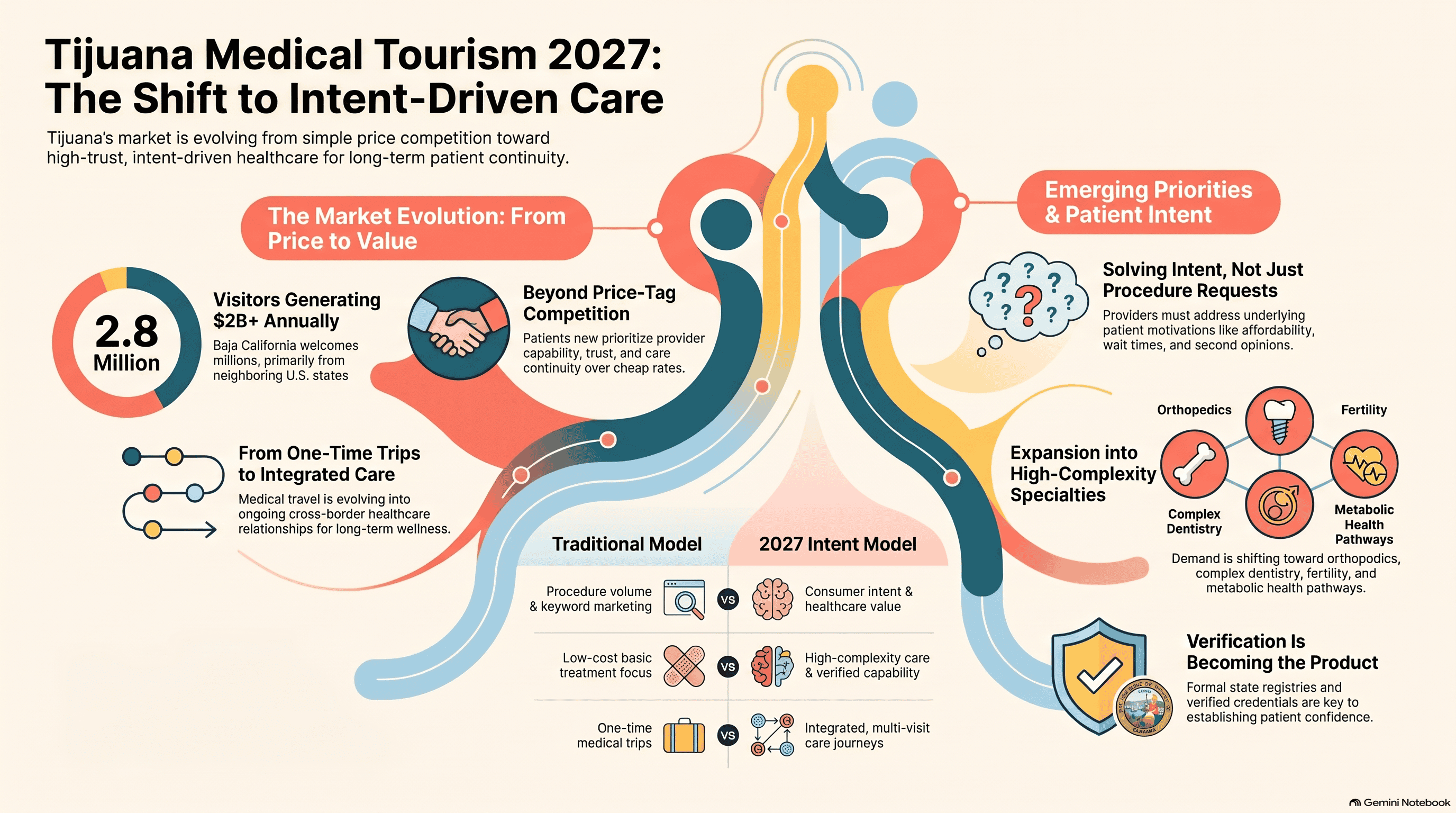
The Real 2027 Shift: From Procedure Demand to Consumer Intent
For years, much of medical-tourism marketing has started with a procedure.
A provider offers dental implants.
Therefore it markets dental implants.
A hospital performs knee replacement.
Therefore it markets knee replacement.
A surgeon performs bariatric surgery.
Therefore it advertises bariatric surgery.
PlacidWay believes that model is becoming insufficient.
The better starting point is the consumer.
Consider three people searching for knee treatment.
One searches:
“Knee replacement cost in Tijuana.”
A second searches:
“Do I really need knee replacement?”
A third searches:
“My insurance denied knee surgery what options do I have?”
All three may ultimately require the same procedure.
But they represent completely different forms of intent.
The first demonstrates price intent.
The second demonstrates clinical decision intent.
The third demonstrates access and affordability intent.
Treating those consumers as identical because they all eventually relate to “knee replacement” misses the most important information about their decision.
PlacidWay's 2027 Consumer Demand and Intent Framework
PlacidWay intends to increasingly organize destination and provider strategy around the reason behind medical travel, not only the treatment requested.
Our developing framework examines several layers of consumer intent.
1. Affordability Intent
The patient has access to treatment locally but considers the cost unacceptable.
Typical questions include:
- How much can I save?
- What does the package include?
- Are there hidden costs?
- Is financing available?
- Why is treatment less expensive?
This remains important, but it represents only one part of demand.
2. Access Intent
The patient cannot obtain treatment easily at home.
Possible drivers include:
- Long wait times;
- Limited insurance coverage;
- High deductibles;
- Provider-network limitations;
- Treatment availability.
These patients may value speed as much as price.
3. Clinical Alternative Intent
The consumer is searching for another option after receiving a diagnosis or treatment recommendation.
Examples include:
- Alternatives to surgery;
- Revision procedures;
- Second opinions;
- Specialized techniques;
- Complex cases.
Trust and medical evidence become particularly important here.
4. Specialist Intent
The patient is not searching primarily for a country.
They are searching for expertise.
Their question is closer to:
“Who is highly experienced with my specific condition?”
This favors specialty centers, surgeons and multidisciplinary programs over generic medical-tourism packages.
5. Verification Intent
The patient has already discovered providers but cannot determine whom to trust.
They begin investigating:
- Licenses;
- Certifications;
- Specialty credentials;
- Facility authorization;
- Reviews;
- Professional history;
- Accreditation;
- Emergency capabilities.
This form of intent is likely to become increasingly important in Tijuana.
6. Logistics Intent
The consumer may already want treatment but is uncertain about the trip.
Questions involve:
- Border crossing;
- Medical lanes;
- Passport requirements;
- Transportation;
- Recovery accommodation;
- Companion travel;
- Mobility after surgery.
Resolving these questions can influence conversion just as much as price.
7. Continuity-of-Care Intent
Patients increasingly ask what happens after they go home.
They need to understand:
- Virtual follow-up;
- Complication protocols;
- Medical-record transfer;
- Laboratory monitoring;
- Rehabilitation;
- Communication with their local physician.
This will become particularly important as Tijuana attracts more complex medical cases.
PlacidWay's Role in the Next Stage of Tijuana Medical Tourism
The changing market creates an opportunity for PlacidWay to play a broader role than simply presenting clinics or treatment prices.
The objective is to become a consumer intelligence, healthcare discovery and patient-navigation layer connecting demand with appropriate provider capability.
Demand Analysis
PlacidWay can evaluate consumer interest by:
- Treatment;
- Medical condition;
- Destination;
- Originating market;
- Stage in the patient journey;
- Affordability concern;
- Access problem;
- Treatment alternative;
- Provider-selection behavior.
This allows market strategy to follow patient demand rather than provider inventory alone.
Consumer Intent Analysis
Search behavior, questions, patient inquiries and decision patterns can be organized around why the person is considering travel.
Instead of asking only:
“Which treatment is this lead interested in?”
the more useful question becomes:
“What problem is this person trying to solve?”
Provider Capability Matching
Providers can then be evaluated around whether their actual capabilities correspond with that demand.
That includes factors such as:
- Specialty;
- Physician credentials;
- Facility capabilities;
- Treatment scope;
- Patient eligibility;
- Technology;
- International-patient experience;
- Languages;
- Recovery support;
- Follow-up capability.
Trust and Verification
Where authoritative verification is available, consumers should be able to understand the difference between marketing claims and verifiable credentials.
Baja California's increasing emphasis on professionalization, registries and verified providers makes this particularly relevant.
Patient Education
Medical-tourism platforms need to answer the questions consumers ask before they are ready to contact a provider.
That means building decision resources around:
- Eligibility;
- Alternatives;
- Risks;
- Credentials;
- Realistic outcomes;
- Recovery;
- Regulations;
- Total travel requirements;
- Follow-up.
Navigation
Finally, patients need help moving from research to action.
The role of navigation is to connect:
Consumer Problem → Treatment Understanding → Provider Discovery → Verification → Consultation → Travel → Treatment → Recovery → Follow-Up.
“The industry has spent years measuring demand by treatment names. The next competitive advantage is understanding the intent underneath that demand. A patient searching for cheaper surgery, a patient denied insurance coverage and a patient looking for a second opinion may arrive at the same procedure, but they require completely different journeys.”
— Pramod Goel, CEO & Founder, PlacidWay
What Tijuana Providers Should Prepare for in 2027?
The Opportunity Map points toward several practical changes.
Dental providers
Move beyond price-led acquisition toward complex case planning, digital capability, implant transparency and long-term restoration planning.
Bariatric providers
Build broader metabolic-health pathways rather than depending exclusively on surgical demand.
Orthopedic providers
Develop complete international-patient pathways including diagnostics, imaging review, implants, mobility planning, rehabilitation and aftercare.
Plastic surgery providers
Make surgeon credentials, facility status, emergency readiness and postoperative care exceptionally easy to verify.
Fertility and women's health providers
Build patient journeys capable of supporting repeated consultations, testing, procedures and remote communication.
Regenerative-medicine providers
Prioritize scientific clarity, transparent protocols, realistic claims and regulatory disclosure.
Hospitals
Position around specialty capability rather than generic international-patient messaging.
The Remaining Obstacles to Tijuana's Growth
Opportunity alone will not determine the market.
Several structural problems remain.
Border Friction
Tijuana's proximity to the United States is a competitive advantage only if the border experience remains manageable for patients.
Baja California already promotes mechanisms including CBX and the Medical Lane as tools supporting health tourism.
For recovering patients, however, predictable mobility remains especially important.
Security Perception
Even when a particular medical district, hospital or patient transportation route is well managed, the wider perception of Tijuana can influence patient decisions.
Providers cannot solve this individually.
The region requires destination-level trust building.
Provider Differentiation
A large supply of providers can benefit patients through competition.
But it can also make selection difficult.
If dozens of clinics present nearly identical messages—affordable treatment, modern facilities, experienced doctors—the consumer still has no clear framework for choosing between them.
Continuity of Care
As Tijuana moves toward orthopedics, oncology, fertility, complex dentistry and chronic-care services, treatment cannot effectively end when the patient crosses the border.
Aftercare must become part of the medical-tourism product.
Market Intelligence
The industry also needs more consistent data regarding:
- Patient origin;
- Treatment demand;
- Repeat visits;
- Conversion;
- Complications;
- Length of stay;
- Procedure trends;
- Economic contribution.
Better intelligence can help both providers and public agencies plan future capacity.
Prediction 1: Tijuana Will Become Less Dependent on the Traditional “Big Three”
Dental care, bariatric surgery and plastic surgery built much of the destination's international profile.
They will remain important.
But PlacidWay expects the mix to broaden toward:
orthopedics + spine + women's health + fertility + ophthalmology + oncology + complex dentistry + metabolic medicine + selected regenerative care.
The 2026 evidence already points in this direction.
Prediction 2: Verified Providers Will Gain an Increasing Advantage
The October 2026 launch of Baja California's updated health-tourism platform and continued development of provider registries indicate a clear policy direction toward professionalization and verification.
Consumers are likely to increasingly expect proof rather than claims.
The question will move from:
“Are you certified?”
toward:
“Show me how your credentials can be independently verified.”
Prediction 3: “Medical Tourism” Will Gradually Become “Cross-Border Healthcare”
This may be the most significant change.
A Californian who visits Tijuana repeatedly for dental rehabilitation, orthopedic consultations, diagnostics or chronic-care services may not think of themselves as a tourist.
They are simply accessing healthcare across the border.
The distinction matters.
Tourism marketing concentrates on a trip.
Healthcare strategy concentrates on a relationship.
Prediction 4: Patient Intent Will Become More Valuable Than Search Volume
A destination could see fewer searches for one procedure and still generate more valuable healthcare demand if the patients entering the market have greater clinical complexity and stronger intent.
This is why PlacidWay believes medical-tourism intelligence must move beyond keyword volume.
Future demand analysis must ask:
- Who is searching?
- What happened before the search?
- What problem are they trying to solve?
- Why can they not solve it locally?
- What prevents them from choosing?
- What evidence would build confidence?
- What happens after treatment?
Those questions reveal the actual market.
Prediction 5: The Winning Provider Will Not Necessarily Be the Cheapest Provider
Tijuana's cost advantage remains substantial. Regional medical-sector representatives have continued to report large price differences between care in Tijuana and comparable U.S. treatment.
But price alone increasingly fails to answer the patient's biggest concerns.
For more complex procedures, consumers evaluate:
cost + expertise + trust + access + convenience + safety + logistics + aftercare.
A provider that competes across all seven dimensions can create a much stronger proposition than one simply offering the lowest quotation.
From Medical Tourism Marketplace to Medical Decision Ecosystem
The transition taking place in Tijuana mirrors a larger transition taking place across global medical tourism.
The first generation of the industry helped consumers discover that healthcare existed beyond their borders.
The second generation helped them compare countries, clinics and prices.
The emerging third generation must help them make better healthcare decisions.
That is the direction PlacidWay believes 2027 will accelerate.
“The future of medical tourism is not sending more patients abroad. The future is helping the right patient identify the right option, with the right provider, at the right point in their healthcare journey. When we understand consumer intent first, medical travel becomes more responsible, more transparent and ultimately more useful to both patients and providers.”
— Pramod Goel, CEO & Founder, PlacidWay
Tijuana's 2027 Opportunity Is Bigger Than Recovery
It would be easy to evaluate Tijuana's future by asking whether medical-tourism volumes will return to their previous highs.
That may be the wrong question.
Bariatric surgery may never return to exactly the same demand pattern it had before GLP-1 medications became widely used.
Other specialties may grow.
Patients may become more selective.
Providers may consolidate or specialize.
Government verification may become more visible.
Healthcare journeys may become longer and more integrated.
The opportunity therefore is not simply to rebuild the previous market.
It is to build a better one.
Tijuana has geography, medical capacity, cross-border familiarity and a large nearby U.S. consumer market that few international destinations can replicate.
Baja California's government is simultaneously placing greater emphasis on professionalization, verified providers and an integrated health-and-wellness ecosystem. Its renewed health-tourism platform now brings together verified health professionals and establishments while linking the broader tourism value chain.
The missing layer is increasingly intelligence and navigation:
understanding what patients actually need, identifying where demand is moving, helping consumers evaluate providers and connecting the complete healthcare journey.
That is where PlacidWay intends to focus.
The PlacidWay 2027 Tijuana Opportunity Map
Our outlook can be summarized in five transitions:
From procedure volume → to consumer demand
From keywords → to consumer intent
From cheap treatment → to healthcare value
From provider listings → to verified capability
From one-time medical trips → to cross-border care journeys
Tijuana's next chapter will not be defined only by how many people cross the border for healthcare.
It will be defined by why they cross, whom they trust, how effectively the region solves their healthcare problem and whether their care continues after they return home.
For PlacidWay, that is the real opportunity entering 2027.
Explore Tijuana's Next Medical Tourism Opportunities
As Tijuana's medical tourism market moves from price-driven travel to intent-driven cross-border healthcare, providers need more than visibility to stay competitive. This Opportunity Map highlights how demand is shifting across specialties, why patient intent matters more than generic procedure searches, and where verified capability, trust and care continuity can create stronger long-term growth.
Educational note: This report discusses medical tourism trends, cross-border healthcare demand, provider positioning and market opportunity areas for educational and strategic planning purposes. It is not medical, legal, immigration or regulatory advice. Providers should obtain appropriate professional guidance before making business, advertising, compliance or patient-service decisions.

