


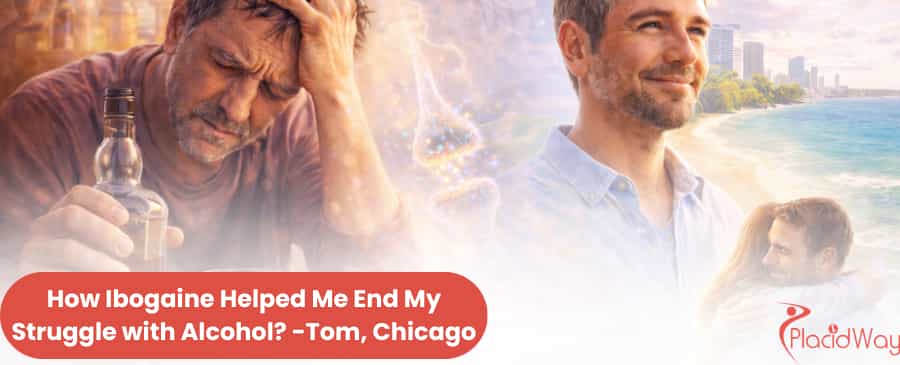
Profession: High School History Teacher
Residence: Chicago, Illinois, USA
Treatment: Ibogaine Therapy for Alcoholism
Treatment Destination: Rosarito, Mexico
Partner Clinic: New Path Ibogaine
For nearly fifteen years, I lived a double life that was as exhausting as it was dangerous. By day, I was Mr. Anderson, the passionate history teacher who could make the complexities of the French Revolution feel like yesterday's news to a room full of distracted teenagers. I loved my job, my students, and the intellectual rigor of the classroom. But as soon as that final bell rang, the mask would slip. I wasn't heading home to grade papers; I was heading to the nearest liquor store in Chicago to begin my nightly ritual of disappearing into a bottle of bourbon.
In a city like Chicago, drinking is woven into the very fabric of social life. From post-work happy hours to weekend sports bar culture, it was easy to hide. But eventually, the social aspect vanished, replaced by a dark, solitary necessity. I stopped drinking to feel good; I was drinking simply to feel normal. The mornings became a nightmare of "the shakes," heart palpitations, and a crushing sense of dread that I would one day collapse in front of my students. The physical demand for alcohol was no longer a choice; it was a biological command that I couldn't ignore.
I tried to stop more times than I can count. I attended AA meetings in drafty church basements, sat through expensive outpatient sessions, and even checked into three separate "luxury" rehabs across the Midwest. Each time, I’d emerge with a head full of slogans and a pocket full of chips, only to have the physical craving for ethanol scream over every piece of logic I possessed within two weeks. I felt like I was fighting a forest fire with a water pistol.
The Rehab-Relapse-Repeat Cycle and the Search for a Breakthrough
The "rehab-relapse-repeat" cycle is a special kind of psychological torture. Every time you fail, you lose a little more of your humanity. You start to believe that you are a moral failure, someone with a "weak character." But as a history teacher, I’ve always been interested in the "why" behind human behavior. I began to suspect that my problem wasn't moral—it was architectural. My brain's reward system had been hijacked, and no amount of "sharing" in a circle was going to fix the neurochemistry that demanded alcohol to function.
I spent my nights (when I was sober enough to read) scouring medical journals for anything that touched on the biology of addiction. That’s when I first encountered the term "Ibogaine." It sounded like something out of a science fiction novel—a plant medicine from Africa that could allegedly "reset" the brain. As an American, the idea of using a psychedelic-adjacent medicine to treat addiction seemed radical, almost taboo. But the more I read about Ibogaine therapy for alcoholism in Mexico, the more I realized it addressed exactly what was missing in my previous treatments: the physiological root.
The data suggested that Ibogaine could eliminate withdrawal symptoms and, more importantly, stop the post-acute cravings that led to relapse. It talked about a "biological off-switch." For a man who had spent fifteen years with a siren blaring in his head, the prospect of an "off-switch" was worth any risk. I knew I couldn't find this treatment in Chicago. I had to look elsewhere, and all signs pointed south toward the professional clinics in Mexico.
Choosing Medical Tourism in Mexico
When I told my wife I wanted to go to Rosarito, Mexico, for Ibogaine therapy, her first reaction was fear. Like many Americans, she had been fed a diet of news stories about "unsafe" medical tourism. We worried about the quality of the clinics, the expertise of the doctors, and the legality of the medicine. But I began to realize that the real "danger" was staying in the current system. The "safety" of my Chicago rehabs had led to three relapses and a declining quality of life. I needed a biological breakthrough, not a safe room to hide in.
I contacted a specialized provider that managed medical tourism for US patients. They were incredibly thorough. They didn't just sell me a package; they requested my full medical history, a recent EKG, and blood work. They explained that Ibogaine therapy for alcoholism in Mexico is a serious medical procedure that requires expert supervision. They connected me with a clinic in Rosarito that focused on "re-wiring" the brain’s addiction pathways. This level of professional scrutiny eased my family's concerns and my own doubts.
The logistics were surprisingly simple. I flew into San Diego, and a private driver from the clinic met me at the airport. We crossed the border together, and within an hour, I was at a beautiful villa overlooking the Pacific Ocean. This wasn't a "shady" back-alley clinic; it was a high-end medical facility staffed by people who truly understood the science of addiction. The cost was significantly lower than my previous stays in US rehabs, proving that affordable healthcare abroad doesn't mean lower quality—it often means more focused care.
The Biological Science of the "Reset"
Before my treatment began, the lead doctor at the clinic sat down with me to explain exactly how Ibogaine would work. He spoke about noribogaine, the metabolite that stays in your system for weeks after the initial dose. He explained how it interacts with the opioid receptors and the serotonin transporters, effectively "cleaning" them. For the first time, I wasn't being told that I needed to "be a better person" or "work harder." I was being told that my receptors needed a scrub.
This biological approach was incredibly empowering. As a teacher, I appreciated the logic. Alcoholism isn't just a habit; it’s a physical state where your brain forgets how to produce its own dopamine. Ibogaine forces the brain to remember. It’s like hitting a factory reset on a computer that has been riddled with malware. Understanding the "how" helped me surrender to the process. I wasn't just there for a spiritual journey; I was there for a medical intervention.
The preparation phase in Rosarito lasted three days. They focused on nutrition, hydration, and emotional stability. I walked along the beach, listened to the waves, and prepared for the internal battle. The medical team monitored my vitals constantly, ensuring that I was in peak physical condition before the Ibogaine was administered. I realized then that the stigma surrounding "medical tourism in Mexico" is often fueled by a lack of understanding of the high standards these specialized clinics maintain.
First Impressions and the Experience
When the day of the treatment finally arrived, I felt a strange mix of calm and anticipation. The setting was peaceful, designed to minimize external noise. As the medicine took effect, I felt a familiar vibration—a high-pitched frequency that signalers call "the hum." Then, the "life review" began. It wasn't a hallucination in the traditional sense; it was more like watching a high-definition movie of my entire life, but with a new perspective of radical honesty.
I saw the moments I had chosen the bottle over my wife's birthday. I saw the days I had been "phoning it in" at school because I was too hungover to care. But interestingly, the medicine didn't make me feel shame. It made me feel objective. It was as if the Ibogaine was saying, *"This is what happened. It was a symptom of your biology. Now, let's change the biology."* The visions were intense, sometimes challenging, but always meaningful. I could feel the "soot" being scrubbed off the windows of my soul.
The Day the Cravings Stopped
The real miracle didn't happen during the visions; it happened about 36 hours later. I woke up in my room at the clinic, and I was struck by a sensation I hadn't felt since I was twenty years old: Silence. The "noise" of addiction—that constant, low-level static that says *drink, drink, drink*—was gone. I looked at the morning light reflecting off the ocean and I didn't immediately think about how a glass of bourbon would make the view better. I just saw the view.
In previous attempts at sobriety, the first three days were a hell of sweating, shaking, and mental anguish. With Ibogaine therapy for alcoholism, there was none of that. I felt a bit tired, certainly, but my body felt "clean." The physical craving—the biological imperative—had been turned off. I sat with the other patients and the medical team, and we all shared a sense of profound disbelief. We had found the off-switch. I felt like a man who had been given a new set of lungs after spending half his life underwater.
Over the next few days in Mexico, the "integration" began. The clinic didn't just kick me out after the dose; they worked with me to build a plan for when I returned to Chicago. They explained that while the biological switch was off, I still had to build new "historical tracks" for my life. But the difference was that now, I had the capacity to do so. The "tools" I had learned in years of rehab finally made sense because I wasn't trying to use them while my brain was screaming for ethanol.
A New Man in the Same Classroom
Returning to my life in Chicago was the ultimate test. I was worried that walking past my old liquor store or the stress of a particularly rowdy class would trigger a relapse. But the "biological reset" held. I found that I could walk through the world with a sense of immunity. The cravings didn't just feel manageable; they felt non-existent. My wife noticed it immediately—the light had come back into my eyes, and my "shakes" were gone for good.
I returned to my classroom with a level of presence and energy I hadn't felt in a decade. I was no longer "phoning it in." I was there, engaged, and truly present for my students. I found that I didn't need a drink to "decompress" because I wasn't carrying the heavy weight of addiction anymore. I started to enjoy the simple things again—a good cup of coffee, a walk through Grant Park, a quiet evening grading papers. The "biological off-switch" had given me my life back.
Why Mexico is the Answer?
If you are reading this and you feel trapped in that same "rehab-relapse" loop, please listen to me: You are not a failure. Your biology has been hijacked, and sometimes, talk therapy isn't enough to get the keys back. Medical tourism for Ibogaine in Mexico saved my life, my career, and my family. It provided a bridge over the chasm of withdrawal that I couldn't have crossed on my own. It wasn't about "willpower"; it was about "bio-power."
Don't let the fear of the unknown or the stigma of seeking treatment abroad stop you. The care I received in Rosarito was world-class, compassionate, and scientifically sound. If you've tried everything else and it hasn't worked, it's because those treatments weren't addressing the biological root of your addiction. You deserve a reset. You deserve to wake up without a craving. You deserve to find your own biological off-switch.
Ready to Find Your Biological Off-Switch?
If Tom's story resonates with you, it's time to take the first step toward a real recovery. Our partner clinics in Mexico offer safe, medically-supervised Ibogaine therapy for alcoholism and other addictions.
Contact a Specialist Today


.png)


.png)









Share this listing