
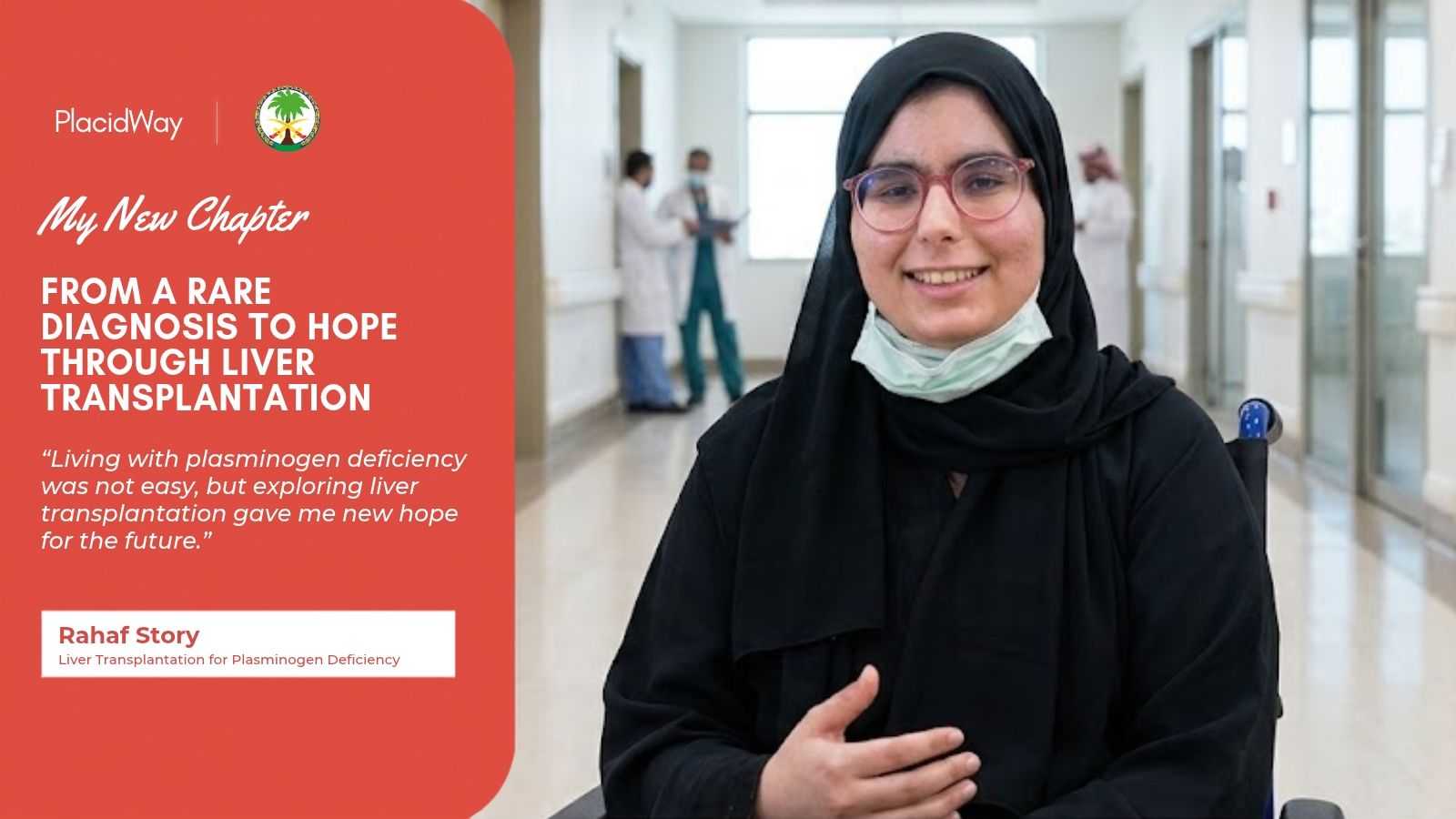
Patient Profile
◉ Name: Rahaf
◉ Age: Patient details not publicly shared
◉ Location: Saudi Arabia
◉ Condition: Plasminogen deficiency
◉ Treatment: Liver transplantation
◉ Destination: Riyadh, Saudi Arabia
◉ Provider: King Faisal Specialist Hospital & Research Centre (KFSHRC)
Journey at a Glance
◉ Diagnosis: Plasminogen deficiency, a rare condition.
◉ Treatment: Liver transplantation at KFSHRC.
◉ Patient Experience: Rahaf’s journey through specialized care for a rare disease.
◉ Future Goal: Recovery and improved quality of life.
Twenty Years of Shadow: A Childhood Stolen by a Rare Condition
For two decades, Rahaf lived in a world fundamentally different from the people around her.
While other children ran freely, played without care, and experienced the simple joy of growing up, Rahaf was trapped in an exhausting cycle of medical fragility.
From the moment of her birth, something was deeply wrong.
As an infant, she could not even breastfeed without immense difficulty.
She cried constantly—an infant's only language to express an unseen, internal distress that doctors struggled to pinpoint.
Her family watched in quiet heartache as the years slipped by.
Childhood became a series of missed milestones, restricted activities, and constant fear.
Her body was missing a fundamental building block of life, making normal growth and everyday vitality an uphill battle.
For twenty long years, Rahaf suffered through medical complications that made basic daily existence a relentless struggle.
Yet, amidst two decades of hardship, her family never gave up hope that somewhere, somehow, a breakthrough was waiting.
Unmasking the Rare Disease: Understanding Plasminogen Deficiency
The turn in Rahaf's life began when her family was guided to King Faisal Specialist Hospital & Research Centre in Riyadh.
There, under the care of Dr. Hazzaa Al-Zahrani and a team of clinical specialists, her mystery condition was finally unmasked.
Rahaf was diagnosed with severe Type 1 Plasminogen Deficiency.
This is an extremely rare genetic metabolic disorder characterized by the lack of plasminogen—a critical zymogen protein synthesized by the liver.
Plasminogen is essential for fibrinolysis, the body’s natural mechanism for breaking down fibrin clots and clearing mucous membrane buildup throughout the organ systems.
Without adequate plasminogen, woody, fibrous lesions form across delicate tissues, leading to severe organ dysfunction, chronic pain, and sight-threatening ocular complications.
"When a condition is so rare that only a handful of cases exist worldwide, hope relies on medical institutions capable of looking beyond conventional treatments."
Because the liver is the sole primary producer of systemic plasminogen, a defect in the liver's synthetic capability meant Rahaf's entire organism was constantly depleted of this crucial enzyme.
She was trapped in a systemic imbalance that threatened her future stability every single day.
The Limits of Conventional Therapy: A Temporary Shield
Following her diagnosis, the medical team immediately initiated the established international protocol for Plasminogen Deficiency Treatment in Saudi Arabia.
Rahaf was placed on intravenous plasminogen concentrate therapy, administered three times every week, accompanied by continuous specialized eye drop treatments to protect her vision.
For a time, this intravenous replacement offered a temporary lifeline.
However, replacement therapy was not a cure—it was a fragile, lifelong maintenance routine.
Every single week required rigid intravenous infusions to keep enzyme levels barely within functional ranges.
The annual financial cost of maintaining this specialized concentrate regimen exceeded 6.5 million Saudi Riyals for the hospital administration.
Even more challenging was the physiological reality of her growth.
As Rahaf grew older and her body weight increased, the synthetic replacement therapies began losing their efficacy.
Challenges of Traditional Replacement Therapy:
-
Lifelong Dependency: Required invasive intravenous infusions multiple times per week without permanent resolution.
-
Diminishing Efficacy: Physiological growth and weight changes led to reduced response to exogenous concentrates.
-
Extreme Healthcare Expenditure: Costing upwards of 6.5 million SAR annually for concentrate formulations.
-
Persistent Organ Risk: Risk of sudden tissue scarring and vision loss remained present between infusion windows.
The treatment that had once stabilized her was no longer enough.
Her health was beginning to slide backward, and a permanent, radical solution was urgently needed.
A Bold Paradigm Shift: Considering Liver Transplantation at KFSHRC
Faced with a deteriorating outlook, Dr. Hazzaa Al-Zahrani convened an extensive medical board with colleagues across the liver transplant department at King Faisal Specialist Hospital & Research Centre.
They asked a pioneering question: If the liver is the factory that produces plasminogen, why not replace the factory itself?
Historically, Liver Transplant in Saudi Arabia was reserved primarily for end-stage liver failure, cirrhosis, or hepatocellular carcinoma.
Using liver replacement as a gene-product delivery system for plasminogen deficiency had never been performed anywhere in the world.
It was a daring, visionary concept in Rare Disease Treatment in Riyadh Saudi Arabia.
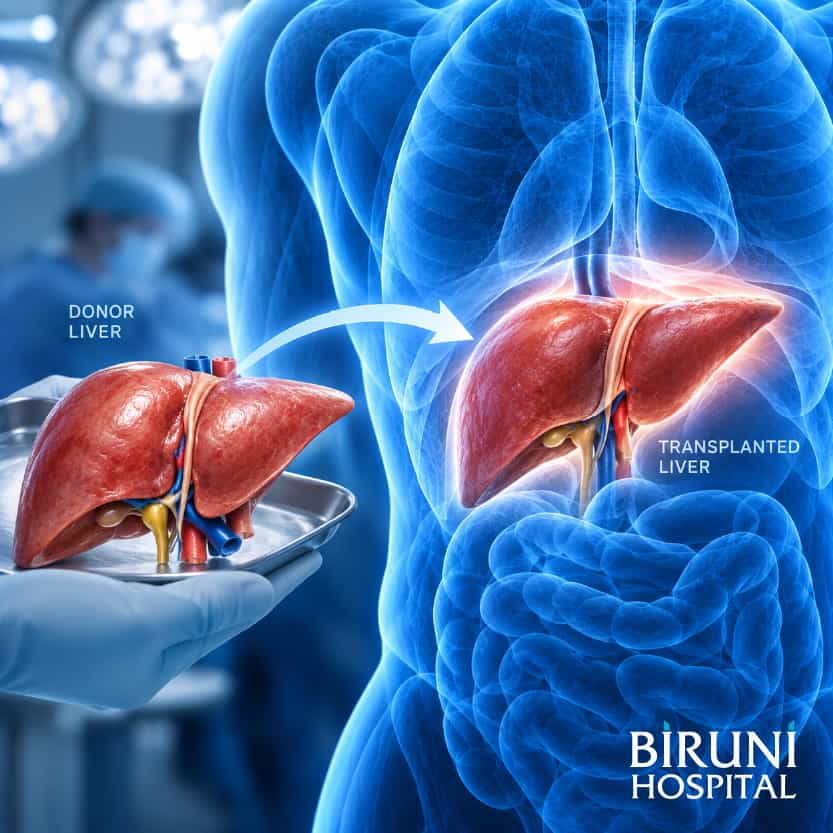
By replacing Rahaf's genetically deficient liver with healthy liver tissue, her body would gain the permanent biological capacity to produce its own plasminogen endogenously.
"True innovation in surgical oncology and transplant medicine lies in expanding the horizons of what a transplant can cure."
The medical strategy was set.
Now, they needed a suitable donor—a gift that would come from the person closest to Rahaf in the entire world.
The Bond of Sisterhood: A Twin Sister’s Life-Saving Gift
Finding a perfectly matched liver organ for a living-donor transplant is one of the most complex challenges in transplant medicine.
The donor must be healthy, genetically compatible, and willing to undergo major surgery out of sheer love.
Rahaf’s twin sister, Raghad, did not hesitate for a single second.
Having watched her sister struggle through pain and limitations for two decades, Raghad stepped forward to donate a portion of her own healthy liver.
As identical/fraternal twins, their biological compatibility offered an ideal immunological scenario for transplantation.
Living-Donor Liver Transplantation Advantages at KFSHRC:
-
Optimal Tissue Compatibility: Twin-sister donation significantly reduces the risk of graft rejection.
-
Immediate Availability: Avoids years of perilous waiting on deceased-donor waiting lists.
-
Elective Surgical Timing: Allows both donor and recipient to be prepared in peak physical condition before surgery.
-
Remarkable Regenerative Power: Both the donor's remaining liver and the recipient's graft regenerate to full functional volume within weeks.
Raghad's selflessness transformed hope into an imminent reality.
The stage was set for a landmark event in global medical history.
A World-First Surgical Achievement in Riyadh, Saudi Arabia
Inside the surgical suites at King Faisal Specialist Hospital & Research Centre, two surgical teams worked in synchronized perfection.
In one operating room, surgeons carefully harvested a portion of Raghad's healthy liver.
In the adjacent suite, Rahaf’s deficient organ was removed, and the healthy graft was implanted with meticulous vascular and biliary micro-reconstruction.
This landmark procedure marked the first time in global medical history that Liver Transplantation in Saudi Arabia was successfully performed to cure plasminogen deficiency.
The result was immediate and extraordinary.
Within just three to four days following the operation, clinical blood work revealed that Rahaf's circulating plasminogen enzyme levels had surged back into normal range.
Her new liver was working flawlessly.
For the first time in twenty years, her body was producing its own plasminogen without a single drop of exogenous medication.
"Within three to four days, enzyme levels normalized completely. Rahaf was cured of a disease she had carried since her first breath."
The disease that had defined her childhood was officially cured.
Reclaiming Life: From Chronic Illness to Complete Recovery
The transformation was nothing short of miraculous.
Rahaf's recovery progressed rapidly under the watchful care of the multidisciplinary post-transplant team.
The painful lesions, constant eye drops, and thrice-weekly intravenous hospital visits became things of the past.
She was finally able to step into the normal life she had watched others live from a distance.
Her father expressed overwhelming gratitude to Almighty God, the surgical team led by Dr. Hazzaa Al-Zahrani, the leadership of KFSHRC, and the government under the Custodian of the Two Holy Mosques and the Crown Prince for making world-class healthcare accessible.
And Rahaf herself shared deep gratitude for her sister Raghad, whose sacrifice gave her a second chance at life.
Milestones of Rahaf's Post-Transplant Recovery:
-
Complete Normalization of Enzyme Activity: Plasminogen synthesis achieved normal biological levels within 96 hours post-op.
-
Cessation of Expensive Concentrate Therapy: Full independence from intravenous infusions and eye drops.
-
Full Donor Recovery: Twin sister Raghad successfully recovered with complete hepatic tissue regeneration.
-
Restoration of Normal Quality of Life: Ability to pursue studies, social life, and physical activities without restriction.
Today, Rahaf is healthy, vibrant, and looking forward to a future unlimited by illness.
Her story is no longer one of suffering—it is a story of complete triumph.
KFSHRC: A Global Pioneer in Advanced Transplant Medicine
Rahaf's successful surgery highlights the world-class capabilities of King Faisal Specialist Hospital & Research Centre in Riyadh.
As a leading center for Rare Disease Treatment in Riyadh Saudi Arabia, KFSHRC continues to push the boundaries of medical science.
By expanding the indications for living-donor liver transplants, the institution offers new hope to patients around the globe suffering from complex, metabolic, and rare genetic conditions.
Through state-of-the-art surgical technology, world-trained medical teams, and deep patient-centered care, Riyadh stands as an international hub for medical innovation and life-saving healthcare.
Explore Advanced Medical Treatment at KFSHRC Riyadh
If you or a loved one is seeking specialized Rare Disease Treatment in Riyadh Saudi Arabia, complex liver conditions, or advanced organ transplantation, connect with the world-class medical specialists at King Faisal Specialist Hospital & Research Centre.
Consult with KFSHRC Specialists TodayDisclaimer: The information provided in this medical narrative is intended solely for educational and informational purposes and does not constitute medical advice or formal medical diagnosis. Treatment protocols, transplant eligibility, and clinical outcomes vary based on individual patient health evaluations. Always consult qualified medical professionals and transplant specialists for personal medical advice and treatment plans.















Share this listing