
Spinal Hernia Treatment in Italy for International Patients with Back Pain
Chronic back pain caused by a herniated disc can transform simple everyday activities like walking, sitting, or resting into severe physical distress. For thousands of international patients searching for relief, traditional open spine surgery often seems overwhelming due to extended recovery times, surgical risks, and significant tissue disruption. Fortunately, medical advancements have introduced non-surgical and minimally invasive procedures that target disc problems directly at their source.
Percutaneous Laser Disc Decompression, or PLDD, has emerged as a groundbreaking medical technique that offers lasting relief from lumbar and cervical disc herniation without the need for large incisions or prolonged hospital stays. By selecting PLDD Spinal Hernia Treatment in Italy through PlacidWay Medical Tourism, overseas patients gain access to advanced European spine care, highly skilled orthopaedic specialists, and state-of-the-art clinical technology. This comprehensive guide explores how laser disc decompression works, why Italy has become a top medical destination, and what international patients can expect throughout their treatment journey.
Content Chapters & Quick Navigation
Understanding PLDD: Modern Innovation in Spine Care
Percutaneous Laser Disc Decompression is a micro-invasive outpatient procedure designed to relieve nerve compression caused by herniated spinal discs. Originally pioneered in the late 1980s and continuously refined through technological advancements, PLDD utilizes targeted optical energy to reduce intradiscal pressure. The fundamental premise of PLDD Spinal Hernia Treatment in Italy relies on basic physical laws governing enclosed spaces: a minute decrease in disc volume produces a dramatic reduction in internal disc pressure.
When an intervertebral disc herniates or bulges, it squeezes adjacent spinal nerve roots, leading to sharp pain, numbness, tingling, and local inflammation. Traditional surgical approaches address this compression by physically cutting through muscle, bone, and spinal ligaments to excise the offending tissue. In contrast, PLDD achieves decompression through a fine needle inserted through the skin directly into the center of the soft nucleus pulposus under real-time radiological guidance.
Because the procedure requires no scalpel incisions, general anesthesia, or extensive bone removal, it eliminates structural scarring and significantly reduces patient trauma. Overseas patients traveling for Spinal Hernia Treatment in Italy benefit from a sophisticated, minimally invasive alternative that restores function quickly while upholding stringent safety standards.
Spinal Herniation: Understanding Causes, Mechanisms, and Symptoms
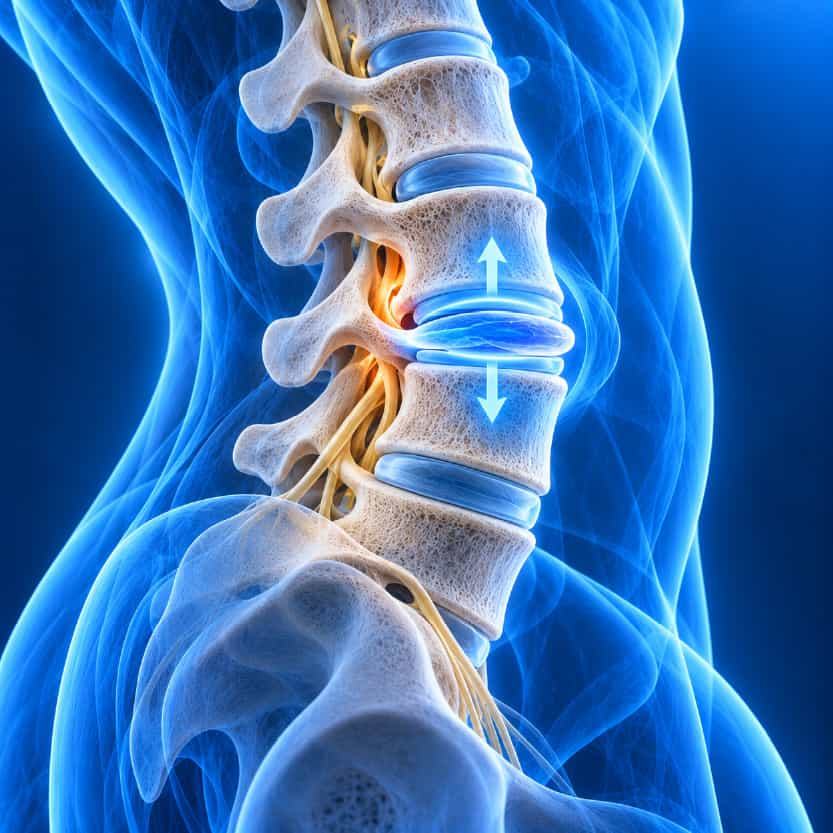
The human spine consists of 33 vertebrae separated by intervertebral discs that serve as flexible shock absorbers. Each disc consists of a tough fibrous outer ring, known as the annulus fibrosus, surrounding a jelly-like center called the nucleus pulposus. Over time, natural wear and tear, repetitive lifting, sudden trauma, or poor posture can weaken the outer wall. When this occurs, the nucleus pulposus bulges outward or ruptures completely, leading to a herniated disc.
Disc herniation occurs most frequently in the lumbar spine (lower back) and cervical spine (neck), as these regions handle the greatest movement and physical strain. Depending on the exact location and severity of the herniation, symptoms can range from mild discomfort to debilitating motor impairment.
Common Symptoms Indicating Disc Compression
- Localized, burning lower back pain that worsens when sitting, bending, or coughing.
- Sciatica radiating sharp or shooting pain down the buttocks, legs, and into the feet.
- Cervical radiculopathy causing pain, weakness, or electric shock sensations through the shoulder, arm, and fingers.
- Persistent numbness or "pins and needles" sensations in specific nerve pathways.
- Local muscle spasms, stiffness, and diminished reflex responses in the affected limb.
Left untreated, progressive nerve compression can lead to chronic nerve damage, reduced mobility, and long-term functional loss. Identifying disc issues early allows patients to explore minimally invasive remedies like PLDD before irreversible changes occur.
The Science of Laser Decompression: Mechanism and Physics
The success of PLDD Spinal Hernia Treatment in Italy is rooted in precise biomechanical principles. The intervertebral disc is essentially a closed hydraulic system contained within a fixed volume. According to Pascal's law, any pressure applied to a confined fluid is transmitted equally in all directions. Conversely, removing even a microscopic amount of fluid or mass from inside the closed container creates a massive drop in internal pressure.
During a PLDD procedure, a thin needle (typically 18-gauge) is guided under precise fluoroscopic or CT visualization into the core of the damaged disc. An extremely fine laser fiber optic cable is then passed through the needle lumen. When laser pulses are delivered, thermal energy vaporizes a tiny fraction of the watery gel matrix inside the nucleus pulposus—often less than 1 gram of material.
This process, known as laser ablation, instantly collapses the internal hydraulic pressure inside the disc. Consequently, the bulging outer wall retracts back into its normal anatomical boundary, releasing the painful pressure exerted on nearby spinal nerves. The surrounding blood vessels and nerve fibers are preserved, allowing the tissue to calm and heal rapidly.
| Biomechanic Phase | Action Inside the Intervertebral Disc | Clinical Result for Patient |
|---|---|---|
| 1. Precise Needle Placement | 18G cannula inserted into the nucleus pulposus via imaging. | No surgical incisions, minimal tissue trauma, local anesthesia. |
| 2. Laser Vaporization | Controlled thermal energy vaporizes small fluid volume inside disc. | Immediate drop in intradiscal pressure without anatomical damage. |
| 3. Disc Wall Retraction | Herniated segment moves inward away from spinal cord/nerve. | Rapid relief from nerve root impingement and leg/arm pain. |
| 4. Post-Ablation Healing | Inflammation subsides, structural integrity of disc is preserved. | Fast return to light physical activities within days. |
Why Choose Italy for Advanced Minimally Invasive Spine Care?
Italy has long stood at the forefront of European medical innovation, boasting world-class clinical infrastructure, rigorous healthcare standards, and internationally renowned orthopaedic and neurosurgical pioneers. When seeking Spinal Hernia Treatment in Italy through PlacidWay Medical Tourism, overseas patients experience high-caliber medical standards paired with compassionate, patient-centered care.
Italian healthcare facilities are equipped with state-of-the-art diagnostic imaging suites, digital fluoroscopy, high-definition MRI technologies, and ultra-precise diode laser systems. Italian spine specialists complete rigorous European clinical training and often contribute actively to international research in minimally invasive spinal therapies.
Key Benefits of Undergoing Spine Treatment in Italy
- Access to highly trained Italian neurosurgeons and interventional neuroradiologists.
- Strict adherence to European Union health, safety, and hygiene regulations.
- Transparent, cost-effective treatment packages compared to North America or Northern Europe.
- Comprehensive medical tourism coordination through PlacidWay Medical Tourism.
- Recovery in an environment renowned for outstanding hospitality, mild climate, and cultural beauty.
Beyond clinical excellence, receiving care in Italy allows patients to recover in a serene setting. The combination of medical quality, reasonable cost structure, and attractive surroundings makes Italy an appealing choice for global healthcare seekers.
Determining Candidacy: Who Qualifies for PLDD?
While PLDD is a safe and effective technique, proper candidate selection is critical for achieving optimal clinical outcomes. PLDD Spinal Hernia Treatment in Italy is specifically designed for contained disc herniations, where the outer disc wall remains intact despite bulging outward.
Before confirming eligibility, specialists perform thorough radiological evaluations, including high-resolution MRI scans, physical exams, and neurological assessments. This ensures that the patient's pain corresponds directly to the herniated segment visible on imaging.
Criteria for Ideal PLDD Candidates
- Patients suffering from persistent contained disc bulges confirmed by MRI or CT scans.
- Individuals who have tried conservative therapies (physiotherapy, medications) for 6+ weeks without sufficient relief.
- Patients experiencing dominant radicular symptoms (leg pain or arm pain greater than axial back pain).
- Individuals seeking a minimally invasive intervention to avoid open spine surgery.
- Patients with no signs of severe disc height loss, spinal instability, or free fragment sequestration.
Conversely, patients with free-floating sequestered disc fragments, severe spinal stenosis, advanced disc degeneration, or spinal instability may require alternative interventions. Experienced medical teams evaluate each patient individually to recommend the safest treatment pathway.
The PLDD Procedure: What Patients Expect Step-by-Step
Understanding what happens during a medical procedure helps eliminate anxiety for overseas travelers. The entire PLDD procedure typically takes between 30 to 45 minutes and is performed under local anesthesia and mild conscious sedation, eliminating the recovery risks associated with general anesthesia.
Here is a detailed step-by-step breakdown of how Spinal Hernia Treatment in Italy is conducted:
Step-by-Step Patient Workflow
- Preparation & Anesthesia: The patient is positioned comfortably on an fluoroscopy table. The skin over the target spine area is thoroughly sanitized, and local anesthetic is injected to numb the entire path.
- Guided Needle Placement: Using real-time C-arm fluoroscopic imaging, the specialist carefully advances a thin 18-gauge spinal needle into the precise geometric center of the affected disc's nucleus pulposus.
- Optical Fiber Insertion: Once optimal needle positioning is confirmed in multiple imaging views, a sterile optical laser fiber is passed through the hollow core of the needle until its tip extends slightly beyond the cannula end.
- Laser Application: Precise energy bursts (measured in Joules) are delivered into the disc nucleus. The physician controls energy density carefully to ensure optimal vaporization while protecting surrounding structures.
- Needle Removal & Bandage: After delivering the calculated laser energy, the optical fiber and cannula are removed. A small sterile bandage is applied to the tiny entry point; no stitches or sutures are required.
- Post-Procedure Observation: The patient moves to a comfortable recovery lounge for 2 to 4 hours of rest and neurological monitoring before being cleared to return to their lodging.
Recovery, Rehabilitation, and Returning Home
Because PLDD Spinal Hernia Treatment in Italy involves no muscle disruption or bone excision, the post-treatment recovery period is remarkably fast compared to open discectomy or spinal fusion. Most patients walk out of the medical center independently just hours after their procedure.
During the initial days following laser decompression, patients are encouraged to take light walks while avoiding strenuous activity, heavy lifting, or prolonged sitting. Minor localized soreness at the needle site is normal and usually resolves within 24 to 48 hours with basic over-the-counter pain relievers.
Recovery Milestones & Best Practices
- Days 1-3: Rest quietly at your hotel, perform gentle walking indoors, avoid bending or twisting the spine.
- Days 4-7: Mild sightseeing, comfortable travel flexibility; most overseas patients can take their return flight home after a follow-up review.
- Weeks 2-4: Return to desk work and daily routine activities; begin light physical therapy or core-strengthening exercises.
- Weeks 6+: Full resumption of normal physical activities, sporting hobbies, and active lifestyles as recommended by your specialist.
A structured physical therapy program focusing on core stabilization, lumbar flexibility, and ergonomic posture education further ensures long-term spine health and prevents future disc issues.
Comparative Breakdown: PLDD vs Open Surgery Options
Evaluating spinal treatment choices requires comparing clinical factors like invasiveness, recovery speed, complications, and structural outcomes. PLDD presents a non-disruptive pathway that preserves natural spine anatomy while effectively relieving painful nerve compression.
| Treatment Aspect | PLDD Laser Decompression | Traditional Open Discectomy |
|---|---|---|
| Incision & Scarring | Needle puncture (1mm), no surgical scars. | Surgical incision (3-6 cm), muscular cutting. |
| Anesthesia Type | Local anesthesia with mild sedation. | Full general anesthesia required. |
| Hospital Stay | Outpatient care (2-4 hours observation). | Inpatient stay (2-5 days hospitalization). |
| Tissue Integrity | Zero bone cutting, minimal ligament disruption. | Removal of bone (lamina) and ligament tissues. |
| Recovery Time | Return to normal daily life in 3-7 days. | Recovery spans 6 to 12 weeks with rehabilitation. |
Navigating Overseas Medical Care with PlacidWay Medical Tourism
Planning international medical care requires coordination, clear communication, and logistics assistance. PlacidWay Medical Tourism simplifies the international patient experience, providing dedicated guidance from initial inquiry through successful recovery and follow-up care.
When organizing PLDD Spinal Hernia Treatment in Italy, overseas patients benefit from a structured, stress-free care pathway designed for safety and peace of mind:
The PlacidWay Seamless Travel & Care Pathway
- Free Initial Medical Review: Submit your latest MRI reports and diagnostic records online for pre-evaluation by top Italian spine experts.
- Customized Treatment Quotations: Receive transparent, itemized treatment quotes with no hidden fees or unexpected hospital charges.
- Travel & Logistics Support: Guidance with medical visa letters, airport transfers, hotel accommodations, and local transportation in Italy.
- Personalized On-Site Care: Multilingual patient coordinators accompany you during hospital visits to ensure smooth communication.
- Post-Return Follow-Up: Continued post-procedure check-ins to monitor your long-term recovery once you return home.
With PlacidWay Medical Tourism handling travel coordination and clinic arrangements, patients can focus fully on restoring their back health and enjoying an exceptional healthcare journey in Italy.
Ready to Live Pain-Free with PLDD Spinal Treatment in Italy?
PlacidWay Medical Tourism connects you with premier specialists for Spinal Hernia Treatment in Italy. Contact our team today for a free expert consultation and personalized quote.
GET A FREE QUOTE





















Share this listing