


Beyond Paralysis: The Definitive Guide to Spinal Cord Injury Rehabilitation and Robotic Innovation
About this video: A traumatic spinal cord injury (SCI) is one of the most challenging diagnoses a person can face, often leading to sudden paralysis and a loss of independence. However, the intersection of advanced medical technology and expert physiotherapy is rewriting the prognosis for survivors. In this inspiring patient spotlight, Uzm. Dr. Nurten Küçükçak?r and the team at Romatem share the recovery journey of Kalamkas, a patient from Kazakhstan who sought specialized care in Bursa following a severe traffic accident. Watch to witness the power of robotic rehabilitation for spinal cord injury and learn how a patient-centered, multi-disciplinary approach can restore mobility where conventional methods often fail.
Video Chapters & Quick Navigation
The Complexity of Physical Therapy After Spinal Cord Injury
Spinal cord injury (SCI) recovery is not a linear path; it is a profound biological and psychological journey. When the spinal cord is damaged—often due to traumatic incidents like traffic accidents—the communication link between the brain and the limbs is severed or disrupted. This leads to immediate complications such as bipedal weakness, inability to maintain posture, and the loss of independent walking capacity.
As Dr. Nurten Küçükçak?r explains at [00:04], Kalamkas arrived at Romatem in February 2023 with a complete inability to sit or walk. The focus of specialized neurological physical therapy is to identify remaining neural pathways and strengthen the muscular support system that remains intact. In the early stages, the goal is often "pre-habilitation"—preparing the body to support its own weight again.
Successful SCI recovery requires a multi-pronged attack. It isn't just about moving the legs; it’s about core stability, autonomic regulation, and sensory re-education. Without a comprehensive center like Romatem, many patients find themselves stuck in a loop of symptom management rather than functional progress.
Robotic Rehabilitation: The Game-Changer in Neuro-Physiotherapy
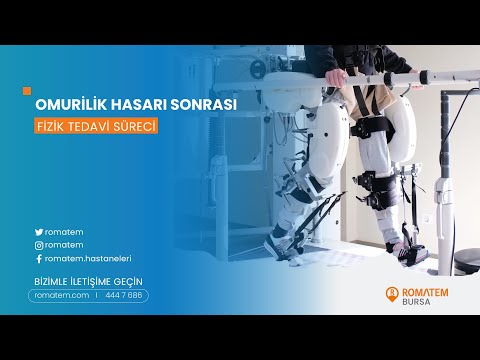
Perhaps the most significant advancement in spinal injury care over the last decade is the integration of robotic assistance. Robotic rehabilitation systems, such as the Lokomat, provide the high-frequency, high-intensity, and precisely repetitive movements necessary to retrain the brain. This is exactly the protocol initiated for Kalamkas [00:21].
Benefits of Robotic-Assisted Gait Training (RAGT):
- Consistency: Unlike human therapists, a robot can provide thousands of identical gait cycles, providing the brain with the massive sensory input it needs to reorganize.
- Safety: Patients are supported in a weight-bearing harness, allowing them to focus on movement without the fear of falling.
- Biofeedback: Real-time data allows therapists to adjust the amount of assistance provided, challenging the patient to use their own muscle power as they get stronger.
At [00:59], the footage shows Kalamkas utilizing these advanced systems. By simulating a natural walking pattern, the robotic system prevents muscle atrophy and joint contractures while simultaneously stimulating the central nervous system.
From Kazakhstan to Turkey: Navigating International Rehabilitation
The story of Kalamkas is a testament to the global nature of modern medicine. After her accident in February 2023, she sought out the best possible care, eventually choosing to travel from Kazakhstan to Romatem in Bursa, Turkey [00:11]. This highlights the importance of medical tourism for spinal cord rehabilitation.
International patients often seek centers like Romatem because of their concentrated expertise in "neuro-robotics." Many local hospitals can provide basic stretching and massage, but few can offer a 7-month intensive program [00:26] that combines robotic gait training, occupational therapy, and manual exercise protocols.
Kalamkas’s testimony at [00:52] confirms the severity of her initial state: "I couldn't sit, I couldn't walk, I was struggling with many movements." The decision to travel was driven by the hope for a functional life, and the results—being able to sit on her own and walk short distances—justify that leap of faith.
The Science of Neuroplasticity: How the Brain Learns to Walk Again
The underlying mechanism that makes recovery possible is neuroplasticity. This is the brain's ability to create new neural connections to compensate for injury. In the case of SCI, the brain must find "detours" around the site of the spinal lesion. This process is not automatic; it requires specific, intensive stimulation.
When Kalamkas engages in gait training, her brain is receiving signals from the soles of her feet and the movement of her hip joints. This sensory feedback tells the brain that "walking is happening," which encourages the growth of new synapses. As Dr. Küçükçak?r mentions at [00:30], neurological rehabilitation is a long-term process precisely because these biological changes take months of repeated effort to solidify.
Without the correct intensity, the brain may enter a state of "learned non-use," where it essentially forgets how to control the paralyzed limbs. Intensive robotic therapy prevents this, keeping the neural maps for walking active while the spinal cord heals.
Intensive Strengthening Protocols for Paralysis Recovery
While robots handle the walking patterns, manual physical therapy handles the raw muscle power. Strengthening exercises [00:15] are a cornerstone of the Romatem protocol. For a patient like Kalamkas, this involves a progression from passive movement to active-assisted, and eventually independent movement.
| Recovery Phase | Therapeutic Focus | Technology Used |
|---|---|---|
| Phase 1: Stabilization | Preventing muscle contractures | Passive manual stretching |
| Phase 2: Postural Control | Sitting balance and core strength | Balance boards and core exercises |
| Phase 3: Gait Training | Repetitive walking patterns | Robotic Gait Systems (Lokomat) |
| Phase 4: Independence | Walking with assistive devices | Walkers and parallel bars |
Balance and coordination training [00:20] are equally critical. Even if the legs have strength, a patient cannot walk if their vestibular system and core cannot maintain center-of-gravity. At [01:04], we see Kalamkas successfully sitting and maintaining balance, a massive milestone for someone who arrived unable to sit up.
The Role of Patient Energy and Psychology in Recovery
One factor that often goes unmeasured in clinical studies but is vital in practice is patient motivation. Dr. Küçükçak?r notes that "Kalamkas concentrated all her energy into the treatment" [00:35]. Neurological recovery is a "patience job" [00:34], requiring a mental resilience that can endure through days of slow progress.
Depression and learned helplessness are common after traffic accidents. The environment at Romatem focuses on creating a "culture of can," where small victories—like moving a toe or sitting for five minutes—are celebrated as major steps. This psychological support ensures that the patient doesn't give up during the critical 6-to-12-month window following an injury.
Kalamkas’s gratitude toward the doctors and physiotherapists like Halil [01:10] shows the importance of the therapeutic alliance. When the patient trusts the team and the technology, their compliance with difficult exercises increases, leading to better functional outcomes.
Why Patients Choose Romatem for Neuro-Rehabilitation
Romatem has established itself as a beacon for patients seeking high-end spinal cord rehabilitation in Turkey. The clinic's success with international patients from Kazakhstan, the Middle East, and Europe is driven by their investment in specialized medical staff and cutting-edge robotics. In the video, the patient mentions seeing the results through Instagram [00:59], highlighting the importance of transparent patient outcomes in medical tourism.
The facility in Bursa offers a comprehensive suite of services that allows for "one-stop" rehabilitation. This is essential for SCI patients who often have complex needs, including urological support, skin care, and nutritional management, alongside their physical therapy.
After 7 months of treatment, Kalamkas has achieved what many thought impossible [01:04]. She is now walking short distances with a walker, a far cry from the patient who arrived paralyzed and bedridden. Her story serves as a beacon of hope for thousands of others currently facing the daunting road of SCI recovery.
Predicting Long-Term Outcomes in Traumatic SCI
While Kalamkas has made incredible progress, the journey continues. Long-term success in spinal cord injury depends on maintaining the gains made in the clinic. Patients are encouraged to continue home-based exercises and returned to the clinic for periodic intensive "boosters."
Functional recovery is often measured by the patient's ability to perform activities of daily living (ADLs). For Kalamkas, the ability to sit independently means she can feed herself, dress herself, and transfer to a wheelchair without total assistance. These "functional" gains are the true measure of success in spinal cord physical therapy.
As Turkey continues to lead in robotic medical services, the future for patients like Kalamkas looks brighter. The integration of AI and more advanced exoskeletons will likely continue to push the boundaries of what is possible in neurological recovery. For now, the combination of manual expertise and robotic precision remains the "gold standard" for those fighting to walk again after a traffic accident.
Ready to Reclaim Your Mobility with Romatem?
Don't settle for a life without movement. Romatem Physical Therapy and Rehabilitation Center offers the world's most advanced robotic systems and expert specialists to help you walk again.
GET A FREE REHABILITATION QUOTEView Full Video Transcript (English Translation)
[00:00:00] Hello everyone. Kalamkas applied to our hospital from Kazakhstan with complaints of leg weakness, inability to sit, and inability to walk following a spinal cord injury developing after a traffic accident in February 2023.
[00:00:14] After our evaluation, we started a rehabilitation process including exercise protocols particularly for muscle strengthening, balance and coordination training, gait training, and robotic rehabilitation.
[00:00:26] we have been continuing the rehabilitation process for about 7 months. We know that neurological rehabilitation requires a long process and is truly a job of patience.
[00:00:35] Kalamkas concentrated all her energy on the treatment and come and look at how much progress we have made in her development. Now let's hear from her.
[00:00:45] Hello, my name is Kalamkas, I am from Kazakhstan. In February 2023, due to an accident, my spine and spinal cord were damaged, and my lower body was paralyzed.
[00:00:54] I couldn't walk properly, I couldn't sit, I was struggling with many movements. I met Romatem Clinic through Instagram and decided to come to Bursa for rehabilitation.
[00:01:04] After seven months of treatment, I can sit and stand up on my own, and I have started walking short distances with a walker.
[00:01:10] I am very grateful to the doctors, physical therapist Halil, and other staff who helped me in this clinic. Good luck to everyone!









Share this listing