


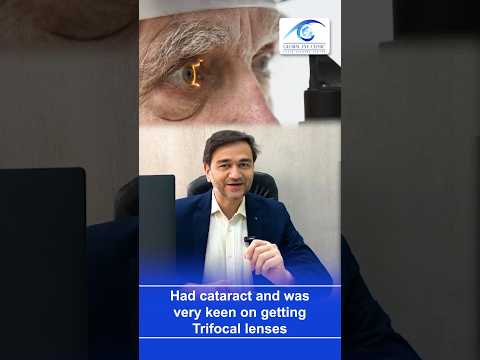
The landscape of advanced ophthalmology has shifted dramatically, making AI-designed trifocal lenses for cataract surgery in India one of the most sought-after treatments for complete visual restoration. Patients undergoing intraocular lens implantation no longer have to settle for basic monofocal lenses that require the constant use of reading glasses. A perfect illustration of this clinical demand involves a highly active 55-year-old male patient [00:00] who recently sought treatment for progressive cataract development. His primary objective was to secure premium presbyopia-correcting lenses that would align with his demanding lifestyle.
Like many individuals in this demographic, he was deeply invested in obtaining trifocal lenses to eliminate his dependency on prescription eyewear entirely. Maintaining clear vision across multiple distances is a functional necessity for modern professionals who constantly shift their focus between physical documents, digital monitors, and distant environments. Upgrading the clouded natural crystalline lens with a highly engineered multifocal implant offers a permanent solution to both cataracts and lifelong refractive errors. The surgical removal of the opaque lens creates an ideal opportunity to recalibrate the eye's entire focusing mechanism.
Despite the obvious advantages of modern intraocular lenses, a significant clinical hesitation prevents many candidates from moving forward with traditional multifocal options. The documented risk of experiencing photic phenomena—specifically nighttime glare and halos—creates severe anxiety for patients who drive frequently after dark. Understanding the complex optical physics behind these visual disturbances is the first step in evaluating the latest artificial intelligence-driven solutions available in the medical sector today.
Video Chapters & Quick Navigation
- The Challenge of Traditional Trifocal Lenses
- Understanding AI-Designed Trifocal Technology
- Total Freedom from Prescription Glasses
- Restoring Night Driving Confidence
- Intraocular Lens Comparison Guide
- Advanced Cataract Treatment in India
- The Surgical Phacoemulsification Process
- Identifying the Ideal Surgical Candidate
The Challenge of Traditional Trifocal Lenses and Post-Surgical Halos
For decades, the standard approach to achieving multifocal vision involved designing intraocular lenses with concentric diffractive rings carved into the optic surface. These microscopic ridges are mathematically designed to split incoming light rays, directing specific percentages of light to different focal points on the retina. While this engineering marvel effectively provides near, intermediate, and distance vision, it inherently causes light scattering at the boundaries of each diffractive step. This specific limitation is what causes patients to experience dysphotopsia, commonly perceived as glowing rings or starbursts around bright light sources.
The fear of these visual disturbances was the exact barrier that stopped the 55-year-old patient from proceeding with standard premium lenses [00:16]. During nighttime conditions, the human pupil naturally dilates to allow more light into the eye, exposing the incoming light to the peripheral diffractive rings of the artificial lens. This physiological expansion exacerbates the splitting of light rays, causing the concentric rings to become highly visible and distracting against a dark background. Even though traditional trifocal options provide excellent visual acuity ranges, the resulting photic phenomena remain a significant compromise.
For individuals who frequently drive at night or work in low-light environments, the presence of halos can induce visual fatigue and reduce contrast sensitivity. Patients are often told that their brains will undergo a process called neuroadaptation, eventually learning to ignore the glare over several months. However, the prospect of waiting for neurological adjustment while dealing with immediate nighttime driving difficulties drives many patients to seek alternative, high-tech intraocular lens solutions.
Understanding AI-Designed Trifocal Technology for Cataract Patients
The introduction of artificial intelligence into optical engineering has revolutionized the way presbyopia-correcting lenses are manufactured. AI algorithms are now utilized to model millions of potential light-ray trajectories, optimizing the lens topography at a microscopic level that human engineers could not achieve manually. By analyzing how light waves interact with different pupil sizes and optical aberrations, the AI generates a customized diffractive profile that smooths out the harsh steps traditionally found on multifocal lenses. This advanced AI-designed trifocal lens completely transforms the postoperative visual experience [00:34].
Through a process called apodization and advanced phase-shifting technology, the AI-optimized surface manages light energy with unprecedented efficiency. Instead of abruptly splitting the light at harsh diffractive edges, the modified topography gently guides the light waves to their designated focal points without significant scattering. This scientific breakthrough ensures that a higher percentage of the light actually reaches the retina to form sharp images, rather than being lost to stray glare. The result is an intraocular lens that delivers continuous visual acuity while producing negligible halos.
Ophthalmologists note that the precision of these AI-based designs virtually eliminates the heavy reliance on lengthy neuroadaptation periods. Patients report high levels of satisfaction almost immediately after the surgical removal of their cataracts, experiencing crisp vision without the distracting optical artifacts. This sophisticated integration of machine learning into medical device manufacturing represents the highest tier of premium cataract surgery available today.
Complete Freedom from Glasses: Mastering All Ranges of Vision
The primary motivation for upgrading to a premium IOL is to achieve total spectacle independence, allowing patients to function naturally across all daily activities. An AI-optimized trifocal implant is specifically calibrated to restore near, intermediate, and distance vision simultaneously [00:49]. Near vision functionality focuses on tasks occurring at roughly 30 to 40 centimeters from the face, which includes reading fine print, threading a needle, or viewing smartphone screens.
Intermediate vision, which typically ranges from 60 to 80 centimeters, has become increasingly critical in the digital age. This focal zone is required for operating computer monitors, reading car dashboards, preparing meals, and engaging in face-to-face conversations. Traditional bifocal lenses historically ignored this crucial middle distance, forcing patients to lean awkwardly toward their screens or wear specialized computer glasses. The AI-designed trifocal lens bridges this gap flawlessly, ensuring a continuous depth of focus that mimics the eye's natural accommodation.
Distance vision covers everything beyond one meter, encompassing activities like watching television, recognizing faces across a room, and enjoying outdoor sports. By distributing the incoming light optimally across these three distinct focal points, the AI lens guarantees that patients are completely independent of corrective eyewear. This seamless transition between focal lengths vastly improves the overall quality of life for individuals undergoing cataract extraction.
Restoring Night Driving Confidence After Intraocular Lens Implantation
Operating a vehicle at night is arguably the most demanding visual task an individual performs, requiring rapid adaptation to dynamic lighting changes. When driving in scotopic (low light) conditions, oncoming headlights create sudden bursts of high-intensity illumination that test the optical clarity of the intraocular implant. Standard trifocal lenses often produce a phenomenon where the headlights appear surrounded by overlapping glowing circles [00:29]. This glare can severely obscure the driver's ability to see pedestrians, lane markings, and traffic signals.
The AI-designed topography specifically targets the mechanisms that cause these dangerous visual disruptions during nighttime driving. By smoothing the transition zones between the diffractive rings, the lens minimizes the scattering of high-intensity light beams entering the dilated pupil. Clinical feedback indicates that patients implanted with these advanced lenses experience such minimal photic phenomena that they cannot practically identify any halos during their nightly commutes.
This restoration of contrast sensitivity and glare reduction brings immense psychological relief to older adults who may have voluntarily restricted their driving habits due to cataract progression. Regaining the confidence to navigate safely on dark roads is a life-changing benefit. It highlights why prioritizing an AI-optimized trifocal lens is a superior medical decision for active individuals.
Intraocular Lens Options: Comparing AI Trifocals to Traditional Lenses
Navigating the various types of intraocular lenses requires a clear understanding of the optical compromises associated with each category. Standard monofocal lenses remain the baseline treatment for cataracts, providing excellent clarity at a single distance but requiring the use of reading glasses for all close-up tasks. Extended Depth of Focus (EDOF) lenses improve upon this by stretching the focal point to cover distance and intermediate vision, yet they still fall short for fine near-vision tasks.
Traditional trifocal lenses address the near-vision deficit of EDOF lenses by utilizing strict diffractive rings, but they introduce the aforementioned high risk of halos and glare. In contrast, AI-designed trifocal lenses represent the apex of current optical technology by merging the comprehensive focal range of traditional trifocals with the low dysphotopsia profile of premium EDOF lenses. This unique combination of benefits makes the AI-based lens the clear choice for demanding patients.
| Lens Category | Distance Vision | Intermediate Vision | Near Vision | Risk of Halos/Glare |
|---|---|---|---|---|
| Standard Monofocal | Excellent | Requires Glasses | Requires Glasses | Very Low |
| Extended Depth of Focus (EDOF) | Excellent | Excellent | Requires Glasses | Low |
| Traditional Trifocal | Excellent | Good | Excellent | High |
| AI-Designed Trifocal | Excellent | Excellent | Excellent | Negligible |
Accessing Advanced Cataract Treatment and AI Lenses in India
The global medical tourism industry has recognized India as a premier destination for highly specialized ophthalmological procedures. Patients seeking AI-designed trifocal lenses for cataract surgery in India benefit from a unique combination of world-class surgical expertise and state-of-the-art clinical infrastructure. The latest AI-based intraocular technologies are readily available in top-tier Indian facilities [01:02], matching the exact standards found in North America and Western Europe.
Leading eye care centers, such as those overseen by experienced professionals like Dr. Hardik Parikh at the Global Eye Clinic, are fully equipped with advanced diagnostic and surgical platforms. These institutions utilize high-definition OCT mapping, advanced biometry for precise IOL power calculations, and femtosecond laser systems. The immense surgical volume managed by Indian ophthalmologists ensures a level of technical proficiency that directly translates to superior patient outcomes and minimized complication rates.
Beyond the clinical excellence, the cost-effectiveness of undergoing premium cataract removal in India is a major draw for international patients. By choosing highly accredited Indian clinics, patients can access these expensive, AI-optimized premium lenses at a fraction of the cost typically billed in Western healthcare systems. This financial accessibility democratizes advanced vision correction without sacrificing safety, hygiene, or surgical precision.
The Phacoemulsification Procedure and Patient Recovery Timeline
The surgical implantation of an AI-designed trifocal lens is performed using an advanced microsurgical technique known as phacoemulsification. During this outpatient procedure, the surgeon creates a microscopic, self-sealing incision in the cornea, typically measuring less than 2.4 millimeters. An ultrasonic probe is then carefully inserted into the capsular bag to emulsify and gently vacuum out the clouded cataract material. This precise extraction preserves the delicate capsular bag, which will securely hold the new artificial lens.
Once the natural lens is entirely removed, the foldable AI trifocal IOL is injected through the same micro-incision. The lens gently unfolds inside the capsular bag, where the surgeon meticulously centers it along the patient's visual axis to ensure optimal optical alignment. The entire surgical process generally takes less than twenty minutes per eye and is conducted under topical anesthesia, rendering the procedure completely painless for the patient.
The post-operative recovery phase is remarkably swift, with many patients reporting significant visual improvements within the first 24 to 48 hours. Patients are prescribed a strict regimen of antibiotic and anti-inflammatory eye drops to prevent infection and control swelling during the initial healing period. While standard daily activities can usually be resumed within a few days, full stabilization of the refractive outcome and final neuroadaptation to the multifocal optics occur over the subsequent four to six weeks.
Identifying the Ideal Candidate for Premium AI-Designed Lenses
Determining eligibility for an AI-designed trifocal lens requires a comprehensive and rigorous preoperative assessment by a qualified ophthalmologist. The ideal candidate must exhibit a strong desire for complete spectacle independence and possess realistic expectations regarding the surgical outcomes. Advanced corneal topography and tear film analysis are conducted to ensure the ocular surface is healthy, as conditions like severe dry eye syndrome or irregular astigmatism can degrade the performance of premium multifocal optics.
Key Clinical Criteria for Premium IOL Implantation
- Healthy Macula and Retina: The absence of advanced macular degeneration, diabetic retinopathy, or severe glaucoma is mandatory for accurate focal projection.
- Controlled Astigmatism: Patients with significant corneal astigmatism may require a toric version of the AI lens to ensure proper light alignment.
- Adequate Pupil Dynamics: The pupil must dilate and constrict symmetrically to maximize the benefits of the AI-optimized diffractive surface during scotopic and photopic conditions.
- Commitment to Post-Op Care: Strict adherence to postoperative drop schedules and follow-up clinical evaluations is crucial for long-term success.
By strictly adhering to these patient selection guidelines, surgeons ensure the highest possible success rates for AI-based intraocular implantations. For those who meet the clinical criteria, moving forward with this advanced procedure represents a permanent upgrade in visual clarity, safety, and everyday convenience.
Ready to Achieve Perfect Vision Without Glasses?
Connect with top-rated ophthalmology clinics for advanced AI-designed trifocal cataract surgery. Secure your personalized medical assessment and pricing details today.
Get Free QuoteView Full Video Transcript
[00:00] Let me discuss with you a story of a 55 year old male who had cataract and was very keen on getting Trifocal lenses so that he's not dependent on glasses for his work be it something near or at distance.
[00:16] But what stopped him was the fear of halos. And yes, most trifocal lenses in the modern day, even though they give excellent range of vision, would produce some amount of halos at night time, especially while driving and there's a headlight coming bang on to your vehicle.
[00:34] Now we have in today's world an AI-designed trifocal lenses which not only gives you an excellent range of vision but also produces negligible halos. So much so that practically, people are not even able to identify that they are there.
[00:49] So this not only gives you freedom from glasses for near, intermediate, and distance vision but also does not produce the dreaded halos.
[01:02] Today's world of advanced technology and science, this AI-based trifocal lenses are also available in India, and you can do that.


.jpg)
.png)
.png)
.png)








Share this listing