

Navigating biological care without guesswork
Safety, Standards, Protection: Stem Cell Therapy in Japan
How strict national legislation, controlled cell processing laboratories, and individualized physician oversight protect patients exploring Regenerative Medicine in Japan.
When chronic joint pain, degenerative wear, or unresolved systemic conditions refuse to respond to conventional care, searching for advanced options can feel exhausting. You spend late evenings scrolling through conflicting clinic claims, bold marketing promises, and unfamiliar medical terminology—all while carrying a quiet, persistent worry: How do I know which clinic actually puts patient safety first, and how do I avoid falling into an unregulated trap?
That hesitation is completely justified. Unlike taking a standardized prescription tablet, biological interventions rely on living cellular materials and delicate clinical workflows. If a facility cuts corners on sterility, skips thorough diagnostic screening, or lacks statutory oversight, the risks extend far beyond wasted travel expenses. True clinical safety depends on an interconnected chain of safeguards: the physician who evaluates your medical history, the cleanroom laboratory that prepares your cells, the quality tests performed before administration, and the national laws governing the clinic.
As global curiosity around cellular medicine expands, understanding how safety is verified in practice becomes essential. This guide examines how medical teams evaluate patient suitability, maintain laboratory quality control, and operate within rigorous statutory frameworks—specifically highlighting how Japan’s regulated medical infrastructure sets clear benchmarks for responsible care.
Navigation
Table of Contents
- Why is safety so important in regenerative medicine?
- How is safety evaluated in clinical practice?
- The importance of cell processing and quality control
- Why is legal regulation important?
- Clinical experience and ongoing research
- Safety considerations beyond the procedure itself
- FAQ
- Plan Your Safe Regenerative Consultation in Tokyo
- Disclaimer
01 · Foundational Principles
Why is safety so important in regenerative medicine?
Safety considerations in regenerative medicine
Cellular therapies interact directly with complex human biological systems. Unlike conventional pharmaceuticals synthesized in uniform chemical batches, living cells respond dynamically to how they are harvested, cultured, stored, and delivered. Because every step influences biological behavior, disciplined clinical governance and tightly controlled laboratory procedures are indispensable—both in active patient care and in ongoing scientific studies.
Online brochures and casual wellness articles frequently oversimplify stem cell procedures, portraying them as effortless, one-size-fits-all solutions. In legitimate medical settings, however, outcomes and safety depend heavily on careful patient selection, direct physician accountability, validated treatment protocols, and strict adherence to healthcare statutes.
For these reasons, responsible providers never frame cellular therapy as a casual spa or cosmetic wellness service. Instead, it is practiced strictly as a specialized medical intervention operating inside an accountable, regulated clinical infrastructure.
02 · Diagnostic & Clinical Standards
How is safety evaluated in clinical practice?
Individual evaluation by a physician
Every responsible clinical journey starts with a comprehensive, one-on-one medical assessment conducted by a licensed physician. Rather than offering identical packages to every inquirer, doctors review past medical records, baseline physical health, current medications, diagnostic blood panels, and specific therapeutic goals.
Depending on those clinical findings, the physician determines whether a patient is an appropriate candidate, outlines realistic expectations, establishes a post-treatment follow-up schedule, and coordinates cell preparation parameters. Because no two patients share identical physiology, individualized medical screening forms the cornerstone of safe decision-making.
Clinical protocols and quality control
Within legally supervised medical institutions, cellular procedures are never improvised. Every phase—from initial tissue collection and sterile transport to cell expansion and clinical administration—follows documented standard operating procedures (SOPs).
These standardized protocols define exact dosing parameters, administration routes, aseptic handling rules, and emergency readiness, ensuring consistency and traceability across every patient case.
03 · Laboratory Integrity
The importance of cell processing and quality control
Controlled cell processing environment
Handling living human cells intended for clinical use demands extraordinary environmental discipline. Even microscopic airborne particulates or trace microbial contamination can compromise cell integrity or trigger adverse reactions in a patient. Consequently, accredited facilities prepare biological materials inside dedicated Cell Processing Centers (CPCs)—specialized cleanrooms engineered with HEPA filtration, positive air-pressure differentials, strict gowning barriers, and continuous environmental monitoring.
Quality control after cell processing
Maintaining a sterile cleanroom is only half of laboratory assurance; verifying the finished cellular product before it ever reaches a patient is equally vital. Depending on the clinical protocol, post-processing quality control (QC) testing evaluates four core benchmarks:
Metric 01
Cell Viability
Confirming a high percentage of living, metabolically active cells prior to clinical delivery.
Metric 02
Sterility Screening
Testing for bacteria, fungi, mycoplasma, and endotoxins to ensure contamination-free samples.
Metric 03
Accurate Cell Count
Measuring exact cell concentration so administered doses match the physician’s treatment plan.
Metric 04
Cell Characterization
Verifying surface markers and biological identity to confirm the cells match intended therapeutic criteria.
Cell processing system at HELENE Clinic
For international patients evaluating Stem Cell Treatment in Tokyo Japan, verifying how a facility manages its laboratory chain of custody makes a decisive difference. At HELENE Clinic, cell cultivation and preparation are executed directly inside an on-site, in-house Cell Processing Center (CPC) governed by documented clinical protocols and an ISO 9001-certified quality management system—eliminating third-party courier delays and preserving strict environmental continuity.
Verified Medical Institution & Clinical Leadership
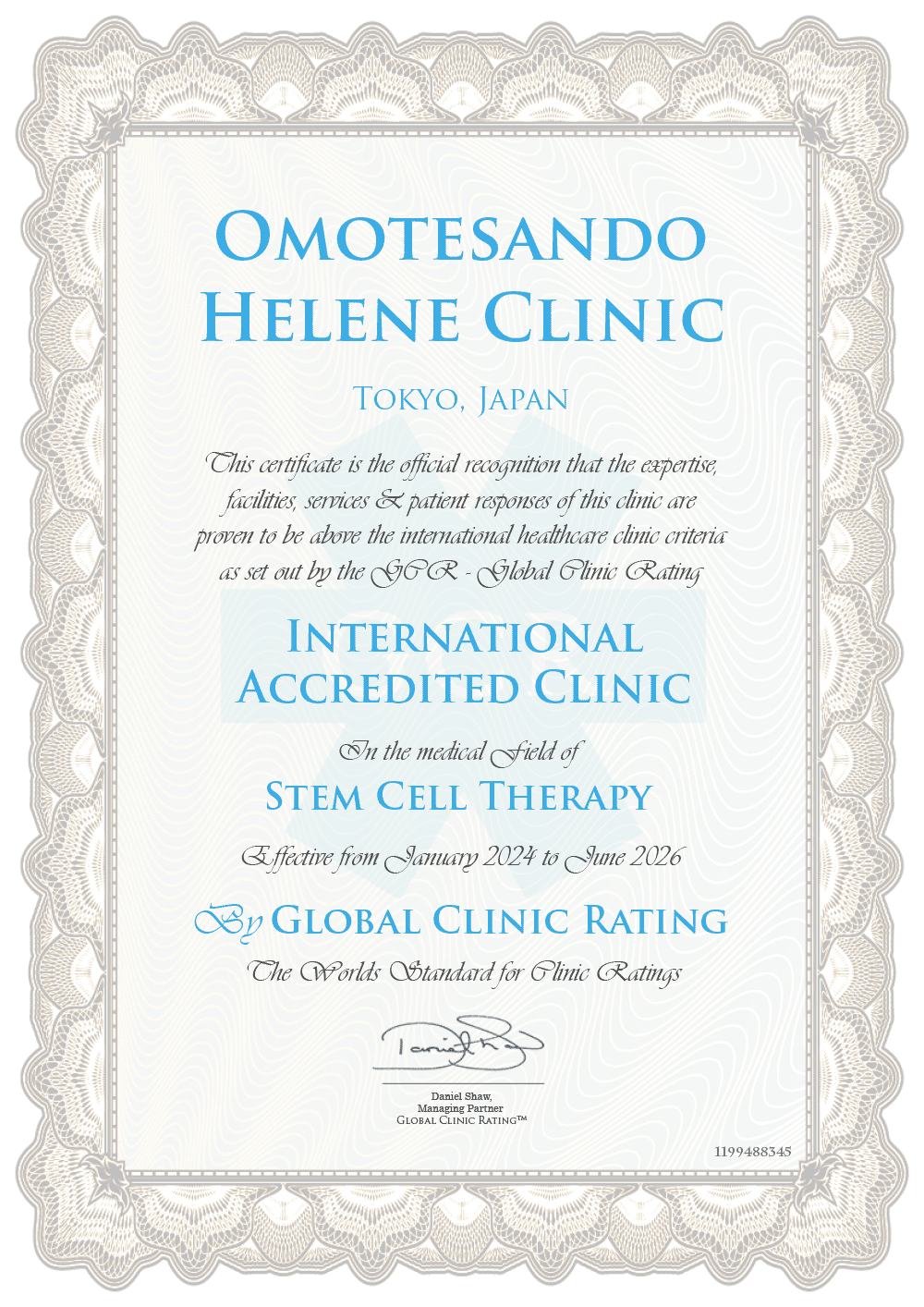
Helene Clinic, Tokyo, Japan — Facility Credentials & Leadership

Regulatory & Quality Assurance
Helene Clinic Certificate
Institutional certification information supporting the clinic's cell processing and clinical governance.

Medical Leadership
Dr. Takaaki Matsuoka
Group CEO and Chief Medical Officer.
04 · Statutory Governance
Why is legal regulation important?
The importance of legal regulation
National healthcare legislation acts as the primary barrier separating evidence-based clinical medicine from unverified experimentation. Globally, regulatory oversight varies dramatically: while some jurisdictions enforce strict pre-approval audits and mandatory adverse-event reporting, others leave cellular interventions in loosely monitored gray zones.
Legal framework for regenerative medicine in Japan
Japan stands out internationally for enacting dedicated legislation—the Act on the Safety of Regenerative Medicine—specifically designed to govern how cellular therapies are reviewed, approved, and delivered. Rather than treating every procedure identically, Japanese law classifies regenerative treatments into risk-based tiers. Before offering a therapy, a medical institution must submit a detailed Regenerative Medicine Provision Plan tailored to the exact clinical objective and risk classification for independent evaluation.
Statutory Accountability
Every authorized regenerative treatment plan in Japan requires certified committee review and ongoing reporting to the Ministry of Health, Labour and Welfare (MHLW).
Physician supervision and continuous legal compliance
Approval in Japan is never a one-time formality. Clinics must maintain active physician oversight, submit periodic safety and administration records to certified regenerative medicine committees, and file mandatory compliance reports with the Ministry of Health, Labour and Welfare (MHLW). This continuous feedback loop ensures accountability throughout the entire clinical lifecycle.
05 · Scientific Progress
Clinical experience and ongoing research
Previous clinical experience and research data
For more than two decades, researchers and clinicians worldwide have investigated stem cell biology across orthopedics, immunology, vascular health, and tissue repair. Decades of peer-reviewed studies and regulated clinical practice have steadily clarified how mesenchymal stem cells and related biologics interact with inflammation, paracrine signaling, and tissue microenvironments.
Research continues to this day
Even with twenty-plus years of accumulated data, regenerative medicine remains an actively evolving scientific discipline. Researchers continue to study long-term durability, optimal dosing intervals, patient-specific responsiveness, and precise cellular mechanisms. Viewing cellular therapy honestly means recognizing both its established operational track record in well-regulated nations like Japan and the ongoing scientific work refining future clinical standards.
06 · Holistic Healthcare Architecture
Safety considerations beyond the procedure itself
Safety of the entire healthcare system
The day of infusion or injection represents only one milestone in a much broader clinical ecosystem. Comprehensive safety encompasses pre-visit diagnostic accuracy, cleanroom governance, physician decision-making, transparent informed consent, structured post-care follow-up, and verifiable legal standing. Patients comparing international options increasingly look past surface marketing to scrutinize the entire healthcare framework standing behind the procedure.
The role of structured clinical assessment
When legally accountable medical institutions pair structured clinical evaluations with transparent laboratory reporting, patients gain clarity instead of uncertainty—turning complex medical decisions into well-informed, collaborative conversations with qualified physicians.
07 · Patient Questions & Answers
FAQ
Click any question below to expand the clinical guidance and explore next-step consultation options.
1. Are stem cell-related approaches considered safe?
Safety in cellular medicine depends on multiple operational safeguards working together: thorough physician screening, sterile cell processing environments, validated quality control testing, and strict compliance with national healthcare laws. When delivered inside a legally regulated clinical system with an established operational track record, risks are systematically minimized.
Request a physician-led safety & eligibility review ?2. Why are legal regulations important in regenerative medicine?
Because cellular therapies involve living biological materials and specialized laboratory preparation, legal regulations establish mandatory standards for plan review, facility hygiene, physician oversight, and safety reporting. Alongside operating under Japan’s statutory framework, HELENE Clinic also submits processed cell samples to independent third-party testing laboratories to verify ongoing consistency and quality.
Ask about third-party quality verification & compliance ?3. Why do some clinics operate in-house CPCs (Cell Processing Centers)?
Operating an on-site Cell Processing Center allows a medical institution to cultivate, test, and prepare cells within a tightly controlled cleanroom environment directly connected to the clinic. HELENE Clinic maintains its own in-house CPC under ISO 9001-compliant quality management, protecting sample integrity and eliminating external transport risks.
Learn more about in-house CPC laboratory standards ?4. How are stem cell-related treatments evaluated on a patient-by-patient basis?
Physicians review each individual’s complete medical history, current physical condition, laboratory biomarkers, and specific clinical goals before recommending any protocol. All treatment decisions are finalized through direct physician consultation within the boundaries of applicable medical regulations.
Submit your medical background for an individualized assessment ?5. Why is Japan often mentioned in relation to the safety of regenerative medicine?
Japan enacted one of the world’s earliest dedicated national laws governing regenerative medicine. Its regulatory architecture mandates formal treatment provision plans, independent committee reviews, direct physician accountability, and continuous reporting to the Ministry of Health, Labour and Welfare (MHLW).
Explore regulated regenerative treatment options in Tokyo ?6. Is research into regenerative medicine still ongoing?
Yes. Scientific and clinical research remains active across numerous medical specialties, focusing on long-term patient outcomes, biological signaling mechanisms, and refined clinical protocols to continually advance evidence-based care.
Speak with a clinical coordinator about evidence-based protocols ?7. What specific quality control tests are checked before cells are administered?
Before clinical release, quality control protocols verify four essential metrics: cell viability (ensuring cells are alive and functional), sterility (screening against bacteria, fungi, and endotoxins), accurate cell count, and surface-marker characterization confirming cellular identity.
Request detailed laboratory QC documentation ?8. What medical records should international patients prepare before a consultation?
Preparing recent blood test results, diagnostic imaging reports, a summary of your diagnosis, and a complete list of current medications or allergies allows the reviewing physician to conduct an accurate preliminary safety evaluation before you book travel.
Get a pre-consultation checklist for your medical records ?9. Does every patient qualify for stem cell therapy after medical screening?
No. A hallmark of ethical, safety-driven clinical practice is declining or postponing treatment when diagnostic findings, active infections, or underlying health factors indicate that cellular therapy is unsuitable or carries elevated risk for a particular patient.
Verify your clinical candidacy with a licensed physician ?10. How is post-treatment follow-up structured after returning home?
Responsible providers establish a structured follow-up schedule prior to discharge, providing complete treatment documentation and remote check-in milestones so physicians can monitor recovery progress and coordinate with your local healthcare team.
Inquire about international patient follow-up protocols ?Take the Next Step Safely
Request a Physician-Reviewed Treatment Plan in Tokyo
True confidence in regenerative care comes from verified laboratory standards, individualized diagnostic screening, and transparent statutory accountability—never guesswork. Share your medical background and therapeutic goals directly with the clinical coordination team to receive an individualized eligibility review, protocol overview, and clear answers regarding your care options for Stem Cell Therapy in Tokyo Japan.
Request Your Personalized Tokyo ConsultationDisclaimer
This article is provided solely for educational and general informational purposes and does not constitute medical advice, clinical diagnosis, or a guarantee of specific therapeutic outcomes. Patient suitability and individual responses vary significantly, and all final medical decisions must be made directly in consultation with a qualified healthcare professional.





























Share this listing