
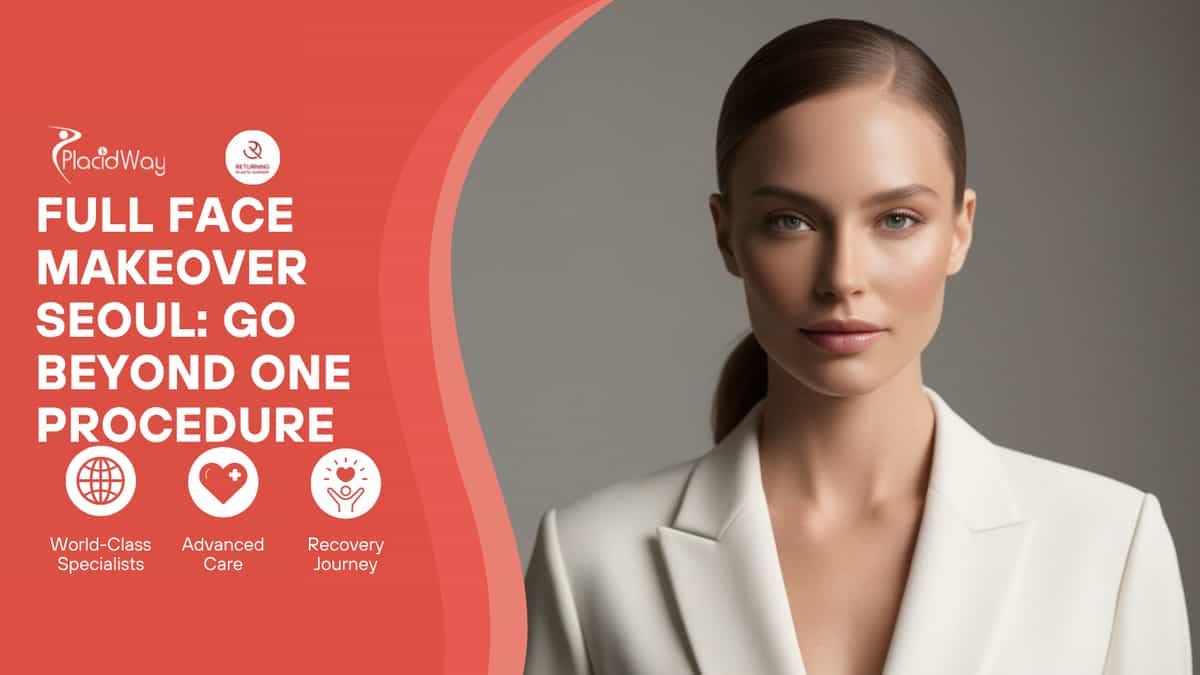
Ready to rediscover a harmonious, refreshed version of yourself in the heart of the world’s plastic surgery capital? This comprehensive full face makeover package in Seoul, South Korea, combines advanced, customized surgical techniques by the specialists at Returning Plastic Surgery to enhance your natural facial architecture. Starting at an estimated $20,000 for a typical 14-day stay, this inclusive plan is tailored for healthy adults seeking a balanced, multi-procedure approach to facial rejuvenation. Please note that your exact eligibility, the specific combination of treatments required, and final pricing can only be determined following a thorough, personalized medical assessment by the surgical team.
Key Insights at a Glance
- Estimated Starting Cost: Packages begin around $20,000, varying widely based on your individualized surgical plan and required techniques.
- Facility Standards: Procedures are performed at Returning Plastic Surgery, a modern facility adhering strictly to the stringent healthcare protocols of South Korea.
- Ideal Patient Profile: Best suited for healthy non-smokers who have realistic goals for comprehensive, multi-zone facial rejuvenation.
- What to Expect: A highly customized multi-procedure approach, which typically combines rhinoplasty, eyelid surgery, fat grafting, or lifting techniques in a single surgical event.
- Travel Commitment: Requires a minimum stay of 10 to 14 days in Seoul to accommodate initial recovery, follow-up evaluations, and stitch removal.
- Mandatory Prerequisites: Strict pre-travel medical clearance, baseline lab testing, and detailed virtual consultations are mandatory prior to booking your trip.
Estimated Costs for Facial Rejuvenation in South Korea
Traveling to South Korea for complex facial surgeries is often more financially accessible than undergoing the same combination of procedures in Western healthcare systems, without compromising on medical expertise or facility standards. Below is a general cost comparison of full face makeover packages across popular medical travel destinations.
| Country | Estimated Starting Price (USD) |
|---|---|
| United States | $45,000 - $65,000+ |
| United Kingdom | $40,000 - $55,000+ |
| Australia | $42,000 - $60,000+ |
| South Korea (Seoul) | Starting from $20,000 |
The following table provides a sample breakdown of how a $20,000 comprehensive package might be structured. Please keep in mind that this is an estimated baseline. Your actual cost will depend strictly on the specific procedures deemed medically appropriate and safe during your in-person consultation.
| Procedure / Service Item | Estimated Cost | Description & Details |
|---|---|---|
| Structural Rhinoplasty | $5,500 | Reshaping of the nasal bridge and tip for enhanced facial harmony. |
| Blepharoplasty (Eyelids) | $3,500 | Correction of upper eyelid hooding and lower eye bag removal. |
| Facial Fat Grafting / SMAS Lift | $8,000 | Volume restoration and deep-tissue lifting for a youthful contour. |
| Anesthesia & Facility Fees | $2,000 | General anesthesia provided by a board-certified anesthesiologist, plus operating room usage. |
| Pre & Post-Op Care Package | $1,000 | Includes preliminary lab work, post-surgery medications, deswelling treatments, and medical translation. |
| Total Estimated Price | $20,000 | Final cost subject to physical assessment and personalized treatment plan. |
What Your Seoul Facial Makeover Package Covers?
To ensure a smooth and stress-free experience, this comprehensive medical package integrates your clinical needs with essential on-the-ground support. Your standard inclusions typically feature:
- All surgeon fees for the agreed-upon facial procedures.
- Fees for the operating theater and clinical facility usage.
- Administration of general or local anesthesia by a licensed specialist.
- Pre-operative medical examinations, including standard blood tests and facial scans.
- Post-operative care kits, including prescription medications, ointments, and recovery garments if needed.
- In-clinic deswelling treatments (such as specialized light therapy) to aid early recovery.
- An assigned in-house English-speaking medical translator for all clinic visits.
- Round-trip airport transfers between Incheon International Airport and your accommodation in Seoul.
What is Not Included in Your Treatment Plan?
While medical expenses and immediate clinical support are covered, patients must plan independently for their broader travel logistics. Exclusions include:
- International airfare to and from South Korea.
- Hotel accommodations for the duration of your stay in Seoul.
- Comprehensive travel and medical complication insurance.
- Daily meals, dining, and general personal expenses.
- Costs associated with extending your stay beyond the planned itinerary.
- Treatments for unrelated, pre-existing medical conditions or unexpected medical emergencies outside the scope of plastic surgery.
Who Should Consider a Complete Facial Makeover in South Korea?
Undergoing multiple facial surgeries simultaneously is a significant medical decision. Ideal candidates are individuals who are fully prepared—both physically and mentally—for a comprehensive transformation. You may be a suitable candidate if you:
- Are a healthy adult with no uncontrolled chronic medical conditions (such as severe hypertension, diabetes, or cardiovascular disease).
- Are a non-smoker, or are willing to completely stop smoking and using nicotine products for several weeks before and after surgery to ensure proper healing.
- Have specific, identifiable concerns regarding facial aging, asymmetry, or structural disproportions (such as sagging jowls, drooping eyelids, or a disproportionate nose).
- Hold realistic expectations about the outcomes, understanding that surgery aims for improvement and harmony, not absolute perfection.
- Have the flexibility to take at least two to three weeks away from work and social obligations to focus entirely on recovery.
Medical Documentation Needed for Your Preliminary Assessment
Before finalizing your travel plans, the surgical team at Returning Plastic Surgery will need to review your basic medical profile to ensure you are a safe candidate. Please be prepared to provide the following:
- Clear, well-lit, high-resolution photographs of your face (front, both profiles, and angled views) without makeup or filters.
- A comprehensive, written medical history detailing past surgeries, hospitalizations, and pre-existing conditions.
- An exhaustive list of all current medications, including prescriptions, over-the-counter drugs, vitamins, and herbal supplements.
- Recent blood test results and, depending on your age and medical history, an EKG (electrocardiogram) report.
- A detailed summary of your specific aesthetic goals and which areas of your face you wish to address.
Step-by-Step Guide to Your Full Face Plastic Surgery
A full face makeover is highly individualized. Rather than being a single, standard operation, it is a choreographed sequence of targeted procedures performed during one surgical session to ensure all facial features remain in harmony. Here is a general overview of how the surgical day progresses:
Step 1: Final Consultation and Surgical Mapping
Before entering the operating room, you will have a final, extensive consultation with your surgeon. They will use specialized markers to draw surgical guidelines directly on your skin, confirming the exact incision points and areas targeted for reshaping or volume enhancement.
Step 2: Administration of Anesthesia
To ensure absolute comfort, a board-certified anesthesiologist will administer either deep intravenous sedation or general anesthesia. Your vital signs will be continuously monitored throughout the entire procedure by a dedicated specialist.
Step 3: Executing the Surgical Plan
The surgical team will execute the procedures in a strategic order. For instance, if you are undergoing a facelift, the surgeon may first lift and tighten the deeper SMAS muscle layers before addressing excess skin. They may then transition to rhinoplasty (reshaping the nasal cartilage and bone) or blepharoplasty (removing excess skin and fat from the eyelids). If fat grafting is included, fat will be harvested from your abdomen or thighs, purified, and carefully injected into areas lacking volume, such as the cheeks or under-eyes.
Step 4: Incision Closure and Immediate Recovery
Once the modifications are complete, the surgeon will meticulously close the incisions using fine sutures to minimize eventual scarring. Dressings, splints, and compression garments will be applied as necessary. You will then be gently moved to a recovery suite where medical staff will monitor you as you wake up from anesthesia.
Your Seoul Medical Travel and Treatment Itinerary
Proper planning is crucial for a stress-free medical journey. While itineraries are tailored to individual healing speeds, a standard 14-day timeline for a full face makeover typically looks like this:
- Pre-Travel: Virtual consultations, medical record review, securing travel dates, and arranging your flights and accommodation in Seoul.
- Day 1 (Arrival): Arrive at Incheon International Airport. Your provided transfer will take you to your hotel to rest and adjust to the time zone.
- Day 2 (Pre-Op Clinic Visit): In-person consultation at Returning Plastic Surgery. You will undergo final blood tests, 3D imaging, EKG, and a detailed discussion of the surgical plan with your doctor.
- Day 3 (Surgery Day): Arrive at the clinic fasting. The surgery will take several hours. Depending on the extent of the procedures, you may stay overnight at the clinic for professional monitoring, or return to your hotel with a caregiver.
- Days 4 to 9 (Active Healing): Rest at your hotel. You will return to the clinic multiple times during this week for check-ups, wound cleaning, and deswelling therapies. Swelling and bruising will peak during these days.
- Days 10 to 14 (Suture Removal & Final Checks): External stitches and splints (like nasal casts) are typically removed. The surgeon will conduct a final evaluation to ensure you are healing correctly.
- Day 15 (Departure): Once you receive final medical clearance from your physician, you are free to fly home.
Recommended Time in Seoul for a Safe Recovery
Patients should not rush the healing process, especially when flying internationally post-surgery. When planning your trip, consider the following regarding your length of stay:
- A minimum stay of 10 to 14 days in Seoul is generally required for a multi-procedure makeover.
- This timeline allows the clinical team to safely remove all non-dissolvable sutures, nasal splints, and drainage tubes.
- Flying too soon can increase the risk of deep vein thrombosis (DVT), exacerbate swelling due to cabin pressure, and complicate wound healing.
- Final travel clearance is solely at the discretion of your treating physician, based on your individual recovery progress.
Navigating the Healing Process After Extensive Facial Surgery
Recovery from a full face makeover demands patience. Because multiple areas of the face are recovering simultaneously, the healing process happens in distinct stages. Proper adherence to aftercare instructions is critical for optimal results.
- Immediate Recovery (Days 1–3): You will experience the most significant discomfort, swelling, and bruising. You must sleep with your head elevated and stick to a soft or liquid diet to minimize facial movement.
- Early Healing (Weeks 1–2): Bruising will begin to change color and fade. Swelling will start to subside, though your face will still feel tight and look puffy. Sutures are removed during this phase.
- Intermediate Healing (1–3 Months): The majority of the visible swelling will resolve. You can usually return to work and social activities with the help of makeup. You will begin to see the newly contoured shape of your face.
- Long-term Healing (Up to 1 Year): Deep tissue healing continues. Minor, unnoticeable residual swelling, particularly in the nasal tip, will slowly dissipate. Scars will soften and fade. It takes a full year to judge the final, settled results.
Understanding the Potential Risks of Multi-Procedure Surgery
All surgical procedures carry inherent risks. Combining surgeries increases the duration under anesthesia and places a higher demand on your body's healing systems. While the team at Returning Plastic Surgery takes every precaution, you must be aware of potential complications. Please note this list is not exhaustive, and your physician will discuss individual risks during your consultation:
- Adverse reactions to general anesthesia.
- Infection at the incision sites or within deep tissues.
- Poor wound healing resulting in prominent, raised, or thickened scarring.
- Facial asymmetry requiring secondary, revisional surgery.
- Temporary or permanent numbness, tingling, or changes in skin sensation due to nerve irritation.
- Prolonged, excessive swelling or hematoma (blood pooling beneath the skin).
Setting Realistic Expectations for Your Transformed Appearance
The primary goal of a comprehensive facial makeover is to restore youthful vitality and create harmonious proportions, rather than entirely altering your identity. Patients typically experience a rejuvenated, refreshed version of themselves. However, it is vital to approach surgery with cautious optimism. Results may vary widely based on your skin elasticity, bone structure, and age. While improvements are often dramatic, the surgical team does not guarantee absolute perfection or the total elimination of all signs of aging. Successful outcomes rely heavily on open communication, realistic goals, and strict compliance with post-operative care instructions.
About Returning Plastic Surgery in Seoul
Returning Plastic Surgery has established a strong presence in Seoul’s competitive healthcare landscape by focusing on bespoke, patient-centric care rather than mass-market procedures. The clinic is tailored to support international patients seeking comprehensive surgical solutions.
- Specialized Expertise: The clinic focuses on complex facial contouring, structural rhinoplasty, and anti-aging lifts, emphasizing natural-looking harmony.
- Board-Certified Professionals: Surgeries are performed exclusively by experienced surgeons holding board certification in South Korea.
- Advanced Safety Protocols: The facility is equipped with modern monitoring systems, 3D diagnostic imaging, and on-site anesthesiologists dedicated to patient safety.
- International Patient Support: Offering dedicated in-house translation services and comprehensive post-operative care programs designed specifically for medical travelers.
Frequently Asked Questions
Is it safe to combine multiple facial surgeries into one operation?
Yes, in the hands of a qualified surgeon, combining procedures like a facelift, eyelid surgery, and rhinoplasty is generally safe and commonly performed. It offers the benefit of a single recovery period and ensures all facial features age and heal in harmony. However, it does require a longer time under anesthesia, which is why rigorous pre-operative health screenings are mandatory.
How painful is the recovery from a full face makeover?
Patients often describe the recovery as more uncomfortable than severely painful. You will experience tightness, pressure, and a feeling of heavy congestion (especially if rhinoplasty is involved). The clinic provides strong prescription pain management medication for the first few days, transitioning to milder painkillers as healing progresses.
Will I be able to eat normally after the surgery?
Not immediately. Due to internal swelling, stitches inside the mouth (if applicable), and general facial stiffness, you will need to follow a strict liquid and soft food diet (soups, smoothies, mashed potatoes) for the first 5 to 7 days. Chewing tough or crunchy foods can strain incisions and disrupt healing.
What happens if there is a language barrier at the clinic?
Returning Plastic Surgery provides dedicated, medically trained English-speaking translators. Your translator will be present during your consultations, on the day of your surgery, and during all post-operative check-ups to ensure you understand every detail of your care.
How soon after surgery can I safely fly back home?
You must wait a minimum of 10 to 14 days before flying. Changes in cabin pressure during flights can cause severe discomfort, increase swelling, or even trigger bleeding in fresh surgical sites. You must receive explicit medical clearance from your surgeon before boarding an aircraft.
Can I explore Seoul while I am recovering?
For the first few days, you should plan to rest strictly in your hotel room. By the second week, short, gentle walks are encouraged to promote healthy blood circulation. However, you must avoid strenuous activity, heavy lifting, and prolonged sun exposure.
When will I look "normal" enough to go out in public?
Most patients feel comfortable running errands or going out in public with the aid of sunglasses and light makeup after about 2 to 3 weeks. However, subtle swelling will still be present, and it will take a few months for your face to settle into its final, natural state.
Where do they take the fat for facial fat grafting?
If your makeover includes fat grafting, the surgeon will typically harvest a small amount of fat using gentle liposuction from an area of your body where it is plentiful, usually the lower abdomen or the inner/outer thighs.
What happens if I require revision surgery?
While the goal is always to get it right the first time, surgical outcomes can occasionally be unpredictable. Clinic policies on revisions vary. Minor adjustments are often performed at a reduced cost or free of surgeon's fees, but you would still be responsible for travel and facility costs. Discuss the specific revision policy thoroughly during your consultation.
Take the Next Step Toward Your Aesthetic Goals
We understand that traveling abroad for comprehensive facial surgery is a major decision. Our team is here to provide transparent, informative guidance with no pressure. Reach out today to schedule a preliminary virtual assessment, share your goals, and receive a customized treatment plan tailored specifically to your anatomy.
Request Free QuoteMedical Disclaimer: The information provided on this page is for general informational and educational purposes only. It does not constitute professional medical advice, diagnosis, or treatment recommendations, and you should always consult directly with a qualified healthcare provider regarding your specific medical conditions and surgical suitability.
References
- MedlinePlus (National Library of Medicine): Facelift (Rhytidectomy) Overview
- Mayo Clinic: Rhinoplasty Risks, Results, and What to Expect
- Centers for Disease Control and Prevention (CDC): Medical Tourism Safety Guidelines
- American Society of Anesthesiologists: Understanding General Anesthesia
- National Institutes of Health (PMC): Complications in Facial Plastic Surgery
















Share this listing