


Are you seeking the highest level of precision for your smile restoration? The computer guided dental implant procedure in Turkey has completely revolutionized how leading oral surgeons approach complex tooth replacement. By utilizing state-of-the-art 3D volumetric imaging and custom-milled surgical stents, top-tier dental clinics can place titanium fixtures with pinpoint millimeter exactness. This ensures maximum long-term stability while completely avoiding the need for extensive mucosal incisions.
This modern, flapless approach not only maximizes patient comfort but also guarantees aesthetic perfection in the highly visible anterior smile zones. The margin for error in these front-facing areas is virtually non-existent, making surgical templates a critical tool for success. Choosing this advanced restorative treatment abroad allows international patients to access world-class dental technology while keeping out-of-pocket expenses exceptionally manageable compared to standard domestic healthcare pricing.
When performed by highly skilled maxillofacial specialists, guided implantology ensures the titanium root is placed at the exact depth and angulation required for optimal biomechanical loading. This comprehensive overview will detail every clinical phase, financial consideration, and restorative benefit associated with undergoing precision dental implant surgery abroad.
Video Chapters & Quick Navigation
- 1. Flapless Dental Implant Procedure Timeline
- 2. Cost of Guided Implant Placement in Turkey
- 3. Benefits of Advanced Guided Implants
- 5. 3D CBCT Scanning & Treatment Planning
- 5. Ideal Candidates for Precision Surgery
- 6. Essential Post-Operative Care Protocols
- 7. Technologies Powering Dental Clinics
- 8. Navigating Your Dental Tourism Journey
1. The Step-by-Step Flapless Dental Implant Procedure Timeline
The clinical journey toward a fully restored arch using digital implantology follows a meticulously planned workflow that entirely eliminates traditional surgical guesswork. The foundational step involves gathering precise anatomical data from the oral cavity using high-resolution intraoral scanners. These digital surface impressions are combined with volumetric bone data to create an exact virtual replica of the patient's dentition.
Specialized dental software merges these overlapping digital files to establish a comprehensive virtual surgical environment. This software empowers the surgical team to simulate the entire operative procedure digitally on a monitor. They can carefully select the most optimal implant diameter, length, and trajectory long before the patient receives any local anesthesia.
Fabricating the Custom Surgical Stent
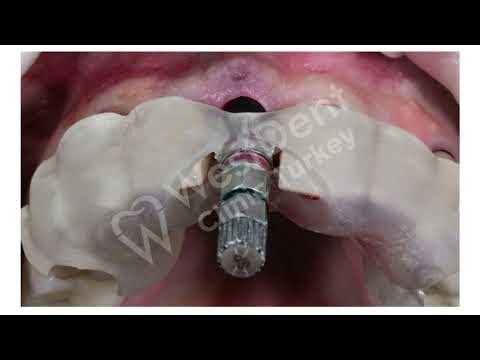
Once the virtual planning phase achieves final approval from the restorative dentist, the digital blueprint is exported to a medical-grade 3D printer. As demonstrated precisely at [00:00], this transparent stereolithographic resin guide is customized to fit intimately over the patient's existing upper teeth. The guide features precisely engineered metallic sleeves that serve as strict physical boundaries for the surgical drills.
This rigid seating mechanism guarantees there is absolutely no deviation from the pre-approved digital treatment plan during the live surgery. The operating surgeon relies entirely on the mechanical restrictions provided by these titanium sleeves. This ensures the osteotomy site is prepared safely without risking adjacent dental roots or critical neurovascular bundles.
Executing the Guided Placement Phase
The actual surgical delivery phase is remarkably swift due to the exhaustive pre-operative virtual preparation. At exactly [00:04], the titanium implant fixture is observed being driven seamlessly through the surgical guide directly into the prepared osseous socket. Because the final depth and three-dimensional angle are mechanically controlled by the stent, the surgeon completely bypasses the need to elevate a mucoperiosteal tissue flap.
This highly advanced, minimally invasive technique drastically reduces the physical trauma inflicted on the delicate gingival tissues. Consequently, the entire surgical intervention for a single guided implant can frequently be finalized in under fifteen minutes. Patients typically leave the clinical setting experiencing remarkably minimal postoperative swelling or discomfort.
2. Cost of Guided Implant Placement in Turkey vs Global Averages
Navigating the financial aspects of full mouth rehabilitations reveals why thousands of international patients travel abroad annually for these complex procedures. The cost of guided implant placement in Turkey remains remarkably competitive despite utilizing the exact same premium European and American dental materials. Patients effectively receive top-tier restorative dentistry at a fraction of standard Western healthcare prices.
In domestic markets like the United States, an individual tooth replacement incorporating guided surgery software, CBCT scans, and a final ceramic crown can easily exceed four thousand dollars. In stark contrast, premier Turkish dental centers bundle these identical clinical services into comprehensive, highly transparent treatment packages. This pricing model completely eliminates the stress of unexpected laboratory or radiological surcharge fees.
| Treatment Phase | Cost in USA (Est.) | Cost in UK (Est.) | Cost in Turkey (Est.) |
|---|---|---|---|
| 3D CBCT Scan & Digital Planning | $350 - $600 | £250 - £400 | Included / $100 |
| Surgical Stent Fabrication | $400 - $800 | £300 - £600 | $150 - $250 |
| Premium Implant Placement (Per Tooth) | $2,000 - $3,500 | £1,800 - £2,500 | $600 - $950 |
Understanding the Price Discrepancy
The significant reduction in overall treatment fees is heavily driven by favorable currency exchange rates and heavily subsidized operational overhead. The best dental clinic in Turkey for implants benefits from government-backed medical tourism incentives that directly lower facility operating costs. These substantial savings are directly passed on to the international patient without ever compromising the strict clinical protocols.
Furthermore, high-volume specialized clinics frequently purchase premium titanium fixtures in massive bulk quantities directly from global manufacturers. This massive purchasing power allows them to offer prestigious implant brands like Nobel Biocare, Straumann, and Osstem at radically discounted rates. Patients receive the exact same lifelong warranty on their fixtures as they would from a local domestic provider.
3. Key Benefits of Choosing Advanced Guided Dental Implants in Izmir
Izmir has rapidly evolved into a global epicenter for highly specialized digital dentistry and full mouth reconstructions. The primary clinical advantage driving this popularity is the unparalleled surgical safety profile offered by computer-guided templates. By meticulously mapping the inferior alveolar nerve in the mandible prior to surgery, the clinician absolutely avoids any risk of iatrogenic nerve damage.
This purely restorative-driven approach guarantees the artificial root is placed in the optimal position to support the future ceramic crown. Traditional freehand surgery occasionally results in implants placed securely in dense bone but angled unfavorably for the final prosthetic attachment. Guided surgery completely eliminates this restorative compromise, ensuring long-term biomechanical harmony.
- Elimination of Surgical Sutures: The strict flapless technique requires no scalpel incisions, meaning absolutely no painful stitches are needed during the recovery phase.
- Preservation of Gingival Architecture: Leaving the mucosal tissues undisturbed perfectly maintains the delicate interdental papilla, ensuring highly natural-looking gums around the new crown.
- Radically Reduced Chair Time: Streamlining the drilling sequence through pre-measured template sleeves allows surgeons to place fixtures in a fraction of traditional operative times.
- Decreased Infection Vulnerability: Minimizing the open wound area inherently reduces the bacterial exposure to the freshly prepared bone socket during the healing phase.
Superior Aesthetic Outcomes in the Smile Zone
Replacing missing central or lateral incisors demands an uncompromising level of precision to achieve a visually undetectable restoration. The "pink aesthetic" refers to the natural scalloping and coloration of the gum tissue immediately surrounding the artificial tooth. Preserving the delicate periosteal blood supply through flapless guided techniques is essential for preventing unsightly gum recession over time.
When the implant emerges through the soft tissue at the exact predetermined angle, the dental technician can design a highly symmetrical zirconia abutment. This customized transition zone prevents the dark metallic shadowing commonly seen with poorly positioned conventional implants. Ultimately, the patient receives a highly aesthetic smile transformation that functions and appears entirely natural.
4. Comprehensive 3D CBCT Scanning and Digital Treatment Planning
Standard two-dimensional panoramic x-rays are inherently insufficient for executing complex, minimally invasive implant surgeries safely. The integration of Cone Beam Computed Tomography (CBCT) provides clinicians with a sub-millimeter accurate, three-dimensional assessment of the patient's entire maxillofacial structure. This crucial radiological data allows the surgical team to precisely calculate the Hounsfield units to determine exact bone density at the planned edentulous site.
Accurate bone density measurements dictate the specific drilling protocols and torque values required to achieve primary mechanical stability. If the cortical bone is exceptionally dense, the surgeon will adjust the preparation to prevent dangerous overheating of the osseous tissue. Conversely, softer medullary bone requires under-preparation to ensure the titanium threads engage securely upon insertion.
Mapping Critical Anatomical Landmarks
The maxillary sinus cavities in the upper jaw and the mental foramen in the lower jaw present significant anatomical challenges during tooth replacement. The digital treatment planning software meticulously highlights these critical boundaries, visually alerting the surgeon to their exact proximity. The virtual implant cylinder is then manipulated safely within the available bone volume to ensure maximum distance from these sensitive structures.
This proactive mapping strategy drastically minimizes postoperative complications such as inadvertent sinus perforations or temporary lip paresthesia. By the time the customized surgical stent is manufactured, every potential anatomical hazard has been thoroughly analyzed and entirely bypassed. The clinician approaches the operative day with absolute confidence in the safety and predictability of the procedure.
5. Ideal Candidates for Precision Dental Implant Surgery Abroad
Determining patient eligibility for flapless guided protocols requires a thorough evaluation of existing bone architecture and overall periodontal health. The most ideal candidates present with sufficient vertical and horizontal bone volume to completely house the titanium fixture without supplementary grafting. These individuals can fully leverage the immediate, minimally invasive benefits of the computer-guided methodology.
Patients seeking highly complex full mouth restorations like All-on-4 or All-on-6 protocols are fundamentally the greatest beneficiaries of this digital workflow. Achieving strict parallelism among four to six separate implants is notoriously difficult with traditional freehand techniques. Guided templates force the implants into the exact required angulations, guaranteeing a perfectly passive fit for the final full-arch zirconia bridge.
Addressing Bone Volume Deficiencies
Individuals suffering from severe maxillary atrophy or long-term missing teeth may require preliminary regenerative procedures prior to receiving their fixtures. Techniques such as lateral window sinus augmentations or autogenous block grafts must frequently heal for six months before guided placement can safely occur. However, minor guided bone regeneration (GBR) can sometimes be performed simultaneously with the template-guided insertion.
A comprehensive digital evaluation will immediately identify whether the patient has the minimal bone dimensions required for a flapless approach. If the bone crest is too narrow, the surgeon may need to intentionally reflect a small tissue flap to visually monitor the thin buccal bone plate during drilling. Regardless of the required approach, the 3D surgical guide remains a vital tool for controlling the final prosthetic positioning.
6. Essential Pre-Operative and Post-Operative Care for Guided Implants
Achieving successful osseointegration heavily depends on strict patient compliance with specialized clinical protocols both before and after the surgical intervention. Pre-operatively, the dental center will typically prescribe a prophylactic dose of broad-spectrum antibiotics to drastically minimize the baseline bacterial load. Patients are also instructed to perform a vigorous chlorhexidine gluconate mouth rinse immediately prior to seating the surgical stent.
Following the completion of the flapless dental implant procedure timeline, the absence of bulky sutures leads many patients to falsely believe they are fully healed. However, the microscopic integration of the titanium threads with the surrounding osteoblasts is a delicate biological process requiring undisturbed healing. Patients must strictly avoid creating any micro-movements of the implant during the initial six weeks of recovery.
- Adhere strictly to a soft mechanical diet: Consume only easily chewable foods to prevent excessive occlusal forces on the healing provisional crowns or healing abutments.
- Eliminate all tobacco consumption: Nicotine acts as a severe peripheral vasoconstrictor, starving the surgical site of crucial oxygen and vastly increasing the risk of early implant failure.
- Maintain diligent oral hygiene: Gently brush the adjacent teeth while utilizing an ultra-soft surgical toothbrush to keep the gingival margins completely free of destructive dental plaque.
- Attend scheduled digital follow-ups: Utilize telemedicine check-ins provided by the clinic to allow the surgical team to monitor the soft tissue maturation remotely.
7. Advanced Technologies Powering Dental Clinics in Turkey
The overarching success of medical tourism in this region is deeply rooted in the rapid, widespread adoption of cutting-edge clinical technology. Leading oral healthcare facilities operate as fully integrated digital ecosystems, combining highly advanced software algorithms with heavy-duty manufacturing hardware. This seamless digital workflow entirely eliminates the compounding human errors traditionally associated with messy analog putty impressions.
Artificial intelligence now plays a massive role in standard implant planning software utilized by top maxillofacial teams. These modern AI algorithms automatically segment the radiological data, instantly isolating the tooth structures, alveolar bone, and critical nerve pathways. This automation drastically accelerates the treatment planning timeline, allowing the specialized surgeon to focus purely on the clinical mechanics of the restoration.
The Integration of In-House CAD/CAM Systems
Possessing an in-house Computer-Aided Design and Computer-Aided Manufacturing (CAD/CAM) laboratory represents a massive logistical advantage for international patients operating on tight travel schedules. Once the intraoral scan is completed, the digital data is instantly routed to a highly precise 5-axis milling machine. These robust machines carve the surgical templates, provisional PMMA crowns, and final monolithic zirconia prosthetics directly from solid material blocks.
This incredible on-site manufacturing capability ensures that adjustments or remakes can be finalized within hours rather than weeks. Patients traveling abroad for immediate load protocols can have their implants placed in the morning and their fixed provisional bridges attached by the late afternoon. This high-speed digital delivery system is the hallmark of modern, premium restorative dentistry.
8. Navigating Your Dental Tourism Journey for Implants in Turkey
Embarking on international travel for complex maxillofacial surgery requires careful logistical coordination and diligent provider research. Prospective patients must prioritize finding highly accredited clinics that strictly adhere to rigorous international sterilization and operational standards. Searching for facilities boasting ISO certifications or Joint Commission International (JCI) accreditations provides an excellent baseline for ensuring superior clinical safety.
Many premium centers dedicated to affordable guided dental implants in Izmir, Istanbul, or Antalya provide comprehensive, concierge-level support systems. These extensive packages meticulously manage every aspect of the patient's journey, from secure VIP airport transfers to comfortable stays in partnered boutique hotels. Having dedicated patient coordinators fluent in your native language completely removes the stress of navigating a foreign medical environment.
Combining Intensive Treatment with a Restorative Vacation
The highly predictable, minimally invasive nature of template-guided surgery makes it exceptionally well-suited for dental tourism. Because the flapless technique generates virtually zero postoperative swelling and minimal localized discomfort, patients rarely require extensive bed rest following the procedure. This rapid physical recovery allows individuals to comfortably explore the rich cultural heritage and stunning coastal scenery of their host city.
Ultimately, choosing to undergo this highly sophisticated digital workflow abroad represents a highly strategic healthcare investment. Patients secure access to the absolute pinnacle of modern implantology, benefit from the hands-on expertise of high-volume surgical specialists, and save thousands of dollars on their comprehensive treatment plan. This seamless combination of world-class technology and luxurious patient care defines the elite standard of global dental tourism.
Ready for Your Precision Smile Restoration?
Take the first step toward a flawless, computer-guided dental implant procedure. Connect with top-rated, internationally accredited specialists and receive a comprehensive, customized treatment plan today.
Get Free QuoteView Video Transcript (Clinical Demonstration)
[00:00] The maxillofacial surgical team firmly seats the custom-milled, transparent resin surgical guide securely over the patient's upper edentulous arch to establish an absolutely immobile physical framework.
[00:02] A rigorous visual and tactile verification is carefully performed to confirm the stereolithographic stent aligns perfectly against the remaining adjacent dentition without exhibiting any unwanted micro-movements.
[00:04] The premium titanium dental implant fixture is meticulously introduced into the sterile surgical field, passing directly through the highly precise, pre-angled metallic cylinder embedded within the resin template.
[00:06] The externally threaded implant is mechanically driven downward into the completely flapless osteotomy site at a heavily monitored, controlled torque velocity, matching the virtual 3D treatment plan exactly.
[00:08] Final optimal seating of the titanium fixture is successfully achieved, securing the immediate primary mechanical stability required for the upcoming restorative prosthetic phase without necessitating any mucosal sutures.




.png)













Share this listing