


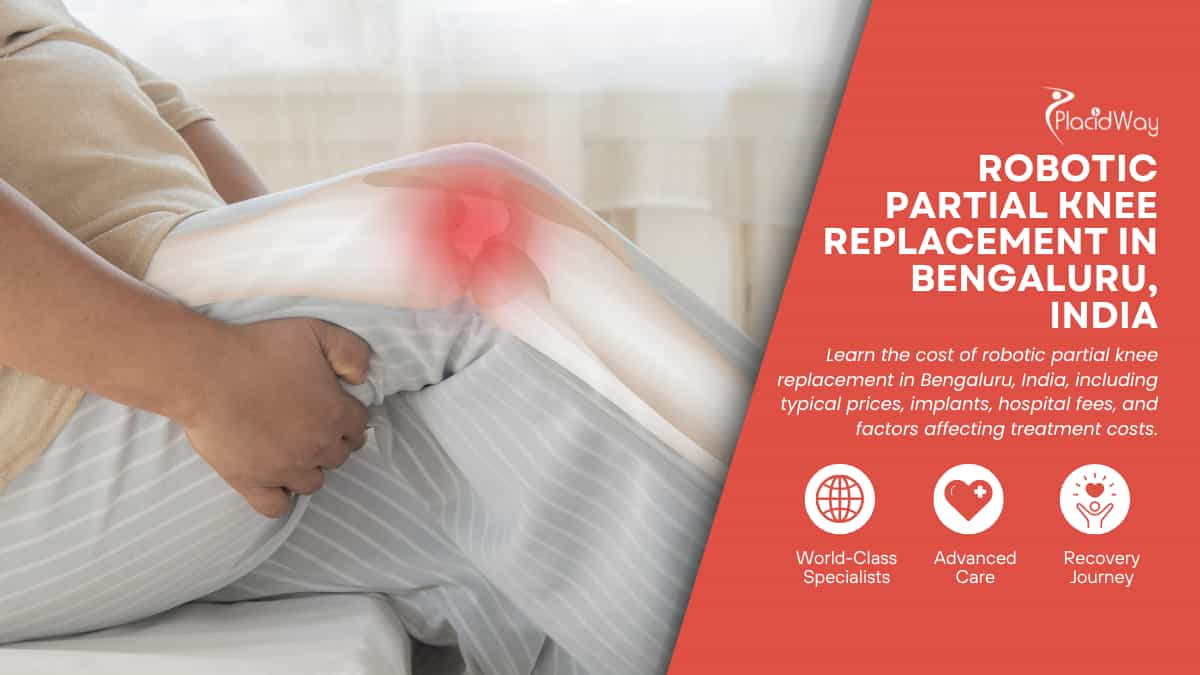
How Much Does Robotic Partial Knee Replacement Cost in Bengaluru?
Key Takeaways
- Robotic-assisted unicompartmental procedures offer enhanced precision compared to traditional manual instruments.
- Total estimated expenses generally cover surgeon fees, operating room charges, and standard hospital stays.
- Patients must plan for a multi-week stay to accommodate initial recovery and travel clearance.
- Continuity of care with a local rehabilitation specialist back home is essential for safe recovery.
How much should you expect to pay for robotic partial knee replacement cost in Bengaluru India?
The estimated financial commitment for robotic partial knee replacement in Bengaluru generally ranges from INR 3,00,000 to INR 5,50,000, depending on the hospital, surgeon’s expertise, implant type, robotic technology, and post-operative care.
When evaluating treatment estimates for robotic partial knee replacement in Bengaluru India, understanding the breakdown of expenses helps prevent unexpected out-of-pocket costs. Comprehensive medical packages frequently bundle surgeon fees, operating room utilization, standard prosthetic components, nursing care, and a three-to-five-night hospital stay. However, preoperative diagnostic imaging, specialized medications, or extended rehabilitation sessions may require separate financial arrangements.
The choice of implant materials and advanced robotic console technology also influences the overall price. High-grade titanium or customized components can alter baseline estimates. It is vital to request an itemized billing statement from your chosen robotic partial knee replacement clinic in Bengaluru India to ensure complete transparency before committing to care.
Regional economic factors and competitive private healthcare structures allow hospitals in Bengaluru to offer advanced surgical care at fractions of Western costs. Even so, clinical quality, sterile operating conditions, and surgeon experience should always take precedence over finding the lowest advertised price.
| Expense Category | Estimated Cost Range (INR) | Included Services & Variables |
|---|---|---|
| Robotic Partial Knee Replacement | ?3,00,000–?5,50,000 | Surgeon fees, anesthesia, hospital stay, implant, and initial post-operative consultations |
| Pre-operative Testing | Additional / varies | X-rays, MRI, consultations, and other diagnostic tests may be separate |
| Rehabilitation & Additional Care | Additional / varies | Physiotherapy, extended care, or unforeseen complications may add to the total |
How does medical tourism in Bengaluru India support orthopedic patients?
The structured ecosystem for international patients provides dedicated coordination, multilingual support, and modern clinical facilities equipped for complex joint reconstruction procedures.
Participating in medical tourism in Bengaluru India offers access to internationally accredited medical centers featuring advanced surgical suites and specialized orthopedic units. Many hospitals maintain partnerships with global healthcare networks, ensuring adherence to strict sterilization and patient safety protocols.
International patient departments help navigate logistical hurdles by managing medical record translations, scheduling consultations, and organizing accessible accommodation near the treatment center. This administrative support reduces the stress of planning major orthopedic surgery abroad.
Nevertheless, you must perform independent research to verify that the chosen facility adheres to rigorous clinical standards. Reviewing institutional accreditations and speaking directly with medical coordinators helps establish transparency before departure.
Always request written confirmation detailing whether your quoted medical package covers unexpected revisions, extended hospital stays, or emergency medication requirements.
Who is an appropriate candidate for a robotic partial knee replacement?
Candidates typically present with osteoarthritis isolated to a single compartment of the knee (medial or lateral), stable ligaments, and minimal knee deformity.
Unlike total knee replacement, a unicompartmental or partial procedure preserves the healthy compartments and cruciate ligaments of the knee joint. This approach is ideal for patients whose joint degeneration is restricted to one area and who have failed conservative measures like physical therapy and injections.
Medical conditions such as inflammatory arthritis, widespread multi-compartmental wear, severe ligamentous laxity, or fixed flexion deformities usually disqualify a patient from partial arthroplasty, steering them toward total knee replacement instead.
A thorough evaluation involving clinical exams and precise imaging scans is required to determine whether your specific wear pattern makes you a suitable candidate for robotic unicompartmental surgery.
What preoperative diagnostics are required before surgery?
Comprehensive diagnostic testing is mandatory to evaluate joint architecture, bone stock quality, and overall physiological fitness for anesthesia.
- Full-length standing X-rays to assess alignment and measure cartilage wear across compartments.
- Specialized CT scans required by robotic software to construct a precise 3D virtual model of the knee.
- Comprehensive blood panels to screen for infection markers, coagulation parameters, and organ function.
- Cardiovascular evaluations, including electrocardiograms, to ensure heart stability under anesthesia.
- Medical clearances from appropriate specialists if you manage chronic conditions like diabetes or hypertension.
What are the potential risks and complications of robotic partial knee procedures?
Like all major orthopedic interventions, joint surgery carries inherent medical risks that require careful monitoring, infection control, and strict adherence to rehabilitation guidelines.
Deep vein thrombosis represents a primary concern, especially when combining major bone surgery with long-distance air travel. Preventative measures, including blood thinners, mechanical compression devices, and early ambulation, are routinely prescribed to minimize vascular complications.
Infection at the surgical site or deep within the joint capsule represents another critical risk requiring prompt antibiotic treatment or secondary intervention. Patients must maintain strict incision hygiene and report unusual swelling, redness, or fever immediately.
Other potential issues include persistent stiffness, component wear, or disease progression in the unreplaced compartments of the knee over time. Selecting an experienced surgeon helps mitigate these mechanical risks.
Robotic platforms use real-time feedback to guide the surgeon, ensuring bone removal matches the exact thickness of the planned prosthetic implant down to fractions of a millimeter.
How should patients plan for post-surgical recovery and travel?
A structured recovery timeline is vital. Medical guidelines strictly prohibit immediate air travel, requiring patients to remain near their surgical center for at least ten to fourteen days.
The initial days post-surgery focus on acute pain management and supervised physical therapy sessions to restore basic knee movement. Once discharged from the hospital, patients transition to a recovery hotel where light exercises continue under professional guidance.
Before boarding a return flight, your operating surgeon must perform a clinical evaluation to provide formal travel clearance. Travelers should request aisle seating to allow leg movement, maintain hydration, and perform gentle seated leg exercises during flight.
Establishing ongoing rehabilitation with a local physical therapist in your home country ensures continuous progress and reduces the likelihood of developing scar tissue or range-of-motion deficits.
What are the requirements for long-term follow-up care?
Long-term success relies heavily on consistent outpatient rehabilitation and periodic radiographic evaluations to monitor implant stability and joint health.
After returning home, you will need to continue physical therapy for several weeks to regain muscle strength and natural gait mechanics. Your local orthopedic specialist should review follow-up X-rays at scheduled intervals, such as at six weeks, three months, and one year postoperatively.
Maintaining transparent communication between your international surgical team and your local healthcare providers ensures that any minor concerns are addressed promptly before developing into more complex issues.
Why Choose PlacidWay?
PlacidWay provides an informative platform designed to help patients research global healthcare providers and compare medical options objectively.
Provider Directories
Access structured databases of international hospitals and specialized orthopedic centers for independent review.
Cost Comparison
Review estimated pricing structures across different global regions to manage healthcare budgets responsibly.
Direct Communication
Connect directly with hospital representatives to ask clinical questions and request detailed treatment estimates.
Accreditation Review
Evaluate facility credentials and safety standards to support informed medical travel decisions.
Educational Resources
Explore guides detailing surgical preparation, recovery timelines, and continuity of care requirements.
Frequently Asked Questions
How does robotic assistance improve partial knee replacement accuracy?
Robotic guidance systems utilize 3D preoperative or intraoperative modeling to help the surgeon map precise bone cuts and align the implant accurately. This technology aims to optimize soft tissue balance and preserve healthy bone stock around the knee joint, though the human surgeon maintains total control throughout the operation.
What factors influence the total price of robotic unicompartmental knee arthroplasty?
The final expense depends on the hospital tier, the specific robotic platform used, the quality and brand of the prosthetic implant, surgeon fees, and the length of your hospital stay. Preoperative diagnostics and required physical therapy sessions also contribute to the overall financial commitment.
Are orthopedic surgeons in Bengaluru experienced with robotic joint procedures?
Many orthopedic specialists practicing in Bengaluru have completed advanced fellowship training in joint arthroplasty and computer-assisted surgery. Patients should verify individual credentials and board certifications through official medical registries before scheduling care.
Can international patients travel safely shortly after robotic knee surgery?
Medical guidelines strictly advise against taking long-haul flights immediately following major joint procedures due to the elevated risk of deep vein thrombosis. Patients typically need to remain near the surgical facility for ten to fourteen days to receive formal travel clearance from their operating surgeon.
What diagnostic imaging is required before scheduling this robotic procedure?
Surgeons typically require high-resolution X-rays and specialized CT scans or MRIs to map the exact geometry of the knee joint. These images help generate the precise 3D virtual model utilized by the robotic navigation system during surgery.
Is physical therapy included in standard hospital packages in Bengaluru?
Initial inpatient physical therapy sessions during your hospital stay are frequently bundled into surgical packages. However, extended outpatient rehabilitation required after discharge usually demands separate financial arrangements, which should be clarified beforehand.
What are the primary clinical benefits of partial over total knee replacement?
Partial knee replacement targets only the damaged compartment of the joint, leaving healthy cartilage and cruciate ligaments intact. This typically results in a smaller incision, less blood loss, quicker early recovery, and a more natural-feeling joint motion compared to total replacement.
What happens if postoperative complications arise after returning home?
You must establish a relationship with a local orthopedic specialist in your home country prior to traveling. Having your complete translated medical records ensures seamless continuity of care if unexpected healing issues or stiffness develop after your return.
Do I need a medical visa to travel for orthopedic treatment in India?
Visa requirements depend entirely on your citizenship and current national entry regulations. Many international patients traveling for planned medical interventions must secure a specific medical visa well in advance of their scheduled hospital admission.
Are robotic arms performing the knee surgery autonomously?
No, the robotic arm is entirely guided and controlled by the human orthopedic surgeon at all times. The system acts as a precise navigational tool to execute pre-planned bone cuts, preventing the surgeon from straying outside predefined safety boundaries.
Compare Treatment Options
Review accredited facilities, compare estimates, and connect with medical providers to make an informed decision regarding your healthcare journey.
Request Treatment InformationReferences
- Understanding Knee Replacement Surgery Cost in Bangalore – Hinduja Sindhi Hospital
- Cost of Robotic Knee Replacement Surgery in Bangalore – Medfin
- Robotic Knee Replacement Cost – Pristyn Care
- Patient Safety and Quality Care – World Health Organization
- International Healthcare Accreditation Standards – ISQua
.png 1x)



.png)
.png)
.png)
.png)





.png)
.png)
.png)


.png)









Share this listing