
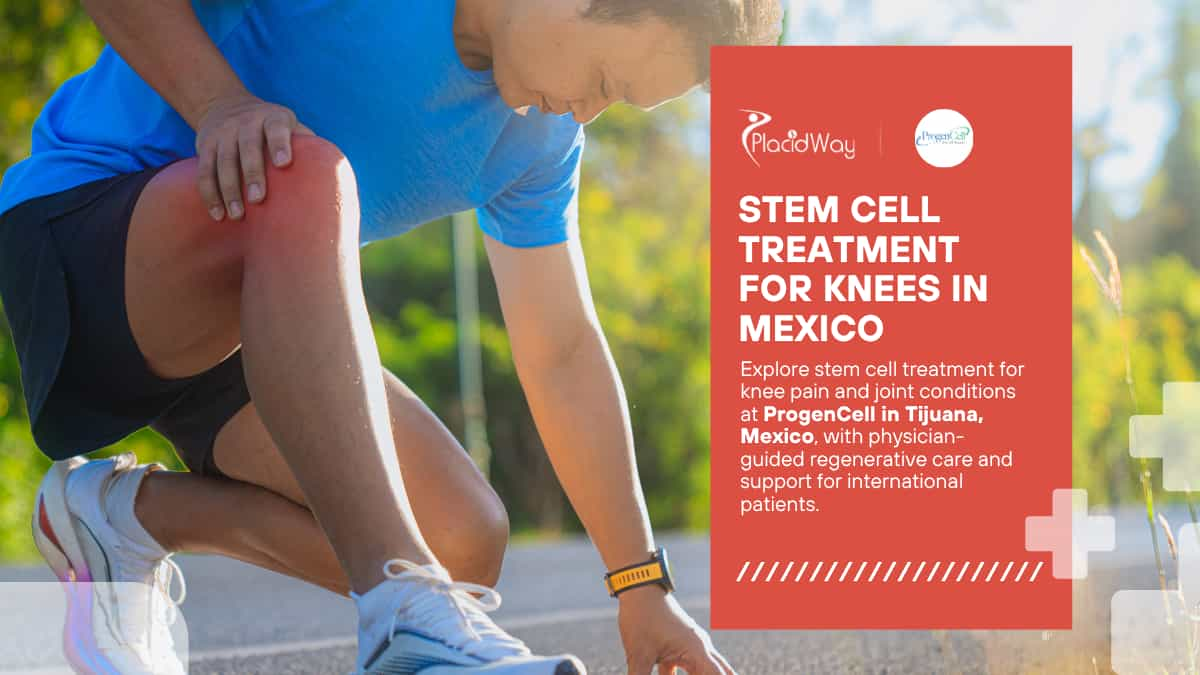
Stem cell treatment for knees in Mexico is presented as a non-surgical option for selected patients with knee pain, arthritis, cartilage changes, or certain injuries. The evidence, regulatory status, cell-processing details, and long-term results require careful review before treatment.
The supplied package lists a starting price of $3,335 USD. This is an initial reference rather than a guaranteed final cost, and medical assessment, testing, treatment design, additional services, and follow-up requirements may affect the total.
Key Insights Before Planning Knee Stem Cell Treatment in Mexico
- The supplied starting price for the ProgenCell package is $3,335 USD; final pricing depends on assessment and package details.
- The package is associated with ProgenCell and lists a location in Tijuana, Mexico.
- Stem cell therapy for knee pain remains an evolving area of medicine, and outcomes are not guaranteed.
- U.S. FDA guidance states that regenerative medicine products are not approved to treat orthopedic conditions such as knee pain or osteoarthritis.
- The package description refers to an autologous approach, but the exact cell source, processing, testing, dose, and injection plan should be confirmed in writing.
- Ask about clinician credentials, facility authorization, itemized costs, exclusions, complication management, and follow-up before payment.
ProgenCell Knee Stem Cell Package in Mexico
This package is associated with ProgenCell in Tijuana, Mexico, inside NewCity Medical Plaza. The package description presents an autologous stem cell approach, meaning cells are described as coming from the patient’s own body.
Before making a treatment decision, confirm the exact cell source, collection process, laboratory handling, dose, injection method, treating clinician, and facility where each part of the treatment takes place.
What Does “Stem Cell Therapy” Mean for the Knee?
Stem cell treatment for knees generally refers to placing cells or cell-containing material into or around a painful knee. The intended purpose may be to influence inflammation, symptoms, or tissue repair, but the exact mechanism and potential benefit depend on the product and diagnosis.
“Stem cell therapy” is not one standardized treatment. Cell source, concentration, processing, delivery method, imaging guidance, and follow-up can vary. A responsible consultation should explain what is known, uncertain, experimental, or unsupported.
Who May Consider Stem Cell Therapy for Knee Pain?
Potential suitability must be decided by the treating clinician after reviewing symptoms, examination findings, imaging, and medical history. The package should not be treated as appropriate for every person with knee pain.
- Adults with persistent knee pain or stiffness affecting daily activity.
- Patients with a documented diagnosis such as osteoarthritis or selected cartilage-related problems.
- People who have discussed exercise, physiotherapy, medication, injections, bracing, and surgical options with a clinician.
- Patients whose general health allows the proposed cell collection, injection, sedation, or related procedures.
- People who understand that improvement may be limited, temporary, or absent.
Patients with infection, uncontrolled illness, suspected cancer, severe deformity, advanced joint damage, or symptoms from the hip or spine may need a different evaluation.
Stem Cell Treatment Cost in Mexico
The supplied starting price for the ProgenCell package is $3,335 USD. This figure should be used for initial planning only. It may not include every test, consultation, medicine, travel service, additional joint, repeat treatment, or complication-related expense.
| Region or Pathway | Cost Planning Basis | What Must Be Compared |
|---|---|---|
| Mexico package | Starting from $3,335 | Cell source, processing, testing, clinician, facility, follow-up, and exclusions. |
| United States | Provider-specific quotation | Regulatory status, clinical-trial pathway, consultation, laboratory, and monitoring costs. |
| Canada | Private or research pathway varies | Eligibility, referral, evidence, travel expenses, and post-treatment care. |
| United Kingdom or Europe | Country and provider specific | Authorization, cell handling, monitoring, insurance, and follow-up arrangements. |
What Should Patients Confirm About the Price?
- Whether the $3,335 figure includes the initial consultation and medical assessment.
- Whether cell collection and processing are included.
- Whether laboratory testing, imaging, medicines, and supplies are included.
- Whether the knee injection procedure and observation are included.
- Whether follow-up visits or remote follow-up are included.
- Whether treatment of both knees or additional joints changes the price.
- What happens financially if treatment is postponed or additional medical care is required.
What May Be Included in the Package?
The following items represent package-planning areas that should be confirmed directly with the provider. They should not be treated as guaranteed inclusions without a current written quotation.
| Package Area | What to Confirm |
|---|---|
| Medical assessment | Review of symptoms, diagnosis, imaging, medical history, and suitability. |
| Cell collection and preparation | Exact collection site, processing method, laboratory handling, testing, and dose. |
| Knee administration | Injection technique, image guidance, anesthesia or sedation, and observation. |
| Aftercare | Activity instructions, medicines, warning signs, and follow-up schedule. |
| International patient support | Communication, appointment coordination, transportation, and other travel assistance if offered. |
What Is Usually Excluded?
- Flights, accommodation, meals, local transportation, and companion expenses.
- Additional imaging, laboratory testing, or specialist clearance.
- Treatment of unrelated medical conditions.
- Repeat injections, treatment of both knees, or additional joints.
- Physiotherapy, braces, medicines, or equipment after returning home.
- Emergency treatment, hospital admission, or management of complications unless specifically stated.
- Revision surgery or future knee replacement.
- Travel insurance and medical evacuation.
Medical Records Needed for Knee Stem Cell Assessment
Providing complete medical records can help the treating team assess the diagnosis, previous treatment, and whether the proposed procedure is appropriate.
- Recent knee X-rays, MRI images, and radiology reports.
- Diagnosis, symptom duration, pain location, and activity limitations.
- Details of previous physiotherapy, medicines, injections, bracing, or surgery.
- Current medicines, allergies, and known medical conditions.
- History of infection, cancer, immune disorders, blood clots, or bleeding problems.
- Recent blood tests or medical clearance if requested.
- Information about smoking, diabetes, weight changes, and mobility.
How Knee Stem Cell Treatment May Be Performed
The exact process depends on the cell source, preparation method, clinical protocol, and patient assessment. If an autologous approach is used, the cells or cell-containing material are described as coming from the patient.
| Stage | What May Happen | What to Confirm |
|---|---|---|
| Medical review | The clinician reviews the diagnosis, imaging, health history, and treatment goals. | Is the proposed treatment appropriate for the specific diagnosis? |
| Consent discussion | The team explains the proposed cells, evidence, uncertainties, risks, alternatives, and follow-up. | What outcomes are realistic and what remains uncertain? |
| Pre-treatment testing | Blood tests, imaging, or other clearance may be requested. | Which tests are required and are they included? |
| Cell collection | If an autologous approach is used, cells may be collected from the patient. | What is the collection site and anesthesia plan? |
| Preparation | The collected material may be processed before administration. | How is it processed, tested, labeled, and handled? |
| Knee administration | The prepared material is delivered into the knee using the selected technique. | Is imaging guidance used and what is the observation period? |
| Aftercare | The team provides activity, medicine, warning-sign, and follow-up instructions. | Who manages follow-up after returning home? |
Treatment Timeline Before and After Travel
| Stage | Typical Planning Activity |
|---|---|
| Before booking | Send records, clarify diagnosis, ask about evidence and alternatives, and request the itemized quote. |
| Before travel | Confirm clinician, facility, cell source, processing, testing, consent, payment, and emergency contacts. |
| Arrival in Mexico | Complete consultation and any tests; treatment may be postponed if findings change the risk assessment. |
| Treatment day | Undergo collection or injection as planned, followed by observation and discharge instructions. |
| Early follow-up | Report symptoms, follow activity guidance, and attend the planned review. |
| Return home | Travel only after clinician-led clearance and arrange local follow-up. |
How Long Should You Stay in Mexico?
Some knee stem cell procedures may be scheduled on an outpatient basis, but the total trip can include consultation, testing, treatment, observation, and early follow-up. The treating clinician—not a travel schedule—should decide when you are fit to leave.
- Keep extra time available if testing or clinical review changes the plan.
- Arrange comfortable transportation and accommodation with minimal walking.
- Ask whether a companion is recommended.
- Confirm the best method of travel after treatment.
- Carry treatment records, medicines, imaging, and emergency contact details.
Recovery and Aftercare After Knee Cell Therapy
Temporary soreness, swelling, or activity limitations may occur after collection or injection. Follow the treating clinician’s instructions about walking, exercise, ice or heat, medicines, and when to resume normal activity.
Do not assume that a minimally invasive procedure requires no recovery. The knee may need protected activity, gradual rehabilitation, and monitoring. If pain worsens instead of improving, contact the provider or a local clinician.
Risks and Possible Complications
This list is not exhaustive. The clinician should explain risks specific to the cell product, collection method, injection technique, and your medical history.
- Pain, swelling, bruising, or temporary stiffness.
- Infection at the collection or injection site.
- Bleeding or injury to nearby nerves, vessels, or tissues.
- Adverse reaction, inflammatory response, or immune reaction.
- Blood clots or complications associated with travel.
- No improvement, short-lived improvement, or worsening symptoms.
- Delay of treatments with more established indications.
- Unclear long-term effects when a product or protocol is investigational.
- Additional costs if further treatment or hospital care is needed.
Expected Results and Evidence Limitations
Pain or function may improve in some patients, but response varies. Any improvement may also reflect rehabilitation or natural symptom fluctuation, and stem cell treatment should not be presented as proven cartilage regeneration.
- It may not correct severe joint narrowing, deformity, instability, or mechanical locking.
- It may not prevent a future knee replacement.
- No specific success rate should be promised without a defined study population, protocol, timeframe, and outcome measure.
- Long-term benefits and structural changes remain areas of ongoing research.
Ask for published evidence matching your diagnosis and the exact product being offered. Also ask whether the treatment is part of an approved clinical trial or another regulated pathway.
Questions to Ask About Evidence
- What exact cell product is being administered?
- What clinical studies support its use for my diagnosis?
- Were the studies performed using the same cell source and processing method?
- What outcomes were measured and for how long?
- Is the treatment approved, investigational, or part of a clinical trial?
- What alternatives have stronger evidence for my condition?
ProgenCell Medical Center Information
The package identifies ProgenCell as the associated center and lists a location at Paseo del Centenario 9580-2802, NewCity Medical Plaza, Piso 28, Zona Urbana Río Tijuana, 22010 Tijuana, Baja California, Mexico.
Before treatment, verify the facility’s legal name, address, local authorization, laboratory arrangements, infection-control procedures, emergency pathway, and clinician licensing. Confirm whether the listed address is used for consultation, laboratory work, treatment, or more than one service.
ProgenCell is responsible for clinical care; a medical-travel platform may help coordinate information and communication. Confirm clinical questions directly with the treating team.
Facility Verification Checklist
- Exact legal facility name and current address.
- Current local authorization and licensing information.
- Clinician credentials and professional registration.
- Laboratory location and cell-processing arrangements.
- Infection-control procedures.
- Emergency and complication-management pathway.
- Follow-up arrangements after returning home.
Frequently Asked Questions About Knee Stem Cell Therapy
What is the starting price for ProgenCell knee stem cell treatment in Mexico?
Is knee stem cell treatment approved for osteoarthritis?
What type of cells are used for this knee treatment?
Who may be considered for knee stem cell therapy?
Can stem cell therapy regrow damaged knee cartilage?
How long does knee stem cell treatment take?
What are the possible risks of knee stem cell injections?
How long should I stay in Mexico after treatment?
What should I ask ProgenCell before paying?
What alternatives should I discuss before knee stem cell therapy?
References
- FDA: Regenerative Medicine Consumer Alert
- AAOS: Stem Cells in Orthopaedics
- Cochrane Review: Knee Stem Cell Injections
- CDC: Medical Tourism
- MedlinePlus: Knee Pain
Medical Disclaimer
This content is for general informational and educational purposes only and does not replace advice from a qualified medical professional. Eligibility, regulatory status, pricing, treatment details, and travel clearance must be confirmed directly with the treating team.




























Share this listing