
Patient Profile
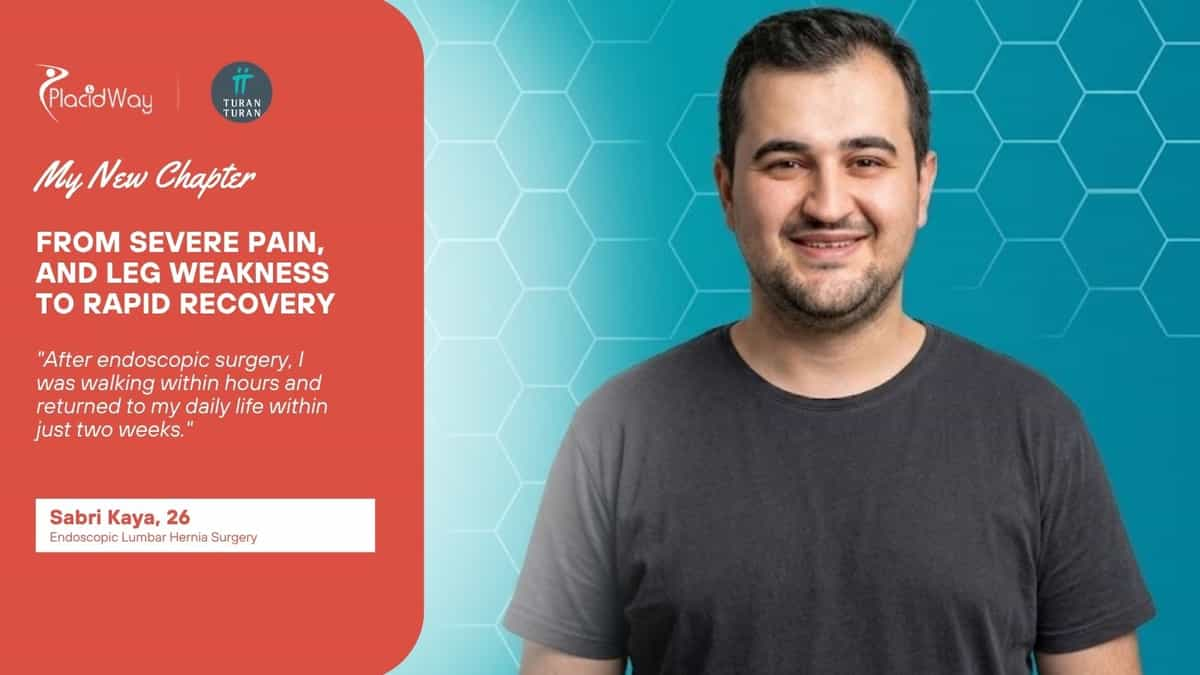
◉ Name: Sabri Kaya
◉ Age: 26
◉ Location: Canakkale, Turkey
◉ Condition: Lumbar hernia with severe leg numbness and motor weakness
◉ Treatment: Endoscopic Lumbar Hernia Surgery
◉ Destination: Istanbul, Turkey
◉ Provider: Turan Turan Health Group
Journey at a Glance
◉ Main Symptoms: Acute lower back pain radiating into the right leg, severe weakness, and loss of sensation.
◉ Mobility: Inability to walk comfortably or ascend stairs safely.
◉ Work Impact: Major operational disruption to his demanding schedule as a physician.
◉ Treatment Choice: Advanced minimally invasive endoscopic spine procedure.
◉ Return to Routine: Full resumption of normal daily activity in under two weeks.
The Unseen Strain: A Young Physician Facing Sudden Physical Crisis
Sabri Kaya was no stranger to physical endurance.
At 26 years old, living in the coastal city of Canakkale, Turkey, Sabri was building the foundational years of his medical career as a dedicated assistant doctor. Long shifts, extended rounds, and grueling hours standing in clinics were simply part of his daily life.
When mild lower back discomfort began creeping in over a month ago, Sabri brushed it aside.
Like many medical professionals focused entirely on patient care, he minimized his own symptoms.
He attributed the subtle ache to fatigue, heavy workloads, and the relentless physical toll of hospital duty.
"For the past month, I had occasionally experienced very mild pain, but I honestly attributed it to my heavy workload. I didn't think I had a true health problem."
Ignored warnings often escalate into emergencies.
Without warning, what began as a dull, tolerable ache suddenly transformed into an agonizing physical barrier.
Just two days prior to seeking specialized care, an acute flare-up struck Sabri with shocking intensity.
The discomfort was no longer confined to his lower spine.
It shot down his right leg like an electrical current, taking away his strength and leaving behind a cold, persistent numbness.
When Walking Becomes an Obstacle: Recognizing Neurological Compromise
For a young professional whose work depends on mobility, the sudden loss of leg function was alarming.
Sabri found himself unable to walk with a normal gait.
Simple movements, like stepping across a hallway or navigating hospital corridors, required immense concentration and effort.
Stairs presented an even greater challenge.
Every step upward felt unstable, as his right leg struggled to bear his weight.
The nerve compression had progressed from simple localized discomfort to active neurological deficit.
Key Clinical Indicators Experienced by Sabri Kaya:
-
Sudden onset of severe, debilitating lower back radiating pain.
-
Progressive neurological deficit including numbness down the right lower extremity.
-
Significant motor strength reduction causing instability during gait and stair climbing.
-
Inability to perform routine clinical duty due to biomechanical impairment.
As a medical professional, Sabri understood the physiological reality behind these symptoms.
Numbness and loss of motor strength indicated direct mechanical pressure on the spinal nerve roots.
This was no longer a simple muscle strain that rest could fix.
It was a clear sign of severe disc herniation demanding immediate medical evaluation.
Seeking Medical Insight: The Path to Expert Evaluation
Navigating a personal health crisis requires trust and clear guidance.
Sabri turned to those closest to him within the medical community.
His wife, a clinical physiotherapist, was the first to review his rapidly worsening condition.
Together with colleagues in Physical Therapy and Orthopedics, they analyzed the clinical picture.
The clinical signs pointed consistently toward advanced lumbar disc displacement.
Recognizing the urgency, Sabri arranged for an immediate Magnetic Resonance Imaging (MRI) scan.
The diagnostic images revealed a significant herniated disc compressing the spinal nerve root.
With MRI in hand, Sabri sought out specialized care for Lumbar Hernia Surgery in Istanbul Turkey.
His wife recommended Dr. Yunus and the clinical team at Turan Turan Health Group.
Known for their work in advanced minimally invasive spinal procedures, the group offered the precise expertise Sabri needed.
"My wife already knew Dr. Yunus, and since she was familiar with Turan Turan, I had an MRI scan and sent the images directly to him. When we arrived in Istanbul, we met face-to-face for a clinical examination."
Physical Examination Over Imaging: A Precise Clinical Diagnosis
Sabri traveled from Canakkale to Istanbul for his face-to-face evaluation.
In modern spinal care, advanced imaging is vital, but clinical presentation always leads the way.
During the consultation, Dr. Yunus conducted a thorough physical and neurological assessment.
He carefully evaluated Sabri’s reflexes, motor strength, sensation patterns, and functional movement.
The clinical finding was clear: the nerve root compression was causing progressive motor weakness.
Relying solely on conservative management carried a risk of long-term nerve damage.
Dr. Yunus explained that prompt surgical intervention was necessary to decompress the trapped nerve root and restore full function.
However, traditional open spine surgery comes with significant tissue disruption and extended recovery periods.
For a young physician needing to return to clinical work, open surgery posed major downtime.
Dr. Yunus recommended state-of-the-art Endoscopic Spine Surgery in Istanbul Turkey.
Understanding Endoscopic Spine Surgery vs. Traditional Open Surgery
Minimally invasive spinal techniques have transformed modern spine care.
Unlike traditional open surgery—which requires large incisions, muscle stripping, and structural bone removal—endoscopic procedures utilize ultra-small access channels.
A miniature camera (endoscope) and micro-instruments are guided directly to the herniated disc material under high-definition visualization.
This allows the surgeon to selectively remove only the ruptured fragment pressing against the nerve, leaving surrounding muscles, ligaments, and healthy tissue intact.
Comparative Advantages of Endoscopic Spine Decompression:
1. Preservation of Structural Integrity: No extensive muscle tearing or major bone resection required.
2. Minimal Surgical Trauma: Involves a tiny incision often measuring less than one centimeter.
3. Reduced Post-Operative Pain: Minimal disruption to surrounding tissues significantly lowers discomfort.
4. Same-Day Discharge potential: Patients frequently mobilize within hours and return home the same day.
5. Rapid Return to Work: Functional recovery occurs in days rather than months.
Sabri recognized the clear medical advantages of this modern approach.
"With endoscopic procedures, the patient's return to normal life and overall comfort are at a much higher level. Open surgeries involve a longer recovery period, affect body integrity, and slow down your return to routine."
Clear communication and technical expertise gave Sabri complete peace of mind.
He entered the surgical suite confident in his care team and the treatment plan.
The Surgical Experience: Seamless Decompression Under General Anesthesia
On the day of the procedure at Turan Turan Health Group, everything moved efficiently.
The medical team prepared Sabri for endoscopic decompression under general anesthesia.
For Sabri, the surgical experience felt remarkably swift and straightforward.
He drifted off to sleep, and before he knew it, he awoke comfortably in the recovery room.
Using endoscopic guidance, Dr. Yunus created a tiny entry point, gently passed between muscle fibers, and targeted the herniated fragment compressing the lumbar nerve root.
The offending disc material was carefully removed, immediately relieving pressure on the nerve.
The entire operation was completed with minimal blood loss and zero unnecessary trauma.
The incision was so small it required only a single, tiny suture to close.
"It was a very comfortable process for me. I went in, was placed under general anesthesia, went to sleep, and woke up. When I first came out of surgery, I genuinely felt relieved. I did not feel any pain at all."
Immediate Mobilization: Walking Four Hours After Surgery
The true benchmark of successful endoscopic decompression is immediate functional recovery.
In traditional open spine operations, patients often face days of bed rest and significant incision pain.
With endoscopic decompression, mobilization begins almost right away.
Just four hours after waking up from anesthesia, Sabri was assisted to his feet.
To his amazement, he stood straight, took a step forward, and walked down the hospital hallway under his own power.
The agonizing leg pain that had restricted his movement days earlier was gone.
His motor control was restored, and his gait felt stable once again.
After a short observation period of two hours to ensure stable vital signs and smooth mobilization, Sabri was cleared for discharge.
He left the hospital on the very same day his surgery was performed.
Sabri’s Post-Operative Timeline:
Hour 0: Successful completion of endoscopic lumbar decompression under general anesthesia.
Hour 4: First unassisted ambulatory walking along hospital corridors with zero procedural pain.
Hour 6: Final post-operative evaluation and official same-day hospital discharge.
Day 1-3: Mild resting at home, followed by daily walks to rebuild stamina.
Day 7: Full resumption of normal light daily household activities.
Day 14: Complete clearance for full return to demanding medical practice and long walks.
Micro-Incision Care and Rapid Healing
Upon returning home, Sabri experienced a smooth, comfortable recovery.
The single stitch and tiny portal incision—measuring roughly the size of a fingernail—healed cleanly without complications.
Because the incision was so small, the risk of tissue infection or post-surgical wound issues was remarkably low.
Sabri didn't need heavy pain medications or prolonged rest.
Instead, he focused on gentle daily walking, gradually increasing his movement over the following days.
"I had only one stitch, and the incision was tiny—about the size of my little fingernail. It was not a wound susceptible to infection. Within a week, I was back to my routine, and I return to hospital duty on Monday."
Within two weeks of undergoing advanced Lumbar Hernia Treatment in Istanbul Turkey, Sabri was cleared to return to his active life and demanding medical schedule.
For a physician who depends on physical stamina, this rapid outcome was life-changing.
Why Istanbul Has Become a Global Center for Minimally Invasive Spine Care
Sabri Kaya’s story reflects a growing international trend.
Every year, thousands of patients seek advanced spine care and specialized procedures in Turkey.
Istanbul has emerged as a premier hub for complex spine surgeries, offering world-class technology and highly experienced clinical specialists.
Centers like Turan Turan Health Group combine state-of-the-art diagnostic imaging, modern surgical suites, and advanced endoscopic capabilities to deliver exceptional patient outcomes.
Key Highlights of Medical Excellence in Turkey:
-
Expert Surgical Teams: Fellowship-trained orthopaedic and neurosurgical spine specialists with extensive endoscopic experience.
-
Advanced Medical Facilities: JCI-accredited surgical suites equipped with high-definition endoscopic platforms.
-
Comprehensive Patient Support: Multilingual medical coordination, seamless consultations, and structured post-operative care.
-
Efficient Care Timelines: Minimal waiting periods from initial consultation to definitive treatment and discharge.
A Physician’s Final Advice: Do Not Suffer in Silence
Reflecting on his journey from sudden disability back to full health, Sabri offers clear advice to anyone struggling with spinal conditions.
Fear of traditional, open surgery often causes patients to delay necessary care, living with avoidable pain and risking permanent nerve damage.
Sabri emphasizes that modern, endoscopic options make spine surgery safe, effective, and minimally disruptive.
"Patients should have no reservations about this. When surgery is indicated, it is a very safe option. If your symptoms have not improved with conservative treatments and surgery is recommended, you should definitely move forward with confidence."
Thanks to expert clinical evaluation, precise surgical execution, and modern endoscopic technology, Sabri regained his quality of life, his mobility, and his career.
Overcome Severe Back Pain and Regain Your Active Life
If you are suffering from severe sciatica, leg weakness, or herniated disc symptoms, discover how advanced Endoscopic Spine Surgery in Istanbul Turkey at Turan Turan Health Group can restore your mobility with minimal downtime.
Request a Free Medical Consultation TodayMedical Disclaimer: The content provided in this article is for informational and educational purposes only and does not constitute formal medical advice, diagnosis, or treatment. Patient outcomes may vary based on individual physical health, clinical condition, and surgeon evaluation. Always consult a qualified physician or spine specialist to determine the appropriate treatment plan for your condition.


















Share this listing