
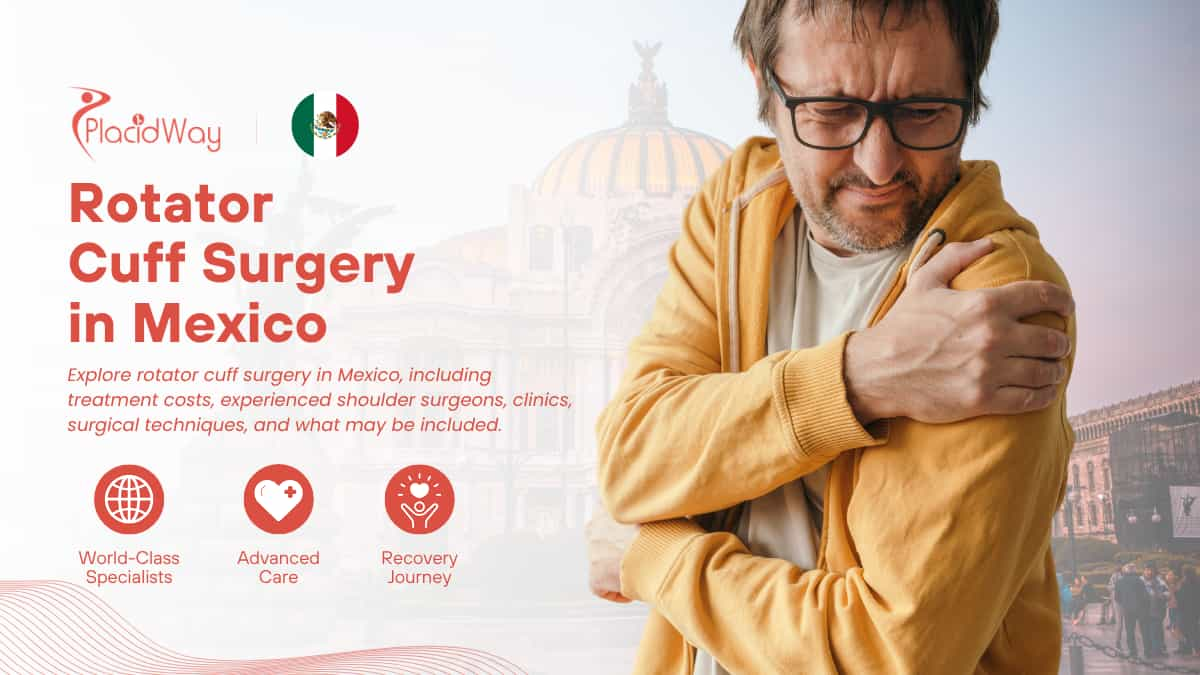
Rotator cuff surgery in Mexico is an option that some international patients research when comparing orthopedic treatment, procedure costs, and specialist availability. This guide explains rotator cuff repair, current published Mexico pricing, treatment approaches, clinic selection, recovery, and the questions patients should ask before scheduling surgery.
Quick Summary
- Rotator cuff surgery in Mexico is an option for patients comparing international orthopedic treatment and private-pay costs.
- PlacidWay's current pricing data lists an average of approximately $9,200 USD, with a displayed range of $8,900–$9,500 USD for rotator cuff repair in Mexico.
- Actual costs vary based on tear severity, surgical technique, surgeon, hospital, anesthesia, suture anchors or implants, hospital stay, diagnostics, and rehabilitation.
- Common surgical approaches include arthroscopic, open, and mini-open rotator cuff repair.
- Mexican providers offering rotator cuff treatment can be found in cities including Tijuana, Mexico City, and Guadalajara.
- Patients should compare the complete treatment cost, rather than relying only on the advertised surgical price.
- Additional expenses may include flights, accommodation, transportation, medications, physiotherapy, and treatment of complications.
- Recovery generally takes several months, with rehabilitation progressing gradually from protecting the repair to restoring movement and strength.
- International patients should establish their post-operative rehabilitation and follow-up plan before travelling.
- Before booking, verify the orthopedic surgeon's credentials, shoulder and rotator cuff experience, hospital or facility, procedure details, price inclusions, and complication policy.
- The decision to undergo surgery should be based on an individual medical evaluation, rather than cost alone.
What Is Rotator Cuff Surgery?
The rotator cuff is a group of four muscles and their tendons that help stabilize the shoulder and allow movements such as lifting and rotating the arm. A tear can develop from an acute injury, repetitive use, age-related tendon changes, or a combination of these factors.
Rotator cuff surgery is generally intended to repair a torn tendon when surgery is considered appropriate. Depending on the tear and the patient's circumstances, treatment may involve arthroscopic repair, open repair, or a mini-open technique.
During a typical repair, the surgeon reattaches the torn tendon to the bone, commonly using sutures and fixation devices such as suture anchors. The exact technique depends on the location and size of the tear, tendon quality, associated shoulder problems, and the surgeon's assessment.
When Is Rotator Cuff Surgery Considered?
Not every rotator cuff tear requires surgery. Treatment decisions depend on factors such as the severity and type of tear, symptoms, functional limitations, age, activity requirements, previous treatment, tendon condition, and overall health.
A specialist may initially recommend non-surgical management for some patients. Depending on the diagnosis, this can involve activity modification, medication when appropriate, physical therapy, and other conservative measures.
Surgery may be considered in selected patients when symptoms and functional limitations persist or when the characteristics of the tear make operative treatment appropriate. A physical examination and imaging—often including MRI or ultrasound depending on the clinical situation—can help the orthopedic specialist assess the injury.
Common Symptoms of a Rotator Cuff Tear
Symptoms vary according to the type and severity of the injury. Common complaints can include:
- Shoulder pain, particularly when lifting or reaching.
- Pain that may become noticeable at night.
- Weakness when raising or rotating the arm.
- Difficulty performing everyday activities.
- Reduced shoulder range of motion.
- Pain or weakness following an acute shoulder injury.
Symptoms alone cannot determine whether a tendon is torn or whether surgery is required. An orthopedic assessment is needed to establish the diagnosis and appropriate treatment.
How Rotator Cuff Tears Are Diagnosed
| Evaluation | Purpose |
|---|---|
| Medical history | Reviews how the injury occurred, symptoms, previous treatment, and functional limitations. |
| Physical examination | Assesses shoulder movement, strength, pain, and stability. |
| X-ray | Can help evaluate bones and other structural changes but does not directly show the rotator cuff tendon. |
| Ultrasound | Can be used to evaluate rotator cuff tendons dynamically. |
| MRI | Can provide detailed information about tendon tears and associated shoulder structures. |
Types of Rotator Cuff Surgery
Arthroscopic Rotator Cuff Repair
Arthroscopic repair uses a camera and specialized instruments inserted through small incisions around the shoulder. The surgeon evaluates the joint and repairs the torn tendon using appropriate fixation techniques.
Current Mexican providers advertise arthroscopic rotator cuff repair as an available treatment approach. For example, Russald Medical Center in Tijuana describes arthroscopic repair using suture anchors and reports a procedure time of approximately one to two hours on its current patient information page. :contentReference[oaicite:3]{index=3}
Open Rotator Cuff Repair
Open repair uses a larger incision to provide direct access to the affected tendon. It may be considered for particular tears or clinical circumstances based on the surgeon's assessment.
Current Mexican provider listings also show open rotator cuff repair as an available procedure. One Guadalajara orthopedic surgeon currently lists open rotator cuff repair from MXN 45,000, although the provider's published price should not be interpreted as a complete national Mexico price. :contentReference[oaicite:4]{index=4}
Mini-Open Repair
A mini-open approach combines elements of arthroscopic assessment with a smaller open incision for the repair. The appropriate surgical technique depends on the tear and the surgeon's treatment plan.
A Mexican cost-result study involving 113 patients found that direct costs varied between techniques, particularly when implants such as anchors were used. Because the study is not a current medical-tourism price survey, its historical costs should not be used as today's patient quote; its findings are useful mainly for illustrating how surgical technique and materials can affect total treatment cost. :contentReference[oaicite:5]{index=5}
Arthroscopic vs. Open Rotator Cuff Repair
| Feature | Arthroscopic | Open / Mini-Open |
|---|---|---|
| Incisions | Usually several small incisions. | Uses a larger incision for direct access in open repair; mini-open uses a smaller incision. |
| Joint visualization | Camera provides visualization inside the joint. | Open access provides direct visualization of the surgical area. |
| Associated procedures | May allow assessment or treatment of other intra-articular problems during the same operation. | Depends on the surgical plan. |
| Cost | Can vary according to equipment, surgeon, fixation materials, and hospital charges. | Can have a different cost structure depending on the facility and procedure. |
The surgical approach should be selected based on the patient's clinical situation rather than simply choosing the technique with the lowest advertised price.
How Much Does Rotator Cuff Surgery Cost in Mexico?
Current pricing varies considerably depending on the provider and the exact procedure. PlacidWay's current Mexico pricing data lists an average of approximately $9,200 USD for rotator cuff repair, with most listed clinic quotes between $8,900 and $9,500 USD. The pricing page states that the figures are based on verified quotes from 4+ clinics and were last updated in June 2026.
A separate PlacidWay page specifically for shoulder rotator cuff repair currently shows an average of $9,000 USD, although its displayed range is based on only one or more verified clinic quotes. This narrower dataset should not be interpreted as a national Mexico average.
| Pricing Source / Example | Published Amount | How to Interpret It |
|---|---|---|
| PlacidWay — Rotator Cuff Repair, Mexico | Average $9,200 USD; $8,900–$9,500 range | Current verified clinic-quote dataset; not a guaranteed patient price. |
| PlacidWay — Shoulder Rotator Cuff Repair, Mexico | Average $9,000 USD | Very limited verified-quote dataset; use for reference rather than a national average. |
What Factors Affect the Cost of Rotator Cuff Surgery?
The cost of repairing a rotator cuff can change depending on the characteristics of the tear and the treatment required. A simple repair and a complex shoulder procedure involving additional pathology are unlikely to have the same cost.
| Cost Factor | Potential Effect on Price |
|---|---|
| Size and severity of tear | Larger or more complex tears may require more extensive repair. |
| Surgical approach | Arthroscopic, open, and mini-open procedures can have different cost structures. |
| Suture anchors | The number and type of fixation devices can affect the surgical cost. |
| Associated shoulder problems | Additional procedures may be necessary if other shoulder pathology is identified. |
| Hospital | Facility charges and length of stay vary between providers. |
| Anesthesia | May be included in a package or billed separately. |
| Rehabilitation | Physiotherapy can add substantially to the overall recovery budget. |
Rotator Cuff Surgery Clinics and Providers in Mexico
Mexico has orthopedic providers in several cities, but patients should evaluate the specific surgeon and facility rather than treating an entire city or hospital group as uniformly suitable for rotator cuff surgery.
Tijuana
Tijuana is particularly relevant for international orthopedic patients because of its proximity to the United States. Current provider information identifies rotator cuff repair services at several Tijuana facilities and specialist practices.
Guadalajara
Guadalajara also has orthopedic and shoulder specialists offering rotator cuff-related treatment. Current Hospital México Americano information identifies a dedicated shoulder, elbow, and hand clinic and lists rotator cuff lesions among the conditions treated.
Patients considering Guadalajara should ask whether the specific facility performs the exact repair recommended for their tear and whether the surgeon has experience with the relevant technique.
Mexico City
Mexico City has multiple orthopedic and shoulder providers. Current Mexican pricing directories show substantial variation in rotator cuff and supraspinatus surgery prices between individual providers. This reinforces the need for patient-specific quotations rather than assuming a city-wide price.
What Should Be Included in a Rotator Cuff Surgery Quote?
Before booking surgery, request an itemized estimate. A quote should make it possible to determine whether you are comparing the same treatment and services with another clinic.
| Item | Question to Ask |
|---|---|
| Surgeon fee | Is the operating surgeon's professional fee included? |
| Hospital | Which facility will perform the surgery? |
| Anesthesia | Is the anesthesiologist's fee included? |
| Anchors | Are suture anchors and other fixation materials included? |
| Diagnostics | Are MRI, X-ray, laboratory tests, or other assessments included? |
| Hospital stay | How many nights are included? |
| Medications | Are post-operative medications included? |
| Rehabilitation | Is physiotherapy included and for how long? |
| Follow-up | What follow-up appointments are included before returning home? |
How to Evaluate a Rotator Cuff Surgery Clinic in Mexico
Patients should evaluate the clinic and surgeon separately. A well-known hospital does not by itself establish that every physician practising there has the same experience with a particular shoulder procedure.
Clinic Evaluation Checklist
- Confirm the legal name and physical location of the facility.
- Ask which orthopedic surgeon will perform the operation.
- Verify the surgeon's orthopedic specialty credentials.
- Ask specifically about shoulder and rotator cuff surgery experience.
- Confirm whether arthroscopy is available when clinically appropriate.
- Ask which hospital will be used for the procedure.
- Request a written breakdown of all medical charges.
- Ask what implant or suture-anchor materials will be used.
- Understand the expected rehabilitation schedule.
- Ask how complications or unexpected additional treatment are handled.
- Obtain copies of operative and discharge documentation for future care.
Don't Choose a Clinic Based on Price Alone
Rotator cuff repair involves tendon healing that can continue for months after surgery. The financial decision therefore needs to include the entire treatment pathway, not only the operation itself.
A lower quote could become more expensive if rehabilitation, accommodation, additional diagnostics, medications, or unexpected treatment are excluded. Conversely, a higher quote may include services that another provider bills separately.
The most useful question is therefore not "Which clinic is cheapest?" but "What exactly am I receiving for the quoted amount, and how will my care continue after surgery?"
Rotator Cuff Surgery Recovery Timeline
Rotator cuff repair is not a procedure with an immediate return to normal shoulder function. The repaired tendon needs time to heal, and rehabilitation progresses gradually. The exact recovery schedule varies according to the size and location of the tear, repair technique, tendon quality, associated procedures, age, general health, and rehabilitation progress.
The American Academy of Orthopaedic Surgeons notes that rehabilitation following rotator cuff injury or surgery is intended to restore shoulder movement and strength and should be performed under the supervision of a physician or physical therapist.
| Recovery Stage | Typical Focus |
|---|---|
| Immediately after surgery | Pain management, wound care, protection of the repair, and use of a sling as instructed. |
| First several weeks | Protecting the repair while gradually working on appropriate passive or assisted movement. |
| Approximately 6–12 weeks | Progressive restoration of shoulder movement and introduction of strengthening when clinically appropriate. |
| 3–4 months | Increasing strength and functional use under rehabilitation guidance. |
| 4–6+ months | Continued strengthening and gradual return to more demanding activities according to clinical assessment. |
Recovery can extend beyond six months. Mayo Clinic's orthopedic guidance describes approximately six months as an average overall recovery period, while emphasizing variability between patients.
Rehabilitation After Rotator Cuff Repair
Rehabilitation is an important component of rotator cuff recovery. The goal is not simply to regain movement quickly, because excessive loading of a healing tendon can interfere with the repair. Rehabilitation therefore normally progresses according to the surgeon's protocol.
Common Rehabilitation Priorities
- Protecting the surgical repair.
- Managing pain and swelling.
- Gradually restoring range of motion.
- Progressively rebuilding shoulder strength.
- Improving functional movement.
- Returning gradually to work, recreation, or sport.
Patients travelling to Mexico should establish their rehabilitation plan before surgery. If physiotherapy will continue in Canada or the United States, ask the Mexican surgeon for written rehabilitation instructions that can be shared with the local physical therapist.
How Long Should You Stay in Mexico After Rotator Cuff Surgery?
The appropriate length of stay should be determined by the treating surgical team rather than by a fixed medical-tourism itinerary. A patient's discharge timing depends on the procedure, anesthesia, pain control, wound condition, mobility, medical history, and surgeon assessment.
Some Mexican providers publish short medical-travel itineraries. For example, Russald Medical Center currently describes a 2–3 day Tijuana stay for its rotator cuff repair pathway, while AMZA Health describes a four-day itinerary including pre-operative assessment, surgery, recovery, and an in-person follow-up. These are provider-specific schedules, not a universal recommendation for every patient.
Travel After Rotator Cuff Surgery: What Patients Should Consider
Travel following surgery creates considerations that do not arise when treatment and recovery occur close to home. The CDC notes that medical tourism can involve risks related to infection, continuity of care, communication, and air travel. It specifically notes that flying after surgery can increase the risk of blood clots.
Patients should therefore ask their surgeon for individualized advice about the timing of their return journey. The answer can depend on the operation, personal risk factors, mobility, medications, and travel duration.
Before Returning Home
- Confirm the surgeon has cleared you for travel.
- Obtain your operative report and discharge instructions.
- Obtain copies of imaging and relevant medical records.
- Confirm your medication instructions.
- Understand your wound-care instructions.
- Have your rehabilitation protocol in writing.
- Know whom to contact if a complication develops after leaving Mexico.
Long periods of immobility during travel can increase the risk of deep vein thrombosis. The CDC recommends discussing individual risk factors with a healthcare professional and taking appropriate movement precautions during travel.
Potential Risks and Complications of Rotator Cuff Repair
Like other surgical procedures, rotator cuff repair carries potential risks. The specific risks depend on the patient's health and the procedure performed.
- Infection.
- Bleeding or hematoma.
- Stiffness or reduced range of motion.
- Persistent pain.
- Nerve or blood-vessel injury.
- Problems related to anesthesia.
- Failure of the tendon to heal.
- Re-tearing of the repaired tendon.
- Need for additional treatment or revision surgery.
Current Tijuana provider information specifically identifies potential complications including nerve injury, tendon or muscle detachment, re-tearing, and persistent stiffness.
The AAOS also notes that treatment decisions should consider factors including age, activity level, tear characteristics, overall health, pain, and functional limitations, and that older age is associated with a higher risk of repair failure.
What Happens if a Complication Occurs After You Return Home?
This is one of the most important questions for an international patient. A surgical package may cover the original procedure without covering medical treatment required after the patient has returned home.
| Situation | Question to Ask Before Surgery |
|---|---|
| Wound problem | Who evaluates the wound if problems develop after returning home? |
| Persistent pain | Can the original surgeon review the patient remotely or in person? |
| Re-tear | What does the provider's policy say about additional evaluation or surgery? |
| Emergency | Who pays for emergency treatment in the patient's home country? |
| Rehabilitation | Who coordinates continued physiotherapy after international travel? |
The CDC recommends arranging follow-up care before travelling and understanding potential costs associated with complications or emergency treatment after returning home.
Travel Insurance and Medical Coverage
Ordinary travel insurance should not automatically be assumed to cover planned medical treatment or complications from elective surgery. Patients should read the policy carefully and ask specifically about treatment abroad, post-operative complications, emergency treatment, and medical evacuation.
The CDC recommends reviewing health insurance coverage and considering additional travel health insurance that can cover medical evacuation when appropriate.
| Coverage Question | Why Ask? |
|---|---|
| Does my policy cover elective surgery abroad? | Many policies have exclusions or specific conditions for planned treatment. |
| Are post-operative complications covered? | Complications may require treatment after the original procedure. |
| Is medical evacuation covered? | Emergency transportation can create substantial additional costs. |
| Is rehabilitation covered? | Shoulder rehabilitation can continue for months. |
Is Rotator Cuff Surgery in Mexico Right for Every Patient?
No. International surgery requires the patient to be medically suitable for travel and capable of completing the recovery process. The CDC recommends a pre-travel medical consultation and advises patients to research both the clinician and facility before travelling for medical care. :contentReference[oaicite:9]{index=9}
Patients may need additional evaluation if they have significant medical conditions, complex shoulder pathology, limited support at home, difficulty travelling after surgery, or uncertainty about access to rehabilitation.
Before You Book: 10-Point Checklist
- Have I confirmed the diagnosis?
- Has a qualified orthopedic surgeon determined whether surgery is appropriate?
- Do I understand the recommended surgical technique?
- Do I know who will perform the operation?
- Have I verified the surgeon's credentials?
- Have I verified the facility?
- Do I have a complete written cost estimate?
- Do I understand the rehabilitation plan?
- Have I planned follow-up care at home?
- Do I understand who is responsible for complications and unexpected costs?
The Bottom Line: Looking Beyond the Surgical Price
Rotator cuff surgery in Mexico can be researched as one option within international orthopedic care, but price should be considered alongside the complete treatment pathway. The procedure itself is only one part of recovery; rehabilitation, travel timing, follow-up, and management of potential complications can influence both the medical and financial outcome.
Patients comparing Mexican providers should therefore request an itemized quote, verify the surgeon and facility, understand the proposed repair technique, and establish a realistic post-operative rehabilitation and follow-up plan before travelling.
Frequently Asked Questions About Rotator Cuff Surgery in Mexico
How much does rotator cuff surgery cost in Mexico?
Current PlacidWay pricing data lists an average of approximately $9,200 USD for rotator cuff repair in Mexico, with a displayed range of approximately $8,900–$9,500 USD. Actual prices vary according to the surgeon, hospital, surgical technique, tear complexity, anesthesia, fixation materials, and services included.
Is rotator cuff surgery cheaper in Mexico?
Private treatment prices in Mexico can differ from prices in other countries, but meaningful comparison requires looking at the complete treatment cost. Hospital fees, surgeon fees, anesthesia, implants, rehabilitation, travel, and follow-up should all be considered.
Is rotator cuff surgery in Mexico safe?
Safety depends on the individual patient's medical condition, surgeon, facility, surgical protocols, and follow-up arrangements. Patients should independently verify the credentials of the treating surgeon and the facility before travelling.
Which Mexican cities offer rotator cuff surgery?
Rotator cuff treatment is available from orthopedic and shoulder specialists in multiple Mexican cities, including Tijuana, Mexico City, and Guadalajara. Availability, technique, and pricing vary between individual providers.
What types of rotator cuff surgery are available in Mexico?
Mexican orthopedic providers may offer arthroscopic, open, and mini-open rotator cuff repair. The appropriate technique depends on the tear, associated shoulder conditions, and the surgeon's assessment.
What is included in a rotator cuff surgery package?
Package inclusions vary. Patients should determine whether the quoted price includes the surgeon, hospital, anesthesia, fixation materials, diagnostics, medications, hospital stay, rehabilitation, and follow-up.
How long does rotator cuff surgery recovery take?
Recovery varies according to the tear, repair, patient characteristics, and rehabilitation program. Recovery commonly takes several months, and some patients may require six months or longer before returning to demanding activities.
How long should I stay in Mexico after rotator cuff surgery?
There is no universal stay that applies to every patient. The treating surgeon should determine when the patient can safely leave Mexico based on the operation, recovery, wound condition, medical history, and travel circumstances.
Can I fly home after rotator cuff surgery in Mexico?
Patients should obtain individualized clearance from their surgical team before flying. The timing depends on the procedure, recovery, mobility, personal risk factors, and length of travel.
How do I choose a rotator cuff surgeon in Mexico?
Review the surgeon's medical training, orthopedic specialty credentials, shoulder and rotator cuff experience, hospital affiliation, proposed technique, and follow-up arrangements. Credentials should be independently verified where possible.
Should I get a second opinion before rotator cuff surgery?
A second orthopedic opinion can help clarify the diagnosis, whether surgery is appropriate, the available treatment options, and the expected recovery process.
What should I ask a Mexican clinic before booking rotator cuff surgery?
Ask who will perform the surgery, where it will take place, which technique and fixation materials are proposed, what the quote includes, how long you should remain locally, how rehabilitation will be handled, and what happens if a complication occurs.
Explore Rotator Cuff Surgery Options in Mexico
Choosing rotator cuff surgery in Mexico requires careful consideration of your diagnosis, surgeon experience, surgical approach, facility standards, rehabilitation needs, and expected recovery.
PlacidWay can help you explore orthopedic providers in Mexico, request treatment information, compare available options, and prepare questions about credentials, costs, recovery, and follow-up care.
Medical Disclaimer
This article is provided for general educational purposes and does not constitute medical advice, diagnosis, treatment, or a recommendation to undergo rotator cuff surgery in Mexico or any particular healthcare facility.
References
- PlacidWay — Rotator Cuff Repair Pricing in Mexico
- PlacidWay — Shoulder Rotator Cuff Repair Pricing in Mexico
- American Academy of Orthopaedic Surgeons — Rotator Cuff Tears
- American Academy of Orthopaedic Surgeons — Management of Rotator Cuff Injuries
- CDC Yellow Book — Medical Tourism
- COFEPRIS — Sanitary Authorization for Health Services



























Share this listing