The Tennis Court He Left Behind: Rami Al-Mansoori’s Meniscal Tear Stem Cell Therapy Story from the United Arab Emirates to Germany

Publish date: Modified date: Medically reviewed by: Dr. Alejandro Fernando on Sep 02, 2026 Author: Pinki Sharma

Persona Banner

Patient Profile

Name: Rami Al-Mansoori

Age: 48

Condition: Meniscal tear, cartilage injury, ligament instability or early knee osteoarthritis

Treatment: Stem cell therapy with structured rehabilitation

Destination: Frankfurt, Germany

Journey at a Glance

Main problems: Chronic knee pain (anterior, lateral, or medial compartment); Swelling and stiffness, especially after activity; Mechanical clicking, catching, or locking sensations; Reduced range of motion and weight-bearing capacity

Previous care: Delayed care, hoping pain resolves with rest and over-the-counter NSAIDs; Private orthopedic consultations in UAE (AED 500–1,000 per visit), receiving advice but deferring treatment due to cost; Physiotherapy courses (3–6 months) with minimal…

Travel driver: Cost efficiency (30–40% savings vs. UAE private), shorter wait times (weeks vs

Treatment explored: Stem cell therapy with structured rehabilitation

Personal goal: Return to stairs, walking and weekend tennis without prolonged work disruption.

You stop taking the stairs to the regional office.

You park closer to the supermarket entrance.

You take an extra second before standing up from your desk.

You stop playing tennis on Friday mornings.

You avoid the slight incline at the mall.

You tell your children you will watch them from the bench.

You buy thicker insoles for your work shoes.

You shift your weight entirely to your left leg when waiting in line.

You stop suggesting evening walks when the heat breaks.

"You're just favoring it too much."

"Maybe you just need new running shoes."

"It takes time to heal at our age."

Your physical world has quietly become smaller.

The hardest part is not the mechanical catching in your joint or the mounting cost of consultations, but the waiting.

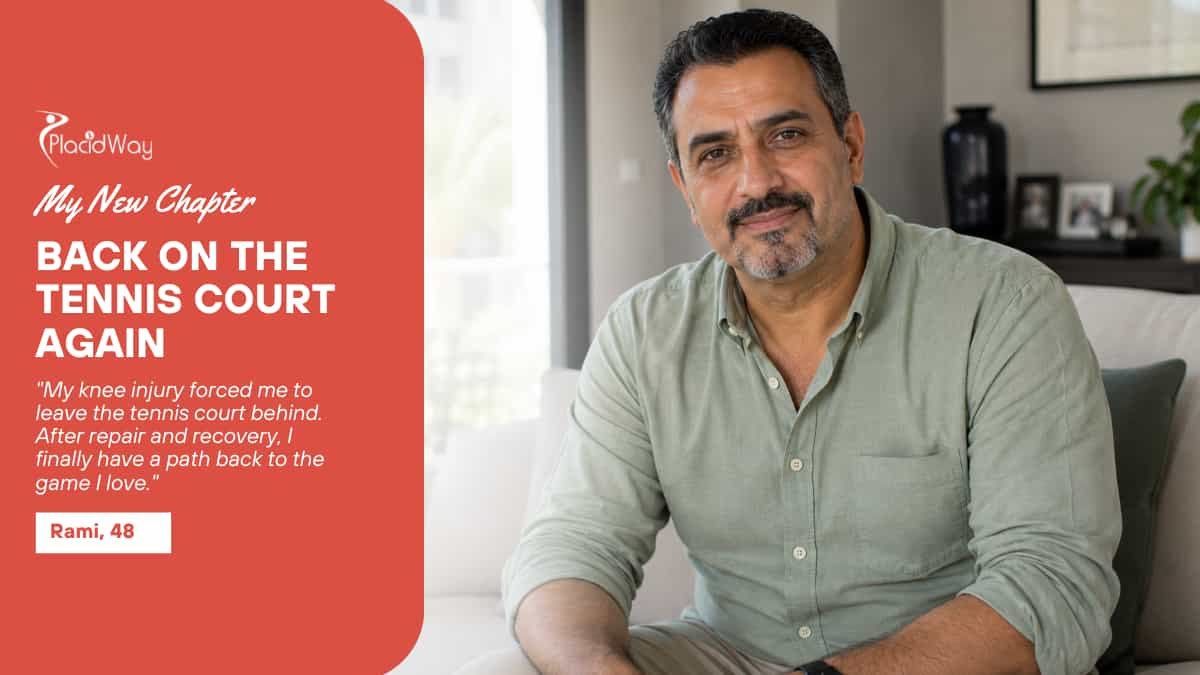
We need to introduce Rami Al-Mansoori and the life he built here.

Rami Al-Mansoori is not a real PlacidWay client.

He is a fictional composite built from the exact situations, clinical realities, and logistical questions expatriate professionals in the UAE currently face.

He is forty-eight.

He works as a regional logistics director in Dubai.

Before the clicking in his right knee becomes a permanent structural ache, he moves through his week with unthinking physical momentum.

He carries suitcases through airport terminals without breaking stride.

He drives the long highway to Abu Dhabi without bracing his leg against the center console.

The conservative treatments simply stop working.

He convinces himself it is merely a passing strain.

Rest.

Ice.

Compression sleeves.

Over-the-counter anti-inflammatories.

Three months of private physiotherapy.

A single hyaluronic acid gel injection that offers four weeks of false hope.

Conservative management for suspected meniscal pathology or early-stage osteoarthritis typically begins with physical therapy and intra-articular injections, with regenerative interventions considered when mechanical symptoms restrict daily function for more than three to six months.

His private orthopedic specialist reviews the MRI and delivers the verdict:

"You need stem cell therapy."

"When?"

The systemic delays push against his daily reality.

In the UAE public health sector, advanced orthopedic treatments can carry wait times extending from six to twelve months, depending on institutional capacity and visa classifications.

But Rami Al-Mansoori doesn't experience healthcare capacity as a national statistic.

He experiences it when he hesitates at the top of a short flight of steps.

"Just go around to the ramp."

He experiences it when he tries to sleep with a pillow wedged awkwardly under his calf.

"Is it throbbing again?"

He experiences it when he considers the physical vulnerability of holding a visa-dependent director role.

"I can't afford to be out long."

He has already tried to be a patient healthcare consumer.

People seeking medical care overseas are often cast as impatient consumers looking for shortcuts.

Rami Al-Mansoori is neither impatient nor careless.

He follows the conservative protocols.

He pays out of pocket for the initial consultations.

He endures the physical therapy exercises that leave his knee swollen by evening.

He researches the credentials of local specialists.

He asks his insurance broker about network coverage expansions.

"I have done everything they asked."

"It just isn't getting better."

The central question shifts:

"How much of my life am I prepared to organise around it?"

The domestic alternative sits just fifteen minutes down the road.

The domestic private option sits right in front of him.

Excellent private clinics exist fifteen minutes from his apartment, offering immediate scheduling and familiar surroundings.

The obstacle is not the quality of local private care, but its severe financial disproportion.

Private stem cell therapy in Dubai routinely quotes at AED 80,000 to AED 120,000.

His insurance network covers only emergency stabilization, leaving the elective therapy entirely unfunded.

He sits at the dining table with his wife, looking at a printed quotation.

"We have the savings to pay it."

"Having money isn't the same as affording."

He isn't searching for international medical options yet.

His browser history reveals the slow escalation of a man looking for a loophole.

How to fix mechanical catching in knee without surgery
Dubai stem cell therapy self-pay cost
Are gel injections better than stem cell therapy
Cheapest country for stem cell therapy expats

The German option surfaces through an expatriate engineering colleague who flew to Bavaria for a spinal procedure last year.

Rami Al-Mansoori pushes the idea away with a common reflex:

"I'm not going abroad just because something is cheaper."

The instinct is entirely correct.

Why does the German medical system keep surfacing in the data?

Frankfurt and its surrounding regions maintain highly structured, protocol-driven orthopedic centers that are tightly regulated for infection control and operative standards.

But the necessary reframe is straightforward.

Countries do not regenerate damaged cartilage.

Specialists do, specialized clinics do, and dedicated clinical teams do.

There is always something concrete to verify beyond a national reputation.

Patients exploring cross-border healthcare are advised to secure independent verification of the treating specialist's specific fellowship training and volume of cases.

Price should never answer a clinical question.

The financial reality requires an itemized understanding of the care.

Current indicative pricing for stem cell therapy in specialized Frankfurt clinics ranges from USD 7,000–10,800, fluctuating based on whether multiple joints or extensive cell processing is simultaneously required.

This represents a substantial reduction from UAE private sector equivalents, even after factoring in premium economy flights and a two-week hotel stay.

He remembers a piece of advice his father used to give:

"If the price seems too simple, you haven't asked enough questions."

"What exactly am I getting?"

Does this include the initial specialist consultation upon arrival?

Are the pre-operative MRI and blood panels covered?

Is the anesthesiologist's fee billed separately?

What type of local anesthesia or mild sedation is used?

Does the quote cover an overnight inpatient stay if observation is required?

Are post-operative mobility aids like crutches and braces included?

How many sessions of immediate post-op physiotherapy are provided?

Are prescription analgesics and anti-coagulants dispensed before discharge?

Who translates the medical discharge notes into English?

Is there a specific fee for the medical assistant?

What is the financial protocol if the specialist determines additional injections are needed during the procedure?

Are follow-up telehealth consultations included once I return to Dubai?

Does the clinic provide transport to my hotel after discharge?

The advertised number is only the beginning of the conversation.

The numbers alone will not repair a torn meniscus.

The logistics must match the medical necessity.

Everything rests on what happens inside the procedure room.

The treatment mechanism dictates the logistical reality.

It is an advanced regenerative technique where a specialist extracts, processes, and injects concentrated stem cells directly into the damaged knee joint to reduce inflammation, promote natural tissue healing, and stimulate cartilage repair.

The objective is mechanical preservation and a rapid return to weight-bearing stability.

But understanding the clinical mechanism inevitably leads to the hardest operational question.

"How do I get home on a five-hour flight with a freshly treated knee?"

This is the operational truth the brochures rarely put on the front page.

Deep vein thrombosis and post-operative swelling are serious considerations for air travel following lower-limb procedures.

Airlines and civil aviation authorities offer varying guidance on when it is safe to fly after stem cell injections, commonly ranging from three days to two weeks depending on the extent of the treatment.

That variation itself is the lesson.

This constraint must be built into the timeline and the budget before committing, not afterward.

"Wait. Does that mean I have to stay in Germany for an extra week?"

Possibly, depending on the precise nature of the treatment and the specialist's explicit clearance to fly.

Where will I stay during those days?

Is the hotel room accessible without stairs?

Does the shower have a step-in lip that I cannot safely cross?

How will I manage my luggage at Frankfurt Airport?

Will I need a wheelchair assist booked for the terminal transfer?

Can I bend my knee enough to sit in a standard economy seat?

Do I need to purchase a bulkhead seat for extra extension?

Who will administer my daily blood-thinning injections at the hotel?

Where is the nearest pharmacy to the hotel if I need more ice packs?

How will I get meals if I cannot walk to a restaurant?

What happens if my injection site begins weeping fluid on day four?

This isn't medical tourism in the usual sense.

His wife is not just coming along for a European vacation.

Sara is the invisible second participant in the treatment process.

She will carry the luggage.

She will remember the medication schedules when Rami Al-Mansoori is groggy from anesthesia.

She will navigate the German taxi apps.

She will be responsible for noticing if his calf becomes unusually red or warm.

She needs to know exactly what the escalation path is if a complication arises in the hotel room at two in the morning.

Comprehensive medical travel insurance covering non-routine complications, separate from standard holiday travel insurance, is a fundamental necessity for cross-border elective procedures.

She is part of the clinical system too.

Then comes the deeply uncomfortable conversation about clinical risk.

No medical intervention is without potential hazard, including infection, persistent pain, blood clots, or failure to resolve the mechanical symptoms.

Rami Al-Mansoori learns to instantly distrust a specific kind of promise:

Completely safe. No risk. Guaranteed success. The best specialist in Europe.

Informed consent means understanding more than just the hoped-for outcome.

Exploring healthcare abroad is not about finding a guaranteed fix.

It is about evaluating trade-offs with open eyes.

His consultation questions gradually become sharper and more demanding.

He no longer asks if Germany is nice in October or if the clinic looks modern.

How many times have you performed this specific stem cell therapy this year?
What is your personal complication rate for post-injection joint infections?
Will you personally perform the entire procedure, or will a resident assist?
What specific imaging do you require from Dubai before confirming my candidacy?
If you find severe osteoarthritis during the pre-treatment imaging, what is your protocol?
Do you use adipose-derived or bone marrow-derived stem cells for the meniscus?
How will you coordinate my rehabilitation protocol with my physiotherapist in the UAE?
What happens if I fail the criteria for flight clearance on day seven?
Who bears the financial responsibility for a revision if the therapy fails within thirty days?
What would you see on my MRI that would make you tell me not to proceed?

He doesn't only want someone willing to treat.

He wants a specialist willing not to.

He needs to know he has exhausted his domestic options first.

Patients possess the right to seek second opinions and request clear breakdowns of private facility fees to negotiate self-pay rates domestically.

Can the local specialist offer a day-treatment rate rather than an inpatient package?

Is there a more conservative approach that lowers the immediate cost?

Will the local hospital accept a staged payment plan?

Can the UAE insurer be petitioned to cover a percentage based on loss of function?

What is the precise timeline if I wait for public system eligibility?

Frankfurt should be compared with Rami Al-Mansoori's real domestic alternatives, not with a worst-case assumption about the local system.

The night before the decision requires comparing real paths forward.

The dining table is covered in documents again.

The printed quotation from the local Dubai clinic. The preliminary email assessment from the Frankfurt sports medicine department. The spreadsheet calculating flights, accessible hotels, and time off work. The travel insurance policy exclusions page. The MRI report detailing a complex tear of the medial meniscus.

"It feels like a lot to manage."

"But we finally know what we're comparing."

The research didn't make them more afraid; it made them more capable of deciding.

What he actually wants is not a medical procedure.

"What are you hoping to get out of all this?"

"I just want my knee fixed."

But the physical relief he actually wants is simple:

He wants to walk through Terminal 3 without scanning the concourse for an empty seat.
He wants to carry his daughter's bicycle up the driveway.
He wants to stand up from a three-hour budget meeting without a visible limp.
Not the medical tourism package. Not the German hospital bed. Not the specialized processing centrifuge. Not the flight to Frankfurt.

And underneath that:

Movement.

He wants autonomy.

Frankfurt might be the answer to his problem.

It might not be.

He might decide the financial savings do not justify the logistical burden of flying with an injured leg.

He might negotiate a self-pay discount with his local Dubai specialist.

He might discover his tear is beyond regeneration and requires an eventual replacement, altering the entire timeline.

He might choose to endure the public waitlist because his career allows him to work remotely.

Sometimes the right choice is deciding not to travel at all.

Choosing to proceed with stem cell therapy in Frankfurt is a triumph only if it is chosen deliberately, with the logistical realities fully budgeted and the clinical risks fully accepted.

Any of those can be an informed decision.

The goal of exploring these options is not to persuade you to fly to Europe.

The goal is to ensure that frustration doesn't make the decision for you.

You do not need to make a final decision today.

Maybe you have stopped playing tennis on the weekends.

Maybe you have learned exactly which movements trigger the catching in your joint.

Maybe you are tired of paying for private consultations that only offer sympathy and high estimates.

Maybe you are worried about how a prolonged absence will look to your employer.

Maybe you are simply exhausted from managing the pain.

You do not need to decide today.

What is the actual structural damage in my knee?

What will happen to my mobility if I wait another six months?

Can I afford the private fees here without compromising my family's financial security?

Am I willing to manage the complex logistics of recovering in a foreign hotel?

Who will travel with me to manage the things I cannot?

Do I trust the credentials of the specialist more than the location of the clinic?

What is the value of getting my daily momentum back?

You are no longer just comparing prices.

You are comparing paths forward.

Hope is not the promise of a flawless outcome.

Hope isn't the promise that treatment will be completely painless.

Hope isn't the guarantee that a foreign clinic is flawless.

Hope isn't ignoring the risks of deep vein thrombosis on a return flight.

Hope is having enough verified information to make a choice that feels entirely yours.

It is knowing the right questions to ask a specialist. It is understanding the true costs, including the hidden ones. It is taking control of a timeline that previously felt dictated by a visa or an insurance policy. It is replacing a sense of trapped inevitability with a sense of agency.

You change your daily vocabulary:

From resignation, to:

"What other informed options do I have?"

PlacidWay — Your Way to Hope.

PlacidWay helps you navigate the global healthcare landscape by connecting you with verified facilities, transparent pricing structures, and the critical information needed to ask the right questions.

We do not provide medical advice or advocate for a specific clinical path, but we ensure you have the comparative data required to evaluate your options intelligently.

For a professional managing chronic knee pain in the UAE, exploring stem cell therapy in Frankfurt isn't a guaranteed promise, but it is one route entirely worth understanding.

Your Way to Hope.

Medical disclaimer

The information provided in this article is strictly educational and does not recommend that any individual undertake medical travel or specific medical procedures. Individual clinical suitability, recovery timelines, and treatment risks require direct professional assessment. Readers should always consult their own qualified clinician or medical adviser in their home system, verify the current regulatory status of any foreign provider independently, and obtain appropriate medical travel protection or insurance before making any healthcare decisions.


The Tennis Court He Left Behind: Rami Al-Mansoori’s Meniscal Tear Stem Cell Therapy Story from the United Arab Emirates to Germany

About Article

  • Treatment: Stem Cell Therapy
  • Country: Turkey
  • Overview Rami Al-Mansoori, a 48-year-old logistics director in Dubai, faced mounting frustration over chronic knee pain from a meniscal tear. Priced out of local private care and facing public waitlists, he researched stem cell therapy in Frankfurt, Germany. This is his story of taking back his mobility.

Trusted Medical Tourism Platform Since 2007

60+
Countries
2k+
Clinics
19.5k+
Reviews
2.5k+
Qualified Doctors
1.1M+
Patients Served Since 2007