Chronic knee pain from severe osteoarthritis can turn simple daily routines—like walking, climbing stairs, working, or getting a peaceful night's sleep—into exhausting challenges. When conservative non-surgical treatments no longer provide adequate relief, knee replacement surgery becomes a vital option to restore mobility and independence. For international patients considering Robotic Knee Replacement in Istanbul Turkey, advanced technology now offers computer-assisted surgical planning and precise implant positioning to help optimize joint balance. This comprehensive guide explores how robotic assistance works, candidacy requirements, recovery expectations, costs, and care at Turan Turan Health Group.
Quick Summary: Robotic Knee Replacement Overview
Core Aspect
Summary Details
Primary Focus
Robotic Knee Replacement in Istanbul Turkey (Turan Turan Health Group)
Role of the Robot
Assistive tool for 3D alignment, mapping, and controlled bone preparation (Surgeon operates)
Typical Cost Range (USD)
$7,500 – $14,000 USD (Depending on unilateral/bilateral, implant brand, and stay length)
Hospital Stay & Recommended Stay in Turkey
3–5 days hospital stay; 10–14 days total recommended stay in Turkey for recovery & monitoring
Ideal Candidates
Patients with advanced osteoarthritis or joint deterioration unresponsive to physical therapy & injections
Key Potential Benefits
Tailored 3D pre-op planning, precision bone cuts, soft-tissue balancing, controlled alignment
Global Growth & Demand for Joint Replacement Technologies
The global incidence of knee osteoarthritis has risen significantly due to aging populations and active lifestyles. As demand for joint arthroplasty increases, medical centers around the world are adopting computer-assisted and robotic technologies to refine intraoperative alignment and personalized anatomical planning.
The chart below illustrates projected growth in global total knee replacement procedures alongside the accelerating adoption of robotic assistance in modern orthopedic centers.
Global Joint Arthroplasty Trends & Technology Adoption (In Thousands)
+ Total Global Knee Replacements+ Robotic-Assisted Procedures
Global joint replacement demand continues to grow alongside increased clinical adoption of robotic-assisted surgical systems. Source: AAOS (American Academy of Orthopaedic Surgeons) & OECD Health Statistics.
Featured Orthopedic Center in Istanbul, Turkey
When considering international medical travel for joint surgery, selecting an established health group with dedicated orthopedic sub-specialization and surgical robotics is essential.
Turan Turan Health Group
Location: Bursa & Istanbul, Turkey
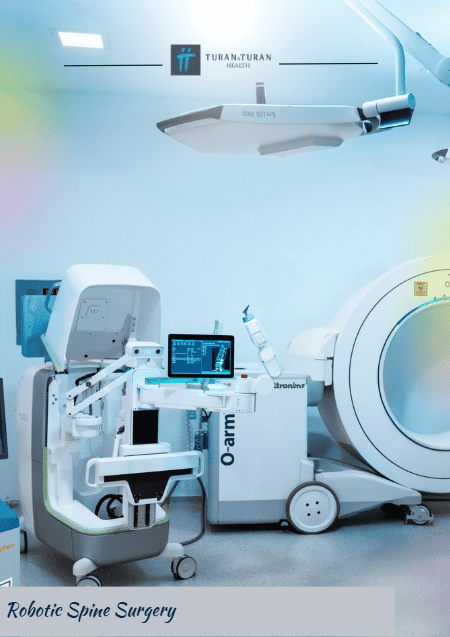
Turan Turan Health Group is a dedicated center for advanced orthopedics, traumatology, and robotic joint surgery. The center focuses on computer-assisted planning, robotic joint replacement, physical rehabilitation, and comprehensive care tailored for international patients seeking treatment in Turkey.
What Is Robotic-Assisted Knee Replacement Surgery?
Knee replacement (also called knee arthroplasty) involves replacing damaged cartilage and worn bone surfaces of the knee joint with artificial implants made of durable metal alloys and high-grade polymers. In traditional surgery, mechanical alignment guides are used by the surgeon to measure and cut the bone.
In robotic knee replacement in Istanbul Turkey, the surgeon utilizes an advanced computer-driven robotic arm system to assist with surgical planning and execution. The technology creates a 3D digital model of the patient’s unique joint anatomy, aiding the clinical team with:
Preoperative & Intraoperative Surgical Planning: Mapping exact bone dimensions and joint space.
Anatomical Mapping: Assessing real-time joint mechanics throughout range of motion.
Controlled Bone Preparation: Guiding the surgical saw within pre-defined boundaries to protect surrounding tissues.
Implant Positioning & Alignment: Assisting the surgeon to position components with millimeter precision.
Soft-Tissue Balancing: Evaluating ligament tension to promote consistent joint stability.
Robotic Surgery Does Not Mean the Robot Performs the Operation
A common misconception is that the robot operates independently. In reality, the orthopedic surgeon maintains complete control throughout the entire procedure. The robotic system provides real-time feedback, visual tracking, and spatial boundary constraints. The surgeon holds and directs the surgical instruments at all times; the robotic arm simply ensures bone preparation stays precisely within the tailored preoperative plan.
When Is Knee Replacement Considered?
Knee replacement is typically considered when joint damage is advanced and non-surgical interventions fail to provide adequate pain relief or functional improvement.
Common Signs to Discuss Surgery
Persistent, severe knee pain that limits daily walking
Difficulty climbing stairs or standing up from chairs
Resting pain or stiffness that disturbs sleep
Chronic swelling and reduced range of motion
Diminished independence despite medication
Underlying Causes of Severe Joint Damage
Osteoarthritis: Age-related "wear-and-tear" breakdown of articular cartilage
Post-Traumatic Arthritis: Degeneration following previous fractures or severe ligament tears
Avascular necrosis or advanced cartilage loss
What Treatments Are Considered Before Knee Replacement?
Ethical orthopedic practice prioritizes conservative, non-invasive management prior to recommending joint replacement surgery.
Physical Therapy
Targeted strengthening of quadriceps and hamstrings to support joint alignment.
Medication & Weight Management
Anti-inflammatory medications, analgesics, and lifestyle modifications to reduce mechanical load.
Intra-Articular Injections
Corticosteroid injections or hyaluronic acid viscosupplementation for temporary relief.
When Conservative Treatment Is No Longer Enough: When non-surgical strategies stop offering sufficient pain relief and functional impairment persists, the patient and surgeon may discuss surgical options.
How Does Robotic-Assisted Knee Replacement Work?
Robotic-assisted procedures follow a structured, multi-step process designed to customize joint reconstruction to the patient's individual anatomy:
Step 1 — Preoperative Evaluation
Comprehensive health clearance, physical exam, X-rays, or specialized CT scans to evaluate bone quality, deformity, and overall joint alignment.
Step 2 — 3D Surgical Planning
Software converts imaging into a 3D virtual model, allowing the surgeon to plan cut angles, implant sizing, and rotation prior to surgery.
Step 3 — Intraoperative Guidance
Optical sensors track joint movement during surgery. The robotic arm provides real-time boundary protection during bone resection.
Step 4 & 5 — Placement & Stability
Prosthetic components are positioned, and the surgeon conducts manual assessments of range of motion, balance, and mechanical stability.
Why Does Precision Matter in Knee Replacement?
Successful knee replacement relies on achieving accurate mechanical alignment and proper soft-tissue balance:
Implant Alignment: Correct angular alignment helps distribute body weight evenly across the artificial joint surface.
Joint Balance: Balanced ligament tension prevents feelings of joint instability or tightness throughout flexed and extended movements.
Personalized Anatomy: Bone structure varies significantly between individuals; robotic mapping accommodates variations in hip-knee-ankle axes.
Long-Term Implant Performance: Accurate positioning is one factor that may minimize uneven wear patterns over time.
Potential Benefits of Robotic-Assisted Knee Replacement
Detailed Planning
Preoperative 3D modeling aids in selecting implant dimensions before incisions are made.
Controlled Bone Resection
Haptic feedback constraints assist in preserving non-diseased surrounding bone tissue.
Soft-Tissue Respect
Real-time tracking helps avoid unnecessary disturbance to adjacent periarticular ligaments.
Early Mobilization
Precise fit supports rapid initiation of postoperative physical therapy protocols.
Important Medical Qualification: Robotic assistance does not guarantee superior results for every patient. Overall surgical outcomes depend on individual anatomy, bone quality, surgeon expertise, implant selection, and adherence to postoperative physical therapy.
Who May Be a Candidate — And Who May Not?
Potential Candidates
Patients with end-stage knee osteoarthritis or post-traumatic arthritis
Individuals experiencing persistent pain and mobility restrictions
Patients who have failed conservative physical therapy and injections
Individuals seeking an individualized 3D anatomical planning approach
Factors Requiring Special Evaluation
Active local or systemic infection
Uncontrolled vascular or metabolic conditions
Severe osteoporosis or compromised bone density
Inability or unwillingness to participate in mandatory rehabilitation
*Note: Suitability is determined strictly through an individualized clinical and radiological assessment by an orthopedic surgeon.
Robotic-Assisted vs. Traditional Knee Replacement
To compare technical features between conventional manual knee arthroplasty and robotic-assisted methods, review the comparison summary below:
Feature
Traditional Knee Replacement
Robotic-Assisted Knee Replacement
Surgeon Performs Procedure
Yes (Manual instruments)
Yes (Robotic arm guidance under surgeon control)
Surgical Planning
Standard 2D X-ray alignment guides
3D digital modeling and software simulation
Intraoperative Guidance
Mechanical cutting blocks & visual estimation
Real-time optical tracking & haptic boundaries
Soft-Tissue Balancing
Manual surgeon feel and tensioning spacers
Digital live feedback on ligament tension gaps
Recovery & Surgical Risks
Patient-dependent; standard joint risks apply
Patient-dependent; standard joint risks apply
Is Robotic Knee Replacement Automatically Better?
Not necessarily. While robotic technology offers advanced precision tools for bone resection and alignment, excellent long-term clinical outcomes are regularly achieved using traditional manual techniques in experienced hands. The optimal choice depends on patient anatomy, surgical complexity, and surgeon recommendation.
International Patient Journey: Traveling to Istanbul
For patients traveling to Turkey for joint surgery, medical planning involves organized stages prior to flight and post-discharge:
Phase
Clinical & Travel Actions
Logistical Considerations
Stage 1: Remote Medical Review
Send knee X-rays/MRI, medical history, and blood work for orthopedic pre-assessment
Final wound check, clearance for flight, home exercise program handoff
Remote digital follow-up consultations at home
Recovery Timeline After Knee Replacement
First Few Days (In-Hospital): Pain management protocols, early standing assisted by a physical therapist, deep vein thrombosis (DVT) prevention, and basic bending exercises.
Weeks 1–3: Transitioning from walker to cane, expanding knee flexion, wound healing checks, and managing mild localized swelling.
Weeks 4–12: Independent walking without assistive devices, gradual return to daily sedentary activities, stationary cycling, and progressive muscle strengthening.
Long-Term Recovery (Months 3–12): Continued improvement in endurance and joint range. Full adaptation continues over several months.
Risks and Possible Complications
Knee replacement is a major surgical procedure. As with all surgery, potential risks and complications must be understood:
General Surgical Risks
Infection, blood clots (DVT/PE), bleeding, or adverse reaction to anesthesia.
Joint-Specific Risks
Persistent joint stiffness, localized nerve discomfort, or lingering residual pain.
Long-Term Considerations
Prosthetic component wear, aseptic loosening, or requirement for future revision.
Does Robotic Assistance Eliminate Risks? No. While computer-guided alignment helps maintain intraoperative precision during bone cuts, it does not eliminate basic biological risks such as infection, blood clots, or individual scar tissue formation.
Cost of Robotic Knee Replacement in Istanbul, Turkey
Cost considerations are a major driver for international medical travel. The table below outlines general cost categories associated with surgical packages in USD:
Surgeon fees, robotic system utilization, high-grade implant, OR costs
$7,500 – $11,500 USD
Hospital Stay & Nursing Care
3–5 nights in private hospital room, medications, inpatient physical therapy
Included in main surgical package
Bilateral Robotic Surgery (Both Knees)
Simultaneous or staged bilateral replacement, dual implants, extended stay
$13,500 – $18,000 USD
*Note: Final costs depend on individual medical needs, implant choice, length of hospital stay, and pre-existing health conditions.
Questions to Ask Before Choosing Robotic Knee Replacement
Am I a candidate for total joint replacement, or can partial replacement be considered?
What specific robotic system is utilized, and how many procedures has the surgical team performed with it?
Which implant manufacturer and model do you recommend for my bone quality and activity level?
What is the total recommended length of stay in Turkey before I am cleared to fly home safely?
What items are explicitly included in the fixed-price international package, and what incurs extra charges?
What is the formal process for remote follow-up or medical assistance if issues arise after returning home?
Frequently Asked Questions
What is robotic-assisted knee replacement?
It is a knee joint replacement procedure where the orthopedic surgeon uses computer software and a robotic arm to assist with 3D preoperative planning, anatomical mapping, and precise bone cuts.
Is robotic knee replacement safer than traditional knee replacement?
Robotic technology offers enhanced accuracy in bone preparation and implant alignment. However, overall surgical risks (such as infection or blood clots) are comparable to traditional knee replacement.
Does a robot perform the knee replacement autonomously?
No. The orthopedic surgeon performs and controls the entire operation. The robotic system only acts as a guided instrument that holds pre-programmed alignment boundaries.
Is robotic knee replacement less painful?
Because robotic guidance helps minimize unnecessary soft-tissue disruption, some patients experience less immediate postoperative swelling, though pain levels vary individually.
How long does robotic-assisted knee replacement take?
The surgical procedure typically takes between 60 to 120 minutes, depending on individual joint anatomy and whether registration bone mapping is required.
Can I walk soon after robotic knee replacement?
Yes. Early physical therapy protocols encourage standing and walking short distances with support (like a walker or crutches) within 24 hours after surgery.
How long does recovery take?
Most patients return to routine daily activities within 6 to 12 weeks, while full strength recovery and complete joint adaptation can continue for up to a year.
How long does a knee implant last?
Modern knee implants are designed to last 15 to 20 years or longer in a significant majority of patients, depending on age, body weight, activity levels, and positioning.
How much does robotic knee replacement cost in Istanbul?
Typical package costs in Istanbul range from $7,500 to $14,000 USD for unilateral joint replacement, which includes hospital stay, surgeon fees, and robotic system use.
Do international patients need to stay in Turkey after surgery?
Yes. Surgeons typically recommend a total stay of 10 to 14 days in Turkey (including hospital time and hotel outpatient therapy) before flying home.
Can robotic knee replacement be performed for severe osteoarthritis?
Yes. Advanced osteoarthritis with severe cartilage wear and joint deformity is one of the main indications for robotic-assisted total knee arthroplasty.
What happens if I need additional treatment after returning home?
International patient departments coordinate with your local doctor or physical therapist by providing comprehensive discharge summaries and operative reports.
Take the Next Step Toward Better Knee Mobility
Persistent knee pain does not have to restrict your quality of life. Explore whether Robotic-Assisted Knee Replacement in Turkey at Turan Turan Health Group is right for your orthopedic care plan.
Educational Purpose: The information provided in this article is for educational and informational purposes only and does not constitute formal medical advice, diagnosis, or treatment recommendations. Robotic-assisted knee replacement is a surgical procedure carrying inherent risks. Consultation with a licensed orthopedic surgeon is mandatory to determine surgical candidacy based on individual medical history and diagnostic imaging.
OverviewExplore robotic-assisted knee replacement in Istanbul, Turkey at Turan Turan, including precision technology, benefits, recovery, and treatment options.
Request your Free Quote
×
Trusted Medical Tourism Platform Since 2007
60+
Countries
2k+
Clinics
19.5k+
Reviews
2.5k+
Qualified Doctors
1.1M+
Patients Served Since 2007
Unlock the Best Robotic Surgery Packages Just for You
Discover the ultimate Robotic Surgery packages designed to meet your health and wellness goals. Choose the perfect fit for your journey.
Group Florence Nightingale Hospitals in Istanbul Turkey
Robotic Surgery
Istanbul, Turkey
Robotic Surgery Solutions Near You: Explore Top Medical Centers
Discover how Robotic Surgery is transforming lives at leading medical centers in , Turkey. Dive into center profile, specialties, doctors, reviews, etc. and explore the best options tailored to your needs in this region.
Transformative Robotic Surgery Experiences: Dive into Procedure Insights
Discover the power of Robotic Surgery through compelling patient experiences. Uncover detailed insights into procedures, recovery journeys, and life-changing results.
Explore Robotic Surgery: Stories, Testimonials, and Procedures
Watch in-depth videos covering everything from Robotic Surgery success stories to detailed procedure explanations. Learn what to expect and hear from real patients.











.png)
.png)
















Share this listing